DD
MM
YYYY

PAGES

DD
MM
YYYY

spot_img

PAGES

Home Blog Page 5577

Access Bank Is Picking Up in Nigerian Banking; GTBank Has Work To Do

1

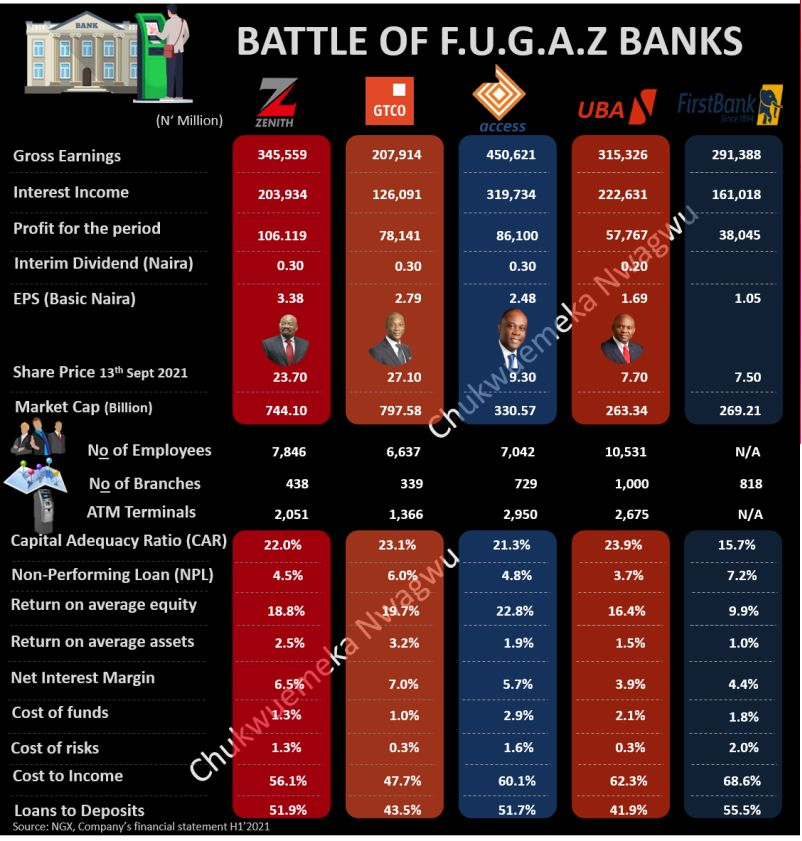
What is happening to GTBank (yes, GTCO)? It is losing steam across the board. Begin with the cost-to-income ratio which used to be industry leading at sub-40%. Now, it has jacked it up to 47% (I guess the holdco setup could have caused that). From gross earnings to profitability, Access and Zenith are there. Access is becoming a critical banking institution; look at the interest income.

There is a pattern I am seeing: improved marginal cost is a solid competitive advantage and being big will work for these relatively big and geographically positioned institutions, as the new era of African commerce begins. Nigerian banking will be totally different in 5 years.

Access and Zenith are on to something; GTBank has to watch itself well.

China’s Big Failure, Missed Path to High-Income State, And Why Africa Must Avoid That

2

China goes to break Ant Group’s Alipay as the nation continues to push for new ordinance for digital firms: “The Financial Times reported Monday, citing sources, that Beijing is moving to break up Alipay, and create a separate app for the company’s highly profitable loans business.”

Africa: do not follow China. China is scoring an own-goal and over the next few years, if this trajectory is not reversed, will begin to fade. As I wrote in Harvard Business Review, China transformed its economy by becoming the manufacturing capital of the world. China, despite that success, is not yet a high-income country. Yes, despite its aggregate wealth, China remains a developing economy. China’s per capita income is around (nominal) $9,000 while the US hits $60,000. In short, Chile is better than China (Nigeria is about $2,000).

Few countries have moved into the high-income status and in all those countries, one thing has been a constant: democracy and free markets. Yes, even if you produce for the world, without a free market system for capital to organize other factors of production based on market forces, you will struggle to get there.

Fair rule, transparency, democratic systems, retrenchment of states for the flourishing of the private sector, predictable and fairly applied regulations, and cardinal rule of law,  are some of the factors that enable economic redesign, towards high-income status. From Japan to South Korea to Taiwan and to potential newcomers into the high-income countries, there was and will always be constant: what worked when you were poor to mid-income, will not work for you to move from mid-income to high-income. 

At a poor state level, you need the government to create order, but quickly the government must retrench for markets, to drive productivity and improve the efficiency of the utilization of factors of production. It is through productivity in an evidently complex national system that nations move to high-income level. In my study of economic systems, only markets have the ability to allocate the factors of production at this level! No politician has any chance. President Xi is not helping China unless he never wants the nation to move to high-income status.

Yes, China is blowing the playbook thinking that what worked from its poor state to mid-income will work for it to move to high-income. Simply, China is scoring own-goals and it would be lucky to stay in mid-income. It has no chance of transitioning into high-income unless the Xi nation changes course.

China Moves to Break Up Ant Group’s Alipay

China Moves to Break Up Ant Group’s Alipay

0

China’s tech crackdown, which has eventually developed the “common prosperity” wing, is about to claim another victim.

The Financial Times reported Monday, citing sources, that Beijing is moving to break up Alipay, and create a separate app for the company’s highly profitable loans business.

The crackdown started with focus on the fintech industry, with Beijing aiming to curtail the extravagance of the industry players who had enjoyed uncommon freedom under President Xi’s leadership. The Ant Group, whose halted IPO was gearing up to be the largest in history, with $37 billion raised for a post-IPO valuation of $300 billion, was the starting point of what has now escalated to other sectors, including edtech and ride-hailing.

The report said that Chinese regulators have already ordered Ant to separate the back end of its two lending businesses, Huabei, which is similar to a traditional credit card, and Jiebei, which makes small unsecured loans, from the rest of its financial offerings and bring in outside shareholders.

“The government believes big tech’s monopoly power comes from their control of data,” said one person close to financial regulators in Beijing. “It wants to end that.”

Alipay has more than one billion users whose data have been collected by the payment service. With the crackdown shifting focus on how the tech firms manage private data, Beijing looks to be moving to break up companies in possession of millions of users’ data.

The report said officials now want the two businesses to be split into an independent app as well. The plan would also require Ant to turn over the user data that underpins its lending decisions to a new credit scoring joint-venture which would be partly state-owned, according to two people familiar with the process.

Under the new rules, the companies affected will no longer be at the helm of decision making, as the responsibility will be shared by stakeholders appointed by the government.

Per FT, Ant has been struggling with regulators for control of the new joint venture, but a compromise was reached under which state-owned companies in its home province, including the Zhejiang Tourism Investment Group, would hold a majority stake.

The people said pushing for local state-owned groups to become Ant’s new partners was a favor from the provincial government.

“Given the mutual trust between Ant and Zhejiang, the fintech group will have a big say on how the new JV (joint venture) operates,” said a former official at the People’s Bank of China. “But the new set-up will also make sure that Ant listens to the party when it comes to critical decision-making.”

Ant is believed to have the upper hand in decision making because its partner doesn’t know a thing about fintech.

According to the report, a person close to Ant said that for the time being Ma’s team would be at the helm of the new venture. “What does Zhejiang Tourism Investment Group know about credit scoring — nothing,” the person said, while noting Ant executives were still concerned they could lose control in the future.

This whirlwind of misfortune is the latest major blow to Ant since its IPO was halted late last year. Watching its shares divided among government appointed stakeholders and having a little say in decision making was not the future the company foresaw.

In an earlier report, Reuters had revealed the make-up of the joint venture, reporting that Ant and Zhejiang Tourism Group would each take 35 percent stakes with other state-owned and private partners allocated smaller shares.

Financial Times reported that the new venture will apply for a consumer credit scoring license, which Ant has long coveted. China’s central bank has issued only three licenses — all to state-run operations — preventing Ant from fully monetizing the vast reams of data it has collected on Chinese citizens, the report said.

Credit scoring companies have now become part of lending business in China under the new rules. This means, apart from Ant, other lending companies will go through the third party credit scoring process to have their customers loans approved. This summer the central bank told industry players that lending decisions must be made based on data from an approved credit scoring company rather than proprietary data, one of the people said.

Per FT, this means that a future Alipay user in need of credit would see their request first routed to the new joint venture credit scoring company where their credit profile is held and then on to the new Huabei and Jiebei lending app to issue the credit.

The new rules, among other things, will hamper the swiftness with which Alipay executes transactions due to the creditworthiness process that is entirely integrated within Alipay. Ant said it made “credit decisions within seconds” in its prospectus for its suspended IPO. But there is more, Ant’s value will suffer long term consequences emanating from these changes.

Teach, Ensure Intellectual Property and Ignite Rapid Innovations in Nigerian Universities

0
National-Universities-Commission-NUC

Inventing new products and creating relatable services to problems have not been significant issues in most African countries. The real issue lies with the fact that the inventors or creators have always been denied the benefits of their ingenuity because of adequate knowledge of how Intellectual Property Protection works before and after developing the inventions.

Our analyst had earlier reported how the failure of protecting patent and intellectual property is weaning innovation ecosystem in Africa. In the piece, the submission was that concerned government stakeholders and individuals need to work collectively towards creation of a sustainable enabling environment for understanding and application of IP in all aspects of the society.

In Nigerian schools, little attention is being paid to the teaching of IP at the basic and secondary schools. This is not quite different at the higher education institutions. Ordinarily, law students are expected to be walked through the principles and practice of IP. However, neglecting other students in other faculties and colleges is doing a great disservice to the Nigerian society. Just as it does to other African societies, where little attention is being paid to inherent opportunities in IP as a business.

From the University of Ibadan to the Babcock University and the Bayero University to Obafemi Awolowo University, existing Intellectual Property policies address concerns of the academics and other staff in the academia more than the needs and concerns of the students. Mostly, according to our checks, the policies focus on issues within the contexts of ownership, rights, protection, commercialization and income sharing between academics and the universities’ authorities.

Beyond the university environment, our checks also established some research institutions and other higher education institutions equally have policies for strengthening intellectual rights. What remains to be done adequately is the teaching of IP as a course across disciplines.

In our experience, we have found that universities only have IP as course for students in the faculty of law and those who are doing programmes that relate to law. For instance, Mass Communication, Journalism and Media Studies programmes have courses that equip students with the skills, knowledge and experiences for understanding the terrain of copyright law.

In its quest of creating awareness about IP, the University of Lagos had the WIPO-Nigeria Summer School between July 19 and 30, 2021. This is laudable, being the first of its kind in Nigeria. Beyond Summer School, Nigeria needs to consider inclusion of IP as a course in all academic programmes. As hinted earlier, graduates of Mass Communication, Journalism, Media Studies and other programmes would always be willing to invent or create sustainable solutions when they realise the extent to which such solutions would be protected and capture value forever.

Never Raised Venture Capital, Bootstrapped MailChimp Sells for $12 Billion

1

MailChimp has been acquired by Intuit for $12 billion. I am not necessarily sure where MailChimp fits  into the Intuit playbook, except maybe QuickBooks, which has a dose of small and medium scale businesses which can be juiced by what MailChimp has prepared.  Intuit has a history of picking winners when you look at Mint, Credit Karma and other recent properties. In short, I have a playbook after Intuit which I called Fish Bait Acquisition Construct by merely observing how the tax-filing giant picks companies.

Founded in 2001, Mailchimp’s landmark cloud service enables businesses to design and send promotional emails and newsletters to customers. The company have since expanded, launching a software that allows online sellers to include a link to their ecommerce stores, a development which some speculate has contributed to the firm’s high asking-price. The company are still owned by their founders, and – surprisingly – have never raised venture capital.

Yet, that Intuit is spending $12 billion (about 8% of its market cap) in cash and stock to swallow MailChimp is not the main story; the main thing is that MailChimp generates close to $1 billion annual revenue now (extrapolated), and has NEVER raised a single venture capital dime! Yes, $0.00 venture funds. 

There are many things to learn about this company – expect many case studies from business schools. Yes, a company never raised venture funds, grew revenue to $1 billion and exited at $12 billion. That is a great business mission, executed!

The acquisition press release below.

Intuit (Nasdaq: INTU), the global technology platform that makes TurboTax, QuickBooks, Mint, and Credit Karma, today announced that it has agreed to acquire Mailchimp, a world-class, global customer engagement and marketing platform for growing small and mid-market businesses. The planned acquisition of Mailchimp for approximately $12 billion in cash and stock advances Intuit’s mission of powering prosperity around the world, and its strategy to become an AI-driven expert platform. With the acquisition of Mailchimp, Intuit will accelerate two of its previously-shared strategic Big Bets: to become the center of small business growth; and to disrupt the small business mid-market.

Together, Intuit and Mailchimp will work to deliver on the vision of an innovative, end-to-end customer growth platform for small and mid-market businesses, allowing them to get their business online, market their business, manage customer relationships, benefit from insights and analytics, get paid, access capital, pay employees, optimize cash flow, be organized and stay compliant, with experts at their fingertips. Delivering on the promise to be the single source of truth, small and mid-market businesses will have the power to combine their customer data from Mailchimp and QuickBooks’ purchase data to get the actionable insights they need to grow and run their businesses with confidence.

The Fish Bait Acquisition Construct