


Welcome Transtura to the family: operating system for people mobility, and supply chain. Welcome to Tekedia Capital, funding the NEXT Africa here.
Nigerian Startup, Prospa, Raises $3.8m to Provide Banking and Software Services to Businesses
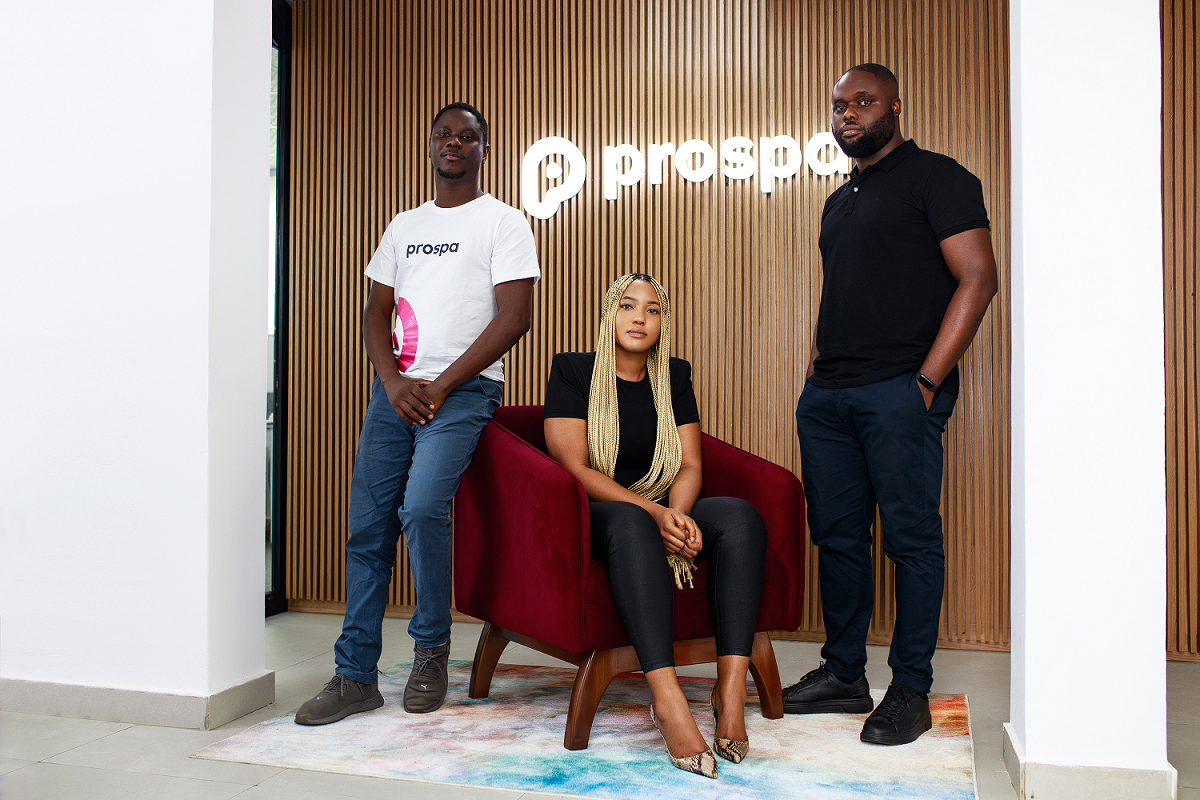
A Nigerian fintech startup, Prospa, has closed a $3.8 million pre-seed round to offer small businesses banking and software services, bridging the gap between banks and businesses in terms of using data to solve problems.
The startup uses data generated through business transactions to provide insight and solutions for businesses, creating growth opportunities for microbusinesses.
Prospa, which was founded two years ago by Frederik Obasi, Chioma Ugo and Rodney Jackson-Cole, was among the 10 African startups that participated in Y Combinator’s winter batch in March.
The idea was developed by Obasi and his cofounders through their experience running other businesses. Spotting the challenge created by Nigerian banking system, which mainly provides financial services, Obasi moved to change the status quo.
With the need for software and personnel visibly high, especially for small businesses that can’t afford to delegate or use machines for operations, the idea of providing software for microbusinesses was born.
In a conversation with TechCrunch, Obasi explained how it started and how they hope to achieve with the newly raised fund.
“When I left my last business, I wanted to do something really big and something that I knew the problem inside out. That’s why I started Prospa,” Obasi told TechCrunch over a call.
Prospa was built between June and September 2019 and went live in October. Since then, the company acquired customers in stealth even when they got into YC. Obasi explains that he wanted Prospa to have organic traction void of the growth driven by hype and media noise.
“We like to think a really long-term game. We really wanted to really test the hypotheses, build an actual business with revenue and understand what we were doing. Then the COVID period came and we started seeing enough traction,” he added.
But when the company began to get some buzz, the typical description people had about Prospa was “a neobank for small businesses.” Over the call, CEO Obasi is quick to dispel that notion. Alongside providing banking services, he says Prospa offers invoicing tools, inventory management, employee and vendor management, an e-commerce store, and payroll features.
“Banking is just a little part of what we do. We know we’re put into the neobank category, but we see our product as 10% banking and 90% software. So the experience is very much different from what you’d get from a neobank and the use case for Prospa users is quite different,” he added.
Prospa focuses on freelancers and entrepreneurs, acting as the “operating system” for their businesses.
Registered businesses on the platform get access to an account number and other features Prospa provides. For unregistered businesses, Prospa takes them through a process of formalizing their business and providing bank accounts. However, in the grand scheme of things, this segment is more of an inroad into an upsell.
Talking on traction, Obasi says the company has tens of thousands of businesses and is growing 35% month-on-month. And from a non-banking perspective, Prospa has managed over 150,000 product catalogs while small businesses have sent out 360,000 invoices on the platform.
Then pricing depends on the business’ turnover. For instance, a business with a turnover of N100,000 (~$200) is not expected to pay Prospa any subscription fee. But businesses with turnovers exceeding ?100,000 pay fees between ?3,000 (~$6) and ?5,000 (~$10) monthly.
Prospa’s pre-seed investment is the largest round of its kind in Nigeria and sub-Saharan Africa at the moment. In Africa, only Egyptian fintech Telda has raised a larger round.
Obasi believes the company’s understanding of the market and what it wants to achieve was the main reason it could command such a price which, according to him, was almost four times oversubscribed.
The investors in the round include VCs like Global Founders Capital and Liquid 2 Ventures. Founders of global fintechs like Mercury’s Immad Akhund, Karim Atiyeh of Ramp, and executives from Teachable, Square, Facebook and Nubank also participated in the round.
Seeing the likes of Akhund and Atiyeh on Prospa’s cap table might suggest to some that Prospa was backed because the company is building a replica of those businesses in Nigeria. However, Obasi says while there are similarities, Prospa is not building a product for startups.
“There’s a massive startup ecosystem in the U.S. where you can basically grow a billion-dollar company just serving YC companies. We don’t have that here. We’re really building for the backbone of the economy, which is small and micro-businesses. Speaking to and being able to build relationships with investors, one of the things we made clear is that we’re not an American copycat,” he said when asked if Prospa could be likened with Mercury and other U.S. startup-focused financial product.
Prospa plans to use its new capital to double down and expand with acquisition strategies to get more customers. In addition to that, the company plans to hire more talent, especially in product and engineering.
Three Miles To The Moonshot – Make It Happen!

Communicate at a higher purpose if you want to lead a dynamic team: more people will join you to go to the moon than go and dig a ground in a village. What is your mission? At Tekedia Mini-MBA, we help founders and business professionals understand the physics of markets. A new edition begins on Monday (Sept 13). Registration is ongoing and closes very soon; join us and you will be closer to the moonshot.
Blockchain use case for e-Commerce in Africa

According to Forbes, globally we exceed over $19 trillion in cash transactions on a yearly basis. You can only then imagine what percentage of that is done in Africa where cash payment remains king.
There are over 100 million micro, small, medium sized enterprises (MSMEs) that exist today in Africa and over 40 million of that exists in Nigeria. Consumer spending is on the rise in Africa. In fact, in 2015, consumer spending surpassed $1 trillion and it is projected to exceed $2 trillion by 2025. So it begs the question, why is the drive towards the adoption and expansion of digital marketplaces extremely slow?
I have a few thoughts to why this could be the case:
Trust remains a major contributor in the lack of adoption in using digital payments for e-Commerce transactions. The establishment of trust between the consumers and merchants (including supply chain companies) will need to be addressed. There are recommendations out there about creating rewards and loyalty programs to help drive consumers towards the adoption of digital payments. These are good suggestions, but it still does not address the problem. The establishment of trust is key in every business model.
Secure Payment Methods is critical to every digital online platform that processes payment transactions. The rise of internet fraud has created a stigma around the adoption of digital marketplaces for countries especially around sub-Saharan Africa. It is apparently clear that e-Commerce platforms across Africa show commitment towards the security of consumer sensitive data, especially their financial data.
Counterfeit and Fraud is another contributing factor. Circulation of counterfeit goods and fraudulent activities such as fraudulent returns and other forms of chargebacks are constraints. Consumers on e-Commerce platforms need to have ways to provide provenance on the goods listed on their platforms. There will be a huge incentive for merchants to have assurances in the prevention of fraudulent chargebacks. These are not largely in existence today, and if they do, these are mitigated manually which drives up operational costs.
These are all perfect use cases for Blockchain Technology. Through the implementation of blockchain, e-Commerce platforms can establish trust, security and provenance by leveraging smart contracts, concensus and decentralization. These are features all known to be offered by blockchain. Blockchain needs to be used beyond just cryptocurrency trading which seems to be its major use across Africa.
Its application in powering e-Commerce in Africa, will potentially be a driving factor towards it’s adoption and expansion.
Source: Medium
The Buy Now Pay Later (BNPL) Evolution And Why Credit Card Companies Must Adapt

Last month, Square said it would pay $29 billion for Australian buy now pay later startup, Afterpay. Amazon put Affirm on great party when it announced a partnership, rallying the stock of the company. Now, PayPal, which just announced that it would also become a stock trading platform (that makes sense since in America they have made buying stocks to be a game thanks to Robinhood. People buy because they are bored and need to have fun!) is hitting the new hot category with $2.7 billion to close out Japan’s Paidy.
U.S. payments giant PayPal Holdings Inc announced Wednesday it would acquire Japanese buy now, pay later firm Paidy in a 300 billion yen ($2.7 billion) principally cash deal, to expand its business in Japan.
Japan is the third largest e-commerce market in the world, presenting the opportunity for PayPal to expand its domestic relevance in the payment business in the East Asian country market.
The deal, which is expected to be concluded in the fourth quarter of 2021, will be minimally dilutive to PayPal’s adjusted earnings per share in 2022. It will also complement PayPal’s existing cross-border ecommerce business in Japan.
But you know those in trouble: credit-card companies. If this buy now pay later trajectory continues, some credit card companies will struggle as banks which power them will have fewer customers. Essentially, these young people are not paying with their cards and that is a problem for credit card firms (and their partner banks).
If you run a credit card business and no one pays attention to what your bank is offering because right at the point of sales, someone is offering customers the opportunity to buy now and pay later at zero or negligible interest rate, you have a real challenge ahead.
This is a new dimension of fintech which nations with data are enjoying. It would be long before Africa can participate at scale on this, unfortunately. In Nigeria, there is currently no fintech or bank offering this solution. Yes, irrespective of whatever they call it, all the solutions in Nigeria come with interest payments. In the US, BNPL comes with zero interest over the agreed period, and the deal closes in seconds with no paperwork!
So how do BNPL make money? Merchants cover the costs as expected since the companies are not charities. Typically, merchants pay a BNPL charge between 2 to 8 percent of the purchase amount. While this is a little more than what merchants pay credit card companies (as merchant fees), the extra advantage is that BNPL brings volume which can offset that extra cost to merchants. So, if people know they can buy your product and pay over four months at zero interest, it could stimulate more buys.
PayPal Buys Paidy in A $2.7 Billion Deal to Expand Buy Now Pay Later Service