DD
MM
YYYY

PAGES

DD
MM
YYYY

spot_img

PAGES

Home Blog Page 5605

Indiagold Raises $12m in Series A Round to Digitize Gold

0

India is a gold country, with households estimated to have a stash of over 25,000 tons of the precious metal whose value today is about half of the country’s nominal GDP. The tradition of keeping gold in the South Asian country dates back to generations and serves the purpose of financial security and also as a hedge against economic troubles.

However, the tradition has its shortfalls which range from insecurity to the challenge of selling the precious metal in a generally acceptable dignified way. This is where Indiagold is trying to help.

Indiagold, a young startup that is attempting to help people put this gold to use, said on Friday it has raised $12 million in its Series A funding. The new financing round was led by Prosus’ PayU and Falcon’s Alpha Wave Incubation (AWI) fund. Better Tomorrow Ventures, 3one4 Capital, Rainmatter Capital and existing investor Leo Capital also participated in the round, which brings the startup’s all-time raise to $14 million.

Founded by Nitin Misra and Deepak Abbot, two former executives of Paytm, Indiagold is building a gold-focused digital alternative credit platform in the world’s second-largest internet market. The startup is using gold to determine the credit worthiness of its customers and providing APIs to banks and other lenders that want to reach this untapped market, TechCrunch reports.

The startup today has two major offerings: It has made it very easy and affordable for people to keep their gold in safe lockers, and it’s enabled them the option to take a loan against their gold reserves.

Once an individual has signed up on Indiagold, the startup’s agents come to their house, inspect and weigh the gold and put it in a RFID-sticker-attached tamper-proof bag. Then they put this bag in a steel box and get the customer to lock it with their fingerprint. As the agents leave the premises, Indiagold app provides a live feed of their journey to the designated vault location.

The idea is to make it very simple for customers to put their gold in a locker. Traditionally, because of the emotional stigma attached to the yellow metal, most people have hesitated to do anything with the gold jewelry they own. Indiagold has devised a procedure that helps them gain trust of their customers.

“This whole business is built around trust,” said Misra in an interview with TechCrunch. “Unlike a norm in some circles of the startup ecosystem where you are expected to break things and move fast, in our business we have to spend time with customers to build that trust,” he said.

Indiagold also offers their lockers at a much affordable price — just a few dollars a year, as opposed to hundreds taken by banks. And unlike banks, Indiagold protects the customers’ gold with insurance coverage.

Customers have access to Indiagold app where they can see real-time value of the gold items they have put in the locker. This is when the startup’s second offering kicks in, should customers need it. In the event these customers need to take a loan, the startup facilitates a line of credit to them within 30 seconds.

Tapping on gold as a loan collateral is a very large market in India — and also one that remains largely unscratched.

“Despite the large gold reserves held by Indian households, the gold loan market has barely scratched the surface. The gold collateral (166 tons) held by Muthoot Finance is less than 1% of the estimated gold reserves in Indian households (~25,000 tons). This is because gold is seen as a family heirloom and passed along generations,” analysts at Bernstein wrote in a report to clients earlier this year.

Customers have the freedom to take loans against only parts of their gold reserve they have stored in the locker. And because they know that their gold items are tied to their biometric, they are confident that nobody is breaking into the locker and melting their jewelries.

If changing consumer behavior wasn’t a big enough task already, Indiagold this year has grappled with several other challenges. The devastating second wave of the coronavirus wiped 70% of its business within days, said Misra and Abbot. “We have gone through a lot in this short journey,” Misra recalled.

But by the first half of this month, business had climbed to an all-time peak, he said.

“Indiagold’s unique doorstep gold loan and gold locker products not only offer unparalleled customer experience but also enable it to offer credit at more affordable rates. The traction Indiagold has seen in a short time is a testament to its superior product capabilities and the deep experience of its pedigreed founders. We believe the gold loan market is ripe for disruption and are thrilled to back Indiagold’s founders,” said Navroz D. Udwadia, co-founder of Falcon Edge Capital, in a statement.

The startup, which is currently operational in the National Capital Region and Indore, plans to expand to 10 cities by the end of the financial year. The duo said they are also working to broaden their product offerings. PayU said in a statement that it will explore ways to collaborate with Indiagold on some product offerings.

A handful of startups are beginning to explore the gold opportunities in India. Bangalore-based Jar, founded this year, is helping young users start their journey of savings by investing in digital gold.

The digital gold idea is providing the non-fungible token (NFT) kind of services to gold enthusiasts, and it has the potential to give the commodity a boost as it competes with cryptocurrency for investors’ attention.

Amazon Joins the ‘Buy Now Pay Later’ Space in Partnership with Affirm

0
Amazon has been investing in India

Amazon has become the latest big name to get into the buy now, pay later space. The e-commerce giant announced it is partnering with Affirm to install the payments option on its popular e-commerce site.

Affirm’s buy now pay later checkout option will be available to certain Amazon customers in the U.S. starting Friday with a broader rollout in the coming months, the companies said in a statement. The partnership will let Amazon customers split purchases of $50 or more into smaller, monthly installments.

“By partnering with Amazon we’re bringing the transparency, predictability and affordability that Affirm provides today to the millions of people who shop on Amazon.com in the U.S.,” Eric Morse, Senior Vice President of Sales at Affirm, said in a statement. “Offering Affirm’s alternative to credit cards also delivers more of the payment choice and flexibility consumers on Amazon want.”

The companies promised transparency in their financial dealings with customers saying “as always, when choosing Affirm, consumers will not be charged any later or hidden fees.”

Also, Amazon spokesperson told Engadget in an email that customers must agree to a soft credit check at checkout. The financial terms offered depend on both the person’s credit card history and the purchase price, she explained, adding that depending on the customer and their order value, they might be offered anywhere from a three-to 48-month payment plan, with interest ranging from 0% to 30% APR.

In addition, Affirm spokesperson said that whatever interest consumers pay related to these loans, they agree to those rates up front, and that interest does not compound.

Affirm’s stock spiked as much as 44% after-hours Friday on the news.

The buy now pay later idea is growing as part of the burgeoning lending space buoyed by younger consumers’ move towards alternative lines of credit. Earlier in August, Square made a big move into the space with a $29 billion acquisition of Australian fintech Afterpay.

As noted by CNBC, the so-called installment loans have been around for decades, and were historically used for big-ticket purchases such as furniture. What we see unfolding now is online payment players and fintechs, competing to launch their own version of “pay later” products for online items in the low hundreds of dollars.

Affirm is one of the best known installment payment options. It works with more than 12,000 merchants, including Peloton and Walmart.

PayPal, Klarna, Mastercard and Fiserv, American Express, Citi and J.P. Morgan Chase are all offering similar loan products. Bloomberg reported last month that Apple is planning to launch installment lending in a partnership with Goldman Sachs.

The partnership makes a lot of sense for Amazon since it will drive a throng of consumers, especially young people, to its e-commerce store.

Fintechnolization And “Every Company Will Spin Out a Fintech Company”

1

Last year, I coined the word “fintechnolization” – a construct that every digital platform must have a maturity state of offering a fintech solution. I had watched all great digital platforms on how they ended up providing fintech solutions even when they began in an unrelated sector. It was also on that framework that I started Tekedia Capital since Tekedia itself is a platform. In that piece, I made a call that in 2021, I would start a financial services solution on Tekedia!

In our last investment cycle, we deployed $3.5 million, validating that call. Yes, if you have thousands of people coming to your platform, you must find a way to offer a financial services solution if indeed you are a platform.

From one of the best in the world, Andreessen Horowitz,  the experts just put out a piece titled “Every Company Will Spin Out a Fintech Company”. Thank you Nnamdi for sharing that piece today. It validates my hypothesis that our digital startups must incorporate elements of financial services irrespective of whatever they do, upon becoming organic platforms.

Fintechnolization of Platforms – Expect This Redesign in Startups

In 3 Years, EFCC Achieved Less than 10% Conviction Rate in 8 Crimes

0

In 2003, the administration of former President Olusegun Obasanjo established the Economic and Financial Crimes Commission with the sole responsibility of getting rid of economic and financial crimes in the country. From the leadership era of Mallam Nuhu Ribadu to the current chairman, Abdulrasheed Bawa, the Commission has carried out a number of arrests and successfully executed persons found guilty of various crimes.

In spite of the Commission’s activities, social commentators, political leaders and public affairs, locally and internationally, have always perceived the Commission has been selective in arresting and prosecuting some politically and economically exposed citizens across the country.

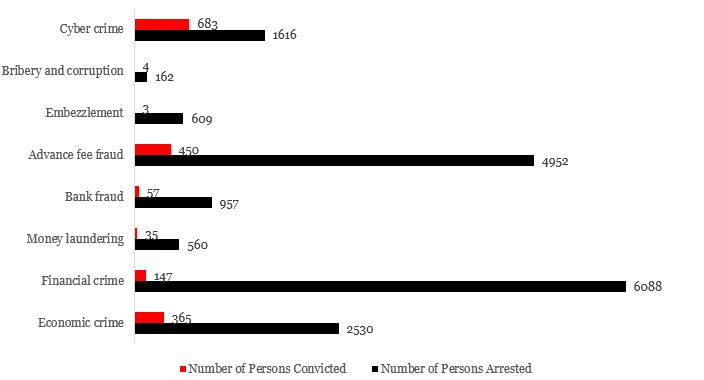
Beyond the public perception and representation of the Commission’s activities in digital and physical spaces, this piece interrogates the recent statistics jointly released in a statistical report of women and men, which establishes the Commission’s performance in terms of number of persons arrested and prosecuted between 2017 and 2019 for economic crime, financial crime, bribery and corruption, cyber crime, embezzlement, advance fee fraud, bank fraud and money laundering.

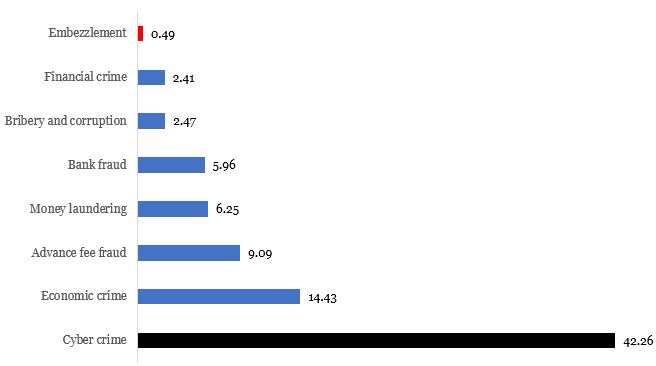
For these crimes, the Commission was able to arrest 17, 474 persons and prosecuted 1,744 persons during the three-year period [see Exhibit 1]. Looking at the number of persons convicted against those arrested, analysis indicates 9.98% conviction success rate. Our analysis further suggests that the Commission appeared to deploy its resources towards ending crimes that are being committed by Nigerians with low socioeconomic and political status.

For instance, the Commission’s data reveal an exponential increase in both arrest and conviction of offenders of cybercrime.  “In 2017, 2018 and 2019 the number of males arrested for cybercrime were 277; 319 and 878 as against 21; 48 and 73 females respectively. Out of these, 134, 151 and 390 males were convicted in 2017, 2018 and 2019 respectively, while only 8 females were convicted in 2019,” the Statistical Report says.

Exhibit 1: Performance across crimes categories

Source: Economic and Financial Crimes Commission, 2017-2019; National Bureau of Statistics, 2020; Infoprations Analysis, 2021

Crime by crime conviction success rate analysis reveals that offenders of economic crime, advance fee fraud, money laundering and bank fraud were more convicted than those who committed bribery and corruption, financial crime and embezzlement crimes during the period.  Our analyst notes that the disparity in arrests and convictions could be linked with a number of factors. The poor criminal justice system remains key obstacle to more convictions.  Concerned stakeholders are expected to work out more strategies and right political will for the arrest and prosecution of offenders.

Exhibit 2: Commission’s Conviction Success Rate based on Number of Arrested and Convicted Persons [in %]

Source: Economic and Financial Crimes Commission, 2017-2019; National Bureau of Statistics, 2020; Infoprations Analysis, 2021

Beat Early Registration Deadline for 6th Edition of Tekedia Mini-MBA

0

The early bird registration deadline for the 6th edition of Tekedia Institute Mini-MBA (Sept 13-Dec 5) is today, Aug 28. Our program is online, self-paced, and costs $140 (or N50,000 naira) per person. It involves pre-recorded and live Zoom sessions, facilitated by executives from the finest companies you admire.

We have many goodies if you beat the deadline including attending our Innovation Week and Career Week free besides access to my books, and certificate courses at Facyber.com. You will also have access to the critics-loved The Dangote System (yes, bring it on, lol).

Beat the deadline and join the best school. Click and register and my team will get you in. They run 24/7 because now we serve 39 countries. Become an innovator and a champion of markets; click and register here.