DD
MM
YYYY

PAGES

DD
MM
YYYY

spot_img

PAGES

Home Blog Page 5628

Tekedia Mini-MBA Congratulates our Fintech Faculty, Olugbenga GB Agboola, CEO of Flutterwave, for Partnership with Discover

0

People, we run a really great program in Tekedia Institute. But this impact would not have been possible without our amazing Faculty members. These are professionals and business legends who are driven by the desire to impact knowledge. We thank them. Typically, whenever I see great things from their companies, I commend them. Who would not like to learn from the best?

Good People, join me to congratulate Tekedia Fintech Faculty, Olugbenga GB Agboola, CEO of Flutterwave, for linking Flutterwave with Discover Global Network: “Discover Global Network and Flutterwave have signed an agreement that will support the expansion of online payments acceptance for both African and international ecommerce merchants. Flutterwave’s merchants will be accepting Discover Global Network cards from Discover, Diners Club International, and network alliance partners on ecommerce payment pages and via apps.“

Tekedia Mini-MBA >> learn from the best. The next edition begins Sept 13; register here.

… press release

Discover Global Network and Flutterwave have signed an agreement that will support the expansion of online payments acceptance for both African and international ecommerce merchants.

Flutterwave’s merchants will be accepting Discover Global Network cards from Discover, Diners Club International, and network alliance partners on ecommerce payment pages and via apps.

With more than 300,000 merchants globally, Flutterwave makes it easier for businesses to process payments. According to Vanilla Plus, the company recently announced the launch of Flutterwave Store, an ecommerce solution for brick-and-mortar businesses and mom-and-pop stores that helps them offer their inventory online, receive payments, and sell from home.

Discover Global Network includes cards from Discover, Diners Club International, PULSE, and more than 20 alliance partner networks including relationships in Brazil, South Korea, India, Turkey, and Nigeria. Discover Global Network also provides acceptance in over 200 countries and territories with more than 50 million merchant acceptance locations and 2 million ATM cash access locations.

This partnership meets a real demand from both local and foreign cardholders to be able to include their card as their saved mode of payment for their online accounts with these merchants to accumulate the points and other benefits associated with their preferred card.

Urgently Needed: Nigeria’s Energy Transition Strategy

0

Nigeria is way behind in preparations for a new energy age. There is a palpable fear about the deleterious impact of climate, as it could undermine our sovereignty and wash off coastal communities from our map. Sadly, Nigeria unlike Saudi Arabia doesn’t have the wealth and technical expertise to drive an urgently needed energy transition, say less of emerging as a regional and global leader. Although, it has plans for renewable power but we are yet to see any plan in place to manage emissions and also to develop a circular carbon economy. In short, we aren’t developing these efforts and reducing emissions as quickly as possible.

In Center for Strategic & International Studies report on energy transition, the report expects National Oil Companies (NOCs) to play a critical role in ensuring global energy security. The challenge is how opportunistically can Nigeria grow as the oil majors shrink. We have seen oil majors’ movement deeper into the seas of the Niger Delta. Also, Oil major’s rapid divestment is feared to set off an energy crisis and experts argued that it will do little to cut emissions.

Activists and experts are worried that forced asset sales could leave more production in the hands of privately held companies like Dangote Oil Refinery & Petrochemicals, Waltersmith Refining & Petrochemical Company Limited, OPAC Refineries, Niger Delta Petroleum Resources, BUA Refinery & Petrochemicals and Edo Refinery and Petrochemical Company Limited and they are doubtful that these firms would adhere to rigorous environmental and safety standards as cries for energy transition ramp up. However, as energy transition get massive global sway, only those with the technical capacity, access to capital, and project management skills could play critical roles in how our clean energy future emerged.

Nigeria in falls into CISS Report as a country with a struggling NOC, i.e NNPC. This CISS report expects NOCs to fill in the gap, to ramp up investment to expand production and capture market share. They argued that these companies may benefit if the global oil and gas industry underinvests in exploration and production in the coming years. Sadly, the energy transition poses serious risks to our competitiveness or even our survival, taking cognizance of the high production cost of making a barrel in Nigeria. It is worrisome that our resource base would become less competitive with the departure of important technical and financial partners.

Presently, we cannot make significant progress without a strategy to manage our energy transition. Privatizing NNPC may help but it looks like we are late. We need to look hard at the present state of things, especially high choking debt levels and how climate change is transforming the north with desertification and the south with massive floods. We need to analyze our energy needs and economic priorities. We need an adaptive strategy, the tools and critical leadership support to pull off our own transition. That is the only way we can drive fast and become more resilient, and not left behind.

It is time to for a major policy shift by the Nigeria Government on oil. We need to start signing an array of sweeping executive orders targeting the environment, including developing a new agency for managing the funds from this last stage of rapid oil transition revenue, localize the Paris climate propositions, tax the fossil fuel industry and use the funds to implement our energy transition before we can start revoking permits for new and old oil fields and converting our government’s fleet of vehicles to electric power.  We need an ambitious proposal that will drive net-zero greenhouse gas emissions across Nigeria’s economy by 2035 while not jeopardizing the overall economic health.

As Nigeria moves into an election year, we need competent candidates who can optimize revenues from our oil and gas leases, help us marshalling out strategies for addressing “the near-term impact on exploration and production, as well as royalties to states,”. Millions of jobs will be lost and gained as diverse climate change plans by West & Asia hit home and so will the impact be for us locally; it will hurt oil-dependent economies like us with dire consequences.

It is time to setup ‘The End of Oil Development Corporation (EDC)’. We can collapse NDDC into EDC and the Federal Ministry of Petroleum into the Federal Ministry of Petroleum and New Energy Resources like we have done with the Federal Ministry of Communications and Digital Economy. This corporation should be driven by bold policy moves and men-of-character that will improve opportunities and boost livelihoods across the oil communities who will feel the crude impact of the end of oil and the larger states as we need to lead the world in recovering from this pandemic-like energy transition. This corporation should lead with the mandates to improve living standards, grow the private sector and spread prosperity in heavily impacted oil communities.

Nigeria needs a clearer sense of energy leadership and her transition strategy must enjoy the full backing of its national assembly leadership. We are moving into a future environment where oil demand will peak or plateau, thereby ushering an exacerbated revenue volatility and with the threat of steep, if not terminal, decline in the value of Nigeria’s oil. So what do we do? We have to focus on value-added downstream opportunities in fertilizers, plastics and specialty chemicals etc.

Yet this has to be matched with structural fiscal reform, cut in public wages and efficiently rechanneling of subsidies, accelerating the deployment of EDC funds for people-oriented capital projects and most ambitiously the upgrade of Nigeria’s youthful workforce in tandem with this energy transition. We must incorporate private sector buy-in and exercise the political will to make our diversification efforts and policy reforms a success.   

In all, with a zero-net future, we must be mindful of too much regulation that could stifles growth. And be wary of too little regulation which could harm public safety and national security. EDC is a platform that will help us continuously discover sweet spots that can lead us into harnessing the likely massive revenue from a chaotic end of oil process and most importantly lead our local communities into the new energy age.

Liquid, Another Crypto Exchange Loses $100m to Hackers

0

Barely one weeks after digital token platform Poly Network was hacked in a $600m heist, another crypto exchange has suffered cyber-attack.

Leading Japanese cryptocurrency exchange Liquid has been hit by hackers, with almost $100m estimated to have been stolen. The company said that some of its digital currency wallets have been “compromised.”

“We are sorry to announce that #LiquidGlobal warm wallets were compromised, we are moving assets into the cold wallet,” the company said on Twitter.

The culminating cases of digital wallets’ heists have cast doubt on the security of exchanges, depleting investors’ trust in putting their money in the digital asset.

So-called ‘warm’ or ‘hot’ digital wallets are usually based online and designed to allow users to access their cryptocurrencies more easily, while ‘cold’ wallets are offline and harder to access and therefore usually more secure.

Blockchain analytics firm Elliptic said its analysis showed that around $97m in cryptocurrencies had been taken, with Bitcoin and Ethereum tokens amongst the haul, according to BBC.

Liquid has said that it was tracing the movement of the stolen cryptocurrencies and working with other exchanges to freeze and recover the assets.

Liquid was founded in 2014 and operates in over 100 countries, serving millions of customers around the world.

It is one of the world’s top 20 biggest cryptocurrency exchanges by daily trading volumes, according to CoinMarketCap data.

More than a week ago, $600m was stolen from blockchain site Poly Network after a hacker exploited a vulnerability in its system.

“The amount of money you have hacked is one of the biggest in defi [decentralised finance] history,” Poly Network said.

Since then the hacker, who goes under the name of Mr White Hat, has returned around $427 million of the assets, and has been reportedly offered a job by Poly Network.

Liquid is not the only Japanese cryptocurrency platform to be hit by a major heist.

In 2014, Tokyo-based exchange MtGox collapsed after almost half a billion dollars of bitcoin went missing, while Coincheck was hacked in a $530m heist in 2018.

Since 2011, hackers have stolen more than $8 billion worth of cryptocurrencies. According to a report from Amsterdam-based blockchain analytics firm Crystal Blockchain, over $2.8 billion was stolen through exchange security breaches that totaled 113 as of last year, and has increased following a number of heists in 2021.

The exchanges are being targeted as bitcoin and the rest of cryptocurrencies gain mainstream acceptance. Bitcoin is gradually rising from its months of slump that started in April, following concern about the impact of mining on the environment. The crypto coin neared $50,000 for the first time in more than three months as players work to stem the tides that have resulted in massive selloffs.

Ndubuisi, With What Is Happening In Fintech, How Do I Invest In Nigerian Bank Stocks?

0

I run a subscription service called Private Client Services (PCS) where business leaders email, call and ask questions. Let me share this correspondence with a client as many here have asked similar questions. I have edited out specific broad recommendations since no one here signed PCS terms (risk on you).

PCS Client Question: Ndubuisi, we want to invest in NSE [Nigerian Stock Exchange] banks. With what is happening in fintech, what do you think?

Ndubuisi Response: Chairman, the long-term outlook on Nigeria’s banking system is positive. However, I see a challenging half-decade on their valuations as investors price the impact of fintechs/ digital challenger banks. As global investors prefer the fintechs, over buying stocks of the banks, I expect a sustained underperformance which would accelerate in late 2023 when the digital tech firms circle more domains. Even insurers and HNI independent investors are betting via these fintechs rather than buying direct bank stocks. Any substitute vehicle is not good for the bank stocks.

Yet, the banks, led by extremely brilliant minds will find ways to keep investors happy: I expect dividends to accelerate and that would be a way to cushion the effect of the evolving perception. So, if you want to buy bank stocks, buy dividend paying ones, with the assumption that even if the stocks do not move, dividends will take care of you. Here are the best using the aggregate of the last 5 years:[…]

The banks have great balance sheets and are evolving also just as fintechs. More so, the only way banks can play would be holdco which gives them structures to also do what fintechs are doing. So, we cannot count them out. Here is my calendar; let us speak and I will provide more insights when you are free.

Ndubuisi

From FUGAZ to GOFIZ, Nigeria’s New Leaders In Financial Sector

2

By 2030, eighty percent of the richest Nigerians would have made money from technology. The empires of the future are being built, and this is a cambrian moment of unparalleled age of entrepreneurial capitalism, bigger than what happened in the 1990s when the new generation banks were started. We’re in the application utility decade, passing from the voice telephony decade (2000s) through mobile internet decade (2010s).

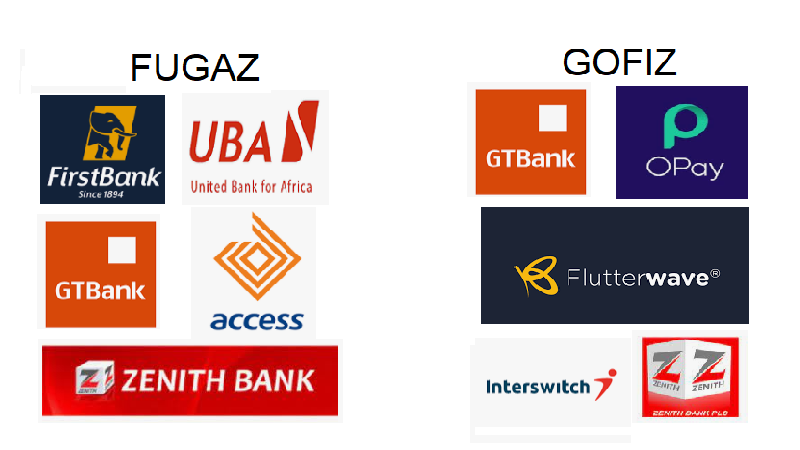
By 2025, about ninety percent of the top leading financial institutions in Nigeria will be all tech. The investment bankers in Lagos always write of FUGAZ (First Bank, UBA, GTBank*, Access, Zenith); I always update that to FUSGAZ to include Stanbic IBTC which has a larger market cap than any of UBA, Access and First Bank even though it is “foreign”. So, for that foreign gene in Stanbic IBTC, let us just use FUGAZ.

Today, I have updated a composite which tracks both public and private businesses, looking at the most critical financial institutions in Nigeria. We have GOFIZ which represents GTBank*, OPay, Flutterwave, Interswitch and Zenith Bank. These are the largest (indigenous*) financial institutions with a market cap of at least $1 billion in Nigeria. The most valued financial entity in Nigeria now is OPAY. Interswitch and Flutterwave (each worth $1 billion) are bigger than First Bank, UBA and Access Bank; sure the former duo are private entities while the latter trio are public.

My tracking system posits that by 2025,  in the top 10 financial firms in Nigeria, 90% will be tech-firms. People, your world is changing.

Welcome GOFIZ but this is not certain. I see 3 mutants on the way.

Nigeria’s Operating OPay Raises $400M at $2 Billion Valuation Led by SoftBank