DD
MM
YYYY

PAGES

DD
MM
YYYY

spot_img

PAGES

Home Blog Page 563

Cardano vs Avalon X: Research Chain Meets Real-Estate-Backed RWAs

0

Cardano has been positioned as a research-led blockchain emphasizing scalability, sustainability, and peer-reviewed innovation for many years now. Cardano price stands at $0.8670, reflecting a 4.94% increase in the past 24 hours.

However, 2025’s biggest question for the investor is no longer just one of blockchain digital ecosystems like Cardano but if blockchain real estate ventures 2025 like Avalon X (AVLX) are the next frontier. That introduces the growing Avalon X vs Cardano debate.

Cardano Price Prediction: ADA’s Current Outlook

Cardano has set itself up as a research-based blockchain, creating its network based on research and careful development. Interoperability and sustainability as its focus set it firmly in the position of one of the top altcoins. The rise in Cardano price is due to renewed interest, especially as ADA continues to enhance its staking and dApp network.
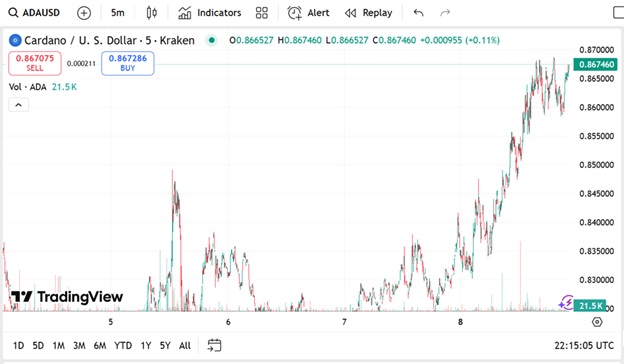
Source: Tradingview.com

Cardano still holds its ground, no doubt, but the story heading into 2025 feels like it’s changing. This is coming amidst different Cardano price predictions, a significant prediction is one by Ali Martinez, who believes that Cardano is breaking out toward $0.92.
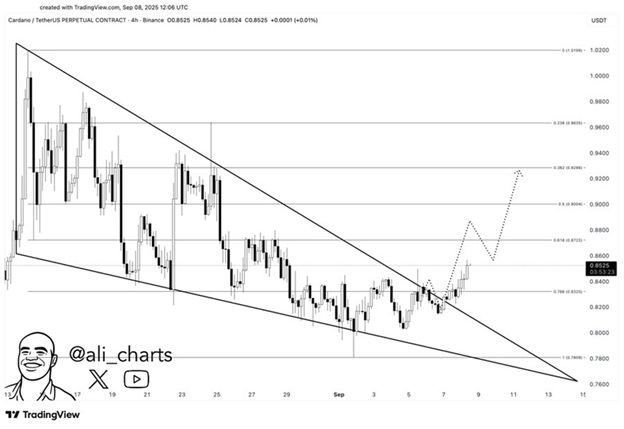
Source: AliCharts on X

More and more investors are drifting toward real-world asset tokens, the kind that tie blockchain to things you can actually see or touch, not just numbers on a screen.

That’s why the Avalon X vs. Cardano comparison keeps popping up. Cardano leans on years of research and carefully planned upgrades; it’s the academic, steady approach. Avalon X, on the other hand, is dangling a direct link to the $379 trillion real estate market.

The Rise of Avalon X and RWA Tokenization

Most crypto projects live entirely in the digital world, but Avalon X is trying something more tangible. Instead of another abstract token, it’s tying value to Grupo Avalon’s almost $1 billion real estate pipeline in the Dominican Republic.

That means investors aren’t just buying into hype; they’re getting fractional access to  blockchain real estate projects and luxury residences that actually generate income. For that reason alone, it’s already being talked about as one of the best real estate backed cryptocurrency.

What makes Avalon X interesting is how it blends blockchain’s promise of transparency with the security of real estate. If you put it side by side with something like Cardano, the difference is clear.

Avalon X, is throwing open the door to immediate exposure in physical assets. Investors looking for the best RWA tokens 2025 are finding AVLX coin as an alternative option.

Why Investors Are Taking Notice

Physical real-world foundations – Grupo Avalon’s pipeline of properties gives Avalon X a solid and income-generating base, distinguishing it from speculation.

  • Global availability – This tokenized property crypto enables investors worldwide to access luxury real estate markets that were previously inaccessible for institutions.
  • Security assured Audited by CertiK, smart contracts ensure transparency, giving Avalon X the legitimacy of one of the best RWA tokens 2025.
  • Reward-based utility – AVLX holders experience discounts, accommodations, and advantages on Grupo Avalon’s developments, equating to lifestyle benefits as opposed to appreciation in price.
  • $1 Million Crypto Giveaway – A headline presale raffle of AVLX tokens in addition to a townhouse being given away in the Eco Avalon development has led to increased investor interest.

Eco Avalon Townhouse Giveaway

A blend that works to explain why real estate blockchain projects 2025 like Avalon X are dominating the talks earlier on about ADA and other legacy altcoins.

What This Means for Cardano

Cardano price increase is proof of ADA’s power, but its appreciation remains within the virtual sphere of blockchain. Avalon X, one of the best RWA tokens 2025, on the other hand, is making waves by pairing finance with physical assets. The Avalon X vs Cardano conflict represents an even broader trend: investors want exposure to not just blockchain networks but also physical wealth markets.

For ADA, the test will be maintaining its position as money pours into leading crypto backed by real world assets. Cardano’s fantasy is no more than a breath away from being extinguished, yet projects like Avalon X show where investor appetite and liquidity is going to move more and more.

Secure Your Stake in Real-World Crypto Growth

The crypto landscape in 2025 is no longer a landscape about hypothetical networks or meme fever. It’s about real estate blockchain projects 2025 that bring blockchain back down to earth. The Cardano price will still be significant to ecosystem believers, but Avalon X is an entirely new genre: property-backed, utility-driven wealth creation.

For investment between Avalon X and Cardano, the decision is straightforward — Avalon X token is one of the best RWA tokens 2025, with validity, lifestyle ease, and global accessibility.

Join the Community

Website: https://avalonx.io

$1M Giveaway: https://avalonx.io/giveaway

Telegram: https://t.me/avlxofficial

X: https://x.com/AvalonXOfficial

 

Score The Penalty Kick With Tekedia Mini-MBA As We Begin on Monday

0
Imagine the thrill of a perfectly aimed penalty kick. Yes, that moment of precision, power, and ultimate goal, to win a trophy. That’s the same feeling you’ll get when you equip yourself with the knowledge and skills from Tekedia Mini-MBA, propelling your career and business towards undeniable success.
 
The Tekedia Mini-MBA Edition 18 is a dynamic 12-week online innovation management program, meticulously designed to elevate your understanding of business execution and growth, all within a crucial digital framework. Running from September 15 to December 6, 2025, this program delivers goals.
 
Good People, it is injury time as we begin on Monday, Sept 15, and you must kick the penalty. Register and score with us here.

Gemini Secures Nasdaq as Strategic Investor Ahead of IPO, Eyes Tokenized Securities Future

0

Gemini, the cryptocurrency exchange founded in 2014 by Cameron and Tyler Winklevoss, has brought Nasdaq on board as a strategic investor just days before its long-awaited initial public offering.

CNBC confirmed that Nasdaq will inject $50 million into Gemini in a deal that extends far beyond capital, creating a partnership that links one of Wall Street’s most established names with one of crypto’s most recognizable firms.

Under the agreement, Nasdaq will integrate Gemini’s custodial services into its offerings for institutional clients. In return, Gemini will serve as a distribution partner for Nasdaq’s trade management platform, Calypso, a system designed to handle collateral management across both traditional and digital assets.

“This partnership positions us to expand our capabilities to serve institutional clients and the broader investor universe as the regulatory landscape around crypto assets evolves,” a Nasdaq spokesperson told CNBC. “We will partner with Gemini on a non-exclusive basis as part of a broader strategy to offer multi-custodial and staking services for crypto assets. Additionally, we will work with Gemini as a distribution partner for Nasdaq Calypso.”

Nasdaq emphasized that its collaboration with Gemini follows the same model it uses for most of its venture investments through Nasdaq Ventures.

IPO and Market Timing

The strategic investment is separate from Gemini’s IPO plans, which are set for this Friday. The company aims to raise up to $317 million in its debut on the Nasdaq exchange — a milestone that would make it one of the most high-profile crypto listings since Coinbase’s blockbuster entry into public markets in April 2021.

Gemini currently manages over $21 billion in assets as of July, underscoring the scale it has achieved despite the turbulence of the crypto market in recent years.

Coinbase Comparison: A Cautionary Backdrop

Coinbase’s 2021 IPO, which briefly valued the exchange at more than $100 billion, was hailed as crypto’s coming-of-age moment on Wall Street. But the euphoria was short-lived. The stock has since endured extreme volatility, with its valuation collapsing during the 2022 crypto winter, a period marked by the collapse of TerraUSD, the bankruptcy of FTX, and a sharp regulatory crackdown.

Analysts point out that Gemini’s IPO comes at a far different moment in the crypto cycle. While Coinbase rode a wave of bullish sentiment and retail speculation, Gemini is entering the market in a more sober climate — one shaped by heightened SEC scrutiny, ongoing debates over crypto regulation, and growing demand for institutional-grade infrastructure rather than speculative trading. There is also a wholesome backing of the Trump administration.

This distinction could help Gemini position its IPO as more stable and strategically grounded, particularly with the endorsement of Nasdaq, a partnership that Coinbase never had at launch. Still, investors will be watching closely to see if Gemini can avoid the post-IPO turbulence that dented Coinbase’s trajectory.

Regulatory Edge and Tokenization Push

The timing of Nasdaq’s stake comes as it seeks a larger role in digital markets. On Monday, the exchange filed a proposal with the Securities and Exchange Commission (SEC) to request a rule change that would permit the trading of tokenized stocks and exchange-traded products (ETPs).

If approved, Nasdaq could become the first major traditional exchange to allow trading of tokenized securities, a development that would blur the lines between conventional finance and blockchain-based markets.

Tokenization — the process of issuing digital representations of real-world assets such as stocks, bonds, or commodities on a blockchain — has been heralded as a potential breakthrough for financial markets. It allows for fractional ownership, faster settlement, and broader access to investment products. However, holders of tokenized assets do not have direct ownership of the underlying securities, making regulatory clarity crucial.

Nasdaq is effectively bridging traditional finance with blockchain-based services at a time when institutional interest in crypto infrastructure is rising by bringing Gemini closer into its ecosystem.  Analysts note that this positions Nasdaq to compete not just with other stock exchanges, but with firms like Coinbase and Fidelity that are building end-to-end digital asset services.

The backing of Nasdaq provides Gemini with credibility and a pathway to institutional expansion at a moment when regulatory scrutiny on crypto exchanges remains intense. In contrast to Coinbase’s flashy Wall Street debut, Gemini appears to be framing its public offering as a strategic, institutionally anchored step into the future of tokenized markets.

PwC Cuts 200 Entry-Level Roles as AI Redefines Pathways Into Work

0

PwC is trimming its graduate intake, cutting 200 entry-level positions in the U.K. as artificial intelligence and weak productivity growth reshape the workplace.

The decision reflects growing strain on Gen Z graduates, who now face far tougher conditions launching their careers than their predecessors did.

The firm’s U.K. chief, Marco Amitrano, admitted that graduate hiring is “under pressure,” with technology advances and volatile global markets weighing heavily on entry-level opportunities. PwC’s cut reduces this year’s intake to 1,300 from 1,500. For Amitrano, the shift feels personal: he began his own career more than three decades ago in an entry-level PwC role. But today’s landscape, he noted, is far less forgiving for young job seekers.

“AI is reshaping roles, global markets remain volatile, and graduate intakes everywhere are under pressure,” Amitrano wrote in a recent LinkedIn post.

In an op-ed for The Times, quoted by Fortune, he added: “Innovation in AI is certainly reshaping roles. For now, the development of new tools and the parallel investment in skills are offsetting more serious disruption. Yet this balance may not last forever. Our research shows that job postings for AI-exposed occupations are growing at a slower pace compared to those with lower exposure—and this gap is widening.”

The pullback underscores a deeper tension within the U.K. economy. Despite promises that higher education would pave the way to stable, well-paying jobs, graduates are now struggling even to secure interviews. Entry-level hiring, once the gateway for young people into professional services, is shrinking rapidly.

The trend is accelerating across companies. Amazon CEO Andy Jassy said in June that AI will reduce the company’s corporate workforce in the coming years, while Salesforce’s Marc Benioff has already credited AI with allowing him to cut 4,000 jobs, reducing his support team from 9,000 staff to about 5,000.

“I need less heads,” Benioff said on The Logan Bartlett Show.

Yet, even as AI is heralded as a tool for turbocharging efficiency, the productivity gains have not yet materialized. MIT research found that 95% of AI pilots are failing. For the U.K., where productivity growth has slumped to Victorian-era levels, this is a particularly sobering reality. Amitrano himself cited weak productivity as the single biggest contributor behind lower graduate intakes at PwC this year.

“Right now, many businesses—both domestic and international—are watching and waiting,” he wrote. “Activity is improving, but it’s still far removed from the levels of investment, hiring and deal-making that we saw immediately after the pandemic.”

The cuts may extend beyond the U.K. According to documents obtained by Business Insider, PwC plans to reduce entry-level hiring in the U.S. by almost a third over the next three years. That trajectory, if mirrored across industries, risks swelling the number of NEETs—young people not in employment, education, or training—already estimated at 4 million.

Still, the AI reshuffle is not universally accepted as the endgame. Some firms are reassessing after leaning too heavily on automation. Klarna, the Swedish payments company, began rehiring humans after AI-led cuts proved counterproductive.

“As cost unfortunately seems to have been a too predominant evaluation factor when organizing this, what you end up having is lower quality,” CEO Sebastian Siemiatkowski admitted in May. “Really investing in the quality of the human support is the way of the future for us.”

A Rebalanced Workforce and A Broken Ladder for Graduates

Under circumstances where AI adoption matures and companies like PwC strike the right balance between automation and human talent, analysts believe that entry-level hiring could rebound within five years. Under this scenario, firms are expected to use AI primarily to handle repetitive tasks while investing heavily in graduate training programs. That would give Gen Z graduates opportunities to work alongside AI systems rather than be displaced by them. Productivity is expected to rise more sustainably, restoring growth in hiring pipelines across professional services.

The darker scenario sees AI adoption continue to squeeze entry-level roles, with hiring freezes spreading across sectors. Analysts note that PwC’s planned U.S. cuts by nearly a third would serve as a template for the rest of the Big Four, and other industries could follow suit. This means graduates would face shrinking opportunities, swelling the ranks of NEETs already estimated at 4 million. With 95% of AI pilots still failing to deliver, the paradox would be that companies might cut humans before AI systems are truly ready to replace them, leaving productivity stagnant and a generation sidelined.

However, the outcome is still uncertain. Currently, PwC is watching productivity numbers and waiting for clearer signs of recovery. But for graduates entering the workforce, the unfavorable message is that the traditional ladder into professional careers may no longer be there when they reach for it.

Business Models, CEOs, and the Microsoft Playbook As It Adopts Anthropic

0

One of the most consequential responsibilities of any Board is choosing a CEO. And for any CEO, the most important task is to discover and execute the business model of the firm. A business model is the logic of the company—the operating formula that explains how value is created, delivered, and most critically, captured.

This is not a mere academic point. Years ago, in a Harvard Business Review piece, I challenged companies with a simple question: as you serve your customers, are you also capturing value for yourself? Because if you don’t, you will fade. Skype delivered immense value to users, but it could not capture value for itself—and it was eventually eclipsed.

That lesson comes alive again with the latest news: Microsoft is partnering with Anthropic. Yes, the same Microsoft that has invested heavily in OpenAI and ChatGPT is now also integrating Anthropic’s Claude models into Office 365 products—Word, Excel, PowerPoint, Outlook—the productivity engines of hundreds of millions of people.

What is going on here? Strategy. The Microsoft CEO operates on a simple principle: frenemies are fine, as long as value is created and captured. When his predecessors refused to open Microsoft to Android and iOS, he came and made peace with competitors. That move unlocked access, widened Microsoft’s ecosystem, and transformed the company’s fortunes—from suv-$400 billion in market cap to $1 trillion in six years, and nearly $4 trillion today.

And now, that same business mindset is being applied to artificial intelligence: anywhere there is value, Microsoft will be there.

In the Igbo Nation, we say “Uwa bu ahia” – the world is a marketplace. For Microsoft, there are no permanent friends or enemies, only permanent opportunities to do business. Because in business, you do not win by subtraction—you win by additions.

(I will expand on this in the next edition of Tekedia Mini-MBA, under the module Grand Playbook of Business & Business Models. Class begins on Monday; you can join here )