DD
MM
YYYY

PAGES

DD
MM
YYYY

spot_img

PAGES

Home Blog Page 5630

Ibadan Radio Broadcast Market and Tug of Dual-Poaching Strategy

0

When one looks at the creation and sustainability of media establishments in Nigeria before and post-independence eras, there is no doubt that media entrepreneurs in the south region are better than those in the north region. From the first newspaper, Iwe Iroyin fun Awon Egba ati Yoruba, to the first television station, the Western Nigeria Television, the south-western part of Nigeria has proved and still establishing its dominance in the media industry.

In the early and late 80s and 90s, the region had quite significant number of new media organisations, created and sustained by government and private individuals. While Ibadan dominated the region media space in the days of parliamentary system of governance, especially in the area of television broadcast, Lagos, the second home of most Yoruba and Igbo, largely controlled the print and radio media space with a number of community, state and national outlook newspapers. Meanwhile, with the emergence of the new technologies, media friendly environment and increase in public consumption of media contents, the two cities could be said to be in quasi-media establishment creation and sustainability.

Beyond dwelling on the nature of the media establishment in the two cities, this piece focuses on the performative behaviour of radio stations that recently founded in Ibadan, the former capital city of the defunct Western Nigeria. Our analyst notes that the stations have employed some strategies for wooing audience. They have also adopted strategies for attracting employees with the intent of creating and capturing value in terms of revenue and profitability.

One of the dual strategies used by the stations is poaching. Application of poaching strategy starts with getting the best employees from the existing stations. For instance, Agidigbo FM and Fresh FM, which recently joined other players in the city used employee poaching strategy. This, according to radio listeners, who spoke with our analyst, has influenced their listening behaviour, changing from the stations which earlier had the employees poached by these two radio stations.

Our check indicates that Agidigbo FM poached the likes of Akinyemi Soul from Fresh FM, Sekinat and Seun Ejodoku Mr D law from Naija FM, GRA from Inspiration FM. These employees were successfully attracted from other stations due to poor renumeration; our check indicates. Apart from using employee poaching strategy, it also emerged that Agidigbo FM used a subsidy to attract audience. For instance, commercial drivers who listen to the station in their vehicles and discovered by the staff of the station automatically have their vehicles fuelled by the station.

From this performative behaviour, it is obvious that competition is becoming more intense in the city such as what has been in existence over the years in Lagos, where audience have a multitude of radio stations to listen to. In another perspective, one of the managers of Ibadan radio stations recently described the competition thus:  I see that with certain numbers of radio station, there is a little lack of capacity in terms of managerial capacity among people that manage these radio stations. The skills are lacking, because you are a presenter does not mean that you can be a good manager; because you are an engineer or a marketer does not mean that you can be a good manager.

Based on these insights and those that would emerge as the competition continues, our analyst notes that owners and managers of the stations need to embrace talent development and acquisition strategies that have adequate sustainability principles instead of stealing employees and audience. It is essential that the strategy is regimentally built on the existing conventional and vocational institutions in the city. The city has a number of institutions that offer media studies and broadcast journalism related courses, where talent could be attracted and nurtured.

Updated: The Lesson from the Fuel-Less Generator And Nigeria’s Weakest Link

7

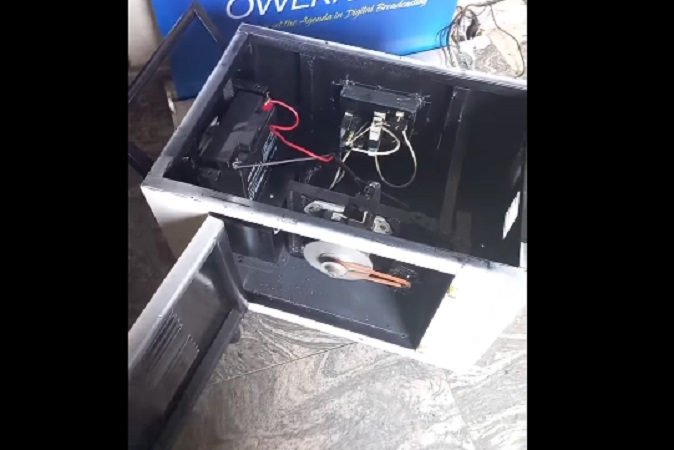
I deleted the generator piece because the TV station which posted the video has removed the video, editing out the contacts of the inventor from the new version I have seen. I do hope they do not charge the guy to repost the original video. With the video gone, there was no need of leaving the piece. So, I deleted it. More so, I will not post the new version where they have edited out the inventor’s contact.

We will continue to showcase inventors but as I have said, praising them online does nothing. The breakthrough will come when someone can bring them together, help them on IP processes and transform them from being inventors to innovators.

But do not think it is an easy thing: many Nigerian makers and inventors will NEVER sign a document because yes, they just like to be doing their garage thing forever. They want FREE money to help them. But ask them to give equity, they will refuse.

Think about it: why must you be begging when you have a great idea? It comes down to our basic education. In America, a kid in primary 4 already knows what copyright means and from there, they understand property rights.

But in Nigeria, men and women have great ideas, and yet they prefer to beg, instead of entering into partnerships. I do not get their “pity feel” because if you ask most to give equity for cash injection, they will refuse.

Yet, I hope we get it right soon!

Watch the video and order your generator; no petrol or diesel!

Comment on LinkedIn Feed

Now that we have been preaching entrepreneurship and practical skills, our education system needs to reflect same too. For every successful enterprise, three key skills must be present: product knowledge, finance knowledge and marketing knowledge. For all the noise and confusion in our entrepreneurial space, all the focus still centre on product knowledge, which is still not optimal anyway, nothing meaningful has been done in the domains of finance and marketing; so the pity party continues.

We have to devote more time into building and organising the market systems, that you can craft or couple things doesn’t mean you can sell or you know anything about finance or contract and its role in an enterprise. We don’t really have a recognisable system in this land, just come as you are, only to scale poverty, as against wealth.

It’s a work in progress, we will see where we are in few years from now; in the meantime, support what you can.

Note: the whole idea of a fuel-less generator is debatable. No one knows what is being claimed until someone can see what was done. So, do not put so much excitement on this post. Personally, I like to support young people, but I do not believe in most of these technical claims.

New Energy Business Model At Tekedia Institute

0

He has worked in Sterling Bank Plc and ran the Power Sector business in Heritage Bank Plc. Then he became the Chief Investment Officer at Climate Finance Advisory. His expertise has been deployed in Deloitte, African Development Bank and United Nations where he worked to shape the climate finance domain.

Dr Jubril Adeojo is the Co-Founder/COO OneWattSolar which has raised $millions on green bonds to build the energy infrastructure of the future in Africa. The first class graduate of business administration of the University of Hertfordshire, master’s degree grad of Oxford Brookes University and PhD from The Da Vinci Institute, is a Tekedia Institute Mini-MBA Faculty on New Energy Business Model.

Dr Adeojo will be in the class tomorrow at Tekedia Live, to educate on the future of energy, climate finance and how we can prepare to capture value.

Tekedia Mini-MBA >> learn from the best.

Schedule for Tekedia Mini-MBA Live This Week

0

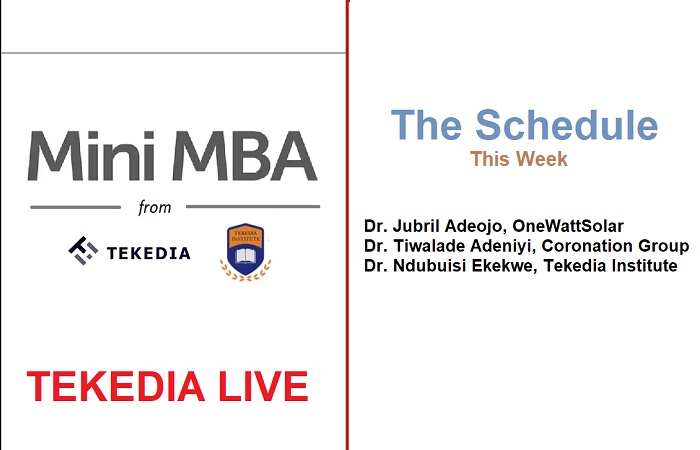
This is the schedule for Tekedia Live for this week. We have moved into the final phase of our program which is Execution. People, it is ACTION time, and how to unlock that revenue, and engineer growth in that business. Over the last few weeks, more than 15 eminent business leaders have spoken at Tekedia Live, helping us to understand and master the mechanics of markets. I am hoping that the roadmap is evident now.

  • -Tue, Aug 17 | New Energy Business Model (OneWattSolar Case Study) – Dr. Jubril Adeojo, COO, OneWattSolar
  • -Thur, Aug 19 | Mastering ESG-Anchored Global Fundraising – Dr. Tiwalade Adeniyi, Sustainability Lead, Coronation Group
  • -Sat, Aug 21 | 8 Options On The Most Important Decision in Business – Dr. Ndubuisi Ekekwe, Lead Faculty Tekedia Institute

Zoom links in the Board.

Registration for the next edition of Tekedia Mini-MBA continues here 

Corporate tax collection in Nigeria continues to improve

0

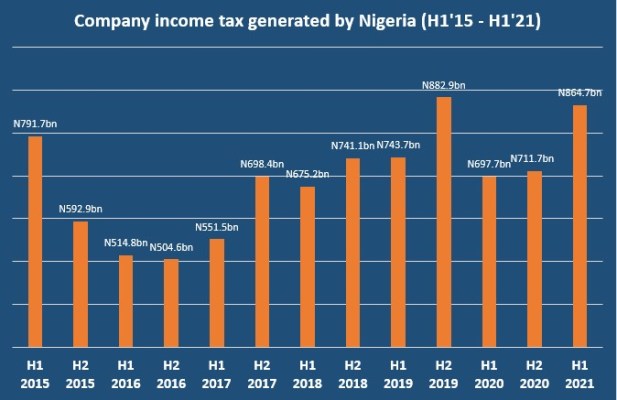
Corporate tax collection in Nigeria continues to improve: “The Nigerian government through the Federal Inland Revenue Service (FIRS) generated the sum of N864.72 billion as company income taxes in the first half of the year (H1 2021), representing a 57.8% achievement rate compared to the annual CIT projected revenue of N1.49 trillion. This is contained in the recently released company income tax report, by the National Bureau of Statistics (NBS).”

Now, the most important part – let us spend that money wisely. We cannot just innovate on tax collection. Yes, we also have to deepen our capacity to grow the economy with the same efforts we have used to accelerate tax collection.

This is the report Executive Summary

Data on Company Income Tax breakdown by sectors for Q2 2021 reflected that the sum of N472.07bn was generated as CIT as against N392.64bn generated in Q1 2021 and N402.03bn generated in Q2 2020 representing 20.23% increase Quarter-on-Quarter and 17.42% increase Year-on-Year.

Professional Services generated the highest amount of CIT with N130.09bn generated and closely followed by Other Manufacturing which generated N87.27bn, Banks & Financial Institutions generated N60.01bn while Textile and Garment Industry generated the least and closely followed by Automobiles and Assemblies and Pioneering with N27.23m, N62.15m and N64.30m generated respectively.

Out of the total amounted generated in Q2 2021, N412.74bn was generated as CIT locally while N51.61bn was generated as foreign CIT payment. The balance of N2.72bn was generated as CIT from other payments.