
DD
MM
YYYY

PAGES

DD
MM
YYYY

spot_img

PAGES

Home Blog Page 565

CreditPro Sets Sights on N2bn Capital Raise Under Fresh CBN License

0

CreditPro Finance Company Limited is preparing to raise N2 billion in capital before the end of 2025, a bold step following its recent licensing by the Central Bank of Nigeria (CBN). The plan, confirmed by Managing Director Adesola Adeyiga in an interview with Nairametrics, represents the company’s first major fundraising initiative since securing the regulatory upgrade.

“This is our first round of investment, and we intend to raise N2 billion before December 2025,” Adeyiga said, stressing that the capital will provide the foundation for both scale and credibility in Nigeria’s competitive finance sector.

How the Funds Will Be Deployed

Adeyiga outlined a three-pronged strategy for allocating the capital:

  • Working Capital – N1.7 Billion: To expand lending operations and ensure liquidity for serving small and medium-sized enterprises (SMEs).
  • Technology Infrastructure – N200 Million: To strengthen the company’s digital backbone, including server upgrades and advanced platforms that can improve customer service and backend processes.
  • Market Expansion – N100 Million: To fund branch openings and marketing campaigns designed to boost customer acquisition and brand visibility.

Fundraising Blueprint

CreditPro is engaging three investment houses, including Mainstreet Capital, to structure the fundraising process. Discussions are exploring private placements and preference shares that may convert to equity.

“We’re exploring multiple avenues, including private placements and preference shares that may later convert to equity,” Adeyiga explained. “While commercial papers are part of our long-term strategy, we’re not immediately pursuing that route due to the newness of this business model under our CBN license.”

The effort marks a turning point for the company, which has spent six years under a moneylender license. With CBN licensing, CreditPro now has the scope to expand its services and strengthen its portfolio for SMEs across Nigeria.

Capital Raising as a Sector-Wide Push

Across Nigeria’s financial services sector, the drive to raise fresh capital has become a central theme. Following CBN’s recapitalization push, commercial banks, microfinance institutions, and now finance companies have been compelled to shore up their balance sheets.

For instance, commercial banks are under pressure to meet significantly higher capital thresholds announced earlier this year, with some moving to the equity markets, rights issues, or private placements. Microfinance banks, too, have been racing to secure billions in fresh capital to avoid license revocation. Against this backdrop, CreditPro’s initiative reflects how smaller finance companies are positioning themselves early to withstand similar regulatory demands and to remain competitive.

Adeyiga believes completing the fundraising will not only provide working capital but also signal to institutional investors that CreditPro is ready to play in the big league. The additional liquidity will be crucial for SMEs, which have faced rising borrowing costs with commercial loan rates now hovering between 32% and 36%.

By reinforcing its balance sheet and scaling operations, CreditPro hopes to carve out a stronger role in bridging Nigeria’s credit gap — a space also being targeted by fintech players like FairMoney, Carbon, and Renmoney, which have raised funds through international debt and equity markets.

Regulatory Footing

CreditPro is no stranger to regulatory scrutiny. In 2023, the company was listed among 173 firms approved by the Federal Competition and Consumer Protection Commission (FCCPC) to operate as digital money lenders. Out of that number, 119 were fully approved, while 54 received conditional approvals. That process, which helped sanitize the digital lending space, positioned firms like CreditPro as credible alternatives in a sector marred by unregulated operators.

Now, with its CBN license in hand and a N2 billion raise in motion, CreditPro is moving from regulatory compliance to strategic expansion. The company’s leadership is betting that the mix of working capital, tech investment, and market reach will ensure it emerges stronger in Nigeria’s evolving finance industry.
Trump’s U.K. State Visit to Feature Top U.S. Business Leaders, Including Nvidia’s Jensen Huang

0
CREATOR: gd-jpeg v1.0 (using IJG JPEG v80), quality = 82

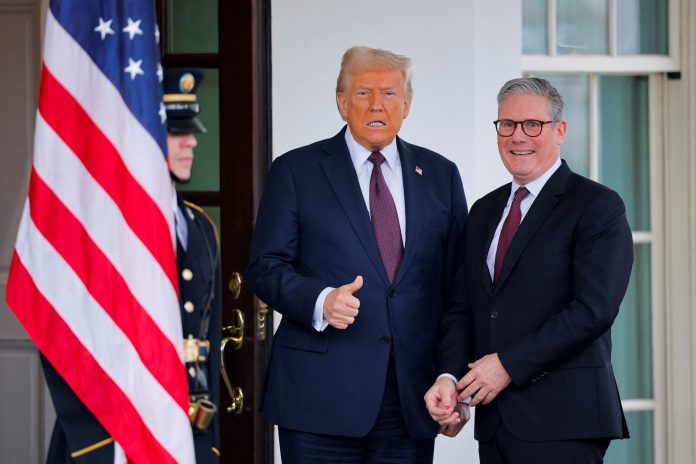
President Donald Trump will be accompanied by some of America’s most powerful business executives on his state visit to the United Kingdom next week, with Nvidia CEO Jensen Huang among the delegation, a source familiar with the plans told CNBC’s Kristina Partsinevelos on Monday.

According to Sky News, the group will also include Sam Altman of OpenAI, Stephen Schwarzman of Blackstone, and Larry Fink of BlackRock. Apple CEO Tim Cook received an invitation as well, though it remains unclear if he will attend. The trip will feature a state banquet hosted by King Charles, where Trump and the business luminaries are expected to be present.

CEOs seek soft landing amid Trump’s tariff war

The growing presence of leading technology and financial executives at Trump’s side highlights how corporate America is recalibrating its strategy amid the president’s escalating tariff war. With new tariffs targeting Chinese imports and the broader tech sector under increasing regulatory scrutiny, many CEOs see proximity to Trump as a soft-landing strategy—a way of shielding their companies from harsher restrictions or positioning themselves to secure exemptions.

Nvidia is a clear example. Earlier this year, the Trump administration cut off Nvidia’s access to the Chinese market by restricting sales of advanced AI chips. Huang immediately moved to build a closer relationship with Trump, arguing that U.S. leadership in AI required some level of continued access to Chinese buyers. His lobbying paid off: after a series of White House meetings over the summer, Trump approved export waivers for Nvidia’s H20 chip, a move that helped the company recoup potential losses.

Following those talks, Trump also opened consideration for the export of other Nvidia chips to China, a step that Huang recently told investors presented a “real possibility” for approval. Such decisions could prove pivotal to Nvidia’s growth, given that the company had earlier been forced to scrap H20 chips that might have accounted for $8 billion in quarterly sales.

Depending on the geopolitical environment, Nvidia now estimates it could sell as much as $5 billion worth of H20 chips in the current quarter.

Trump has publicly praised Nvidia for being a technological leader, celebrating the moment the company’s valuation soared past $4 trillion. Huang, in return, has positioned Nvidia as a national asset, telling the administration that allowing exports strengthens U.S. national security by ensuring that the U.S. stays ahead in the global AI race.

Trump even claimed that he negotiated a 15% cut of Nvidia’s chip sales in China, though Nvidia clarified last month that details of the government’s share had not been finalized.

A pattern of engagement

However, Huang’s attendance on the U.K. trip is consistent with his broader engagement with Trump. In May, he joined the president on a visit to Saudi Arabia for an investment forum, another sign of Nvidia’s strategy of staying closely aligned with the administration’s global economic initiatives.

Meanwhile, other CEOs are navigating similar pressures. While Altman’s OpenAI depends on U.S. government support for research and regulatory clarity, and Cook’s Apple has been vulnerable to tariffs on Chinese-made devices, each executive has reasons to keep ties with the White House warm.

Diplomacy through business

The inclusion of executives like Huang, Altman, Schwarzman, and Fink on the U.K. state visit underscores how Trump is fusing business leadership with foreign policy, using corporate figures as both economic ambassadors and political allies. Their presence at the banquet with King Charles signals a deliberate effort to project American corporate strength abroad, even as tensions over trade, AI, and semiconductor dominance with China continue to loom large.

But for U.S. firms, these appearances are more than ceremonial—they are part of a broader survival strategy in an era of tariffs, export controls, and geopolitical realignments.

Google Expands Gemini’s Reach with Audio, New Languages, and Smarter Reports

0

Google is pushing forward with a new wave of Gemini-powered updates, adding more versatility to its AI products and broadening access to its Search and research tools.

The company on Monday rolled out three key improvements: audio file compatibility for the Gemini app, five new languages for Search’s AI Mode, and expanded report formats for NotebookLM.

Josh Woodward, vice president of Google Labs and Gemini, announced the changes in a post on X, highlighting that audio uploads were the “#1 request” from users of the Gemini app.

Audio comes to Gemini

The addition marks a significant step for the app. Free users will be able to upload audio up to 10 minutes in length and are capped at five prompts each day. Those subscribed to AI Pro or AI Ultra plans can upload audio recordings up to three hours. Gemini now accepts up to 10 files per prompt across multiple formats, including compressed ZIP folders.

NotebookLM, Google’s research-oriented tool, already supported audio, but the Gemini app’s adoption widens its reach to users who want transcription, analysis, or conversation with audio content on the go.

Search expands with new languages

Google Search’s AI Mode is also extending its reach globally. With the integration of Gemini 2.5, the service now supports Hindi, Indonesian, Japanese, Korean, and Brazilian Portuguese.

A company blog post described the move as a major step toward inclusivity: “With this expansion, more people can now use AI Mode to ask complex questions in their preferred language, while exploring the web more deeply.”

The update signals Google’s intent to make Search’s AI features more accessible outside English-speaking markets, a push likely aimed at strengthening its footprint in Asia and Latin America, where rival platforms have been growing.

NotebookLM becomes a content generator

Meanwhile, NotebookLM is moving from a research companion into a content generator. The tool can now create structured reports in a variety of styles—study guides, briefing documents, blog posts, flashcards, and quizzes—drawing directly from a user’s uploaded files.

Reports are available in more than 80 languages and can be customized in tone, structure, and format. According to Google, the new features “should be 100%” rolled out by the end of this week.

This makes NotebookLM more competitive with general-purpose AI writing tools, while maintaining its edge as a research platform that can detect themes, patterns, and connections across diverse file types.

A month of rapid releases

The updates cap a whirlwind stretch for Google’s AI division. In August, Gemini began automatically recalling user details and preferences from prior conversations, while free users gained access to Workspace’s video generator, Vids. In September, Photos upgraded to the latest video model, Veo 3, and introduced the ability for free users to generate short, four-second silent videos from their still images.

The steady drumbeat of updates underscores Google’s urgency in the AI race, as it tries to match and outpace rivals like OpenAI and Anthropic. By layering audio, languages, and flexible content creation into its products, Google is signaling that Gemini is not just a conversational AI—but an ecosystem designed to permeate everyday work, study, and online exploration.

How Google’s updates compare in the AI race

Google’s recent spree comes as competitors are consolidating their own AI bets. OpenAI, backed by Microsoft, has been integrating its models more deeply into Office, Windows, and Azure while experimenting with memory features for ChatGPT. Meta, meanwhile, has doubled down on Llama and struck a high-profile partnership with Midjourney to strengthen its image-generation capabilities. Anthropic has been refining its Claude assistant to attract enterprise clients.

Against this backdrop, Google’s Gemini upgrades stand out for their consumer focus—rolling advanced features like audio uploads, multi-language Search, and structured reports directly into apps used by students, workers, and casual users. While OpenAI and Meta emphasize ecosystems tethered to enterprise and social platforms, Google appears intent on embedding Gemini in everyday digital habits, from search to note-taking to personal research.

AI as Co-CEO? Futurist Predicts Corporate America Could Soon Welcome “Boss Bots”

0

When the 2008 financial crisis reshaped global markets, companies elevated the Chief Financial Officer into a strategic powerhouse, transforming the role from number-cruncher to boardroom heavyweight.

A decade later, the digital revolution gave rise to Chief Digital Officers, reflecting corporate urgency to harness new technology. Now, according to futurist Michael Tchong, artificial intelligence is on track to trigger the next seismic shift: the arrival of the AI co-CEO — or even a stand-alone machine at the top.

Tchong, who has spent decades studying the interplay between technology and business, believes that the efficiency gains from AI are beginning to challenge the very foundations of executive work. He told Business Insider that decision-making, forecasting, and risk modeling — functions long reserved for human leaders — are increasingly being optimized by machines. With investors constantly demanding higher returns, he predicts that AI’s promotion into the corner office is only a matter of time.

“It becomes inevitable,” he said.

Competitive pressure building

Tchong foresees a domino effect once early adopters embrace AI leadership. “If you don’t have an AI co-CEO,” he warned, “you’re going to be seen as being corporately deficient in the way you’re handling your affairs.”

The comment reflects an emerging tension. While AI conversations in the workplace often center on fears of mass layoffs, at the executive level, they increasingly focus on how leaders themselves will use the technology. For Tchong, that conversation is shifting from AI as a tool to AI as a peer.

Pressure to perform

Tchong predicts that AI bosses won’t just answer queries or draft reports — they will act as tireless executives, capable of sending emails at any hour and continuously fine-tuning operations. This outlook aligns with broader investor pressure for companies to showcase AI adoption.

Salesforce CEO Marc Benioff recently revealed that AI had enabled the company to cut around 4,000 customer-support roles, underlining the technology’s disruptive potential. Already, some executives delegate tasks like quarterly reporting to AI systems, while a handful of firms outside the US have formally named AI executives.

Leaders are also entertaining the idea openly. Klarna CEO Sebastian Siemiatkowski has said AI could take over his job. Mechanize cofounder Tamay Besiroglu aspires to automate every role, including his own. Sam Liang, CEO of Otter, has predicted that avatars will soon represent executives in meetings.

Look out, CEOs

Investor influence could accelerate the shift, Tchong argues. If an AI co-CEO proves capable of boosting profitability, Wall Street may push others to follow suit.

“The inevitable conclusion that everyone will reach is that, ‘Hey, your co-CEO is already doing a fabulous job at optimizing your profits. Why can’t it also run the whole company?’” he said.

The economic logic is hard to ignore. “The AI CEO does not demand a $29 billion salary,” Tchong quipped — a clear nod to the massive executive pay packages that dominate headlines in Silicon Valley.

Not everyone’s convinced

Skeptics like Tom Gimbel, founder of staffing firm LaSalle Network and incoming chairman of the American Staffing Association, see limits to this vision.

“I think the CEO always remains a human,” he told Business Insider, emphasizing that leadership is fundamentally about judgment and decision-making, supported by advisors, attorneys, and boards.

For Gimbel, the real risk lies in lower- and mid-level jobs where AI can easily replicate tasks, not in leadership positions that require “100% decision-making.”

AI chief and “chief empathy officer”

Tchong imagines a hybrid model: humans taking on vision, crisis management, and emotional intelligence — effectively serving as “chief empathy officers” — while AI handles optimization and tedious tasks.

He acknowledges concerns about accountability, particularly if AI makes a mistake, but counters that human leaders also stumble. Bots, he said, simply have “bouts of fantasy.”

A lesson from history

What Tchong describes fits a broader historical arc: the steady elevation of specialized roles in response to economic and technological upheavals. Just as CFOs rose after the 2008 financial crisis and Chief Digital Officers emerged during the smartphone and cloud boom, AI leaders may soon become a fixture of the C-suite.

The difference, however, is scale. Whereas CFOs and CDOs were human specialists brought in to master new challenges, AI co-CEOs would represent a handover of authority to technology itself — a leap from augmentation to delegation of leadership.

If investors begin rewarding companies that embrace AI co-leadership, competitive pressure could force others to follow. That would create a new divide between “AI-led” firms and those maintaining traditional hierarchies.

For now, most AI deployments are operational, aimed at boosting efficiency and reducing headcount. But with executives increasingly using AI as a proxy in meetings and strategy discussions, the groundwork is being laid.

Should Tchong’s forecast materialize, the corporate corner office may soon look less like a seat of solitary human power and more like a shared command center — where one half is a human leader, and the other a machine running tirelessly in the background.

Bitcoin Surpasses Key Liquidity Zone as Traders Eye $116K

0

Bitcoin has broken past a critical liquidity zone, sparking speculation about its next major move.

According to CoinGlass data, liquidity has been heavily concentrated between $109,500 and $110,000, a range Bitcoin has now decisively breached.

The leading cryptocurrency extended has its recovery from a low of $109,993, reaching an intraday high of $112,107 early Monday. As at the time of writing this report, Bitcoin was trading at $112,777. This upward move pushes BTC beyond a zone that many traders have been watching closely, raising questions about whether the rally has enough strength to continue.

On the daily chart, Bitcoin is retesting the $112,000 level after bouncing from the $107,000 support zone. The price currently sits just below the 100-day moving average (MA), which has flipped into short-term resistance. The Relative Strength Index (RSI) is hovering near 48, reflecting mild buying pressure but a lack of strong momentum.

For now, the $110,000 zone remains a pivotal level. If bulls can defend this area, Bitcoin could target $116,000 and potentially revisit its recent peak near $124,000. Conversely, failure to hold above $110,000 could trigger a drop toward $104,000, where a larger pool of demand exists.

Crypto analyst Lennaert Snyder noted:“If Bitcoin reclaims $112,500, we can start looking at the upside again. Rejecting $112,500 triggers shorts.” However, while some analysts predict an upside price movement for Bitcoin, others remain skeptical. Peter Schiff, co-founder of Echelon Wealth Partners, believes Bitcoin is more likely to fall below $100,000 than rally above $200,000.

“Markets are forward-looking. That’s why gold is up 10% ahead of expected rate cuts. Bitcoin’s failure to rally alongside gold should be a major warning sign,” Schiff said, highlighting Bitcoin’s underperformance compared to gold.

On-Chain Metrics Raise Concerns

Despite the recent price stability, Bitcoin’s network activity shows signs of weakening. Active addresses have been declining for months, suggesting reduced retail participation and slowing organic adoption. This indicates that short-term speculation, rather than genuine usage, is driving market activity.

Data from CryptoQuant analyst IT Tech reveals a sharp decline in Bitcoin whale balances. Total holdings have dropped below 3.36 million BTC, with a negative 30-day change. Long-term holders sold 241,000 BTC in the past month, and whales offloaded more than 115,000 BTC over the same period. Analysts warn that continued selling could push Bitcoin toward $95,000 or lower in the coming weeks.

Notably, Bitcoin Treasury Companies now collectively hold 1 million BTC, a record high. However, their buying momentum has slowed drastically. Strategy’s monthly purchases fell from 134,000 BTCin November 2024 to just 3,700 BTC in August 2025. Other treasury firms bought 14,800 BTC in August, down from 66,000 BTC in June.

Macro Catalysts in Focus

Traders are closely watching upcoming U.S. economic data, which includes: Consumer Price Index (CPI)release on Thursday and Jobs report on Friday. These reports could influence Federal Reserve policy, impacting liquidity and driving volatility in the crypto markets.

Future Outlook

Bitcoin’s path forward hinges on whether it can maintain strength above the $110,000 support zone. However, sustained whale selling and declining network activity remain bearish headwinds.

With key economic data set to drop later this week, traders brace for heightened volatility as Bitcoin tests its next decisive move.