DD
MM
YYYY

PAGES

DD
MM
YYYY

spot_img

PAGES

Home Blog Page 5650

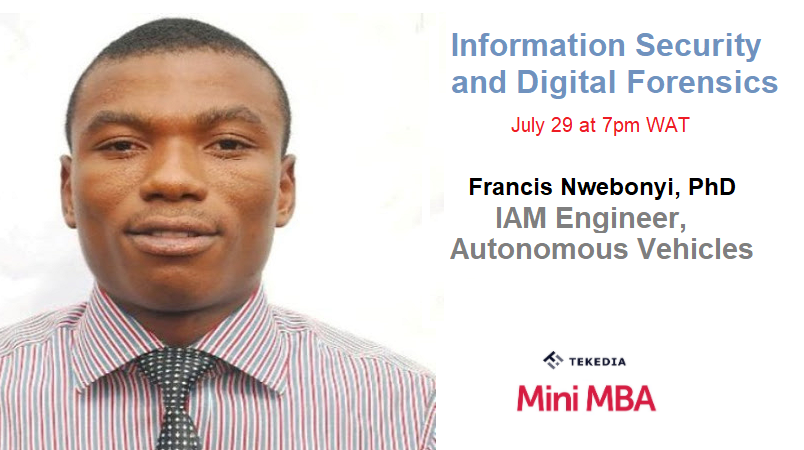
Tekedia Live: Information Security & Digital Forensics – Dr. Francis Nwebonyi, July 29th

0

His job is to secure the integrity of autonomous vehicles for BMW Group’s future diving machines. He is an IAM Engineer (Identity and Access Management Engineer) and holds a PhD in Computer Science with focus on Network and Information Security from Universidade do Porto. He had earned an MSc in Computer Security and Forensics from the University of Bedfordshire. He is part of our Cybersecurity and Digital Forensics Faculty.

Dr Francis Nwebonyi in a team at the forefront of creating the next generation software systems for vehicles of the future. And certainly, when it comes to digital security, we like those who hold extremely critical positions in such domains. Dr Nwebonyi will be at Tekedia Live, the Zoom session of Tekedia Mini-MBA, to offer management-level understanding of the domain. I have told him “no geek tech”! Lol. 

Yes, this will be all management and business insights on how we can build secure businesses in this digital era. 

  • Thur, July 29 | 7pm-8pm WAT | Information Security & Digital Forensics – Dr. Francis Nwebonyi, Critical TechWorks, Portugal

Tekedia Mini-MBA: learn from the best here.

The Jeff Bezos’ $2 Billion Seat in Space with NASA

1

This is what legends do; they buy seats at the table. Yes, Jeff Bezos continues to shape his world. If they say it is money, give it to them – and then join the party. If that party is estimated to be worth hundreds of billions of dollars, this $2 billion is a pure “equity investment” for that future: “NASA may have chosen Elon Musk’s SpaceX over Blue Origin to build the spacecraft that will land the next Americans on the moon, but for Jeff Bezos, the race isn’t over. The world’s richest man has offered to spot the agency $2 billion in exchange for part of the moon landing contract. NASA originally awarded the contract solely to SpaceX due to budget constraints, but Bezos said he hopes waiving $2 billion will reopen the door to a joint contract.”

  • Blue Origin will bridge the HLS budgetary funding shortfall by waiving all payments in the current and next two government fiscal years up to $2B to get the program back on track right now. This offer is not a deferral, but is an outright and permanent waiver of those payments. This offer provides time for government appropriation actions to catch up.
  • Blue Origin will, at its own cost, contribute the development and launch of a pathfinder mission to low-Earth orbit of the lunar descent element to further retire development and schedule risks. This pathfinder mission is offered in addition to the baseline plan of performing a precursor uncrewed landing mission prior to risking any astronauts to the Moon. This contribution to the program is above and beyond the over $1B of corporate contribution cited in our Option A proposal that funds items such as our privately developed BE-7 lunar lander engine and indefinite storage of liquid hydrogen in space. All of these contributions are in addition to the $2B waiver of payments referenced above.

If the best real estate project of the future is in space, getting yourself to the gates now could be catalytic. Now, we will be waiting for NASA to respond. I am betting that Blue Origin will join the party and Bezos will have a big seat on the table. People make money for moments like this!

Oh yes, one man said that money is necessary to get yourself out of the inconveniences of life. With $2 billion, even space programs will align.

Microsoft Beats Forecasts, Posts Big Earnings

0

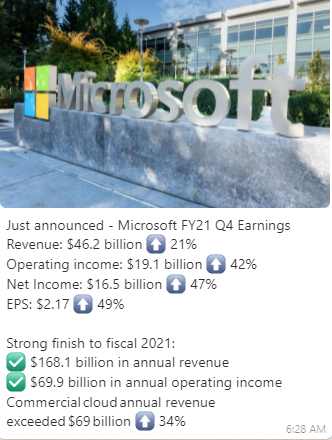
Microsoft issued fiscal fourth-quarter earnings on Tuesday, with reports that exceeded expectations. The software and hardware company’s quarterly revenue shares initially fell before rebounding and rose as much as 1% in extended trading on Tuesday.

Microsoft has joined Tesla and Apple whose revenue reports demolished Wall Street estimates.

Here’s how the company performed:

Earnings: $2.17 per share, adjusted, vs. $1.92 per share as expected by analysts, according to Refinitiv.

Revenue: $46.15 billion, vs. $44.24 billion as expected by analysts, according to Refinitiv.

Revenue rose 21% year over year in the quarter, which ended June 30, according to a statement. Revenue had increased by 19% in the previous quarter. CNBC consensus gives details of further earnings that augmented the total revenue.

With respect to guidance, Microsoft called for $14.5 billion to 14.75 billion in fiscal first-quarter revenue from its Productivity and Business Processes segment, higher than the $14.07 billion StreetAccount Estimate.

For the Intelligent Cloud segment, the company sees $16.4 billion to $16.65 billion in revenue, higher than the $15.71 billion consensus. And the More Personal Computing segment guidance was $12.4 billion to $12.8 billion in revenue, with the middle of the range coming in just short of the StreetAccount consensus of $12.67 billion.
In the fiscal fourth quarter, Microsoft’s Intelligent Cloud segment, which includes the Azure public cloud, Windows Server, SQL Server and GitHub, produced $17.38 billion in revenue, up 30% year over year. Analysts polled by StreetAccount had expected $16.33 billion in revenue.

Revenue from Azure, which competes with Amazon Web Services, grew 51% in the quarter, or 45% in constant currency. Analysts had been expecting 45.3% revenue growth from Azure, according to a CNBC consensus, while the StreetAccount consensus was 42%. In the prior quarter, Azure revenue grew 50%. Microsoft does not disclose Azure revenue in dollars.

In the fiscal first quarter, Azure revenue growth in constant currency should remain relatively stable on a sequential basis, Microsoft’s finance chief Amy Hood said on the company’s earnings call.

The Productivity and Business Processes unit, which contains Office productivity software along with LinkedIn and Dynamics, contributed $14.69 billion in revenue, up 25% and above the StreetAccount consensus of $13.93 billion.

Microsoft’s seat growth for commercial Office 365 subscriptions accelerated to 17% from 15%, with the company citing higher revenue per user and better results from products designed for small businesses and front-line workers. The Teams chat and calling app in Office 365 now has 250 million monthly active users, Microsoft said. The premium E5 tier now accounts for 8% of all commercial Office 365 subscriptions, Hood said.

Microsoft’s More Personal Computing segment, which features Windows, as well as devices, gaming and search advertising, generated $14.09 billion in revenue. That’s up 9% and more than the $13.74 billion StreetAccount consensus.

Technology industry research company Gartner estimated that PC shipments grew 4.6% in the quarter. Microsoft’s revenue from device makers for Windows licenses in the quarter fell 3%, with license revenue associated with consumer PCs decelerating to a decline of 4% from 44% growth in the prior quarter. The company pointed to supply constraints, which PC makers Dell and HP have flagged in recent months.

Sales of Microsoft-branded Surface PCs dropped 20%, worse than the decline in the mid-teens range that Microsoft had called for in April, because of supply challenges.

The coronavirus pandemic benefited Microsoft results in some ways and hurt in others. The company’s revenue from Xbox content and services, including sales of video games, declined 4%, with the metric comparing unfavorably against 65% growth in the year-ago quarter.

Microsoft’s server products category, which features the Windows Server operating system and SQL Server database software, delivered 16% revenue growth, up from 3% in the prior quarter thanks to an easy comparison against the year-ago quarter because of transactional weakness at the time. Those conditions also arose because of Covid.

Search advertising revenue grew 53% as the advertising market rebounded. That also benefited the LinkedIn business, which showed 46% growth. The Marketing Solutions business tied to advertising grew 97%, with more than $1 billion in quarterly revenue, Microsoft CEO Satya Nadella said on the call. LinkedIn overall now generates $10 billion in annual revenue, he said.

During the fiscal fourth quarter, Microsoft announced its intent to acquire speech-recognition company Nuance Communications for $19 billion, including debt. It also introduced Windows 11, a new version of its desktop operating system, although sales of licenses to device makers will be deferred.

The company’s board voted to make Nadella its chair, and Microsoft’s top individual shareholder, co-founder Bill Gates, announced that he’s splitting up with his wife, Melinda French, who also once worked at Microsoft.

Notwithstanding the after-hours move, Microsoft shares are up about 29% since the start of 2021, while the S&P 500 index has risen almost 17% over the same period.

The Intel’s Massive Evolution

2

Intel wants to become like TSMC when it comes to manufacturing chips. TSMC is the world’s largest contract manufacturer for integrated circuits. With it, all you need to do is to design your circuit, send to it and it will manufacture it, and send the chips back to you. You can call it Amazon AWS as in cloud computing where the cloud infrastructure which anyone can rent with a debit or credit card is equivalent to foundries worth $billions which TSMC has built to turn sands into smart systems for the world.

So, just as cloud computing has done well, TSMC has also done really very well. And Intel wants to copy that business model as it looks for ways to get out of the paralysis it has found itself. So, Intel is opening its foundries for friends and enemies, provided you are open to pay: “Buffeted by the success of Samsung, TSMC, and Apple’s new M1 chip, Intel is announcing a new business strategy to compete in the next era of semiconductors. It will start to make chips for Qualcomm, one of the world’s biggest chip designers — the first time it’s opened its foundry to a rival.”

Earlier this year, Intel got a new CEO and kicked off a new business plan that would open its foundries to other chip-design firms, the same way TSMC and Samsung Semiconductor operate. At its “Intel Accelerated” event today, the company laid out a roadmap for its future as a for-hire foundry. Besides the future of ever-smaller process nodes, the company also announced it has scored one of the world’s biggest chip designers, Qualcomm, as a future foundry customer.

As part of entering the foundry market, Intel will start naming its process nodes more like its rivals. The process-node numbers used for chips like “5nm” started out life as a measurement of transistor size, but eventually the marketers got hold of them and companies started cheating down their numbers to look more advanced. Intel says its new naming scheme will better align with how TSMC and Samsung talk about their foundry technologies. Gone are the days of “Intel 10nm Enhanced Super Fin”—instead, the node is called “Intel 7.” It should have a comparable density to the TSMC and Samsung 7 nm nodes and will be ready for production in Q1 2022 (TSMC and Samsung are currently shipping “5nm” products). “Intel 4″—which Intel previously called “7nm”—is now said to be equivalent to TSMC and Samsung’s 4 nm node, and it will begin manufacturing products in 2023.

This is a very great strategy, and statistically it makes sense for Intel. I have written on this many times and my argument is like this: building foundries costs $billions of dollars making the business risky when Intel has to fab for only its products. If it does not have a product winner in the market, the foundry will become highly underutilized. That risk of usage efficiency affects its capacity to modernize its factories, and because of that inertia, it has lost ground to Samsung and TSMC which fab for anyone that can pay. 

Samsung serves Apple while TSMC serves everyone. For those companies, they do not have to depend on internal design wins to fill foundry capacities since those winners could come from any of their many customers. If Samsung Galaxy does not do well in the market but Apple iPhone does well, Samsung Electronics will be fine since it helps Apple to manufacture the core microprocessor in iPhone. That is at the heart of the One Oasis Strategy which I wrote in Harvard a few months ago.

With that confidence that even outside clients can have the winner, companies like TSMC and Samsung can invest in new fabs since statistically one of their many customers will win the next evolution. But the old Intel was tethered to its internal success which is not always guaranteed. If a processor series does not do well, the foundry investment will struggle.

But today, this new strategy will unlock massive opportunities in Intel and I think it is a great win. Intel will serve Amazon AWS, Qualcomm and who knows companies like Nvidia and AMD in the near future, freeing the foundry from pure dependence on its internal designs. If you look at it, that is a massive evolution for the semiconductor giant. And it is a great one.

Comment on LinkedIn Feed

Comment: I’d like to view this from the point of national security. If conflict starts around Taiwan today and very close to Asia, the US will be cut off from critical and cutting edge manufacturing capabilities. The China – Taiwan – US feud isn’t going anywhere soon. There is need for a backup.

My Response: I made that point here but note that TSMC is building a factory in US to deal with that – https://www.tekedia.com/tmsc-to-build-a-12bn-semiconductor-factory-in-the-u-s/

Comment: It was always clear that Intel has to start thinking like a startup to be competitive in today’s fast paced semiconductor industry. Closed source business models will not survive in the next couple of years and the early effects are what we can clearly witness with Intel losing relevance in this sector.

The cost of computing power is already past Moore’s law where all manufacturing has fast caught up with design metrics with more and more people having access to latest tech. The producers rather than then architects are clearly winning in this regard. Collaboration is Intel’s best bet in surviving the onslaught of manufacturing over architecturing.

More and more open source chip architectures such as RISC-V will play a huge role stealing market share from the big players in the years to come.

Comment: In the long run nations, businesses and organizations must learn to live, interoperate and interact with rivals to keep the numbers good, to remain relevant, the current world architecture calls for more openness than reclusiveness, we must embrace the challenge while we build requisite capacity to compete.

The China’s BIG Pause!

1

China is causing massive redesigns in the online technology space. Across all domains, the Asian nation is rewiring the architectural structures of popular digital firms like Didi, Alibaba and Meituan. And the most troubling part: no one knows what the final playbook would be.

China has paused edtech firms from going public or raising new capital. It has also asked a ride hailing company to stop adding new users. Honestly, when it comes to things like this, you will at least appreciate that we have something better than China: ability to rant in Nigeria – and keep going.

According to the New York Times, this high voltage searchlight which has been used to wage regulatory cleaning on these firms have wiped out more than $80 billion from the coffers of American investors like BlackRock and Sequoia: “These kinds of startups had attracted American investors like Sequoia and BlackRock, and previously earned a valuation from JPMorgan of more than $100 billion. That estimate was revised to $24 billion on Monday.” Most expect that $24 billion to hit below $10 billion by next month as China will turn some properties into pure non-profits!

These new rules targeted some of China’s hottest software sectors — especially those with large American investment. The educational regulations, for instance, essentially bans tutoring companies from making profits, raising money, and listing on stock exchanges. The Chinese government said the move was due to the education sector being “hijacked by capital.” These kinds of startups had attracted American investors like Sequoia and BlackRock, and previously earned a valuation from JPMorgan of more than $100 billion. That estimate was revised to $24 billion on Monday, according toThe New York Times.

“The worst-case became a reality,” JPMorgan analysts wrote. “It’s unclear what level of restructuring the companies should undergo with a new regime and, in our view, this makes these stocks virtually uninvestable.”

The news has also wiped billions from publicly-traded companies like Chinese e-commerce giant Meituan, which offers ride sharing, food delivery, and travel booking. The company’s stock dropped 14% on Monday, following the news of regulations.

Regulations for delivery companies cover a broad range of labor issues, including a mandate that workers are paid at least the minimum wage according to where they’re working. The new rules also require less stringent algorithmic management to allow more time for deliveries, as well as access to social security and insurance.(Fortune newsletter)

When you talk of geopolitical risk, I am not sure the smarts in BlackRock had modelled what is happening in China now with its big tech. That explains why American firms must consider Africa where we treat investors better. I mean, there is no way any nation that is not China would destroy assets like this without an American ambassador raising an alarm on the need to preserve  investments. But so far, no one is talking because China reports to none!