DD
MM
YYYY

PAGES

DD
MM
YYYY

spot_img

PAGES

Home Blog Page 5655

How Bitcoin will change the world

0

Can you tell me what interests you most about the internet? I will tell you in a moment what interests me most about the internet.

It is the fact that the internet or information technology has solved great problems. That is not all; it is also very interesting to see the huge innovations springing up as a result of the internet.

One among them is the Smartphone. With the Smartphone, you are connected to the world in real-time at all times.

 Truly the world has become portable and a global village with our smartphones.

In addition, are you aware that many industries exist today because of the internet? Industries like e-commerce such as Amazon, eBay etc, hailing services such as Uber, Bolt, Vaya, and a host of other marketplace and shared business models.

The next wave of technology innovation is already happening. It is going to add more value and solve more problems than the internet does.

That innovation is Bitcoin and Blockchain which now supports some new industries such as Defi, NFT, Crypto etc

But, wait for a second, how will that happen? I will show you exactly how it will happen in the next section.

Ways Bitcoin will change the world more than the Internet

During the B-word conference, the Bitcoin conference was organized by Jack Dorsey. The event has very impressive entrepreneurs in attendance such as Elon Musk, Jack Dorsey and investor Cathie Wood. 

They discussed a couple of bitcoin features that with them, the Bitcoin invention will change more lives and solve some of the problems left by the internet invention.  

Here are the three of the foremost problems that Bitcoin will solve

Remittance Cost

There are many countries that their economy depends heavily on remittance. Examples of such countries include emerging countries such as El Salvador and Nepal. 

One of the problems these countries faced is the high cost of remittance coming into the country.

What is the cost of the high remittance? It is due to the centralized nature of the financial system. Money has to pass through several mediums before it finally arrives at the expected destinations. In the process, the cost increases, this leads to many problems for the receiving economy.

When bitcoin becomes the native currency of the internet, sending money will become as fast as sending a chat or a tweet, even faster. When this happens life will become better for these countries, leading to economic growth.

Hedge against Global Inflation

How many burgers can $5 buy in 1970 and how many burgers can it buy today?  The correct answer would be that fiat currency has reduced in real value while wages remain constant.

This is a serious problem because; people will not be able to live the lifestyle that they dreamed of. The reason for this is due to the unlimited money supply by the monetary system. 

Imagine the Federal Reserve or central banks printing more money. This increase in money supply fuels inflation which will deplete purchasing power. You know what your purchasing power is your real power, without it you will die.

The Bitcoin monetary system is based on a currency supply of 21 million. It means that it can help any country hedge against inflation. The standard of living of the people will increase with Bitcoin.

Bitcoin Fixes the Money Error

The central bank monetary system has errors. The errors range from devaluation to printing of massive volumes of fiat now and then. 

The reason for this is due to the centralization system of fiat and it is less of an information system.

According to Elon Musk during the B world conference, bitcoin fixes this error because it is an efficient information system. An information system that is decentralized, open-source and has a scarce maximum supply

Conclusion

Though Bitcoin technology is still evolving, it has promising solutions for the world. With layer 2 innovations such as Lightning Network, these solutions are already being enjoyed by people.

This new information system will practically change the way many things have been, from inequality to a more equal society.

The next Wave of bitcoin price will be determined by Jack Dorsey, Elon musk and Michael Saylor as explained in this article.


Zoom to Charge Kenyan Users 16% VAT from August, As the World Rallies for International Tax System

0
Zoom

Besides the global push for digital taxation, which will force multinationals to pay 15% taxes wherever they are, African countries are beginning to create a new tax regime that will see consumers of digital services paying taxes.

Earlier in the week, Zoom, a popular teleconferencing app announced that it will from August 1, 2021 charge Kenyan users digital tax payable to the Kenya Revenue Authority (KRA).

Kenyans will now have to pay a 16% Value Added Tax (VAT) on digital services. The VAT tax on digital services was introduced by the Finance Act, 2019, but in 2020, the Treasury drafted the Digital Market Supply as an addition to the digital taxation framework.

“Taxable supplies made through a digital marketplace, digital scope of taxable supply through a marketplace, downloadable digital content including downloadable mobile applications, e-books and films … digital content for listening, viewing or playing on any audio, visual or digital media,” a statement from the new rules partly said.

The Digital Market Supply, which came into play last year, means that companies operating subscription-based digital services will have to charge consumers for VAT. The firms were given a six-month transitional clause to comply with the new rules.

Zoom is registered in Kenya as a non-resident supplier of electronic services. The communications platform falls under the category of firms meant to remit the 5 percent digital taxes which were made into law in January 2021. The electronic tax will however, be collected from non-VAT registered customers in Kenya.

“If you are registered for VAT in Kenya, you should provide Zoom with your Personal Identification Number (PIN) and a declaration that you are registered for VAT in Kenya. If you are registered for VAT, then no VAT will be charged on the supplies made to you by Zoom,” a statement by Zoom said.

Zoom’s annual subscription rate for premium videoconferencing services is about $250 (Ksh25,000) while the rate for its basic services goes for about $150 (Ksh15,000). This means that Kenyans, both individuals and firms, who consume these categories of services will have at least $25 more to pay for Zoom services.

However, corporations are more likely going to bear the brunt of the new VAT rules as they make more use of the app. Basic users are likely not going to pay for the services since they are limited to packages that can only host a maximum of 100 participants per meeting.

The move may likely kick off a new era of digital tax regime in Africa, as many countries including Nigeria have been mulling digital tax laws that will force online companies to register in the countries where they’re operative and pay taxes. The federal government of Nigeria said in June after it banned Twitter, that the microblogging app need to register and pay taxes among other things to be unbanned.

But like in Kenya, the Nigerian Finance Act, 2019, introduced a provision for non-resident digital businesses to apply 7.5% VAT on their B2C invoices to customers in Nigeria. Twitter does not fall in this category because it doesn’t offer subscription-based services.

To tax multinational digital companies, the world must reach a consensus on how much is to be taxed. Washington has been leading global negotiations that would force multinationals to pay tax wherever they are, and so far, the recommended minimum rate of 15% has got the backing of 130 countries.

The outbreak of covid-19, which shifted a lot of professional activities online, has seen tech firms rake in more revenues. The economic growth, which was powered by multinational services, instigated global calls for a fair international tax system.

“We need to put an end to corporations shifting capital income to low tax jurisdictions, and to accounting gimmicks that allow them to avoid paying their fair share,” US Treasury Secretary Janet Yellen told European finance ministers.

The Challenge Ahead for Industrialization of Nigeria

2
Lagos Island (source: Guardian)

Few days ago the news of a student in the  University of Ilorin who lost his life due to 300 million naira forest trade rented the air. It was a very sad incident loosing another youth aside numerous deaths of people by Covid 19. I was discussing this sad incident with a student colleague who happened to be a researcher in the department. He jokingly said Owonikoko go and learn Forest Trade instead of Fuzzy logic. Initially I thought he was right,  what have i gained by mastering the act of using fuzzy logic. For those of us  who doesn’t know what Fuzzy logic is all about,  Fuzzy logic is an artificial intelligent tool which  had been employed as part of the technology behind  washing machines, air conditioners, facial pattern recognitions and vacuum cleaners

Fuzzy logic can be employed to solve problems such as load forecasting, energy management, control system and prediction of a disease outbreak etc.  Why do I need fuzzy logic? The zeal to solve one major problem in Nigeria which is reliability of electrical power systems; this is what gave me the interest to a research topic. When I present this topic to my research supervisor, he was so amazed by the topic and he gave me a greenlight. He said Waheed you need to  study the mathematical background behind Fuzzy logic. This was a very big  task, it took me more than 3 months to understand this to some extent.  I had to see many videos and read a lot of journals before I could have an indebt knowledge about Fuzzy logic.

After the initial task, Fuzzy logic was used to carry out load forecasting on a transmission line of a station in Kwara State. The developed model was effective and it gives an accurate results. The advantage of this model was that if adequately explored by all transmission station in Nigeria, the generating station will know the amount of electrical power needed by the various transmission station for a day ahead load demand. Having said this Fuzzy logic was later employed for demand side energy management.  Based on the previous work, a journal that had been accepted but yet to be published by Pertanika journal of science and technology is in progress.

To my point, having gone through all this rigorous research ethics. There is no assurance that the Nigeria government will put this model into use. The government are not providing funds for researchers as expected and more so  lots  of good research had been carried out in the past by our various universities in the country. This researches always end at publication level, most of the achievements that had been made are not always put to use. This type of habit is among the bad act that is drawing our country backward.

The way forward, adequate fund should be provided by the government to promote research in our various higher institutions. The government should be responsible for bridging the gap between the academics and industries. They should ensure that the academic achievements made in our various institutions are put to use. The government should also encourage industries to look inward rather than importing expensive technologies  all the time. By so doing,  Nigeria citizens  will begin to have confidence in locally made products.

The Burning Bush in Your Market – And  A Call To LEAD

2

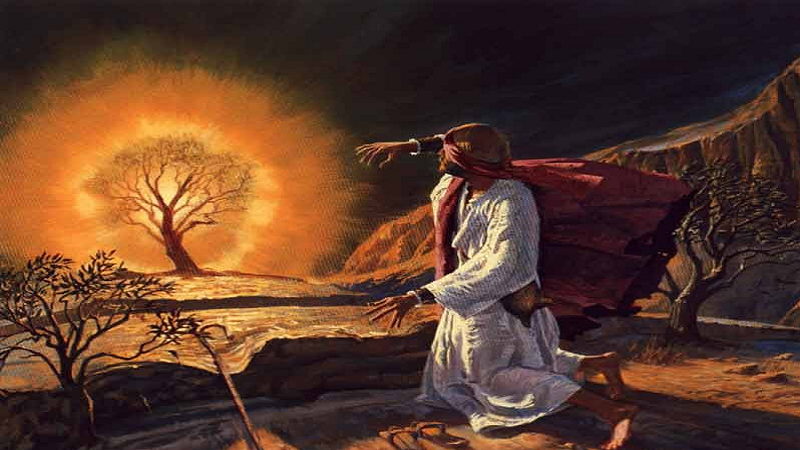
He was on Horeb, and saw a burning bush. The bush was on fire but it did not burn up. So he thought, “I will go over and see this strange sight—why the bush does not burn up.” There are huge business lessons for us here.

First, his attention was needed for a very important message; he needed to be consumed by something uncommon. Second, his bravery was tested – what would he do seeing a burning bush unconsumed by fire? Third, if he passes the test, his offer letter would be signed; “I am sending you to Pharaoh to bring my people the Israelites out of Egypt”.

In companies, only undistracted, focused and committed people are typically called to execute higher missions. Moses was attentive to have seen the burning bush. Are you paying attention to new market opportunities and shifts in customer preferences? Firms typically put the selected ones through tests with uncommon KPIs and targets to see how they respond. Can you stand the burning bush in the Nigerian economy and still deliver great numbers?

Like Moses, do you go into the market or do you just give up and run away from the market burning bush? But note this: if you run from the burning bush, that CEO, Directorship, GM, etc role will not come. Yes, you have just missed an opportunity to LEAD on that role.

And to companies, just as Moses was supported, you need to support the leader once you have sent on that mission. Yes, do not send leaders on missions without support. The Lord prepared Moses and gave him assurances of support all the way. He identified the mission, and gave him a roadmap to present the mission to the elders of Israel.

Just as I AM [the highest authority] empowered Moses, firms must use high authority to communicate and support great missions. Happy Sunday.

Reference: Exodus 3:1-17 New International Version (NIV)

Now Moses was tending the flock of Jethro his father-in-law, the priest of Midian, and he led the flock to the far side of the wilderness and came to Horeb, the mountain of God. There the angel of the Lord appeared to him in flames of fire from within a bush. Moses saw that though the bush was on fire it did not burn up. So Moses thought, “I will go over and see this strange sight—why the bush does not burn up.”

When the Lord saw that he had gone over to look, God called to him from within the bush, “Moses! Moses!”

And Moses said, “Here I am.”

“Do not come any closer,” God said. “Take off your sandals, for the place where you are standing is holy ground.” Then he said, “I am the God of your father,[a] the God of Abraham, the God of Isaac and the God of Jacob.” At this, Moses hid his face, because he was afraid to look at God.

The Lord said, “I have indeed seen the misery of my people in Egypt. I have heard them crying out because of their slave drivers, and I am concerned about their suffering. So I have come down to rescue them from the hand of the Egyptians and to bring them up out of that land into a good and spacious land, a land flowing with milk and honey—the home of the Canaanites, Hittites, Amorites, Perizzites, Hivites and Jebusites. And now the cry of the Israelites has reached me, and I have seen the way the Egyptians are oppressing them. 10 So now, go. I am sending you to Pharaoh to bring my people the Israelites out of Egypt.”

11 But Moses said to God, “Who am I that I should go to Pharaoh and bring the Israelites out of Egypt?”

12 And God said, “I will be with you. And this will be the sign to you that it is I who have sent you: When you have brought the people out of Egypt, you[b] will worship God on this mountain.”

13 Moses said to God, “Suppose I go to the Israelites and say to them, ‘The God of your fathers has sent me to you,’ and they ask me, ‘What is his name?’ Then what shall I tell them?”

14 God said to Moses, “I am who I am.[c] This is what you are to say to the Israelites: ‘I am has sent me to you.’”

15 God also said to Moses, “Say to the Israelites, ‘The Lord,[d] the God of your fathers—the God of Abraham, the God of Isaac and the God of Jacob—has sent me to you.’

“This is my name forever,
the name you shall call me
from generation to generation.

16 “Go, assemble the elders of Israel and say to them, ‘The Lord, the God of your fathers—the God of Abraham, Isaac and Jacob—appeared to me and said: I have watched over you and have seen what has been done to you in Egypt. 17 And I have promised to bring you up out of your misery in Egypt into the land of the Canaanites, Hittites, Amorites, Perizzites, Hivites and Jebusites—a land flowing with milk and honey.’


50% of Nigerians are open to leave Nigeria for economic reasons – World Bank

1

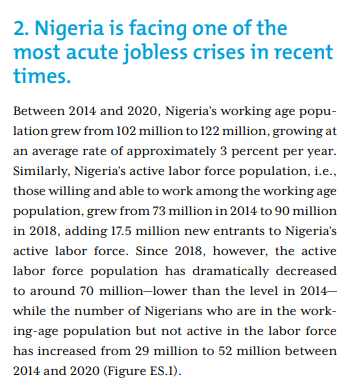
About 50% of Nigerians are open to leave Nigeria due to the high unemployment rate and explore a better economic future outside the nation. This number was 20% in 2014. Also, close to 50 percent of Nigerian jobseekers face chronic unemployment of more than 2 years. This is contained in the latest World Bank report – ‘Of Roads Less Travelled: Assessing the Potential for Migration to Provide Overseas Jobs for Nigeria’s Youth.’

This report finds that Nigeria’s labor market has not kept pace with the increasing number of labor force entrants in recent years. Combined with rising aspirations of increasingly educated youth, there are continuing signs of migratory pressure in Nigeria’s economy. The recent rise in irregular migration from Nigeria is one manifestation of this problem. Together with steps taken to curb irregular migration, it is essential for countries such as Nigeria to improve their managed migration systems to enable youth to find overseas employment and to benefit from remittances as well as transfer of skills, technology, and investment. The findings presented in this report stems from a deep engagement with stakeholders in Nigeria and abroad and it is our hope that this exercise will support the Government of Nigeria in filling critical information gaps to aid migration policymaking.

This is a challenging report for the nation. We hope our political leaders will act and fix things. I have put my suggestion on how we can create innovation of the future by fixing access to capital. With problems everywhere, what may be missing is the capacity to combine factors of production to fix them. If we can do the matching, among Knowledge, Capital, and Entrepreneurial Capitalism, the issue of Labour could be fixed.