DD
MM
YYYY

PAGES

DD
MM
YYYY

spot_img

PAGES

Home Blog Page 5656

Register for Tekedia Mini-MBA And Master The Physics of Business

0

Good People, I invite you to register for the next edition of Tekedia Mini-MBA. In our program, we are mastering the physics of business and how to generate alpha in business systems. The next edition begins Sept 13 to end Dec 6. It is one of the most exciting business excursions you will attend. Online, thrice weekly Zoom, self-paced and costs just $140 or N50,000.

Begin here and register to join our Innovation Week and Career Week at no extra cost –

Tekedia Mini-MBA >> learn from the business executives creating the great products and services you use daily, from the amazing companies you admire.

Bitcoin Falls Below $30,000 Again As Governments’ Clampdowns Fuel Decline

1
Bitcoin is soaring

Bitcoin has continued its free-fall as emerging events exacerbate the spiraling decline the cryptocurrency market has recorded since May. The leading cryptocurrency dropped below 30,000 once again on Tuesday, erasing previous gains that offered hope of recovery.

Bitcoin dropped to $29,655.22 from around $31,000 where it hung on Monday, undermining the $30,000 support that investors have been counting on. The crash, which affected other coins including ether and altcoins, started shortly after bitcoin hit its $60,000 milestone in April. Reasons for the continuous decline can be traced to regulatory decisions by governments and growing concern about carbon impact of mining on the environment. Tesla’s CEO Elon announced earlier in the year that his electric car company will no longer accept bitcoin due to carbon emission concerns.

In May, China banned its financial institutions and payment companies from providing services related to cryptocurrency transactions, and warned investors against speculative crypto trading. The decision was followed up by a crackdown on miners. China’s crackdown fueled a nosedive that plummeted the $2 trillion cryptocurrency market, and other governments’ actions are now compounding the situation.

Last week, police in Malaysia crushed 1,069 of powerful mining rigs—essentially, PCs purpose-built mining tools, with a steamroller.

Authorities in the city of Miri in Sarawak, Malaysia seized 1,069 rigs from miners alleged to have stolen electricity for their operations, per a report from local publication The Star. The devices were seized in a joint operation between Miri police and Sarawak Energy Berhad between February and April, and have an estimated value of RM5.3 million ($1.25 million USD).

The Malaysian authorities made the move after miners were accused of stealing electricity. Six miners were arrested.

The crushing of the mining rigs has become one of the boldest warning messages to cryptocurrency miners by a government. In the face of increasing rift between the authorities and miners over the use of electricity, miners in other countries have had their full share of the government’s clampdown.

Earlier last week, the Ukrainian Security Service (SBU) similarly busted a crypto mining operation for allegedly stealing electricity from a nearby regional energy provider. That bust had its own unique hook: some 3,800 PlayStation 4 consoles made up the majority of the seized devices, as the systems had apparently been modified to mine an unidentified cryptocurrency. Game consoles are significantly less powerful than dedicated PC mining rigs, but there’s still potential for profit when the energy cost is zero.

Apart from the energy conflict, there is an increasing move by governments to regulate the cryptocurrency market, which poses further risk to the dwindling market. US Treasury Secretary Janet Yellen has urged lawmakers to act quickly to construct and adopt new rules on stablecoins.

“Bringing together regulators will enable us to assess the potential benefits of stablecoins while mitigating risks they could pose to users, markets, or the financial system. In light of the rapid growth in digital assets, it is important for the agencies to collaborate on the regulation of this sector and the development of any recommendations for new authorities,” she said in a statement.

Tighter regulation will mean governments having a measure of control over crypto operations, and that will defeat the original purpose of cryptocurrency.

Many governments are also working to develop digital currencies that will serve as government-backed alternatives to crypto coins. With all these happening to the cryptocurrency market at the same time, it is expected to witness further decline even though there are projections of market rebound before the end of the year.

The Age of Sachetization and Why Pricing for $3 Daily Spending Captures Most Value in Africa

0

You have these elements when it comes to business playbooks:

  • Nature to consumers (N2C): Nature provides them to consumers and the products are not available under normal circumstances to be monetized. Examples are air and village clean water from the stream.
  • Government to consumers (G2C): If the Nigerian government goes ahead with its e-naira digital currency, moving deposits from commercial banks to the central banks, that would be a great example. Companies can still monetize on it but lower in the food chain.
  • Business to Consumers (B2C): an example is Tekedia Mini-MBA where companies serve consumers, fixing their frictions.
  • Business to business(B2B) like Fidelity Bank Plc buying cars from Innoson Motors. 
  • Consumer to consumer(C2C ): this is peer-to-peer where people attain equilibrium and execute business transactions. That is happening in Nigeria with the cryptocurrency ban.
  • Others: B2B2C, etc

As a founder, picking the space to play in these options and how you serve the clients is the most critical decision you would make. Largely, where you commit will determine your business model. In Tekedia Capital, I will not fund a B2C company in Rwanda because it does not have the numbers. But I am open to B2C in Nigeria. Rwanda can only be attractive for B2B provided I can get early commitments for the product. So, geography shapes your playbook.

Once that is determined, the next question is this: how do I monetize now that I have known how to hit the market? For that one, you look at different indicators. One is how much can people afford to pay? Recently, breaking the pricing into “sachets” helps. That ensures people can buy what they can afford.

Flour Mills Nigeria Plc has improved its pricing and the market rewarded it. Nestle is now the queen of sachetization and it is doing amazingly fine. Cadbury is struggling because its products are not that well optimized on pricing. Unilever is also under siege but it has to clean its books first. In these entities, having well priced products, in segments that customers can afford, at their levels, is very important.

[…]

This is the age of sachetization in Nigeria irrespective of whatever you are selling. We are doing it in Tekedia Mini-MBA with bands for core courses, review of labs, projects supervision, etc. Having broken all into “sachets”, our members have the freedom to pick as they need. If we had lumped all together, resistance to conversion would mount. Pay attention to your pricing playbook – it is a key factor now to success in Nigeria.

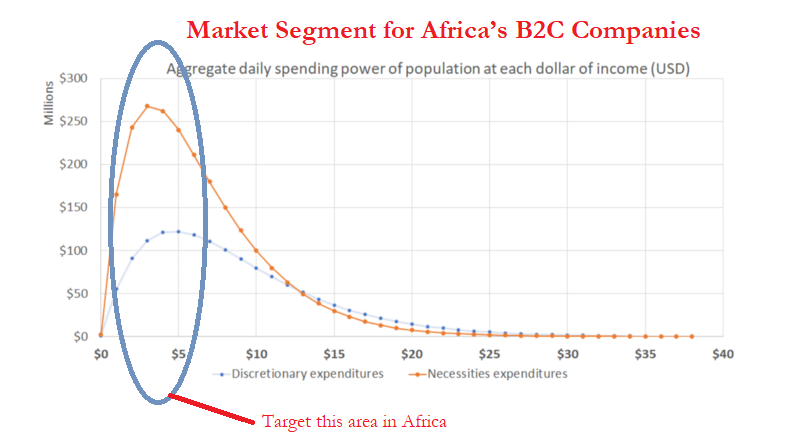
To a large extent, Africa’s largest consumer base for B2C is at $3 daily spending bucket. So, if you want the highest possible capture of the population, that product must be priced around that point. There are many ways to do that including packaging in sachets and doing Buy Now Pay Over Time. 

This is it: to win in Africa, you must understand your pricing playbook and the broad mechanics of product pricing. The market is super sensitive to prices.

The Core Market Segment in Africa – Middle of the Pyramid

What Is Your Sachetization Playbook in Nigeria?

African Startup Founders: The Special Party Will Begin In Year 2025

1

I have seen a pattern in most things in technology: it typically begins in the United States. Then, in 3-5 years, it diffuses into emerging markets at scale. Then, American firms begin consolidation. They always begin with India – and after 5-7 years, what they have done in India is replicated in Africa. That pattern has been followed on opening offices, design centers, labs, etc. In the last three years, I have seen a massive acceleration of US firms acquiring Indian companies.

YouTube just picked India’s SimSim this week, to boost YouTube ecommerce. With most US big tech largely barred from acquiring within the US (antitrust), outside America will see action. And you know what: I expect them to come to Africa by 2025!

YouTube said on Tuesday it has acquired social commerce startup Simsim. The Google-owned firm said the acquisition is to help viewers discover new products and find expert advice they trust.

The firms did not give details of the deal, but two people with knowledge of the matter told TechCrunch the Indian startup was valued at over $70 million.

Two-year-old Simsim had raised about $17 million prior to today’s announcement and was valued at $50.1 million in its 2020 Series B financing round.

People, from 2025, American dollars will come, shopping for startups in Africa to acquire at scale. My playbook is to prepare for that moment: mergers or acquisition would be HUGE. They want exposure to add more digits in Wall Street’s market caps, and they will buy themselves into the soul of Africa’s entrepreneurial capitalism.

This is the age of application utility and Africa’s startup ecosystem will begin to experience exits at scale from 2025. Yes, what happened to Paystack would become very common. I am investing and building for that future. Not all will sell, but because of the buy-activity, those that stay the course will see massive value accumulation.

Be ready ,.. #build #innovate #move

LinkedIn Comment on Feed

My Comment: Are we now building for Americans to acquire? How is this different from the playbook of using permanent residency and scholarships to weaken Africa? We don’t seem to understand what these guys have done to us already, and we are still providing them ropes to hang us.

Why is everyone worried about China? Because it managed to upend the playbook the West has used to keep every other region on the ground, and China is now the bad guy…

How has selling natural resources to the West helped Africa rise? The people who make the purchase fix the price, they take the valuables and give you paper money, and we celebrate. Now we want to do same with our start-ups too? We will remain owned forever then.

I think western education the way it’s currently structured is weakening our people, we now give so much for so little, and we are even grateful to them.

For the sake motherland, our heritage and pride, the idea of wholesale of our innovations should be discouraged, the best we can do is to give them a small slice, they will need us more than we will need them.

So, for me, let that 2025 be when African start-ups will take their rightful position in global economic power play, I wasn’t brought in this world to be enslaved by any race.

My response: It is continuum as in mathematics – if you acquire them, they go and build new ones, and after 3 cycles, they attain equilibrium. China’s model is not applicable as using state capitalism, the government became a platform for exit. We need liquidity at the first cycle and after that maturity will come later. For building to host at all costs will emerge from 2032.

Comment: Ndubuisi, while we need money to attain equilibrium, we need to identify our precious jewels, the poster children, and keep them away from wholesome acquisition, because they will become symbols of our heritage; some things cannot be repeated once sold.

My response: The people funding African startups today are not mainly Africans – they will want quick exit. By after two cycles. Africans will have capacity to fund for long-term. By then, our people would have made money and can stay the course. Things take time.

My response: “by quick exit that means they are doing debt financing and not equity…..” . But I was referring to VCs who have been investing in African startups. Most are foreign funds or money. They are actually taking equity. But they will want to be out as quickly as possible. So, if the big tech comes they will dance. Today, those with money in Africa are not investing in tech at scale. The young people in tech will end up doing the investing but they have to exit and money made first!

Robinhood Files for IPO, Targeting $35 Billion Valuation

0

After dealing with a scandalous trading conflict that pitied it against GameStop earlier in the year, Robinhood Markets Inc. is targeting a valuation of up to $35 billion in its initial public offering in the United States. The company disclosed this in a filing on Monday, in a listing that will become one of the biggest in the year.

In January, the online brokerage was caught at the center of a confrontation between a new generation of retail investors and Wall Street hedge funds. Last month, the trading platform was fined $70 million by the financial industry regulatory authority (FINRA) over allegations that it caused customers “widespread and significant harm” on multiple different fronts over the past few years.

Reuters reported earlier that Robinhood was aiming for an IPO valuation of up to $40 billion. The filing reveals price and expected ownership of shares from individuals and companies including Salesforce.

About 55 million shares are being offered in the IPO to raise over $2.3 billion. Nearly 2.63 million of those shares are being offered by the company’s founders and chief financial officer, the filing showed. Proceeds from those will not go to Robinhood.

Shares are expected to be priced between $38 and $42, the company said.

Salesforce Ventures, the investment arm of software provider Saleforce.com Inc, is looking to purchase up to $150 million worth of Class A common stock at the IPO price, the filing showed.

Robinhood was founded in 2013 by Stanford University roommates Vlad Tenev and Baiju Bhatt. They will hold a majority of the voting power after the offering, the filing showed, with Bhatt having around 39% of the voting power of outstanding stock while Tenev will hold about 26.2%.

The company’s platform allows users to make unlimited commission-free trades in stocks, exchange-traded funds, options and cryptocurrencies. Its easy-to-use interface made it a go-to for young investors trading from home during coronavirus-induced restrictions and its popularity has soared over the past 18 months.

The trading mania in the so-called meme stocks helped fuel a four-fold jump in its revenue over January to March, Robinhood’s IPO filing earlier this month detailed, but the quick expansion came at a cost as Reuters report reveals.

The company faced criticism after it was forced to curb trading in the middle of the surge this year in GameStop and other previously beaten-down stocks.

At the time, Robinhood was forced to raise $3.4 billion in emergency funds after its finances were strained by the massive jump in retail trading and a resulting jump in capital demands from clearing houses.

That round valued the company at around $30 billion, according to people familiar with the matter.

Robinhood’s stock market flotation comes amid a record 15-month run for the U.S. IPO market, as investors rushed to buy shares of high-growth tech companies.

The company plans to list on the Nasdaq under the symbol “HOOD”. Goldman Sachs and J.P.Morgan are the lead underwriters for the offering.