DD
MM
YYYY

PAGES

DD
MM
YYYY

spot_img

PAGES

Home Blog Page 5791

Nigeria’s changed Diaspora Remittance Policy, and India’s new COVID Crisis – The making of a Nigerian Perfect Storm

0

In a move to boost US Dollar supply into the economy, the Central Bank of Nigeria (CBN) announced on 30th November 2020, new rules that allow beneficiaries of Diaspora remittances to receive US Dollar foreign currency either into their USD domiciliary (foreign currency) account or as cash pick-up from bank branches.

The Ethnic South Asian population in Nigeria has doubled roughly every 5 years since 2000 and currently stands at around 64,000 people officially though it is said that the figure may be some percentage higher if ‘undocumented migrants’ were included.

Nigeria has a very small locally born South Asian population. South Asia itself is the main source of migrants. Some come to invest while others arrive having pre-secured an expatriate salaried position. Smaller numbers of ethnic South Asians are inter-Africa migrants, particularly South Africa and Kenya. A yet smaller number are job hunters that have been displaced from expatriate positions in UAE.  Globally there are also ethnic South Asians in Europe, particularly UK, North America, Australasia, the Sijori Triangle, parts of the Caribbean, particularly Trinidad, and Guyana in South America, but these generally show little interest in Nigeria as either a migration option or a job market.

Almost from nowhere, an unprecedented outbreak of COVID has happened in India which at least equals the vehemence, pace and penetration of any national or local outbreak in the history of the pandemic thus far.

The last 24 hours has seen an increase in about 350k cases and over 2,200 deaths.

While there are no direct flights between India and Nigeria, Nigeria has ratified a bilateral aviation agreement with India in October last year, and Nigeria was added to India’s ‘travel bubble list’, a COVID sensitive selection of routes and destinations.

Common sense predicates that Nigeria and India would not consider a bilateral aviation agreement unless sufficient  air traffic between the two countries pre-exists to warrant it.

Canada and Australia have led with the ban of flights that may involve passengers originating in India while some other countries such as the US, UAE and Saudi Arabia have taken action at carrier level. There is yet no announcement from Nigeria.

The Indian Government is so sensitive about this outbreak, it has appealed to social media, for example, Twitter, to take down comments relating to the rampant pandemic in the country.

Samriddhi Sakunia, Journalistic Student and COVID response volunteer, from Jharsuguda, India, speaking on Al Jazeera ‘The Stream’ Program – ‘Can India Survive Coronavirus ?’

‘Twitter is normally a place where people share thoughts… but right now in India, Twitter is a ‘Help Centre’ … thousands of volunteers… so we can try to arrange oxygen, beds, ICU, ventilators… How do I feel? Right now I feel numb… I cannot sleep at night knowing that there are people outside the hospitals waiting to get a bed… there are people dying outside the hospitals…’ Samriddhi Sakunia on Al Jazeera.

On July 26 last year, the day after National Nigerian Diaspora day, President Buhari thanked the Diaspora for the $25bn sent to relatives. Last year’s Annual Diaspora Remittance exceeded 80% of the yearly budget

This means a significant proportion of the Nigerian population is supported by overseas remittances.

With the delay in official response to the India outbreak, there is a strong chance that new mass viral loading has already happened in Nigeria from South Asia.

Without doubt, if this triggers a new Nigeria wide lock-down, it will immediately halt all forms of direct face-to-face services. The closure of retail banking outlets is a given!

Since domiciliary accounts cannot dispense Naira by ATM, all of these breadline dependents of the Diaspora President Buhari is so grateful to, will become cut off from the remittances that is so much their life-blood.

Unless The Governor of the Central Bank of Nigeria (CBN), Mr. Godwin Emefiele has some surgical measure that will automatically trigger on the fly seamless continuity of access to their funds for desperate people amid a covid compliant retail banking shutdown…

This situation has all the ingredients of a very Nigerian PERFECT STORM


References and Acknowledgements : 

https://www.oyamoneytransfer.com/newrules-moneytransfer-to-nigeria/https://simpleflying.com/nigeria-india-bilateral-agreement/

https://www.theguardian.com/world/2021/apr/21/system-has-collapsed-india-descent-into-covid-hell

https://www.vanguardngr.com/2020/07/buhari-applauds-nigerians-in-diasporas-development-contribution/

https://nypost.com/2021/04/24/indian-government-asks-twitter-to-silence-covid-criticism/

https://www.oneindia.com/india/from-uk-to-uae-list-of-countries-that-have-suspended-flights-from-india-amid-covid-19-surge-3248848.html?story=3

Al Jazeera ‘The Stream’ Program – ‘Can India Survive Coronavirus ?’

airwaysmag.com/airlines/countries-ban-airlines-suspend-india-flights/


Time for Corporate Nigeria To Lead in Nigeria

0

People, I think it is time for Corporate Nigeria to reach out to the government and offer any help that will change the current trajectory. Because if this trajectory continues, we may not have a nation to do business. Anything is possible including cutting corporate tax by 50% and asking companies to use the savings to hire young people. There needs to be a deal which would be centered on the wellbeing of our young people.

Hopefully, that will provide space for the government to build foundational anchors for growth and development. I do not want to read about agriculture programs, mining initiatives, etc since without security, everything goes. There needs to be an immediate Contract for Nigeria Future and the organized private sector holds the ace as it is the only vehicle that can offer practical hope to young people. Yes, they can hire 200k youth in 3 months but they keep 50% of their taxes!

Please share this and get these men and women to know that staying by the side is not an option anymore. They need to get ahead and see what could be done, to get our youth busy, with hope, for the nation to have a future. Simply, send a deal to the government with the fierce urgency of now.

Fintech app usage up 61% year-on-year: deVere

0

The use of fintech apps has increased more than 61% since the pandemic started last year, reveals deVere Group, one of the world’s largest independent financial advisory and fintech organisations.

The jump comes as financial technology apps show further evidence that the way we manage our finances further shifted in light of the coronavirus pandemic.

James Green, deVere Group’s Divisional Manager of Europe, notes: “Pre-coronavirus, we were already in an exciting new era driven by the lightning pace of the digitalisation of our everyday lives.

“But like so many areas of our lives, the pandemic has accelerated this trend.”

He continues: “The jump in usage of fintech apps from existing clients, and a sharp increase in enquiries from potential ones, underscores that people are becoming more tech-savvy than ever.

“Like never before, people are embracing the convenience of immediate, low-cost access to, use and management of their money.”

The deVere CEO and founder, Nigel Green, who has been a long-term advocate of fintech having launched a series of pioneering apps, believes the trend will further increase.

“The financial services sector is currently undergoing, I believe, possibly the most profound transformation in history.

“We’re seeing seismic and far-reaching shifts in client expectations. As the world moves towards an ever-more digitalised and globalised future – which is increasingly influenced by those who’ve grown-up with ‘on-the go’ tech – this phenomenon can only be expected to gain momentum.

“The way we save, invest, use and manage our money has changed forever. We are witnessing a personal finance revolution.”

The CEO goes on to add: “This revolution is a positive force.

“Fintech allows all clients’ personal financial services to be dealt with online and/or on their mobile devices, wherever they choose to be.

“It will speed-up financial inclusion around the world, especially for those who aren’t able to use financial services because of the biases of traditional financial firms.

“In addition, it allows firms within the financial sector the opportunity to diversify, reduce costs, fulfil regulatory requirements and further enhance the client experience.”

Of the year-on-year jump in fintech apps usage, James Green concludes: “Whether the trend in the usage of fintech is a long-term one will be demonstrated as lockdown restrictions are eased around the world and we look ahead to a post-pandemic future.

“I will be surprised if those new users of fintech will ever go back to traditional methods of accessing, using and managing their money.”


deVere Group is one of the world’s largest independent advisors of specialist global financial solutions and fintech to international, local mass affluent, and high-net-worth clients.  It has a network of offices across the world, over 80,000 clients and $12bn under advisement.

Welcome Future Leaders To Tekedia CollegeBoost

0

Tomorrow, many Nigerian students, led by their Students Union Government leaders will begin a great journey. I want to welcome them to Tekedia Institute CollegeBoost, a mini-MBA designed for students.

Our mission is simple: “to discover and make scholars, noble, bright, and useful”. We will do this by working with schools, governments, firms and individuals.

The Board opens tomorrow. Eyitayo Adeleke will be scheduling a Zoom and I will be speaking with you all. It’s a beautiful world and one of abundance.

Future Leaders, welcome to the Institute.

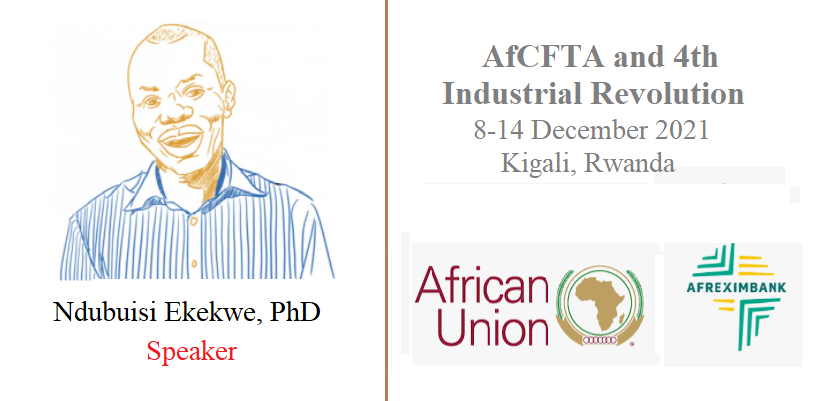
Ndubuisi Ekekwe To Give A Major Speech On AfCFTA and 4IR

2

I wrote a well-received article in Harvard Business Review which most African policy leaders have circled back to me. In that piece, I posited that pursuing an African industrialization policy that mimics China’s model is hopeless since what made China what it is today would be disintermediated by new technologies. Africa has anchored its industrialization policy on the paradigm that once wage rises in China, the continent would magically pick some opportunities in low skilled manufacturing which have typically moved from US and Western Europe. 

However, in my piece, I made the case that those jobs and opportunities may not even leave US and Western Europe because of robots and AI. So, if that is the case, what Africa hopes to happen will not come to pass. China will not get the low level manufacturing opportunities of the future, and Africa will not either. Nonetheless, China is deepening its abilities to become a leader in high skilled manufacturing. 

In December, on the invitation of the African Union and Afreximbank, I will speak on AfCFTA and the 4th Industrial Revolution (4IR) and how our continent can lead into the future. That talk will be in Kigali, Rwanda.

You can read the piece here.