DD
MM
YYYY

PAGES

DD
MM
YYYY

spot_img

PAGES

Home Blog Page 5796

As Cryptocurrency Plunges, Investors Are Being Confronted with Hard Realities

1
Bitcoin is soaring

The cryptocurrency bubble seems to be nearing an abrupt end as prices continued to tumble. The overall crypto market lost more than $200 billion in Friday’s trading session after reports surfaced that President Joe Biden would seek to raise capital gains taxes on millionaire investors to fund other policy initiatives.

Bitcoin leads the charge, with prices for the internet currency dipping below $50,000 on Friday, for the first time since early March.

Bitcoin is down 17.08% week-over-week, around 30% from its all-time high of nearly $65,000 early last week, plummeting its market cap below $1 trillion. The tumble has been less severe for Ethereum, which hit an all-time high just yesterday but has since dropped 13% as the broader market has crawled back.

Plenty of altcoins have also taken a beating. Dogecoin erased the breakneck gains of the week and then some, nearly halving its price after a meteoric climb last weekend. XRP is down 35% week-over-week, Stellar is down 30% and Polkadot is down 25% since last week.

Overall, Coinmarketcap estimates the global crypto market has shrunk around 10% in the past 24 hours.

Crypto prices have been on a tear for the past several months, but the past week has been the clearest sign of a correction to climbing prices, though many see news of President Biden’s adjustment to the hikes on the capital gains tax as the most apparent reason for the market’s slide as investors cash out hoping their gains won’t be reached by a retroactive application of the rules.

Coinbase, which went public last week via direct listing, shaved about 10% off its share price this week, but was largely unaffected Friday in intraday trading.

Bitcoin’s decline was reportedly in part due to a power outage in Xinjian, which besides the concern about volatility, raises questions about its decentralization.

If the outage from a single province in China can reduce the hash rate output by 45%, its decentralization has come under serious question.

However, the drop in prices has riled up investors as experts continue to warn of further drop as a result of expected correction.

“It might start to ease but not for a good while because you’ve got so much speculation surrounding it – that’s what’s driving those wild swings in price, Fiona Cincotta, senior markets analyst at trading house City Index.

Cryptocurrencies have seen significant rise recently as institutional investors adopt them, minimizing its volatility concerns and shooting their prices up. But concern remains that the frenzy could be cut short unexpectedly, considering the dips in prices since the beginning of the week.

Despite the fears, cryptocurrency enthusiasts believe the bull is still running and will keep the bubble on as the market receives new dumps. As for Biden’s tax takes, experts believe that crypto could still offer investors a haven to hide their money.

Ryan Selkis, CEO of crypto data company Messari, pointed to one corner of the crypto market where investors could hide out:

“For better or for worse, when you look at these cycles historically, everything rises at the same pace and then when the tide goes out, you start to see which assets actually have some long-term interesting fundamentals. So, I think as we look around the asset class, bitcoin and ethereum are obviously your bellwethers. But if you think about this capital gains issue, one of the unintended consequences might be that more capital’s locked in this crypto ecosystem long term and medium term. And ultimately, that’s going to be to the benefit of this entire new class of assets. They’re referred to as DeFi assets — essentially, being able to borrow against existing crypto holdings rather than sell them and trigger a taxable offense. You might have structurally higher interest rates, you might have a better tax setup to invest in those assets and those protocols in that ecosystem versus taking money out of the equation.”

United States Pauses Parts of Nigeria With Severe Travel Advisory

0

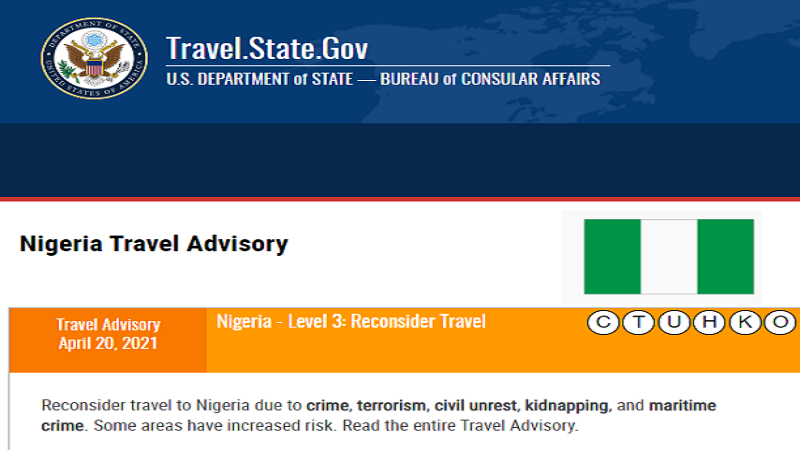
The United States does not usually do it this way: segregating countries at this specific level when it comes to security. The latest is that the US does not want its citizens to travel to some parts of Nigeria. In a blistering travel advisory at TravelStateGov, the United States has listed the core hot security spots in Nigeria. They noted crimeterrorismcivil unrestkidnapping, and maritime crime as things to worry. People, this is the new map:

  • Borno, Yobe, and northern Adamawa states due to terrorism and kidnapping
  • Bauchi, Gombe, Kaduna, Kano, Katsina, and Zamfara states due to kidnapping
  • Coastal areas of Akwa Ibom, Bayelsa, Cross River, Delta, and Rivers states (with the exception of Port Harcourt) due to crimekidnapping, and maritime crime.

Who will redirect this ship called Nigeria?

For the full advisory, click here.


Reconsider travel to Nigeria due to crimeterrorismcivil unrestkidnapping, and maritime crime. Some areas have increased risk. Read the entire Travel Advisory.

Read the Department of State’s COVID-19 page before you plan any international travel.

The Centers for Disease Control and Prevention (CDC) has issued a Level 1 Travel Health Notice for Nigeria due to COVID-19, indicating a low level of COVID-19 in the country. Visit the Embassy’s COVID-19 page for more information on COVID-19 in Nigeria.

Do Not Travel to:

  • Borno, Yobe, and northern Adamawa states due to terrorism and kidnapping
  • Bauchi, Gombe, Kaduna, Kano, Katsina, and Zamfara states due to kidnapping
  • Coastal areas of Akwa Ibom, Bayelsa, Cross River, Delta, and Rivers states (with the exception of Port Harcourt) due to crimekidnapping, and maritime crime

Join Tekedia Live on “How To Scale A Business in Africa” Today at 7pm WAT

0

Join me at Tekedia Live as we co-share, co-learn and advance on how to scale a business in Africa. We will be looking at different playbooks, from what Flutterwave is doing. From What Interswitch is doing. From what Dangote Cement is doing. From what Equity Bank is doing…It would be a great conservation on how to DRIVE GROWTH in Africa. Today at 7pm WAT . Zoom link in Tekedia Mini-MBA Board.

A previous session.

Vote for Tekedia Institute At Mhagic

0

Today is the last date to win Mhagic for 430 students to attend Tekedia Mini-MBA on full scholarships. Arinze Onyeasigbulem began the competition for Tekedia Institute, and mobilized many. Faith Nwaobia, Eyitayo Adeleke, ? Chinedu Junior Ihekwoaba and many others are pushing for Tekedia. Tekedia Institute has also been pushing on social media and print Guardian adverts. To VOTE, go here. Everything ends today.


Why Nigeria’s Bitcoin Ban and Naira4Dollar Are Yet To Boost Naira

1

It is now about three months since the Central Bank of Nigeria cut-off Bitcoin and broad cryptocurrency from its banking networks. The adoption of Bitcoin had earned Nigeria the Bitcoin Nation within the African continent. But instead of the crypto market cooling as a result of the bank, the thing has ramped up significantly: “Data retrieved from Usefultulips (a Bitcoin analytic data provider) shows that the usage of Bitcoin’s peer to peer trading in Nigeria surged by 27% since the CBN directive took effect about 85 days ago, as Nigerians moved about $103 million worth of Bitcoins on just Paxful and LocalBitcoins channels alone.”

The robust bitcoin trading activity in Nigeria has earned the country the title of Africa’s Bitcoin Nation. A 27-year-old Nigerian office worker who was spotlighted by the AFP,  Chigoziri Okeke, described how he first invested in cryptocurrencies five years ago with the intention of just making a payment. When his crypto wallet’s value increased by 10% in a few short days, however, he was hooked and started directing a percentage of his salary toward the market. Today, this investor’s crypto portfolio is worth USD 50,000, comprising various digital assets.

Nigeria’s apex bank had effected two huge policies: (1) ban of cryptocurrency exchanges in Nigeria (2) introduction of Naira4Dollar where people get N5 for every dollar wired from outside Nigeria. But besides these two, there is another one: you cannot receive $10,000 within your domiciliary account in any Nigerian bank account in a month, provided that payment is initiated within Nigeria, teller deposit or bank transfer.

Yes, despite these changes, Naira has not found its moments. Why? It has to do with market frictions. The use of cryptocurrency “override the political complications of official channels. The global reach of cryptocurrencies avoids the inflation risk inherent to official currencies, especially in politically unstable countries reliant on fickle foreign investors” as Association of Bureau De Change Operators of Nigeria (ABCON) noted.

In the review, ABCON pointed out that cryptocurrency transactions were faster than conventional transfers, which require passing through SWIFT, the interbank messaging system that handles cross-border payments.

“These exchanges override the political complications of official channels. The global reach of cryptocurrencies avoids the inflation risk inherent to official currencies, especially in politically unstable countries reliant on fickle foreign investors.

“Thus, while we commend the CBN for introducing the package of N5 for $1 transfer, it can be seen that the challenges exceed non-payment of foreign currency by the IMTCs and the exchange rate.

“Strategies that satisfy the most sensitive of these advantages of cryptocurrency exchanges must be introduced to redirect flows to the official channel,” it stated.

ABCON also expressed concerns over the country’s unemployment rate, stressing: “The government must apply radical approaches with the use of conventional and unconventional economic and political tools to redress the trend.”

Nigeria’s Own-Goal

Nigeria’s biggest mistake is to make everything more non-official by pushing the cryptocurrency exchanges to peer-to-peer where they become more opaque to the government’s high voltage searchlights. Ideally, the government could have embraced the new crypto startups and use regulations to shape them. Your dollar-for-dollar remittance is not doing it. Your Naira4Dollar has not helped. What could help is bringing the banned channels to come under your regulatory domain so that the participants can enjoy whatever that system gives them, while you exert more controls. Unless we do that, we will continue to struggle on this.

And CBN does not need to listen to the Association of Bureau De Change Operators of Nigeria (ABCON) which has has asked the “Central Bank of Nigeria (CBN) to introduce measures that will neutralize the positive effects of cryptocurrencies as a channel for diaspora remittances”. The fact is this: CBN does not have the power or capacity to do just that. The ABCON industry is being disrupted and they need to advance to be relevant.

All Together

No matter what the government does via financial engineering to help the Naira, there is only one thing that will boost the Naira: economic diversification, and that will likely come via improved productivity. Unfortunately, productivity will not happen without fiscal federalism. In other words, Nigeria needs to produce and make things, and unlock comparative advantages within states. It is only when we can do that would we see the Naira ramp up. Anything less will be gimmicks which will fade over time.