A conversation between an Apostle of Sustainability and a would-be convert:
Apostle: There are several real global problems the world is currently faced with.
Brethren: The world has always faced problems, go on the history lane. By the way what sort of problems are you talking about.
Apostle: Population explosion, food insecurity, environmental degradation, climate change, sustainable and ethical consumption and others. Bro, they’re too many.
Disenchanted pause.
Brethren: I think this whole Sustainable development is a utopian dreamland, unreal reality!
Apostle: How?
Brethren: For example, sustainable use of paper. Is it better to collect old paper polluting the air with trucks and then use strong chemicals and consume energy to purify and make a new (low quality!) paper and then do all this over again until the whole Earth is polluted, OR to plant trees for paper, burn old paper (and get the energy from it) and let those trees to breathe in the CO2 generated by burning the old paper in the same amount required to replace old paper with new?
Apostle: Sighs
Apostle: The world is really complex; life is complex too: don’t expect simple answers to complex problems. The complexity of the world we live in requires us to remain flexible, innovative, and adaptive.
In the construct of sustainability, I do not think we need any Sustainability High Priest to lead this but “True believers” who can confront us with the inconvenient truths of the global problem we are all witnessing today. The problem is real, and the threat is existential. Discrete interventions have failed to address these problems that require systems thinking and a holistic approach that equips us with the knowledge to make the transition towards sustainability.
Apostle: Do you disagree?
Brethren: Abeg (please) change the topic.
Apostle: Abeg make we talk am talk (please let’s discuss the issue further).
This article for Tekedia Institute came from the fusion of some contradicting concerns. The first of these were thoughts on the release of the 2021 global university rankings by The Times. The second was a development in Nigerian Current Affairs, where the Minister of Education, Malam Adamu Adamu announced the creation of twenty new Nigerian Universities. The third was a throw back to a previous article by Tekedia Lead Faculty , Prof Ndubuisi Ekekwe
One of the things that struck me as odd from the start was the extent to which global rankings of Tertiary Educational Institutes vary. I recall a few years ago, Covenant University in one list was only just outside the top 100 globally, and at the time was ranked higher than any university in India!
I can no longer quote the site but I distinctly recall the comment that introduced it. This was because a client representative for whom I had done Beverage Factory Start-Up work for, had leveraged it to make a comment on LinkedIn. This is what caused it to turn up in my ‘feed’. He was drawing attention to the contrast between the ranking of Covenant and the Indian universities, He then used this as a leap to the conclusion that Nigeria should not have Indian nationals in jobs that required graduate candidates as the ranking showed Nigeria had a University, ‘notionally’ better than the foreigners country of origin (that is assuming Indian nationals with graduate jobs in Nigeria received their academic training in India).
Being the sort of data driven individual I am, of course, I would never then just accept this to reside in my cranial cavity without following the data, and to my surprise, on that specific rating system, and for that particular year, the claim of the content author was true!
I did of course, find an alternative rating system where, while respectable, Covenant had fared less well. I also found several universities in India ranked above it.
The difficulty with University rating systems is that in order to do well, individual universities need to score highly on whatever exotic cocktail of criteria and metrics the rating system is slanted in favour of.
Rating systems are aimed at a global visiting audience and the percentage of international students has become a uniformly present focus for many of them. This needs some degree of ‘unpacking’.
University Entrant Mobility. Years ago, ranking systems were published in ‘Broadsheets’. In fact, the most respected ranking systems in the world were originally produced by ‘Broadsheet’ publications, such as ‘The Financial Times’ in the UK. Leading US periodicals like TIME and Newsweek also liked to get involved. With the advent of the internet, and now with people regularly accessing global data over ‘OTT’ services on Smartphones, things have changed. Online rating systems, like any ‘free-to-browse’ online service need to earn their keep somehow. ‘Pay per click’ adverts, and sale of user behavioural data to sponsors, are common options. Undergraduates where easy commuting from the parental home is a big selling point will have less to do on an online rating system. The more globally flexible a university prospect is, the more online queries they will make. There is therefore a vested interest in the online systems rewarding higher rankings to universities proportionate to their international student component.
Global Economic Migration Popularity of University Location
Some countries attract a higher proportion of annual global economic migrant activity than others. Some economic migrant prospects see studying abroad as a migration tool. US, Canada, UK and France are common destinations. While many go through formal processes, while still studying, of legally securing the interests of a relevant employer for a graduate trainee positions, a small minority never attend university at all, and disappear into the ‘grey’ job economy as soon as able after arriving. Some very ‘average’ universities attract international students on the back of their nations migrant destination popularity. Some countries have great universities located in backward economies with poor working conditions, low profession diversity and high unemployment. Is it right that a rating system should elevate some universities and penalize others simply because some international students are making selection choices based on metrics more closely related to the nation a university is in, rather than the university itself?
Unique Local Dialect Expertise
Some universities around the world offer value to different communities locally and regionally by lecturing through obscure languages or language variations of little national, and no international significance, in provincial areas of little interest to students focused on international mobility or migration. Examples of these may be a very localized dialect of Arabic in North Africa which isn’t widely understood by Arabic speakers internationally, or a local dialect of Chinese in a provincial city that differs significantly from either Cantonese or Mandarin. Nevertheless such universities may also excel in producing graduate excellence in innovation demand areas such as STEM. Rating systems rarely acknowledge the value of universities efforts to gain traction with local and regional communities. This, again feeds into the bias towards universities which attract a higher proportion of international students creating more revenue for rating system owners through more site visits. Rating systems are particularly biased in favour of universities which lecture through English.
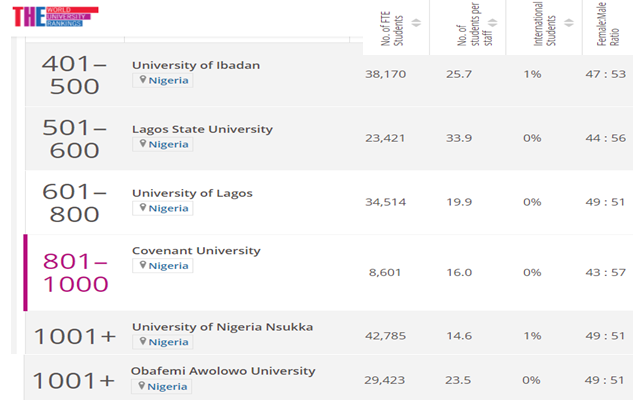
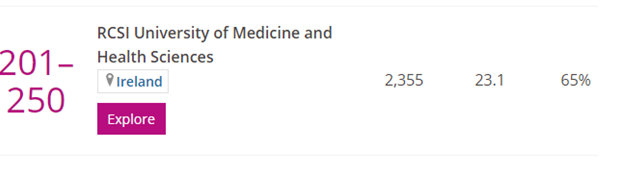
Top ranking Nigerian Universities in the 2021 list. Covenant falls to 4. LASU overtakes UNILAG for the first time. Critical metric – International Students will depress rankings of Nigerian Universities, highest achievers only attaining 1%Ireland, originally dubbed ‘The land of Saints and Scholars’ due to an excess of Monasteries, during British Rule, and the early days of The Republic was destitute with insupportably large families and high infant mortality rates. The phrase mutated to reflect that typically, one boy from each family would get sent to the priesthood to have a living, while otherwise, it had more learned persons than it had jobs. Today, the Royal College of Surgeons in Dublin boasts 65% overseas students. That’s almost two foreigners for every local.
Lecturer to Student Ratio
Lecturer to student ratio is heavily weighted in many rating systems. It is however not a guarantee of individual student growth in a subject. Many other components and catalysts not only improve knowledge uptake, but more importantly, develop the capacity of the individual to critically appraise sources of information for themselves and onboard it selectively in a unique personalized process. Developing one’s own information discovery and internalizing techniques as an evolution from the condition of receiving instruction, is probably the key leap that needs realization in a graduate study. This is arguably more important a learning output than any technical knowledge or data set memorized. Once these techniques are strongly anchored in an individual, they continue to serve through life, while specific technical application or subject matter may become obsolete, or no longer relevant in the dynamic professional space.
In online pursuits, these components and catalysts may be supporting static content, media libraries, third party engagement environments and services, dynamic learning community tools, and other virtual tools provided. In bricks and mortar delivery environment, access to photocopiers and printers on demand, with free paper may have historically been a huge plus, right now, free campus Wi-Fi with high transfer rates may be more facilitating. In STEM research pursuits, equipment can be a big distinguishing factor. It is hard to grow leaders of the future from inspiration confined to a lecturer, a board, and a piece of chalk, when there are other alternatives which supply on demand access to the latest cutting edge equipment, some costing tens of millions of dollars. Partnering leading industries in the professional development of students is a huge plus. Being able to schedule, for example, sessions in the flavour labs at Firmenich or Givaudan, the research facility at Pfizer, or the engineering development workshops at Hyundai Heavy Industries can be a huge enabler for relevant students.
Universities offering nuclear related courses have frequently built their own ‘research’ nuclear reactors ranging anywhere from several hundreds of thousands of dollars to several million, depending on the design and when built. Reed College in Portland, Oregon US, produced a draft costing for the decommissioning of their research reactor in 2018 costing $4.4m USD
‘Students, even ones who are not planning a career in science, need to learn the scientific method. Mostly because this is critical in reducing the level of insane stupidity that appears on the internet regularly…. handwashing techniques and ways to ensure a bench is sterile is useful in the recent pandemic (as well as most of them understanding what a virus is and therefore never saying things like ‘antibiotics can kill COVID19’ or ‘What about Chloroquinine?)’ – David Lascelles ‘Writers and Authors’; Lecturer in Biology and Social Care.
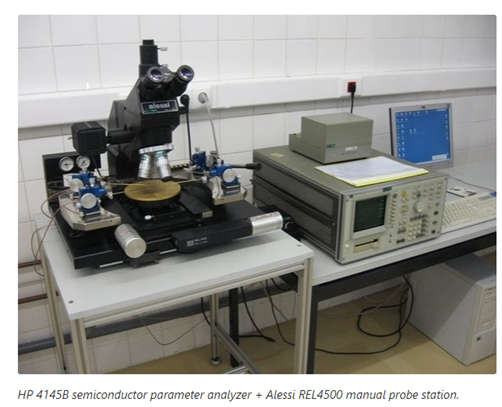
Quality up to date equipment may be more important than lecturer-student ratio. Obsolete equipment in a Portuguese University – the hardware device has a long obsolete floppy disk drive while the system is running Windows 4!
Cost Transparency
Different young adults have widely varied ‘life skills’ sets on admission to university. Others complete first degrees as more mature students. Students with parental dependency for much or all of their undergraduate life are best suited to a cost regime where as much of the cost is payable and visible in advance as possible.
I lament at the stories I have heard from students in Nigeria as far back as the turn of the millennium, with impromptu provision of handouts and other study aids by lecturers accompanied by demands for payment. A robust system should ensure that direct exchange of money or ‘value in kind’ between students and lecturing staff should never need to happen. On the very rare occasion that a lecturer is required to seek recompense for costs out-of-pocket, then such products or services should be managed formally through the bursars office with full chain of custody transparently documented.
Career Conversion
Whether students secure jobs post graduation is a major factor in the ranking methodology of most ranking systems. However the actual approaches different ranking systems take to the metric is highly subjective. The extent to which a position is considered relevant to the course of study, whether it is considered employment at graduate level, whether the remuneration is considered broadly consistent with graduate expectations in the specific job-market, and the duration of the window post graduation in which success is expected, varies significantly.
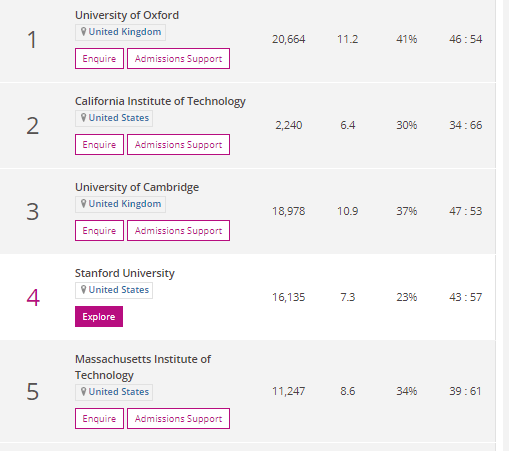
A pandemic effect? The height of the pandemic 2020. UK takes 1+3. US has 3 in the top 5 but no Ivy League! The highest being Harvard at 7. A US rating system of solely its own universities however, placed Princeton top of the list in 2019 the year before the pandemic.
Politics , Pandemic, The Environment and Distance Learning
Reflecting back to the hidden agenda of overseas migration, universities that benefit from overseas student volume and by inference their ranking, as a result of their nations immigration popularity, have been hit by pandemic travel restrictions and by student visa throttling driven by political shifts.
Nigeria is a strong producer of globally mobile aspirants.
With the maturing of e-learning, proponents of immigration control at popular study locations argue that if the interests of non nationals in a university is genuine, then they can choose from that universities online portfolio rather than needing to be domiciled at the physical location. Politicians who find resonance with segments of public attitude are quick to secure political capital with voter bases by bringing in restrictive measures as we have seen with the former presidential regime in the US. Though right wing in principle, this finds unlikely support among environmentalists who view any avoidable human mobility as bad for the environment.
The pandemic has forced people to at least consider different approaches to getting things done, which is always a better option than being completely denied progress or a solution. While some business interests with a narrative will have us believe things have completely and irretrievably changed (which isn’t true), nevertheless, necessity has caused us to challenge notional adverse opinion to some ways of doing things. These in many cases were found to have less validity than perceived and in some cases were found to be baseless. Online learning has become a winner here.
Moving on… The Minister of Education, Malam Adamu Adamu has announced twenty private Universities.
In a previous article here on Tekedia, Prof Ndubuisi Ekekwe had this to say: ‘ Nigeria cannot fund our current university system. People, Harvard spends close to 3x what Nigeria budgets for the ministry of education, from primary to university levels.
The problem is complicated because the professors are part of the problems. Yes, everyone wants to be a Vice Chancellor and the more schools established, the higher the number of opportunities……..
…. Today, what do we have? Bureaucratic systems where a former VC of Kwara State University could buy a bulletproof Toyota at N74M as an official car, even when the school borrows N400M monthly to pay salaries!’ (March 15 2021)’
There are many questions that come out of the point at which these different news items and articles converge…
One may be: How can everything move forward to be self financing?
Morerover: How can the educational collective move forward to learning excellence?
It is possible the twenty or so extra institutions serving the same local population will have some positive impact on the lecturer-student metric.
Nevertheless, more needs to be done to improve the foreign student metric which is practically non-existent. If global perception of the universities can see positive change, then perhaps perceived improvements will become real improvements by induction.
A professional visa service site lists the types of visas available to overseas visitors to Nigeria… How can Nigerian Universities be expected to achieve respectable global ranking (dependency on international student metric) if FGN doesn’t even have a student visa in its portfolio of visa products? A global view of this could be that FGN does not even have confidence in its own university products ability to prompt interest in such a visa. Improvements could develop Nigeria’s university system into a source of much needed foreign currency.
However other steps also need to be taken to develop quality.
In the light of ongoing conflict and terse exchanges between Academic Staff Union of Universities (ASUU) and the Nigerian Government and the stated roadmap for the development of these private universities, there are serious concerns.
On behalf of Malam Adamu Adamu, Minister of State for Education, Chukwuemeka Nwajiuba, said during the monitoring period, the new universities would be affiliated to older generation universities for academic and administrative mentoring to be moderated by NUC.
“This is part of NUC‘s initiative for early-warning signals to detect compromises in quality for the application of corrective and remedial measures to redress such situations. Substantive licences will be issued to well-managed institutions after the three years of probation following their satisfactory performance and growth, within guidelines stipulated by the Commission,”
If these are indeed to be PRIVATE concerns, then let them be PRIVATE concerns. They do not need to be mentored or otherwise contaminated by management ideologies of institutions that simply can’t crack the global top 1000.
Moreover, they can do well without the ASUU relationship dynamic. They need to stop thinking of these ‘Private’ Institutions as extensions of inert and impotent state apparatus.
When Globacom, MTN et al, were granted GSM licenses, were they put in some perpetual probation with NITEL standing in judgment over them and ‘marking their paper’?
If that happened where would Nigeria’s Telecoms sector be now?
But this is what is being advocated for the Tertiary Educational Sector!
Private Universities need to follow a new road they carve out for themselves. They have more to learn from the disruptive agility of Tekedia Institute than they do from any of Nigeria’s more ‘traditional’ educational institutions.
Because my future is in my children and my children are Nigerians. Therefore the future prospects for Nigeria are somehow, the prospects for myself. Take what I have written here not as a declaration of what is, but as signposts to how things may be.
It is up to Nigerians to interpret those signposts and decide the roads to travel.
This is your journey.
Let the debate begin.
Decommissioning Proposal for research reactor at Reed College US https://www.nrc.gov/docs/ML1807/ML18074A347.pdf
Visa options for Nigeria: https://www.passportvisasexpress.com/visa_services/nigeria/country_information/nigerian_visa_types#more_visa_types list of Nigerian Visa types.
Details of a pulsed neutron diffraction study at University of Groningen , Netherlands https://research.rug.nl/en/publications/pulsed-neutron-diffraction-study-of-zr-rich-pzt
Reaction to Trump Student Travel Ban in 2020 https://www.ccn.com/heres-how-students-are-reacting-to-trumps-defacto-student-ban/
Ndubuisi Ekekwe Article – Nigeria’s University Lecturers Threaten to Resume Suspended Strike Over Delays on Salaries: https://www.tekedia.com/nigerias-university-lecturers-threaten-to-resume-suspended-strike-over-delays-on-salaries/
Times Higher Education Stats 2020 https://www.timeshighereducation.com/world-university-rankings/2020/world-ranking#!/page/0/length/25/sort_by/rank/sort_order/asc/cols/stats
Times Higher Education Stats 2021 https://www.timeshighereducation.com/world-university-rankings/2021/world-ranking#!/page/0/length/25/sort_by/rank/sort_order/asc/cols/stats
The World’s largest economy by purchasing power parity (PPP) is China, well ahead of the United States. But the #1 on nominal GDP is the United States – and that is expected to move to China’s trophy table in years. But China is not just coming for the GDP crown, but a likely massive dislocation of the global economy: “The United States government has been rattled by China’s push to develop a digital alternative to its currency yuan. Bloomberg reported that the Biden administration is stepping up scrutiny of China’s plans for a digital yuan, with some officials concerned the move could kick off a long-term bid to topple the dollar as the world’s dominant reserve currency, according to people familiar with the matter.”
Honestly, imagine if Africa is pushing this, bringing its dozens of currencies under a unified supranational digital-based banking ordinance that would make commerce to work more efficiently. This is not even about monetary union with its associated welfare losses, when central banks lose autonomy to the supranational bank, making it harder for them to use macroeconomic tools to adjust for perturbations in their local economies. My point is that a digital clearing house is possible to make these African currencies “disappear” and “dissolve” into bits operationally.
I do think we need to begin that conversation at the African Union as very soon, China will be offering loans in e-yuan, and giving discounts to countries that adopt it. Most African banks would sign up as agents to enable trade in China, and just like that, the United States will understand that empires rise and fall on trade.
Yes, if China disintermediates dollars across countries via e-yuan, everyone will understand that being called the manufacturing capital of the world is not just a statement. Possibly, e-yuan will save many countries about 8-15% lost which is lost during conversion first to US dollars, and then to Yuan as they import from China! This is China 3.0.
The United States government has been rattled by China’s push to develop a digital alternative to its currency yuan.
Bloomberg reported that the Biden administration is stepping up scrutiny of China’s plans for a digital yuan, with some officials concerned the move could kick off a long-term bid to topple the dollar as the world’s dominant reserve currency, according to people familiar with the matter.
Recently, China has increased efforts on many fronts to put the digital yuan in circulation as soon as possible.
Now that China’s digital-currency efforts are gathering momentum, officials at the Treasury, State Department, Pentagon and National Security Council are bolstering their efforts to understand the potential implications, the people with the knowledge said.
American officials are less worried about an immediate challenge to the current structure of the global financial system, but are eager to understand how the digital yuan will be distributed, and whether it could also be used to work around U.S. sanctions, the people said on the condition of anonymity.
A Treasury spokeswoman declined to comment. A National Security Council spokeswoman did not reply to a request for comment.
The People’s Bank of China has rolled out trial issuance of a digital yuan in cities across the country, putting it on track to be the first major central bank to issue a virtual currency.
The first trial was held in Luohu District, where the central bank issued 10 million e-yuan in October 2020, while a second round was conducted in Futian District at the beginning of this year.
A broader roll-out is expected for the Winter Olympics in Beijing next February, giving the effort international exposure.
China is teaming up with Hong Kong, Thailand and the United Arab Emirates (UAE), along with the Bank of International Settlements (BIS), to explore cross-border payments for digital currencies.
In its report, Bloomberg noted that many key details of the digital yuan are still in flux, including specifics on how it would be distributed. China’s recent establishment of a joint venture with SWIFT, the messaging nexus through which most cross-border settlements pass through today, suggests it is possible a digital yuan could work within the current financial architecture rather than outside of it.
U.S. officials are reassured that China’s intentions aren’t to use the digital yuan to evade American sanctions, according to people familiar with the matter. The dollar’s current dominance in cross-border transactions gives the U.S. Treasury the power to cut off much of a business or even a country’s access to the global financial system.
China’s officials have said the main intentions of the digital yuan are to replace banknotes and coins, to reduce the incentive to use cryptocurrencies and to complement the current private-sector run electronic payments system — dominated by Ant Group Co.’s Alipay and Tencent Holdings Ltd.’s WeChat Pay. The PBOC has been working for years on the digital yuan, also called the e-CNY, having set up a specialist research team in 2014.
Chinese leaders are pragmatic
“To provide a backup or redundancy for the retail payment system, the central bank has to step up” and provide digital-currency services, Mu Changchun, the director of the PBOC’s digital-currency research institute, said at an event last month.
The Biden administration isn’t currently planning to take any action to counter longer-term threats from China’s digital currency, the people familiar with the discussions said. However, China’s plans have given renewed impetus to efforts to consider the creation of a digital dollar, they said.
Members of Congress have also been increasingly interested in a digital dollar, aware of China’s moves, and asked Federal Reserve Chair Jerome Powell and Treasury Secretary Janet Yellen about the issue in hearings earlier this year.
Powell said in February the Fed was looking “very carefully” at a digital dollar. “We don’t need to be the first. We need to get it right.”
Yellen has signaled interest in research into the viability of a digital dollar, a shift from a lack of enthusiasm under her predecessor, Steven Mnuchin.
“It makes sense for central banks to be looking at” issuing sovereign digital currencies, she said at a virtual conference in February. Yellen said a digital version of the dollar could help address hurdles to financial inclusion in the U.S. among low-income households.
A recent report from the U.S. Director of National Intelligence said the extent of the threat of any foreign digital currency to the dollar’s centrality in the global financial system “will depend on the regulatory rules that are established.”
China’s currency makes up little more than 2% of global foreign exchange reserves compared with nearly 60% for the U.S. dollar. Policy decisions, rather than technical developments, will also be necessary to push forward yuan internationalization, as China maintains a strict regime of capital controls.
China’s financial system is too “fragile and weak” to pose a real threat to the dollar’s status as the world’s reserve currency, according to Mark Sobel, U.S. chairman for the Official Monetary and Financial Institutions Forum.
“At the end of the the day the markets have more confidence in the Fed” than China’s central bank, said Sobel, a former senior U.S. Treasury official for international matters.
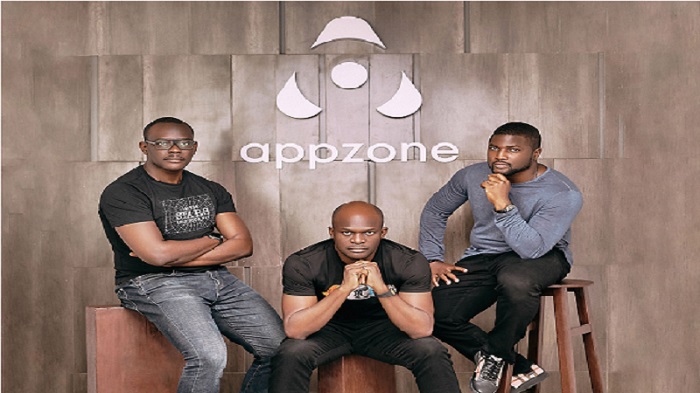
Appzone, a fintech software provider that builds proprietary solutions for these financial institutions and their banking and payments services, has announced it raised $10 million in a new Series A investment.
Founded by Emeka Emetarom, Obi Emetarom, and Wale Onawunmi in 2008, the Lagos-based company provides commercial banks with custom software development services.
The Series A was led by Nigeria-based investors such as CardinalStone Capital Advisers, a Lagos-based investment firm. Other investors based in the country include V8 Capital, Constant Capital, and Itanna Capital Ventures. New York-based but Africa-focused firm Lateral Investment Partners also participated.
The Series A round being led by Nigeria-based investors is welcome shift in the Nigerian tech ecosystem, where foreign investors have dominated most fundraising series.
Appzone launched its first core banking product targeting microfinance institutions in 2011. In 2012, it launched its first product (branchless banking) for commercial banks. It went live with its mobile and internet banking service in 2016 and launched an instant card issuance product in 2017. In 2020, the company launched services catered to end-to-end automation of lending operations for banks and blockchain switching.
“We started Appzone with the intention to build out innovative local solutions for banking and payments on the continent,” CEO Obi Emetarom told TechCrunch. “The focus was to leverage our ability as an enabler to create proprietary technology for both segments.”
Appzone is a Google for Startups Accelerator that has made a remarkable difference by introducing first-of-its-kind technology to the African fintech industry.
The company says it created the world’s first decentralised payment processing network, the first core banking and omnichannel software on the cloud, and the first multi-bank direct debit service based on single global mandates.
The investment round coincidentally happened at the same time the company is introducing the scaling of a third layer that focuses on end-user applications.
So far, we’ve touched on two layers of this ecosystem—the digital core banking service providing software that runs financial institutions’ entire operations and interbank processing, which integrates these institutions into a decentralized network powered by blockchain, Emetarom said.
Appzone plans to develop a unit outside its banking and fintech layers, to connect individuals and businesses to their services. This is where most new-age fintech startups operate, and although Appzone is coming late to the party, it has a bit of an edge, the CEO said.
“Most of these companies operating in end-user applications have to depend on services from core banking and interbank processing to be able to get their own offerings out there. For us, I think we have an advantage in terms of costs and flexibility because we are already operating in both layers,” Emeratom said in relation to what he thinks of competition.
Tech Crunch reported that the company is planning to blitzscale its products and services after working silently for more than a decade.
To do this, it will focus on its pan-African expansion sternly even though a large part of its 450 clients are based in Nigeria. Other countries with a presence include the Democratic Republic of Congo, Ghana, Gambia, Guinea, Tanzania, and Senegal. Before now, Appzone lacked the resources to push into these markets aggressively even though they showed promise. But having closed its Series A, the plan is to drive growth in these countries and expand across more African countries.
In addition, another means Appzone plans to achieve scale is by growing its engineering team — a department it takes pride in. These engineers make up half of Appzone’s 150 employees and there are plans to double down on this number. Like most Nigerian startups these days, Appzone is big on senior engineers. Still, while it might present a problem to other companies, Emetarom says the company has no issue training promising junior talent to grow in expertise.
“Our proprietary tech allows us to innovate at a fraction of a cost, and they are built by essentially the best local talent available. Because those systems are really complex and the level of innovation required is on another level, we literally seek out the to 1% of talent in Nigeria,” he remarked. “We know that even though the expertise isn’t there, we can accelerate acquiring that expertise when we train the very best talents. The more we train our engineers, the faster they grow in terms of expertise, and they will be able to deliver at the same level of world-class quality we expect.“
Appzone had earlier, closed a $2 million from South African Business Connexion (BCX) in 2014. And in 2018, it raised $2.5 million in convertible debt and bought back shares from BCX in the process. But overall, the company said it has raised $15 million in equity funding.