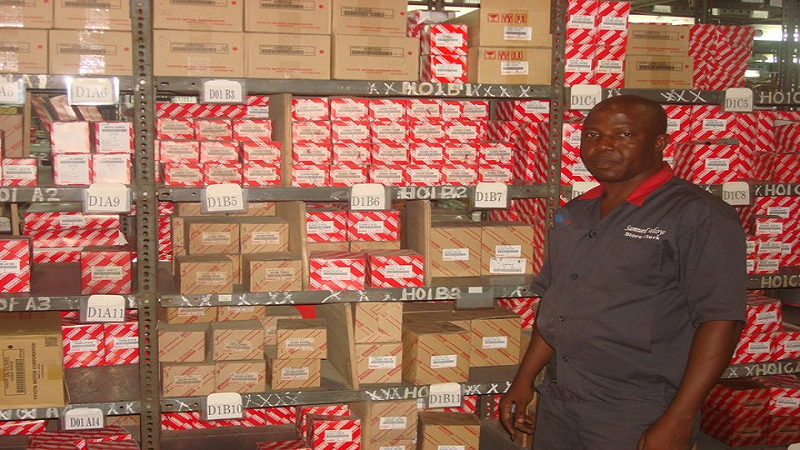
The warehouses are nearly empty, with scanty goods and people who come at intervals. Some of the traders wobbled in disappointing silence while others form circles of joke and discussion. In the past, that time of the day would have been the peak of the business bubbles. The warehouses would have been filled with people and goods, with money moving from hand to hand, bank account to bank account, and goods, from the warehouses to shops – but a lot has changed.
It is past 2 pm outside the warehouses, a man (identified as Okwudiri) noticed as he looks at his watch. He has sat in front of his shop since 8 am, waiting for customers. There is none. His phone has not rung from a customer’s call either. Many of his colleagues take a walk in the hope of finding someone looking for an engine or any vehicle spare part to buy. The fact that they have not returned means that they haven’t found one. He shakes his head in disappointment. In the past, customers used to wake him from sleep very early in the morning, but those days are gradually becoming a thing of nostalgia.
That is the current situation in Ladipo Auto Spare Parts Market, a multibillion-naira vehicle spare parts market located in Mushin, a Lagos suburb. A lot had changed there since 2020 in the wake of the COVID-19 pandemic putting the market’s estimated $1.9 billion annual revenue in jeopardy.
Although in every conventional market in Nigeria, the impact of COVID-19 does not escape notice; there are scanty customers, scanty goods, and depleting business capitals. But like every other import-based market, the Ladipo market has an amplified case.
“You can stay for a whole day in the market and see no one to ask you; how much is this or that,” Okwudiri said in fluent Igbo.
“And sometimes when they do come, you will not have what they are looking for because goods have become scarce; importers are no longer travelling overseas to buy goods.”
In December 2019, when COVID-19 became public knowledge in Wuhan, China, the world was oblivious of its impact on lives and economies. As the virus turned pandemic, forcing countries to initiate precautionary and safety measures to protect, foremost lives, and then businesses, it beckoned despair and tragic economic consequences. For Nigeria already grappling with a flawed health system and economic turmoil, the stakes became higher.
On February 27, 2020, when Nigeria recorded its index COVID-19 case, it came with a disproportionate size of anxiety based mainly on its perceived inability to contain the transmission and treat those infected.
About 6,164 miles away in China, the government shut down cities and businesses as the number of cases rose significantly. The alarming increase was stoking other countries’ eagerness to shut their borders and ports to prevent the further spread of the virus by travellers. But for economic consideration, many countries, especially in the west, hesitated, leaving the global supply chain window open, but it didn’t last long.
By May 2020, almost every country in the world was in a race to shut its airports, borders and seaports. Nigeria was no exception. Ships were quarantined for two weeks following a safety protocol issued by the World Health Organisation (WHO).
By May 31, 2020, Nigeria had recorded 10,162 COVID-19 cases. Lagos was the epicentre of the pandemic forcing the government to impose a lockdown. That was the beginning of the plights of Ladipo traders. Spare parts importers were caught in their tracks. And as the last of the shipments from their previous trips were delivered, the scarcity of goods set in.
“It was the hardest time I have ever had to face in my time in this market,” Okey, who works in one of the warehouses, recounts. “Everywhere was dry. After we survived the lockdown, there was no business, no goods, customers were not coming, and there’s no work to do.”
Before the pandemic, traders imported over 30 container shipments daily, each worth nearly N20 million.
The Ladipo market bubbles involve unloading these container shipments in different warehouses and selling them off to buyers in the shortest period possible. The buyers are mainly retailers who own shops within and outside the market. Through these activities, many earn a living – unloading goods from containers and moving them from the warehouses to customers’ vehicles or the retailers’ shop.
The travel restrictions resulted in a significant drop in the number of shipments coming into the market daily. Sales plunged; so did revenue, and not a few were out of business.
“Even overseas there, the governments initiated lockdown, and that’s part of the problem. I have not travelled since the beginning of the pandemic,” Sylvester Mogbo, CEO, S O Mogbo Motors Ent. Nig., who used to travel to the United States, said.
“The few consignments I have managed to receive were possible because I sent money to someone over there, and he shipped the goods to me.”
To keep the business going, the importers rely on their overseas partners, mostly Nigerians. They would send the money to their partners, allow them time to scout goods and ship them to Nigeria. It’s a half-bread-is-better-than-none approach but with risks.
“Sending money comes with risks. You can send the money, and the person will ship whatever he likes to you. Because many people overseas don’t really know what the Ladipo market needs, even when they’re sent samples and given instructions, they will never get it the way you would if you travel yourself. And there is a delay in shipment now due to safety COVID-19 protocols that involve quarantining ships,” Mogbo added.
Ejike (a spare part merchant) who used to travel to Malaysia said, “The disadvantage is that the person you are sending the money to may have an ulterior motive. He can defraud you or start his own business with it.”
He narrated the experience of a friend who waited longer than required for a consignment because his overseas partner nearly double-crossed him.
“It happened that his overseas contact used his money to make the shipment to another importer in Onitsha. It was until the Onitsha-based importer sold off the goods that his contact was able to make my friend’s shipment to him. That’s not quite long ago. That’s part of the risks,” he said.
He explained that another disadvantage is that overseas partners may inflate the price of goods. For instance, if the price is $500, he may add $50.
“But when you travel, under two weeks, you are done buying. You ship your goods and come back to Lagos to wait one or two months, depending on where the goods are coming from,” he said.
Although overseas partners sometimes ship goods with their own money, counting on their Nigerian partners to sell and return the invested capital with profit, the availability of goods in the market depends mainly on Nigerian importers’ ability to travel. They travel up to four times a year pre-pandemic era.
“When you travel, your turnover becomes faster because you know what the market needs and could easily find it. But when you send money to your partner, he will only make purchases based on the accompanying list. And it may take him more than a month,” Ejike added.
For importers, retailers, and warehouse managers, COVID-19 has created a survival-of-the-fittest situation.
“COVID has ruined everything; no business, importers are not travelling, goods are not coming in. Before, we used to have over 20 containers weekly. But now, we’d be grateful to have three in a month. We that run warehouses are barely surviving; our overhead cost is increasing while business is decreasing. No turnover. We pay warehouse owners their rent fees without making close to what we are paying. We are running at a loss,” Kenneth Aniche, a warehouse manager, lamented.
Nwanagu, a manager at Triumph Warehouse, said seeing one container to unload in a month had become difficult, unlike before, when they used to have as “many as 10 containers weekly.”
The COVID-19-induced import challenges have spiked the cost of goods and services in the market. Before the outbreak, an average vehicle engine sold for around N300,000 now costs nearly N600,000, Mogbo explained.
“This means that business right now is left for those with huge capital. Many shop owners who used to buy up to 10 engines can only afford five or less. Those who used to buy three engines can no longer afford any,” he disclosed.
Apapa gridlock and forex: Adding insult to injury
The importers also attributed the rising cost of auto spare parts to the instability of forex and the high cost of moving cargoes from the ports.
Mogbo said he spent N1.2 million to move a 40-feet container from Tin Can Island port to Ladipo Market in December, nearly the cost of shipping it from the United States.
Congestion and gridlock at the port’s terminals are a national menace both the federal and Lagos governments have struggled to contain. On April 25, 2019, President Muhammadu Buhari created a task team chaired by Vice President Yemi Osinbajo to reduce the traffic.
However, the traffic situation degenerated. The task team was accused of corruption and worsening an already terrible situation. Trucks piled up in queues, and the cost of haulage rose in Tin Can Island ports. In February 2020, the House of Representative resolved to probe truck drivers’ extortion in Apapa port by law enforcement agents.
The motion titled, ‘Urgent Need to Investigate the Unwarranted Extortion of Truck Operators and Other Port Users by Law Enforcement Agents at Apapa Port,’ was moved by Olusola Fatoba, representing Ado Ekiti Irepodun-Ifelodun Federal Constituency. Due to the traffic managers’ illicit activities, he said, the trucks spent up to two months before gaining access into the terminal. That inflates the cost of haulage from the Apapa ports to every other part of the country. Fatoba added that truck operators pay as high as N300,000 to gain access into the port as the Task Force had turned traffic management into a cartel.
“So you have one entrance and exit serving the busiest seaport in the country. Maybe 10 containers get out in a day. One thousand trucks are on the queue to get in; nobody is directing trucks to keep moving. There seem to be concerted efforts to keep the system moving slowly,” Sam Hart, an importer who had goods to clear from the port, lamented.
He explained that the entire place could be at a standstill for two days.
“So it takes weeks for flatbed trailers to get to the front of the queue. The closer the trailer is to the loading point, the higher the bargain. Like ticket sales at rush hour. The driver you negotiated with last week can accept double what you offered and ditch your deal,” he added.
With growing calls for the task force to be disbanded, in December 2020, the federal government handed the Apapa traffic management over to the Lagos government.
“After weeks of careful planning, I am pleased to announce that the presidential task team charged with the responsibility of the restoration of law and order on Lagos roads, leading to Apapa and around Lagos port and maritime logistics corridor, has successfully handed over its activities to the Lagos state government to be supported by the Lagos State Police Command,” said Kayode Opeifa, the Vice Chairman of the task force.
Based on this assurance, the traffic-induced high cost of clearing that has contributed to the economic pains of Ladipo traders was expected to decline.
Also, Hadiza Bala-Usman, Managing Director of the Nigerian Ports Authority (NPA), said on February 18 that drastic measures are taken to curtail the surging adversity of gridlock around the ports. She said an app, ‘Eto,’ was developed to remove human interference in the trucks call-up process, while seven parks are designated for the trucks to put them out of the roads.
“Sanitizing the ports corridor is to have a designated parking space. If you don’t tell people where to park, they will park anywhere. So we have seven truck parks available in collaboration with the Lagos state government. It means that you can’t go into the port if you are not parked in the truck park,” she said.
With the electronic call-up system in place, road users and residents said Apapa routes had been cleared of trucks for the first time in many years. However, there is concern about how long the current situation will last, as other factors like bad access roads persist.
A chief executive officer of a logistic company who does not want to be named said it’s too early for the electronic call-up system’s success to be ascertained.
“This e-call-up system just started. It is too early to say if it’s working or not. It’s until all the trucks start operation fully that we can say whether they have gotten it right or not. And that will take weeks,” he said.
On forex, Ejike said, “The price of the dollar keeps going up with each consignment. If you buy $1 for N475 today, it will be N485 or there about next time. It lessens the number of goods you will buy and makes the goods more expensive.”
Nigeria’s exchange rate disparity deteriorates further as the economy came under the pandemic’s weight following the decline in oil revenue. The exchange crisis, characterized by internal foreign exchange shortages and consistent high black-market rates, has become the nightmare of import-based businesses.
The Central Bank of Nigeria (CBN) has adjusted its FX policies to unify the exchange rate. The policies include the repeated devaluation of the naira, increased sales of dollar to bureau de change operators, lifting of the restriction on dollar circulation in the country, and the ‘Naira 4 Dollar Scheme,’ designed to stimulate dollar liquidity in Nigeria through diaspora remittances. The scheme offers diaspora remittances recipients through CBN’s International Money Transfer Operators, N5, for every $1 received as remittance inflow. But these policies have done little or nothing to lessen the exchange disparity; the parallel market price keeps going up.
The overseas partners of Ladipo market importers have learnt to take advantage of the situation whenever the naira plunges. Instead of buying goods and shipping them to Nigeria, they send the foreign currency equivalent. The money gets sold in the parallel market. That way, they make more profit than they would have if they shipped goods and avoid the risk of incurring loss due to forex disparity.
The International Monetary Fund (IMF) said Nigeria’s current situation of multiple exchange rates and non-transparent rules for foreign exchange allocation creates uncertainties for the private sector. Unifying the various rates into one market-clearing rate would establish policy credibility.
“Sustained premiums in the parallel market and unmet foreign exchange demand indicate the need for further adjustment in the exchange rate to reduce the gap between supply and demand. An appropriately valued exchange rate and a clear exchange rate policy would also help instil confidence and private sector-led recovery,” the IMF said.
Vaccine to the rescue
Mogbo, like other importers, said one of the fastest ways to get out of the predicament is COVID-19 vaccines because in overseas-destinations of Ladipo importers, there are still restrictions preventing life from returning to pre-pandemic normalcy, and it takes only vaccine passport for one to use more freedom.
Jonathan Nwinyinya, chief executive officer, Jona O Int., who used to travel to Europe, said COVID-19 safety restrictions contributed to the scarcity of vehicle spare parts in Europe, especially in Germany, currently experiencing its third wave of the pandemic.
“Goods are very scarce in Europe right now due to coronavirus, especially in Germany. Now our partners mainly buy from Poland, Norway and Denmark,” he noted.
He explained that lockdowns and other safety restrictions limited the ability of their partners in Europe to scout for goods, and it has also increased the cost.
With this situation, the solution undoubtedly lies in vaccines. Still, with many countries yet to vaccinate most of their population, it’s a solution farfetched, and Nigeria is more distant from the solution than other countries where Ladipo market importers travel.
So far, there have been only 10 vaccines licensed and approved for general use, but Nigeria lacks the financial and infrastructural capability to secure enough for her large population.
A member of the private sector-led Coalition Against COVID (CACOVID), the BUA Group, as a gesture beyond its corporate social responsibility, had paid for one million doses of vaccines for Nigeria in early February. In March this year, the country received 3,924,000 AstraZeneca/Oxford vaccines, and has begun to administer them to its citizens.
The revival of the Ladipo market lies in importers getting their vaccine passport, a certificate of COVID-19 vaccination with QR code for authentication that affluent countries are currently hinting on as a compulsory document for future travels. Nigeria expects more vaccines in the near future, but they will come in quantities that will only cover a fraction of its population. With Nigeria’s vaccine procurement’s current prospect, Ladipo Market traders’ economic adversity may linger into the distant future.
The number of container shipments coming into the Ladipo market has reduced by more than a half, which means about 60 percent of its $1.9 billion annual revenue lost to the pandemic.
Nwinyinya said the situation affected everyone in the market, no matter how large one’s capital is. He said those who manage to have some goods are not selling enough because the parts have become more expensive and unaffordable for most customers. But the hardest hit are those with little capital. While some have succeeded in getting another business or job to do, others are barely surviving.
“Most of the shops are now empty; many traders can no longer pay for shops. If there are 10,000 people in Ladipo, three to four thousand are no longer in business. Many are just littering, looking for customers to hustle,” he said.
He explained that although shipments now come once or twice a year, importers who have trusted overseas partners who can make the shipments are fortunate because the rest of them are almost going bankrupt.
“If the situation continues like this for the next year, many people will leave Lagos for their respective villages,” he lamented.