DD
MM
YYYY

PAGES

DD
MM
YYYY

spot_img

PAGES

Home Blog Page 5850

The Cautious Puppy (Financial Lessons from Puppies)

0

“Life lessons are everywhere, if we would but stop, look and reflect.”

This is a quote from Life Lessons from Ants by Liz Taylor. Being bitten by an ant, she paused and reflected on the capacity, courage, and constancy of ants. Like her, I am about to share an interesting story with you as told by my brother, Alfred, about a dog and her litter when he sojourned in the City of Zaria. I reflected on this and discovered a perfect similitude in behavior of these animals and man in his quest to grow his wealth.

One evening I laid on the sofa reflecting over my interaction with a prospective investor earlier in the day. She wanted to invest a certain amount of money that she felt the returns I offered weren’t that good. She had spent her day moving from one bank to another in search of a high interest yielding account to invest in but found none. “I will keep searching and if I can’t find an option better than yours I will contact you,” she said. It was at this moment the story of the cautious puppy popped up in my head. I had to call Alfred to share the story one more time because of the great financial lessons we can learn from it.

Alfred: “There was this beautiful dog that strayed into the compound I lived in and made it her home. I fed and cared for her. She had a shiny white hair coat with black spots. Neighbors thought I always bathed her. She had her first litter of puppies that were taken away by thieves. Then she had another litter of six puppies. These puppies despite being unable to see as they were just a few days old were so restless except Patty. I named all of them and built a house for them to restrain their wanderings and protect them from danger all around. Every time I returned from work I would find them in a nearby bush and in different corners around the compound. What amazed me was that their eyes were still not opened but they kept moving blindly.

Patty was unlike the rest. She was always sleeping, even when she started seeing she only moved when the mother was around and never came out in her absence. She never responded to the voices of strangers nor accepted food from them. She was very intelligent like the mother. Not surprising she became the only survivor and grew to the size of the mother. One of the puppies due to its curiosity died with its head trapped in some place, a neighbor sold one in my absence and the rest got stolen by thieves. Patty grew into a beautiful dog before I left Zaria. Her carefulness saved her life.”

The Dog and Her Golden Pups

Now, let us take the mother dog to be our golden stream of income that we divest in our bid to create wealth. For an employee, this comprises his salary, bonus, annual leave allowance, 13th month, etc. For a business person, it is revenue and profit. Her pups were precious to her but they had their lives in their hands. The mom gave them instructions before she goes out in search of food daily. If we could decode her barks, growls, whining, and howls to her pups, we would hear her say something like: “Don’t leave house. Stay together. You know your eyes are not yet opened; it’s a dangerous world out there. I will be back soon. I love you all. Be safe!” Somehow, it happened that only Patty kept the mom’s instructions everyday while her siblings were always lured by the exciting and dangerous world. Unfortunately, the restless pups were lost forever.

Conclusion: Diversifying into a more predictable, stable, and less risky investment.

This is the point in this entire story. Not putting all your eggs in a single basket of very risky investments. There are a thousand and one investment opportunities out there promising unbelievable returns with concealed equal chances of loss. This is apparent with the pups that were so restless, roving to their unfortunate fate. If given these ten investment options: fixed deposits, crypto currency, treasury bill, stock market, mutual funds, trade financing, crowdfunding, micro lending, agric business, and angel investment to invest in, I bet, if at all, treasury bill and fixed deposit will be the least attractive to you. But they could be your Patty. 

Relationship between Profit, Loss and Risk

In The Financial Expert that was Swindled by a Rogue  I drew two diagrams, Fig 1: The Wealth Creation Curve, and Fig 2: The Backward Bending Wealth Creation Curve to explain the danger inherent in forcing our funds to do the impossible. I see no better concept to use to close this piece on the need to divest into a more stable and low risk portfolio investment. Fig 1 depicts a normal wealth creation curve that has minimal risks with predictable growth. Fig 2 is the abnormal case where an investor wants to reap the highest return in the shortest possible time. This forces the wealth creation curve backwards equaling the risk of losing the investment. So, why not let time take its course on one of your portfolios?
Paystack’s Parent, Stripe, Raises $600m In A Fresh Round to Reach $95bn Valuation

1

Stripe, which builds economic infrastructure for the internet, announced on Sunday it has raised a $600 million funding round that puts its valuation at $95 billion.

The round was graced by many investors, including Allianz X, Axa, Baillie Gifford, Fidelity Management & Research Company, Sequoia Capital, and Ireland’s National Treasury Management Agency (NTMA).

The $600 million round has put the payment company above SpaceX and Instacart, whose valuation is placed at $74 billion and $39 billion respectively. Stripe has thus become the most valuable private company in Silicon Valley.

“The company will use the capital to invest in its European operations, and its Dublin headquarters in particular, support surging demand from enterprise heavyweights across Europe, and expand its Global Payments and Treasury Network,” Stripe said in a statement.

Stripe recently acquired Nigeria’s fintech startup, Paystack for $200 million, underscoring its determination to become a global brand. Although it’s still far behind other giants in the online payment industry, its $95 billion valuation makes a bold statement.

It was also named a Leader in The Forrester Wave™: Merchant Payments Providers, Q3 2020, achieving the highest scores of any company ranked.

Having fully established in the United States, the company has been taking investment to other parts of the world to secure more market share.

John Collison, President and co-founder of Stripe said Europe has become a lucrative destination for companies, and Stripe plans to cash in on the boom of its digital economy.

“We’re investing a ton more in Europe this year, particularly in Ireland. Whether in fintech, mobility, retail or SaaS, the growth opportunity for the European digital economy is immense,” he said.

Of the 42 countries in which Stripe powers businesses today, 31 are in Europe. And many of the continent’s largest and fastest growing companies are building on the platform.

Axel Springer, Jaguar Land Rover, Maersk, Metro, Mountain Warehouse and Waitrose have all recently turned to Stripe to grow and diversify their online revenue, or move faster on their transformation projects. Meanwhile, Europe’s hypergrowth companies such as Deliveroo (UK), Doctolib (France), Glofox (Ireland), Klarna (Sweden), ManoMano (France), N26 (Germany), UiPath (Romania), and Vinted (Lithuania) all build on Stripe to compete on the global stage.

Stripe now counts more than 50 category leaders—companies processing each more than $1 billion annually—as customers. Enterprise revenue is now both Stripe’s largest and its fastest growing segment, more than doubling year over year, the company said.

Stripe said it will double down on enterprise capabilities, particularly its customer success teams, to help even larger businesses like Twilio or Zapier significantly increase their revenue.

“We will also invest in our global expansion to help companies such as Glofox or MATCHESFASHION increase their market opportunity. And through partnerships with enterprise solutions like Salesforce Commerce Cloud we will make it even easier for large multinationals around the world to switch to Stripe,” said Mike Clayville, Stripe’s Chief Revenue Officer.

Stripe said it has built programmable infrastructure for global money movement, known as its Global Payments and Treasury Network, as well as a growing roster of products and services atop that foundation, including Billing, Capital, Connect, Issuing, Radar, Terminal and Treasury.

Only 14% of commerce takes place online today, despite the global economy accelerating its shift to online in 2020. Stripe’s aim is to grow the GDP of the internet, making it easy for ambitious companies everywhere to grow their business.

The company said it will continue to build its Global Payments and Treasury Network, further expanding its suite of software and services to help ambitious businesses drive more revenue in 2021. And Stripe services will also soon be available to millions more businesses in Brazil, India, Indonesia, Thailand and the UAE.

“We’re investing in the infrastructure that will power internet commerce in 2030 and beyond. The pandemic taught us many things about society, including how much can be achieved—and paid for—online, but the internet still isn’t the engine for global economic progress that it could be. While Stripe already processes hundreds of billions of dollars per year for millions of businesses worldwide, the opportunity ahead is much larger for Stripe than it was when the company was started 10 years ago,” ,” said Dhivya Suryadevara, Stripe’s Chief Financial Officer.

The Nigeria’s 33.3% Unemployment Rate

0

Nigeria’s unemployment rose to 33.3% in the Q4 of 2020, according to data released by the Nigerian Bureau of statistics (NBS) on Monday.

The unemployment rate rose from 27.1% in the second quarter 2020 to reach the new height, putting the number of unemployed people in Nigeria at 23.19 million.

The NBS report said that while the unemployment rate rose by 6%, underemployment rate witnessed a decrease.

“During the reference period, the computed national unemployment rate from 27.1% in Q2, 2020 to 33.3% in Q4, 2020, while the underemployment rate decreased from 28.6% to 22.8%. A combination of both the unemployment and underemployment rate for the reference period gave a figure of 56.1%.

“This means that 33.3% of the labor force in Nigeria or 23,187,389 persons either did nothing or worked for less than 20 hours a week, making them unemployed by our definition in Nigeria. This is an additional 1,422,772 persons from the number in that category in Q2, 2020,” the report said.

The total number of people in employment (i.e., people with jobs) during the reference period was 46,488,079. Of this number, 30,572,440 were full-time employed (i.e., worked 40+ hours per week), while 15,915,639 were under-employed (i.e., working between 20-29 hours per week). This figure is 20.6% less than the people in employment in Q2, 2020.

The data highlight a significant rise in unemployment and underemployment among youths, urban and rural dwellers.

The unemployment rate among rural dwellers was 34.5%, up from 28.2% in Q2, 2020, while urban dwellers reported a rate of 31.3% up from 26.4%. In the case of underemployment among rural dwellers, it declined to 26.9% from 31.5%, while the rate among urban dwellers decreased to 16.2% from 23.2% in Q2, 2020.

For the period under review, Q4, 2020, the unemployment rate among young people (15-34years) was 42.5% up from 34.9%, while the rate of underemployment for the same age group declined to 21.0% from 28.2% in Q2, 2020. These rates were the highest when compared to other age groupings.

Under State disaggregation, Imo State reported the highest rate of unemployment with 56.6%, followed by Adamawa and Cross River States with 54.9% and 53.7% respectively. The State with the lowest rate was Osun in the South-West with 11.7%.

For underemployment, the state which recorded the highest rate was Benue with 43.5%, while Lagos State recorded the lowest underemployment rate, with 4.5% in Q4, 2020.

A total number of 12,160,178 did not do any work in the last 7 days preceding the survey, the NBS data said.

With these figures, Nigerian has surpassed South Africa and it’s running after Zambia’s 33.4%, which leads on Bloomberg’s list of 82 countries with rising unemployment rate.

Over the last five years, Nigeria’s labor market has recorded alarming figures of job loss, compounded recently by the decline in oil revenue and emergence of COVID-19, which forced many companies to downsize.

It has become more like a race for Africa’s largest economies. South Africa, which just like Nigeria, fell into recession last year, has 32.5 unemployment rate. Although the two countries share a common problem of insecurity and civil unrest stemming from the rising number of youths without jobs, Nigeria has further concern.

Inflation has been on the rise since August 2019, when the oil-rich nation closed its borders to enforce its food import ban. With inflation at 17.33%, food prices rose above 20% year-on-year in January, stoking the hunger crisis that president Buhari administration’s economic policies have failed to address.

Nigeria has an exploding population of more than 200 million people with over 40% living below the poverty line ($2 per day). The Q4, 2020 unemployment rate means additional 1,422,772 persons may likely be added to the growing number of people fighting extreme hunger in Nigeria.

Dependency has become a survival strategy for those not working. 148.7 million Nigerians are depending on 57.8 million who are working. This means, approximately, only 28% of the population is actually working, and on average, about three persons depend on one working Nigerian, according to data from StatiSense.

The International Monetary Fund said the recovery of Nigeria’s battered economy will be slow. With its current 1.5 growth rate, output will only recover to pre-pandemic levels in 2022, the IMF said.

Oil accounts for 90% of Nigeria’s GDP which plummeted as the oil market came under the weight of the pandemic. Although there has been recent signs of recovery with Brent Crude rising as high as $69 last week, its sustainability is not guaranteed as economies are yet to fully reopen.

With the current economic outlook, the number of people becoming jobless will increase, and with the food import ban and crisis in the north limiting farming activities, inflation will continue to rise as population growth outpaces output expansion.

Tekedia Mini-MBA Special Live Session – “Coming & Thriving in America”

0

Tekedia Institute is proud to announce the introduction of a Live session – Coming & Thriving in America. The goal of this session is not to move Africa to America, but to provide knowledge systems which will help African professionals in diasporas to thrive. The course will run for 2 hours on a Saturday, and it is 100% LIVE. The course is broken into four sessions:

  • Preparing at home nation: this focuses on playbooks and critical things one has to do before journeying to America.
  • Integrating into the American system: this focuses on skills and things one has to do to integrate and find value within the US system upon arrival.
  • Harvesting the efforts: this explains career strategies, business ventures, and options after capabilities have been developed in the earlier phases.
  • Connecting back to home nation: when established in America, how to link those capabilities to the home nation.

To register for Tekedia Mini-MBA, check below.

NB: The current Tekedia Live which runs on Saturdays will be unaffected by this new course.

Flutterwave Brings Paypal to African Merchants

2

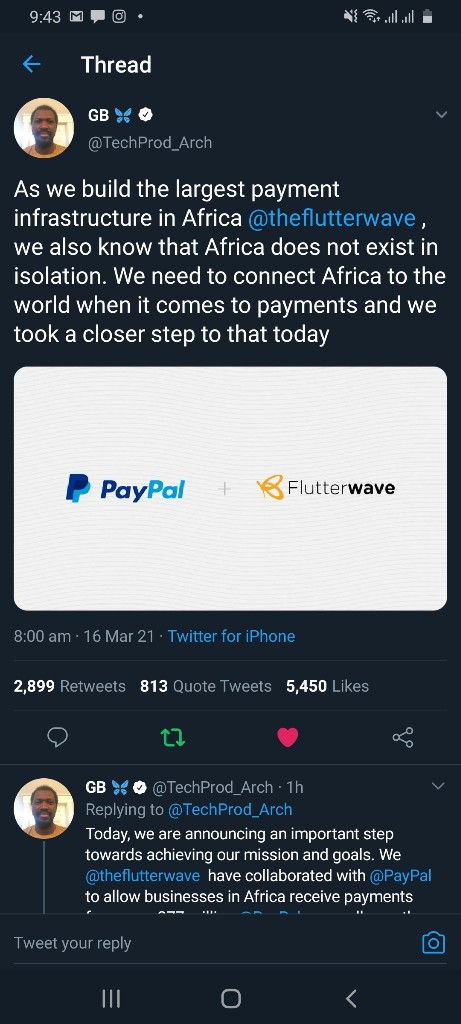
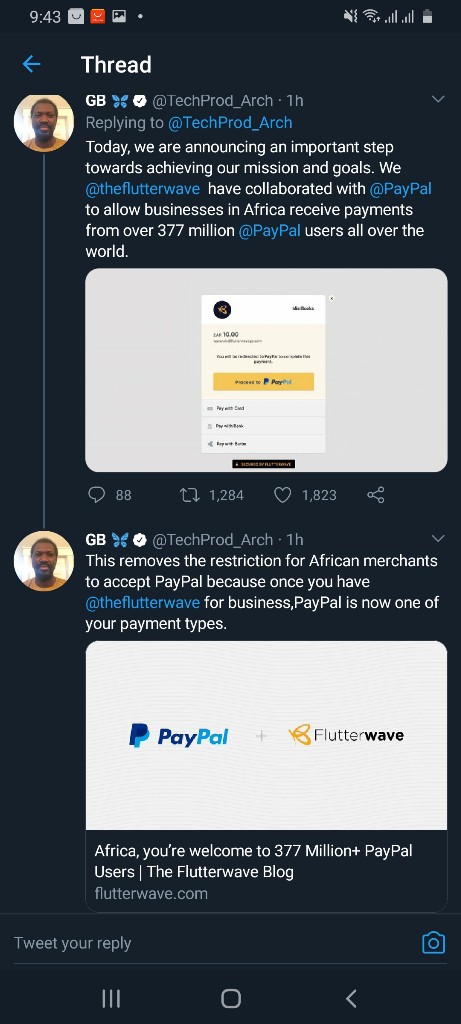
Flutterwave has closed one of the most challenging links in global digital payments for most African merchants and creators: inability to receive payments from Paypal. Yes, you can pay but you are not allowed to receive, until now. According to the company,  it has a “ collaboration with global payment leader PayPal to enable PayPal customers globally to pay African merchants in the continent through Flutterwave’s platform.

The collaboration will be instrumental in supporting SMEs and freelancers to overcome the many challenges presented by the highly fragmented and complex payment and banking infrastructure, as well as connecting them with more than 377 million PayPal account holders globally.” This is monumental as more people can reach the Western Europe and American customers, out of Africa.

If you are a member of Tekedia Mini-MBA and need support on integrating with Paypal and Flutterwave, we have made resources available to provide guidance. Tekedia already uses this Flutterwave technology – our support team will assist.  We want you to sell globally and internationally.

Again, we congratulate Olugbenga ‘GB’ Agboola, the CEO of Flutterwave, a Tekedia Mini-MBA fintech faculty.

The press release

Flutterwave, Africa’s leading payments technology company, today announces a new collaboration with global payment leader PayPal to enable PayPal customers globally to pay African merchants in the continent through Flutterwave’s platform. The collaboration will be instrumental in supporting SMEs and freelancers to overcome the many challenges presented by the highly fragmented and complex payment and banking infrastructure, as well as connecting them with more than 377 million PayPal account holders globally.

Traditionally, Africa’s ecommerce ecosystem has lacked suitable payment solutions to meet demand for seamless transactions worldwide, further constraining its contributions to the global digital economy. However, this collaboration eliminates significant barriers that have previously hindered African consumers and businesses from the untapped potential of cross-border ecommerce.

Flutterwave has transformed the payments space in Africa by offering flexible, quick and affordable payment services to individuals and businesses across the continent. As of today, African businesses have even more access to sell to global customers using PayPal’s secure platform to receive and make payments online. Cross-border ecommerce continues to provide significant growth opportunities for Africa’s economy. Research firm Statista estimates that the total value of ecommerce in Africa generated $16.5 billion in 2017 and is expected to reach $29 billion by 2022. This growth potential will provide many opportunities for SMEs and freelancers worldwide, subsequently increasing Africa’s share of global trade.

This announcement solidifies Flutterwave’s position as the global African payments partner of choice for multinationals looking to enter new markets, further reassuring new and existing merchants and investors of Flutterwave’s global capabilities, secured platform and high standards of safety.

Speaking on the announcement, Olugbenga ‘GB’ Agboola, Founder and Chief Executive Officer of Flutterwave, said: “We are excited to bring PayPal’s fully integrated services to businesses across Africa. The collaboration reinforces our vision of creating a seamless digital payments system for Africa’s business communities that can now transact with international consumers.

By working with PayPal, we can further strengthen our commitment to our customers and service users as we will be enabling them to transact and expand their business operations to reach new markets. PayPal’s global reach is unrivalled and collaborating with them allows our customers to explore new markets where PayPal is embedded.

“Through our collaboration with PayPal, we are also bringing together two trusted global payment brands to provide millions of consumers and businesses a gateway to new opportunities,” he said.

Since inception, Flutterwave has processed over 140 million transactions worth over USD $9 billion worldwide and continues to expand its footprint to ensure consumers and merchants receive the best-in-class digital payment service. This collaboration further underscores its commitment to ensuring merchants have vast opportunities to deliver services and conveniently transact through its platform.

Just last year 2020, PayPal‘s 377 million+ users made transactions that saw PayPal end the year with a $936 billion total payment volume for the year 2020. This trillion dollar opportunity didn’t include most African businesses until this new integration between Flutterwave and PayPal.