DD
MM
YYYY

PAGES

DD
MM
YYYY

spot_img

PAGES

Home Blog Page 5863

How University of Ibadan Don Built a Radically Simple Model of Change Makers Production in 21 Years

0

He is one of the citizens who believes that Nigeria will be better despite its current socioeconomic and political challenges. As a child and youth, he enjoyed positive outcomes of social and economic policies and programmes of governments in 70s and 80s. After his first and second degrees, Professor Ayobami Ojebode started his teaching career at the University of Ibadan in 1997 with the intent of building Nigeria’s future using moral principles inculcated in him by his Igboora parents and teaching methodologies at the Obafemi Awolowo University and the University of Ibadan between 1992 and 1995.

From 1997 to 2013, the year he became a professor at the Department of Communication and Language Arts, till now, how the new leaders with a strong commitment to the building of Nigeria as a country that gives every citizen equal opportunity to survive and contribute to its [Nigeria] growth will emerge has been his strategic principle. In this piece, our analyst examines the principle along with his academic and personal life, covering last 21 years of being a teacher at the Nigeria’s Premier University.

His love for indigenous and development communication studies should not be a surprise to those who know his family background and interest in developing African culture and history in all ramifications. According to our source, his late father was known for having superior interest in Africa, especially Yoruba culture and traditions. Hence, Professor Ojebode’s research interest, according to our analyst, is biologically driven on one hand and academically driven on the other hand, if one considers the role played by late Dr Larinde Akinleye and Professor Ebenezer Oludayo Soola.

These two scholars had great influence in his choice of research areas, the study of indigenous, mass and other communication media in the context of Nigeria’s political, economic, environmental, social and development peculiarities.

He has about 60 publications to his credit. One of his publications, titled Doing Community Radio, has been adopted as a training manual in radio stations within and outside Nigeria. Same with another of his publications titled Audience Research for Campus Radio Stations.

He has been a consultant to many national and international organisations such as the World Bank, DFID, Institute for Media and Society (Nigeria); Institute for Development Studies (UK); the University of Leuphana (Germany), and the Partnership for African Social Governance Research (PASGR) (Kenya).

Professor Ojebode has been a visiting researcher, a visiting scholar, a keynote speaker, a consultant, a trainer and/or examiner in universities and research institutes in Nigeria, Ghana, Kenya, South Africa, the United Kingdom, the Netherlands, Germany, Peru and the United States. He delivered the keynote paper at the 2012 National Programmes Planning Conference of the Federal Radio Corporation of Nigeria (FRCN) in Akure, Ondo State, titled Radio programming in the twenty-first century: face-to-face with reality.

In his 21 years of being a University teacher, Professor Ojebode won grants and honours. He has also been a fellow in national and international institutions. He has played the roles of a leading researcher and consultant in many projects that cut across his research interest. In the area of administrative service within the University of Ibadan, especially at the Department of Communication and Language Arts, information indicates that his leadership style remains one of the best. In 2020, he ended his leadership of the Department with 41 PhD Graduates, 13 First Class Undergraduate degrees in 9 Years.  This feat is largely linked with his commitment to service to humanity, result-oriented leadership style and collaborative work ethic.

Before becoming a professor, our analysis shows that he spent 3 years and 3 months on average. The highest years were 5, which he spent between 2008 and 2013, the year he was pronounced as a professor of development communication at the Department of Communication and Language Arts of the Institution.

Professor Ojebode’s drive to attain a professorial position in 2013 could be discerned from the aggressive publication pursued between 2008 and 2013. Our analysis reveals that Professor Ojebode had 35 publications during the period out of 63 publications mapped by our analyst [from 2004 to 2021], including journal articles, chapters in books and other educational and public policy engagement materials.  According to our analyst, he is one of the lecturers at the Department who rose to the professorial position without being associate professor, indicating his publication prowess.

Exhibit 1: Publications between 2004 and 2021

Source: Ayobami Ojebode’s Publications,2004-2021; Infoprations Analysis, 2021

Research Interests and Solutions to Muted Voices

As noted earlier, his research areas include indigenous, mass and other communication media in the context of Nigeria’s political, economic, environmental, social and development peculiarities. Clearly, his consideration of the Nigerian settings and other locations in Africa for exploration of problems and needs within the peculiarities resonate with his strategic principle and philosophy of building better future for people and society in general. In his inaugural speech as a professor of the University, he narrated how the findings of his many years of researching the contexts established muted voices, being aided by individuals, organisations and political leaders.

From our analysis, Professor Ojebode has supervised undergraduate projects and postgraduate theses. Available information reveals that he has supervised a Master student from the Netherlands and a PhD student, who was a Ghanaian. He has supervised 150 undergraduate projects and 120 masters theses.

Analysis of his 63 publications indicates that he has researched issues and needs within other communication media [notice board, indigenous communication channels among others], mass media, indigenous and development most. “I can only supervise students [especially postgraduate students] whose interests fall within my broad area of research interest,” Professor Ojebode says when our analyst asked about criteria for supervision.

This statement was analysed further and we found that in 16 years, Professor Ojebode’s research focus and contexts connect strongly. During the years, there were significant connection of the indigenous as a research interest with development issues and needs. This also emerged in other communication media as a research interest. Indigenous and other communication media were also found to be strongly associated with social issues and needs.

In what establishes his profound interest in shaping political, economic, social and environmental landscapes through applied researches and policy engagement with leaders, his 16 years of publication [of the 63 publications examined by our analyst] indicates that over 30%, 27%, 26% and 20% were devoted to investigation of issues and needs within development, environmental, social and economic contexts respectively out of expected 100% for each context. What he cannot capture within publications was addressed through his keynote speaking and policy engagement or dialogue with beneficiaries of his research activities.

Collaboration Ladder: What is it for the Upcoming Scholars?

More than 39% of his 63 publications were single authorship while over 60% were co-authorship. From the 38 publications with co-authorship, Professor Ojebode was the leading author/editor in 55.3% of the publications. He was second author and third author in 26.3% and 13.2% of the publications respectively.

Between 2008 and 2013, Professor Ojebode collaborated with other colleagues in Nigeria and beyond more than what happened between 2004 and 2008, our analysis reveals. In 2010, 7 publications emerged as a result of collaboration with other scholars and professionals in communication and non-communication related industries and sectors across the world.

From indigenous to other communication media research interests, co-authorship permeated throughout 16 years of publication examined by our analyst. This is not different from what our analyst discovered within the research contexts. Single authorship alone dominated within the environmental research context [see Exhibit 4].

In our analysis, there was a 98.2% of single authorship in co-authorship within the research interests earlier explained. It was 86.9% within research contexts.  Does it mean that your in-depth knowledge of a particular research gap or the area drive who to collaborate with? “Yes, but also … whoever is first to bring up an idea ended up being the first author. Well, sometimes, I cede that right to help make the junior person also visible.”

Exhibit 2: Publication by Authorship Category

Source: Ayobami Ojebode’s Publications,2004-2021; Infoprations Analysis, 2021

Exhibit 3: Authorship by Research Interest

Source: Ayobami Ojebode’s Publications,2004-2021; Infoprations Analysis, 2021

Exhibit 4: Authorship by Research Contexts

Source: Ayobami Ojebode’s Publications,2004-2021; Infoprations Analysis, 2021

Lessons from His Change Makers Creation Model

From teaching to community service, it is clear that Professor Ojebode ran a Hybrid-Concentric Model (HCM), which prioritises the collaborative and supportive principles according to our analysis. “I have managed to situate my energy in “the place where four footpaths meet” – mentoring, teaching; research and community service.” Our model shows intra and inter connectivity of the paths. In the area of teaching, Professor Ojebode’s skill in identifying people’s strengths and exploring them for the benefit of everyone is better understood from Kamorudeen Salaudeen, one of his students, who says: “I can’t forget his introduction to reading class in 100 level, a course that linked reading and writing together in an applied fashion through weekly summary exercise. The bundle of skills acquired in the course has connection with all branches of communication studies.  This is just one of his functional teaching techniques.

“Theory and research are both trouble spots to all students, not only of communication. Ojebode has the key to their simplification. Those who read should still remember how Quick Walk through Research Methodology, a study material he wrote and distributed free to his students. Kamorudeen Salaudeen is a lecturer at Fountain University, Osogbo in Osun State.

Exhibit 5: Hybrid-Concentric Model (HCM)

Source: Ayobami Ojebode, 2021; Infoprations Analysis, 2021

Drivers of his model are not quite different from what the past and present students said about him when he presented his professorial speech in 2019 and what they are saying now as he celebrates 21 years of teaching, researching and engaging policy leaders in Nigeria and other countries.

His abilities and capabilities to demystify complex concepts during teaching and grey areas while supervising including quality interpersonal relationship remain the key factors of producing the needed change makers. Supportive future, solution-driven teaching and qualitative mentoring are also found as significant elements of the model. Mark Ighodalo says “I can’t believe it is 21 years, you have been working diligently, raising leaders.” “His lectures were never boring! He was most times comical, and will always spice and garnish every lecture with jokes and stories!” Isaac Audu Ogoja, another past student adds.

Indeed, he is a change maker who also wants more change makers for where he lives and have interests in. Our analysis shows that his dominant co-authorship remains a template that could be used by other established academic scholars to spur upcoming ones into unexpected greatness. Established scholars and emerging ones also need his policy driven research approach and engagement with the users of research outputs.

Exhibit 5: Drivers of Hybrid-Concentric Model

Source: Present and Past Students’ Comments on Kudoboard, 2021; Infoprations Analysis, 2021

Tekedia Mini-MBA Edition 4

3

This registration has closed. Please join the next edition here.


Invent, innovate and drive organizational transformation, performance, and growth. Capture emerging opportunities in changing markets while optimizing innovation and profitability. Digitally evolve your business or functional area, turning digital disruption into a competitive capability and advantage. Master the concepts of building category-king companies, and thrive.

Registration for 4th edition of Tekedia Mini-MBA (Feb 8 – May 3, 2021) continues. Tekedia Mini-MBA, from Tekedia Institute, is an innovation management 12-week program, optimized for business execution and growth, with digital operational overlay. It runs 100% online. The theme is Innovation, Growth & Digital Execution – Techniques for Building Category-King Companies. All contents are self-paced, recorded and archived which means participants do not have to be at any scheduled time to consume contents.

  • Our dedicated learning management system, school.tekedia.com, is where you will take your classes.
  • Our “Facebook for Innovators” is live hub.tekedia.com . The Android version is coming once Google approves. It will enable our members to collaborate more effectively.

More so, it is a sector- and firm-agnostic management program comprising videos, flash cases, challenge assignments, labs, written materials, webinars, etc by a global faculty coordinated by Prof Ndubuisi Ekekwe. When we finish, we will issue a certificate from the Tekedia Institute, Boston USA.

Register and join us. You will emerge transformed with tools and capabilities that engineer confidence, performance and growth.  Accelerate your leadership ascent with us and have access to speak with me on your career and professional development! Here are our programs and costs.

Code Program
MINI Tekedia Mini-MBA costs US$140 (N50,000 naira) per person.
MINR Add extra (optional) $30 or N10,000 if you want us to review and provide feedback on your labs.
MINF Annual Package (includes 3 editions of MINI and optional 2 certificate courses): $280 or N100,000.
CERT: Add extra (optional) $60 or N20,000 for each capstone-based Certificate specialty course. You must have attended, begun, or about attending Tekedia Mini-MBA to qualify. The following Certificate tracks are available:

The Certificate program is completely capstone-based. Tekedia capstone is a research paper or a case study exploring a topic, market, sector or a company. Tekedia Institute supervises the work.

How To Register

After payment, email tekedia@fasmicro.com with participant’s name and code or program paid for, to complete the registration.

Registration Benefits

Slide Anything shortcode error: A valid ID has not been provided


Video presents overview of Tekedia mini-MBA.

Tekedia CaseWorks

Tekedia has produced and still produces case studies, concept notes & investment briefs, exclusive to Tekedia Mini-MBA members. Visit Tekedia CaseWorks for some of the companies and brands.


Tekedia Mini-MBA Syllabus

Theme: Innovation, Growth & Digital Execution – Techniques for Building Category-King Companies

Introduction

Over the last few decades, digital technology has emerged as a very critical element in organizational competitiveness. It has transformed industrial sectors and anchored new business architectures, redesigning markets and facilitating efficiency in the allocation and utilization of factors of production. The impacts have been consequential: nations like Nigeria are moving towards knowledge-based economic structures and information societies, comprising networks of individuals, firms and states that are linked electronically and in interdependent relationships. In this program, we will examine this redesign within the context of fixing market frictions and deploying growth business frameworks in a world of perception demand where meeting needs and expectations of customers are not enough.

Program Time: Feb 8 – May 3, 2021

Venue & Format: Online via videos, articles, webinars, and flash cases. Program is self-paced which means you consume the materials at your own time and pace. It is completely online. You will have something to complete within 7 days. You decide when you do that within the window. Where you live or your time zone would not be an issue as program is not live-delivered.

Cost: US$140 (N50,000 naira). We have a payment plan, i.e. installment payment plan (email us for details)

Program Structure: The program structure is presented below.

Slide Anything shortcode error: A valid ID has not been provided

Target Audience: This program is designed for professionals across functional areas like sales, marketing, technology, administration, legal, strategy, finance, etc across all business sectors and domains.

Learning Objectives: To innovate is to set a new basis of competition in an economy, business sector or market. Most times, it results to disruption. This program is designed for private (large, SMEs, startups) and public institutions. Participants will:

  • Master the mechanics of growth – the reward of innovation – through frameworks, cases and evolving strategies.
  • Understand how to undergo transformation journey that is fully aligned with corporate objectives through measurable and realizable benchmarks.
  • Acquire business capability tools that do not just RUN their firms but can TRANSFORM them.
  • Design corporate growth experiments in Lab sessions based on One Oasis Strategy, Aggregation Construct, Double Play Strategy, Accumulation of Capability Construct, and more.
  • ETC

Tekedia Advanced Diploma Programs – Immediate Access Upon Payment

Each track of Tekedia Advanced Diploma programs runs for 8 weeks (2 months). A track has no Live Zoom session, and it is completely self-paced and online. Upon payment, you have immediate access to start learning. The program includes class notes, flash cases and videos, but no webinar.  Each track costs $100 or N36,000 naira per participant. The tracks and curriculum are presented below.

DLSM Advanced Diploma in Logistics & Supply Chain Management
DBIS Advanced Diploma in Business Innovation, Growth & Sustainability
DBPM Advanced Diploma in Project Management
DIRM Advanced Diploma in Risk Management
DIBA Advanced Diploma in Business Administration
DIDT Advanced Diploma in Innovation & Design Thinking
DIAT Advanced Diploma in Accounting, Auditing, Forensics & Taxation

Part A – General for All Tracks

In the first 4 weeks, all the tracks take the same courses.

 Week Part A – Common to All Tracks
1 Innovation & Growth:

Growth and Innovation of Firms

Digital Transformation, Innovation & Strategy

2 Business Systems & Processes:

Grand Playbook of Business & Entrepreneurial Pursuit

Process Improvement and Operations Management

3 Business Model & Transformation:

Modern Business Models and Growth Execution

Effective Organizational Change Management

4 Design and Innovation Lessons:

Innovation Lessons (5in5, Global, Africa)

Product Design and Packaging

The electives for the tracks are presented on this slider-table.

Tekedia Live Sessions

We run optional three Live Zoom sessions (two weekdays and one Saturday). This provides a way for our members to ask our Faculty and experts live questions and get feedback.

Sample certificate to be issued to co-learners

Capstone-Based Certificate Program

Tekedia capstone is a research paper or a case study exploring a topic, market, sector or a company. You will pick a topic which the Institute will approve. Then you will go and execute that project. Think of this as a final year student product in a university. We expect it to last a maximum of 3 months. The member will submit a report at the end of the capstone. For someone who wants to start a business, you may choose a topic to do market study in that sector. You design a questionnaire and execute your study. Essentially, the essence of this is to apply what you have learnt in the Mini-MBA to produce a practical business document.

You must have attended, begun or about attending Tekedia Mini-MBA to qualify to register. Each certificate course costs $60 or N20,000 as noted above where the Certificate tracks were listed.

Sample certificate awarded for a Certificate program


Tekedia Mini-MBA Adds Session Labs for Blockchain, Cryptocurrency, Decentralized Finance & Cybersecurity

Amazon AWS Credit to Innovators

Tekedia Mini-MBA is a quasi startup accelerator, extending the school core innovate & grow mindset to support innovators. That means, innovators and companies can have access to resources which our Fund provides. If you are in our program, and need support, we will help. We have credits  to support founders and companies in Tekedia Mini-MBA who are bootstrapping or have raised small money. Then, as you grow, we will offer you more credits.

Tekedia Now Offers Amazon AWS Credit To Innovators In Mini-MBA

Special Weeks

Tekedia runs two special annual programs – Tekedia Career Week (not designed for finding jobs but rather planning careers) and Tekedia Innovation Week for our members. Admission is that member must have attended a Tekedia Mini-MBA program in that year. The dates are announced in our program curriculum. For the last edition, click here.

Our Career Week is not designed for finding jobs. Rather, it is structured to TRANSFORM workers, founders & professionals into business leaders and champions of innovation in their companies. The sub-theme is Nurturing Innovators: Career Planning & Resilience During Disruption. It is packaged under the Tekedia Mini-MBA theme of Innovation, Execution & Growth. Our knowledge experts for the Week include human resources experts and leaders from MNCs and startups, across industries and global regions:

Other Tekedia Mini-MBA Programs

  • Tekedia CollegeBoost  is a version of the Advanced Diploma in Business Administration for colleges and schools.
  • Tekedia Mini-MBA for Corporates is a customized version of the general Tekedia Mini-MBA for companies.
  • Tekedia Mini-MBA for Governments is a customized version of the general Tekedia Mini-MBA for governments, government agencies and related public institutions. 
  • Tekedia Live (GMP and AMP) Training: The General Management Program (GMP) and the Advanced Management Program (AMP) are live (i.e. real time) virtual programs which are delivered by our experts.
For more details about these programs, click here. For institutions, if you need a brochure, email us for one.

Our Contact Email

tekedia@fasmicro.com

Lead Faculty of Tekedia Institute

Prof Ndubuisi Ekekwe is the Lead Faculty of Tekedia Institute

  • PhD, Electrical & Computer Engineering, Johns Hopkins University, USA
  • MBA, University of Calabar, Nigeria
  • BEng Electrical & Electronics Engineering ( Federal University of Technology, Owerri, Nigeria)

Prof Ndubuisi Ekekwe invented and patented a robotic system which the United States Government acquired assignee rights. Dr Ekekwe holds two doctoral and four master’s degrees including a PhD in engineering from the Johns Hopkins University, USA. He earned undergraduate degree from FUT Owerri where he graduated as his class best student. While in Analog Devices Corp, he co-designed an accelerometer for the iPhone. A recipient of IGI Global “Book of the Year” award, a TED Fellow, IBM Global Entrepreneur and World Economic Forum Young Global Leader, Prof. Ekekwe has held professorships in Carnegie Mellon University and Babcock University, and served in the United States National Science Foundation Committee.

The South African press called him “a doctor of innovation” for helping organizations on the mechanics of business innovation, strategy, and growth. Since 2009, the Chairman of Fasmicro Group which controls many startups and entities has been writing in the Harvard Business Review. He was recognized by The Guardian as one of 60 Nigerians Making “Nigerian Live Matter” on Nigeria’s 60th Independence Day (Oct 1, 2020).

Selected Faculty & Testimonials

We have more than 85 Faculty members; see the full list here.  For selected testimonials on our program, click here.

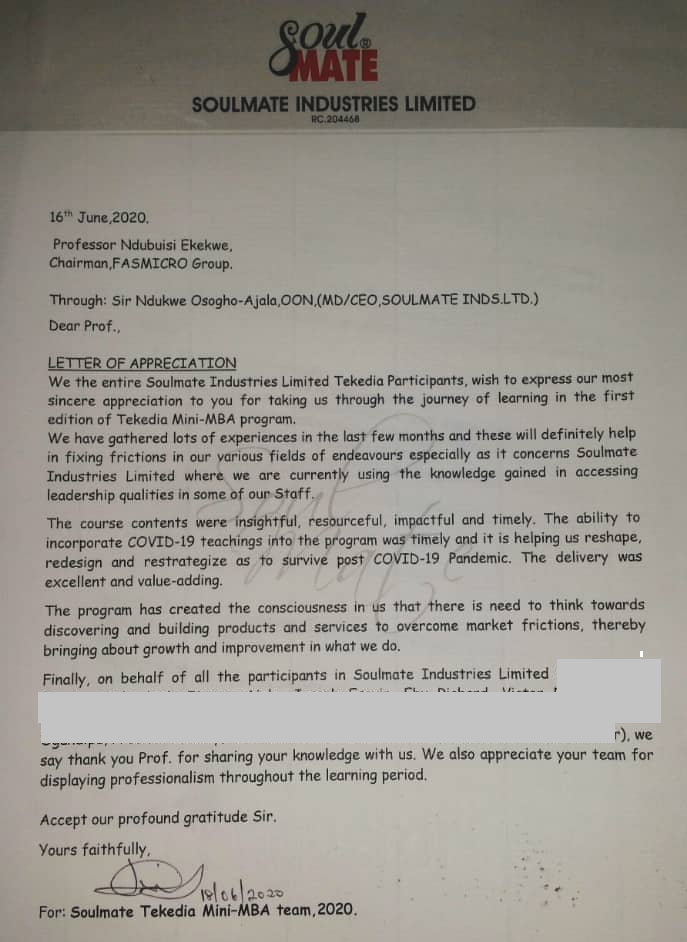
Testimonial from Soulmate Industries Ltd


ebook Free for early registrants
Free for early registrants


You get discount coupon to this book


The Banker Explains Why Nigerian SMEs Struggle To Get Affordable Loans

1

Ebenezer Onyeagwu, the GMD of Zenith Bank Plc, in an interview with Arise TV, explained why small and medium scale enterprises struggle to get low interest loans in Nigeria. I have noted already that Nigerian banks cannot easily lend in single digits due to many factors. Those factors include that the central bank “lends” to them at about 11%, and they have to insure the funds, and by the time they add cost of operation & compliance, with small profit, anything less than 17% may not be possible.

See it this way: the Central Bank of Nigeria (CBN) lends at close to 11% to banks and NDIC, the deposit insurance regulator, asks banks to insure (put another 2%). If you add banking operations costs and need to make small money, no bank can lend below 17% annually in Nigeria.

But some nations lend to their banks at 0.25%: “In December 2020, the Federal Reserve maintained its target for the federal funds rate at a range of 0% to 0.25%.” This cheap money makes it possible for U.S. banks to give cheap loans to their SMEs. Yes, you can get a business loan at 6% or even lower.

But in Nigeria, starting at 11% made it impossible for banks to match that.  Because they have to move above 17%, it creates a vicious circle which makes things harder. See it this way – at that 17%, most SMEs cannot return whatever banks have given them, setting the banks up for losses. Simply, there are few businesses in Nigeria where you can make profits when your cost of capital is 17% before taxes to repay your loans.

According to Mr. Onyeagwu, “if you look at the numbers, you will see that these regulatory costs account for a whopping 28 percent of our overhead.” Yet, it is not only Nigerian banks which are regulated; American banks are regulated and yet they can lend at sub-6%. The most fundamental thing here is the prime rate which in the US tends towards zero while in Nigeria hovers around 11%. Read the full interview here.

Arise TV: So, how can we get interest rates on loans down to single-digit?

Ebenezer Onyeagwu: First of all, if you are looking at interest rate, you have to look at it in terms of the theoretical framework and issues around money supply, demand for money, issues around government borrowing and the fiscal deficits. So, when you put all that together, you will see that you cannot have a situation where you decree interest rate by fiat. Interest rates would always be set by the dynamics and realities in the market. In this case, if you are looking at interest rate in Nigeria, you have to index it to the risk-free rate. One-year risk-free rate in Nigeria is like 10 per cent. So, it will be difficult to have single-digit rate in Nigeria. However, the Central Bank of Nigeria has come up with a number of laudable initiatives to support single-digit lending.

We have intervention funds such as the Creative Industry Financing Initiative, where banks in the country provide long-term single-digit funding for entrepreneurs who are in cinema, movie, ICT and fashion designing. We also have what is called the Agri-Business/Small and Medium Enterprise Investment Scheme. It is also a pool of fund available for businesses in that space. You can as well access these loans. Apart from these ones, the CBN also have different intervention schemes such as the Anchor Borrowers Scheme, the Commercial Agricultural Credit Scheme and others, and all these loans are single-digit and they provide long-term financing. The big problem we have is that when you see an SME approaching you for loan, the SME may not have a track record; he walks up to you and tells you that he needs a single-digit loan and needs N20 million.

But I can’t give you N20 million without looking where you are coming from. So, we cannot decree interest rate by fiat. But the regulators have done a good work by providing funding schemes and whoever is eligible would get such single-digit long term loans once they meet the criteria. So, the funding is there, but the SMEs when they approach the banks don’t often meet the eligibility criteria.

Yet, you cannot ask the Central Bank of Nigeria (CBN) to drop its rate to 1% without thinking of inflationary pressures in the economy. The apex bank at the end has to pick a lesser evil – and today, it is that SMEs cannot get cheap loans. If you want them to get loans at 6%, you may end up messing up the economy. This happens because of the structural nature of our economy. Yes, CBN cannot just wake up and tell banks, from today, you need to lend at 6% because it cannot!

The MTN Nigeria’s Record N1.346 trillion Turnover

1

Covid-19 broke industrial sectors, but some sectors, despite the paralysis, captured huge financial values. With people constrained in their homes, talking and using the web became  the few options to keep the hours going: “Adoption of our data and digital services accelerated as lockdowns and gathering restrictions were imposed, and work-from-home became the norm for many”, noted MTN.

Yes, the telecommunication sector, across the world, saw growth, accelerated by Covid-influenced intervention programs. So, it is not surprising that MTN Nigeria is reporting a record number – a turnover of N1.346 trillion for the financial year 2020! In other words, MTN Nigeria is the largest publicly traded company by revenue in Nigeria. If you have not run the math, that is about 10% of Nigeria’s national budget as turnover!

But earnings were restrained by a rise in direct network operating costs by more than a quarter from N246.604 billion to N310.248 billion, and in discounts and commissions by over one fifth from N56.586 billion to N68.528 billion.

An 18 per cent rise in MTNN finance costs, which represents the cash it spends on interest on short-term loans, from N122.080 billion to N143.687 billion also capped earnings.

Pre-tax profit came to N298.874 billion, up from the N291.277 billion reported for the corresponding period of 2019, according to the telco’s financial statement published by the Nigerian Stock Exchange.

Profit for the year inched up 1 per cent from N203.283 billion to N205.214 billion.

Shareholders fund upped from N145.857 billion to N178.386 billion at the rate of 22 per cent. MTNN shares closed trade on the floor of the NSE on Monday at N174 per unit, posting no movement.

Yes, a South Africa’s DNA’d company is helping us to understand that wealth abounds in Nigeria. Congrats to the home of Y’ello.

The World’s Greatest Invention – And Why Nigeria Needs It.

1
Nigeria leaders

Markets cannot advance faster than the legal ordinance in economies. The foundation of all modern economies can be traced to property rights. If you check the gross world product (GWP) – aggregate GDPs of all nations – you will notice that for more than 1,400 years, from AD 1, the GWP was flat, meaning that per capita income was decelerating, across generations, implying that man/woman was getting poorer. 

But around the birth of America, something happened: legal ordinance was put into market systems through property rights. And just like that, the linear GWP began to grow exponentially. In a publication in Harvard, I noted that until nations advance the legal ordinance, by strengthening property rights – intellectual or  otherwise – they will remain largely poor.

The cement for factors of production is legal ordinance. Nigeria will not advance faster than the strength of its property rights. When a cow eats a farmer’s crops, and there is no consequence, Nigeria gets poorer. When a man steals the ideas of his neighbour and there is no consequence, Nigeria misses a pulse. You may think that it does not matter. It does, because the safest abode for capital is an economy, run within a strong rule of law. If you do not have that safe legal destination, capital will disinvite itself! 

Nigeria needs to fix the fundamental things about the nation. Yes, we need to go intellectual. If we do, we will notice one factor: you cannot leapfrog the strength of your legal systems, as you advance as a nation! If you do not know, know it now that the invention of intellectual property rights is the biggest invention in human history.  The ordinance of markets lives on a great legal system – and the biggest magnet for capital is that legal system. As the high priest to the IPRs, the legal system makes markets function and runs. That is the law for economic development.

Intellectual property rights are legal rights that provide creators protection for original works, inventions, or the appearance of products, artistic works, scientific developments, and so on. There are four types of intellectual property rights (IP): patents, trademarks, copyrights, and trade secrets