DD
MM
YYYY

PAGES

DD
MM
YYYY

spot_img

PAGES

Home Blog Page 5880

The Updated Nigeria’s National Cybersecurity Policy and Strategy

0

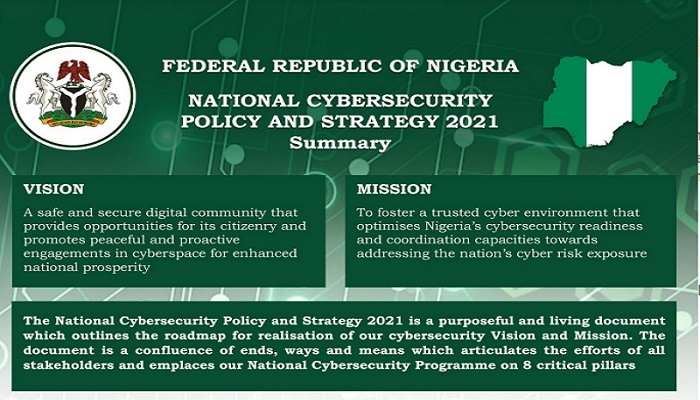
Here is a summary of the National Cybersecurity Policy and Strategy for Nigeria. The following is the lead statement from the President announcing it.  Download the full report here.

PRESIDENT MUHAMMADU BUHARI UNVEILS NIGERIA’S  NATIONAL CYBERSECURITY POLICY AND STRATEGY 2021

ON 23 FEBRUARY 2021


On 23 February 2021, President Muhammadu Buhari unveiled the National Cybersecurity Policy and Strategy 2021 as the overarching policy and strategy framework for driving Nigeria’s cybersecurity efforts towards the attainment of our national objectives.


Nigeria is currently at a turning point in its history. The country is blessed with a young and vibrant population which has the potential to exploit the benefits of the Internet to enhance economic progression and improve national security. Nigeria is also witnessing a rapid surge in the adoption of the Internet and social media for almost all aspects of daily life. Therefore, there is no argument that the Internet or cyberspace is now central and indispensable to the country’s national development.  

  1. However, like several other countries across the globe, the growth and development of the Internet is accompanied by significant problems. We are witnessing a rise in threats posed by cybercriminals, online financial fraudsters and cyber terrorists who use the Internet to cause apprehension. We are also observing a surge in the use of the Internet and social media for propagation of hate speech, fake news and seditious messages, as well as the risks of breaches to personal information and government sensitive data. Some global events such as the rapid emergence of new technologies, the outbreak of the COVID-19 pandemic and the advent of 5G technology, have further widened the scope and diversification of these cyber threats.
  2. Therefore, in a bid to ensure that we effectively embrace and harness the benefits of the digital revolution while effectively combating the heightening risks of cyber threats, it became expedient to review Nigeria’s National Cybersecurity Policy and Strategy 2014 and develop a comprehensive National Cybersecurity Policy and Strategy 2021 for the common good of the country. The document was formulated by a multi-stakeholder committee comprising representatives from various sectors of the Nigerian economy including Government agencies, private sector, academia, professional organisations and the international community. The National Cybersecurity Policy and Strategy 2021 will provide Nigeria with the necessary platform to effectively confront the dynamic nature of threats in our cyberspace. The document will also provide the framework that would enable us harness the efforts of our private sector, academia and industry towards progressive economic and national development. To this end, the document will provide the roadmap for technical education, digital skills acquisition and indigenous technology production, thereby creating job opportunities for our youths and supporting our resolve to alleviate poverty and boost our economy.


  1. The National Cybersecurity Policy and Strategy 2021 signifies the rejuvenation and renewal of President Muhammadu Buhari’s promise and commitment to Nigeria’s national security and economic prosperity and it ensures that our National Cybersecurity Programme is prioritized among other national exigencies.


  1. Mr President ended his speech by commending the efforts of the National Security Adviser (NSA) and his staff as well as other stakeholders for the remarkable work in developing the document and contributions towards strengthening the development of cybersecurity in Nigeria. The President urged the National Security Adviser (NSA) to continue to coordinate the efforts of all stakeholders to ensure that Nigeria’s Internet and cyberspace are used for the enhancement of national security and economic progression. He finalised his speech by saying that he is confident that, together we can pave the path for the creation of new opportunities to usher Nigeria into a bright future driven by a prosperous cyberspace and digital economy.


Rethinking News Writing: A Question of RBA versus VBA

0

In one of the previous analyses, our analyst notes that the Nigerian news media need to consider news as a product not as a content. Readers and listeners are being denied the opportunity of deriving the needed value when they are exposed to mere presentation of the expected 5W’s and H, news values, headlines and quoting the newsmakers directly and indirectly.

This, according to our analyst, is the appropriation of resource-based approach without consideration of value-based approach in addition. Though, in our experience, it emerged that Nigerian news media are picking manifest and latent issues or needs from the newsmakers’ views and other sources, and framing them towards setting certain agendas to the public, it is obvious that they are misusing their framing and agenda-setting power. This is more pronounced when conflicts and violence are being reported.

Our analyst notes that using value-based approach in addition to the resource-based approach or without it has greater benefits for the audience. VBA entails the inclusion of 5W’s and H, news values, headline, headline analysis using impression and engagement factors for choosing an appropriate headline, emotional measurement using fear, anger, sadness, joy and value proposition [this has been discussed in the previous analysis] are key resources of the VBA.

Catering for the audience information urge using RBA is not enough. Application of VBA offers mental, emotional and inclusive peace benefits rather than conflict-induced values being presented through RBA in most cases. During the trending period of the emergence of Sunday Igboho as a ‘protector’ of victims of insecurity in Oke-Ogun in Oyo State, Sahara Reporters wrote “Ooni Is My Father, I Hold Him in High Esteem – Sunday Igboho.” Reporting the same event/information, The Punch said “I hold Ooni in high esteem, says Sunday Igboho.”

With 69 score out of expected 100 score, Sahara Reporters engaged audience more than The Punch which had 66 score. In terms of creating a lasting impression on the audience, Sahara Reporters also led with 51 while The Punch had 45 score. Despite the difference, the two newspapers were succeeded in creating fear with attainment of the same score of 62. In terms of sadness, Sahara Reporters had 61 while The Punch had 62. These insights indicate that using part of the VBA, these newspapers ensured mental and emotional benefits. Our analyst notes that the newspapers want the public to understand that Ooni should be respected and that Sunday Igboho regretted his action.

Tekedia Institute Welcomes A Chinese Economic Expert and Thought-leader, Dr Henry Chan

0

Tekedia Institute is excited to welcome a Chinese economic expert and a thought-leader in the domain of digital and electronic commerce, Dr Henry Chan, to our Institute. Dr Chan has developed a course on ecommerce for Tekedia Mini-MBA. More so, we will host him at  Tekedia Live as follows:

  • Topic: Ecommerce in China
  • Date; March 9, 2021
  • Time: 12 noon WAT
  • Zoom link: in the school board

In his course at Tekedia Mini-MBA, he explained the rise of Digital China and the factors driving the Mobile-AL China.

Dr Henry Chan completed his university degree in Engineering from The University of the Philippines,  MSc in Biopharmaceutical from The University of New South Wales and PhD in Management from Singapore Management University. He is a businessman turned to scholar work with extensive experiences in agriculture, hotel management, manufacturing, banking, and investment.

Dr Chan is the senior visiting research fellow of Cambodia Institute for Cooperation & Peace and his research interest is Chinese economic development, ASEAN & China relations, technology & economic growth. He is an active conference and seminar speaker on topics ranging from climate change, regional and international geopolitics to economic development.

The New Category-King of Nigerian Banking

4

Can we say that the New Category-King is now evident? I think in the FUGAZ world, Zenith Bank has clearly overtaken GTBank as Nigeria’s leading financial institution. The impressive ascension of Zenith Bank is a case study for everyone: service excellence will win trophies in banking. Zenith’s technology leapfrogged and the balance sheet responded.

And there is a historical perspective to that: the best of Nigerian banking began when the new generation banks imposed new or higher  fees – commission on turnover (COT) – and accelerated service in early 1990s. They reduced what used to be three hours of wasted time, in bank halls, to fifteen minutes – and Nigerians responded. Yes, Nigerians paid the fees but got out of the bank halls faster!

From that experience, it is evident that the most profitable bank customers want service, not just low costs. In other words, if your fees increase marginally and you deliver value, good moments will come.

Zenith Bank’s FY 2020 results broke records: the Profit After Tax (PAT) of N230.6 billion, a 10.4% increase compared to 2019’s N208.8 billion, made it the first Nigerian bank to cross N200 billion on PAT. Hail the new king!

Now, everyone wants to be at the zenith now that Zenith is there; expect new playbooks from other members of FUGAZ.

Meet Princess Amarachi Okeoma-Ihunwo, The 9-Year-Old Who is Proficient in Over 10 Programming Languages

1

When Princess Amarachi Okeoma-Ihunwo was four years old, she asked me some interesting questions with the curiosity of a child but the expectation of an adult. How did going to school come about? What was the world like before the advent of the telephone? I was intrigued by her beautiful mind and knew right there that she was born a star girl.

And I was not wrong.

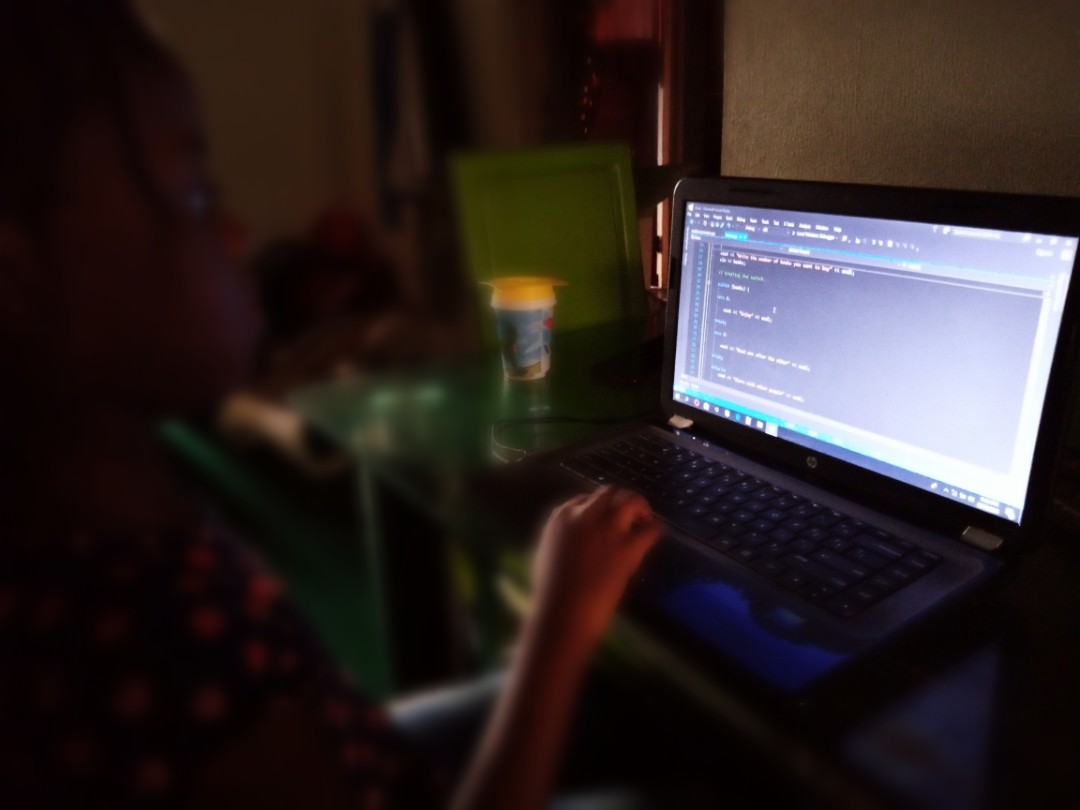
Five years later, she has become proficient in web design, JSON, Linux, JavaScript, JQuery, Python, HTML 5, CSS 3, SQL, PHP, XML, and Ajax. I quickly put clothes into my travel bag and hit the road to Warri, Delta State, in Nigeria where she, her two little brothers, and her parents reside when she called me on Whatsapp to tell me she was learning mobile app development. It was long overdue—I had to see what this young girl had transformed into. She was aware I very busy with my job as a social investment advisor in Port Harcourt—I explain this to her whenever she calls me asking when I will be come to visit her. So, she could not keep calm when I told her my leave request had been approved.

“I can help you do your office work, you know,” she boldly told me when I was worried about some backlogs I needed to clear before going into leave mode fully. Her voice did not betray a plea; she was not asking if she could help me, she was telling me she could do my work! So much self-confidence and assurance in her own abilities. I would later learn that her father seldom allowed her do ‘work’ on some of his real projects to quench her insatiable appetite for coding.

“I searched on Google to learn how to add a pdf file to my website, I didn’t know how to do that, my father didn’t teach me that… But I chose to learn it because I want to create tutorial videos with download links, I can host on my website so viewers can download my videos.”

“You know, it’s a digital world, so I just thought to expose her and her only brother at the time to basic computer applications like Microsoft Packages like Word, Excel, & PowerPoint,” Mr Okeoma Ihunwo, Princess’ father narrated, “But she picked them up too fast and I was like, okay girl, maybe we can do more programs. And she impressed me beyond my expectations.” Mr Okeoma is a programmer who has experience working with top IT firms like Intel.

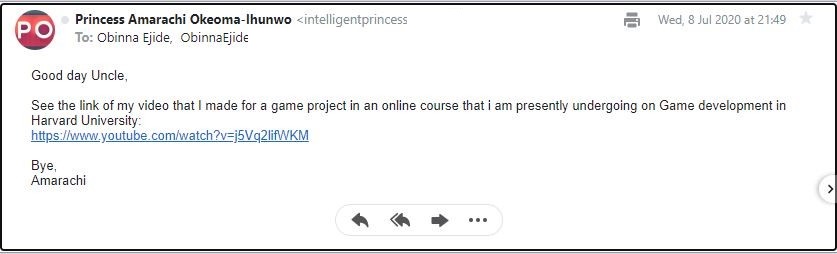
Based on her father’s recommendation, Princess took online courses from Harvard University on Game Development and has now developed her own games. The role parents or guardians play in shaping the interests of children can significantly reduce the deficit in learning opportunities available at school. Princess is gradually learning that tech education is still infantile at the early education levels in Nigeria. “I tell my classmates in school about the programs I am learning and they look at me like I am saying something strange,” she tells me I ask her if she wished she were in a circle of friends that code like her.

This low adoption of tech education at the primary and secondary education levels in Nigeria betrays the popular narrative that Africa’s tech ecosystem is growing fast. Tech is still being introduced to primary education curriculum in Nigeria like a vaccine is to a diseased host. The ideal expectation, which resonates with current global realities, is that tech should be an essential nutrient in the educational feed given our children. There are limits to how much Capital (explained as multimillion dollar series funding) can do to help develop tech, but better use of human capital nurtured from childhood is key to sustainable growth and development of the tech ecosystem in Nigeria and Africa.

“I searched on Google to learn how to add a pdf file to my website, I didn’t know how to do that, my father didn’t teach me that… I want to make some tutorial videos I can host on my website and create links that viewers can go to for download of the videos,” Princess said while explaining to me the workings of her website. Perhaps Jean Piaget’s theory is true, that everything we do for children deprives them of the opportunity to do it for themselves, summing up intelligence as not something a child has but something a child creates. But I’m intrigued by the passion she exudes about this her new found love. Whether we were about to build houses with toy blocks with her siblings or go over some problems in mathematics, her best subject, in preparation for her common entrance examinations, she would first inquire whether she could work with a laptop in the house after all work or play. I am also impressed that her love for mathematics is a fine complement to her good communication skills. We exchange emails, place calls to each other, and oftentimes I forget we’re not of the same generation.

Whether coding will turn out to be Princess’ future career is still probable. When I asked her, she noted she would like to become the CEO of a bank someday, something she is enthused about given that her mother is a Relationship Manager in one of the leading commercial banks in Nigeria. Becoming a bank CEO with a background in tech is something rare or, perhaps, non-existent in the traditional banking industry. The fintech industry, however, is fiercely challenging this norm in the competitive Nigerian financial sector with the rise and rise of young, savvy tech gurus leading tech start-ups.

Although it is hard to deny that women are grossly underrepresented as CEOs/cofounders when you consider the number of fintech founders/co-founders in Nigeria, role models like Fara Ashiru Jituboh, the woman behind Okra, Africa’s first API fintech “super-connector”, and Odunayo Eweniyi of Shapire Global Limited (the company behind PiggyBank) could be role models to help inspire Princess if she cares to dream in that direction. The right time to grow her interest and build her capacity is now, as a child. Naomi Dickson, a dental technologist-turned-software-analyst based in Lagos, Nigeria, echoes this by reliving her own experience:

“At the start of my journey I almost quit because I thought it was impossible… I encountered in a funny way most of the things I learnt as a child and realized no knowledge is a waste. I think the girl child needs the right information and encouragement. She needs to know that she can do it—and if these things are introduced to her early, she’d get a better grasp of it,” Naomi replies me when I write to her about Princess.

“I tell my classmates in school about the programs I am learning and they look at me like I am saying something strange.”

When I ask Princess the question again, if she wished she were in a circle of peers that code, and further explain the benefits of belonging to a community of kids with like interests, she nods her head. A few ideas come to my head, but I am worried about the constraints of geographical boundaries. Warri as a city is unpopular when it comes to bootcamps for coding. Edna Okeoma-Ihunwo, Princess’ mum, tells me that she wishes her daughter could be a part of a project where her coding capacity can be fully harnessed for global competitiveness. Oluwafunmilola Kesa, a software engineer that enjoys teaching kids how to build applications, thinks Princess has got the right foundation to do so. Olufunmilola is currently a PhD candidate in University of Warwick, I met her through a mutual friend when my mind was snapping with ideas about Princess.

Well, I think Princess and other kids her age need to find coding as natural and fun the same way they find themselves mimicking characters or events that they relish. Once, I found Princess in the sitting room wielding a TV remote in the approved manner of a microphone in the hands of a preacher, bouncing about the area of her imaginary stage and introducing to her imaginary audience the beneficiary of an imaginary award. I watched her furtively, awaiting the decision from her lips. “And the Best Player in the Universe is… Cristiano Ronaldo!”