DD
MM
YYYY

PAGES

DD
MM
YYYY

spot_img

PAGES

Home Blog Page 5884

Side Effects of Eye Service

1

Some call it eye service, some window dressing, and others, grandstanding. Irrespective of the name it bears, eye service is never a desirable behaviour to emulate. Eye service describes the behaviour of a person, who wants observers to have a false positive impression about him. It is usually used to depict behaviours of employees, who only perform their duties when their superiors, supervisors, or bosses are watching them. But, in addition to that, eye service also includes people that pretend to be well-informed and skilled just to impress their bosses.

As implied above, employees that engage in eye service do so for several reasons. One of these reasons is laziness. Another one is mischief. Then, there are those that do it because they don’t want to lose their jobs or receive punishments for their unproductiveness. Finally, there are those that act this way because they want to attract the attention of their bosses, hoping to win favours.

In the case of the first three groups, the concerned employees avoid their bosses because they want to remain invisible. These groups do not want their bosses to remember they exist in the office. All they care about is to receive their financial benefits, especially their salaries, and promotions. Any other incentives, such as assignment of special duties, assignment of company vehicles, and so on, are not their interests. These are the people described as “marking time”, because they don’t do anything that will help them or their employers to grow.

However, unlike the other groups, the last group is made up of employees that always seek the attention of their bosses. These are the ones that provide their bosses with information, ideas, opinions, and knowledge they gathered from colleagues without giving them credits. It is in this group that you find idea thieves and those who pull down their colleagues to climb up. It is from this group that “square pegs in round holes” emerge from.
Nevertheless, there is no form of eye service that is good. This is because the behaviour has detrimental effects on all the actors involved. Eye service affects those that practice it, their colleagues, and their employers. How these happen are discussed below.

  • Its Effect on Affected Employees

Employees that practice eye service may not always know that it affects them negatively. Most of them think they are being smart until they find themselves redundant and almost on the way out. Their avoidance of duties keeps them away from learning their works, thereby causing them to remain stagnant. Those that steal their colleagues’ ideas to win favours put themselves at tight corners when their bosses give them responsibilities based on the impressions they have been creating. By the end of the day, these people lose when others are gaining. Of course, they might climb to the top, but they can’t remain there.

  • Effects on Colleagues

No one wants a pretentious person in his team. This is because, apart from lying to cover up for them, having such a person creates extra work for team members. This puts stress on workers, whose bosses believe they have enough hands to handle assignments. Further, if a pretentious person is promoted (especially if made the supervisor of his team) or rewarded for “excellence”, his colleagues will feel cheated and dissatisfied with their work. This can cause conflicts in the workplace, which will in turn cause many workers to work haphazardly, complain about their works, engage in eye service, or resign.

  • Effects on Employers

One way or the other, employers lose when their workers play eye service. Some of them are deceived into entrusting these people with crucial positions they cannot handle. Because these workers do not perform as they ought to, production becomes low and employers make less profit. Those put in positions they could not manage may end up making mistakes that could cost their organisation a lot. This is why employers should find ways of evaluating their employees before assigning them any duty.

Eye service can be found in all the sectors of the economy. However, it is commonly found in offices, where workers are not well supervised. This bad behaviour has done more harm than good and it affects all the people concerned. This is why employers should not hesitate to punish workers that engage in this type of behaviour so it will serve as a deterrent to others.

What One Word Defines Your Mission?

0

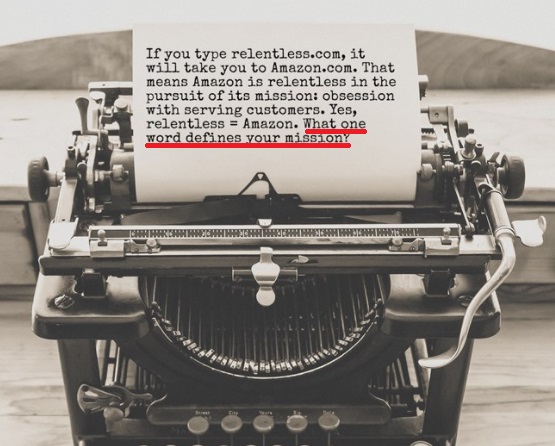
If you type relentless.com, it will take you to Amazon.com. That means Amazon is relentless in the pursuit of its mission: obsession with serving customers. Yes, relentless = Amazon. What one word defines your mission?

The DNA of empires is the accumulation of capabilities.

I go with “execute” which I use a lot because until it is made to happen, it has not happened.


Attitudes of Nigerians that have the Potential of Harming the Country

0

What every citizen owes his country, whether it is the country of origin or that of adoption, is love. Citizens are expected to act in ways that will protect the reputation of their countries as well as project its image. However, this notion is disappearing for Nigerian citizens, both home and abroad, and it is becoming a thing to worry about.

Today, many Nigerians are no longer patriotic. They act in ways that show their lack of love for the country but pretend to care about it. Those committing crimes and other atrocities have already declared their hatred for Nigeria and so, are known enemies of the nation. However, the country has a lot of unknown enemies, who thought they are practising “patriotism” but are unwittingly destroying the country’s image and reputation.

The first offenders, in this case, are the Nigerian media houses and their journalists. For reasons bordering around satisfying their owners, keeping their clients happy, and attracting income, the press has chosen to spread destructive news about the country. Whether out of ignorance, mischief, or pure malice, these newsmen and newswomen have decided not to dig deeper to source for facts before reporting. They publish news articles devoid of substance even though they know how misleading those could be. They do not come back later to apologise, in tabloids, or republish articles to correct their initial damages even though their errors have been pointed out by the public, private individuals, or concerned organisations. Maybe until the Nigeria judiciary becomes effective and media companies begin to lose money through lawsuits will they learn to do things the right way.

The next offenders here are the elites. For reasons best known to this group of people, they say ills about this country despite benefiting immensely from it. Only a handful amongst them comes out once in a while to reveal the beauty of the country. Since everyone thinks Nigeria is bad, the elites allow people to walk in the dark. They seem to enjoy being the only privileged ones in the country because that will keep them on the chair forever.

The one that is going to be more destructive for the country is the attitude of the masses. Not quite long ago, Nigerians think well of and pray for the greatness of their country. But recently, it seems as if many Nigerians want their country to crash. From the look of things, a lot of Nigerians hope to see the county implode. What they hope to gain from it, nobody knows. But what they don’t know is how they will fair if such happens. Nigerians are playing with a rattlesnake, wondering if it will bite them. Or maybe they hope for a miracle that will stop them from dying if the snake bites.

In case you are wondering about the things Nigerians do that will affect the country negatively, I will suggest that you look around and notice how antagonistic people are becoming to the country. They do this by:

  1. Sharing bad news about the country and ignoring good ones.
  2. Sharing fake news gleefully, even when they know it is false.
  3. Attacking people that speak well of the country.
  4. Attacking people that debunk fake news.
  5. Negatively branding people that preach peace in the country.
  6. Negatively branding people that provide details that clarify “bad” news.
  7. Ridiculing people that still believe in the country.
  8. Discouraging people, especially investors, that have plans that will help the country.
  9. Encouraging people with innovation potentials to leave the country.
  10. Undermining policies and programmes that will help Nigerians.

And many others not captured here.

It is possible most people don’t know that their attitudes and actions will harm the country. Maybe they thought they were fighting bad governance and corruption or, as stated earlier, being patriotic. Some believe that by pointing out only the bad and ignoring the good, they will make the leaders sit-up. However, they need to understand that patriots don’t destroy the image of their countries. A patriot encourages people, both local and foreign, to live in and invest in his country. He preaches hope and proffers solutions to existing problems within his community. It is time Nigerians meditate on their actions and attitudes towards the country and decide where they stand. They should always remember that no matter where they find themselves tomorrow, Nigeria is still their root.

Partner with Tekedia Institute

0

It touched me – some of our co-learners at Tekedia Mini-MBA joined our class 90 minutes on Zoom before time. I mean, this is starting at 7pm but dozens are already in an hour ago – we are still 30 mins away. People, we need your support to educate, inspire, and advance our young people. If you are a foundation – Mastercard Foundation, Ford Foundation, The Rockefeller Foundation, Dangote Foundation etc, – Tekedia Institute can help you accomplish your mission in the developing world.

We have demonstrated that we can motivate young people to learn via a new model of education. Our website had crashed, at 1am, because most members, to enjoy cheap internet browsing, study that time. What we are doing is simply uncommon. Partner with us.

How can you explain this – young people getting to class 90 mins before time? Simply, the program has impacts!

Ecommerce in China – A New Course at Tekedia Institute

0

Dear Co-Learners, 

The China ecommerce course is now ready for Tekedia Mini-MBA. Dr Henry Chan, a leading industry consultant and academic in the ecommerce space in China and its interface with the world, has just completed an amazing course on “E-commerce in China”. The videos and everything are ready, and our team will be adding them in the next coming weeks. Our team is also working to schedule him for Tekedia Live. 

Going through the course, I can see a theme: inventing new business models is  critical and there is no single business model that can serve every part of the world. He put efforts to explain how China and its innovators have worked to create what they did. 

More so, we are also working with the former CEO of Coca Cola India as we work to bring global insights to our business school. This is necessary as we have 36 countries represented in the current edition.

In about 40 minutes, I hope to meet everyone in the class.