DD
MM
YYYY

PAGES

DD
MM
YYYY

spot_img

PAGES

Home Blog Page 5885

Shecluded – Building Impactful Gender-Anchored Companies

0

She runs an extremely unique company: “a finance company providing women with access to financial growth services to help then achieve their goals”. This firm has deepened partnerships with some leading financial institutions to execute the mission. Interestingly, we recently noted that the fintech startup has been funding young women to attend Tekedia Mini-MBA through scholarships via a non-profit.

Tekedia Institute is happy to announce that the Founder & CEO of Shecluded, Ifeoma Uddoh, will be our guest at Tekedia Live on March 23 at 11am WAT. Her company is bringing a new playbook on how to build inclusive economic structures: “Magic happens when you combine a smart woman, access to credit and the power of a collaborative community.”

Through a partnership with Stanbic IBTC Bank, Shecluded is making pension accessible to women. The firm is also investing in female founders. I must tell you that the math is working; Ifeoma studied industrial mathematics in my alma mater, FUTO, and understands numbers: empower women, empower the world!

A core pillar of our Institute is to make scholars “noble”. We do think Shecluded will inform and inspire us on that mission. Zoom and more details in the Board.

We welcome Ifeoma and Shecluded to Tekedia Institute.

The Updated Nigeria’s National Cybersecurity Policy and Strategy

0

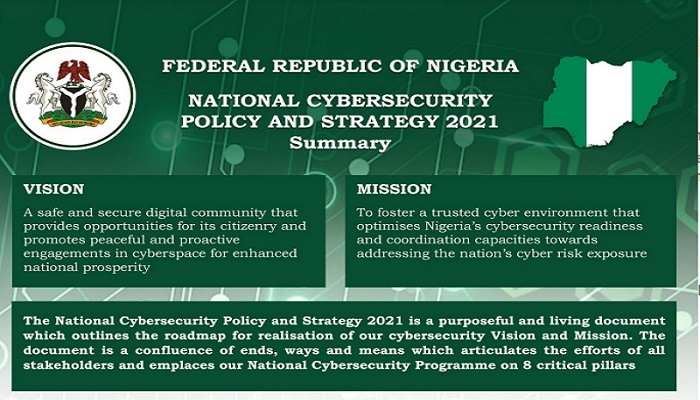
Here is a summary of the National Cybersecurity Policy and Strategy for Nigeria. The following is the lead statement from the President announcing it.  Download the full report here.

PRESIDENT MUHAMMADU BUHARI UNVEILS NIGERIA’S  NATIONAL CYBERSECURITY POLICY AND STRATEGY 2021

ON 23 FEBRUARY 2021


On 23 February 2021, President Muhammadu Buhari unveiled the National Cybersecurity Policy and Strategy 2021 as the overarching policy and strategy framework for driving Nigeria’s cybersecurity efforts towards the attainment of our national objectives.


Nigeria is currently at a turning point in its history. The country is blessed with a young and vibrant population which has the potential to exploit the benefits of the Internet to enhance economic progression and improve national security. Nigeria is also witnessing a rapid surge in the adoption of the Internet and social media for almost all aspects of daily life. Therefore, there is no argument that the Internet or cyberspace is now central and indispensable to the country’s national development.  

  1. However, like several other countries across the globe, the growth and development of the Internet is accompanied by significant problems. We are witnessing a rise in threats posed by cybercriminals, online financial fraudsters and cyber terrorists who use the Internet to cause apprehension. We are also observing a surge in the use of the Internet and social media for propagation of hate speech, fake news and seditious messages, as well as the risks of breaches to personal information and government sensitive data. Some global events such as the rapid emergence of new technologies, the outbreak of the COVID-19 pandemic and the advent of 5G technology, have further widened the scope and diversification of these cyber threats.
  2. Therefore, in a bid to ensure that we effectively embrace and harness the benefits of the digital revolution while effectively combating the heightening risks of cyber threats, it became expedient to review Nigeria’s National Cybersecurity Policy and Strategy 2014 and develop a comprehensive National Cybersecurity Policy and Strategy 2021 for the common good of the country. The document was formulated by a multi-stakeholder committee comprising representatives from various sectors of the Nigerian economy including Government agencies, private sector, academia, professional organisations and the international community. The National Cybersecurity Policy and Strategy 2021 will provide Nigeria with the necessary platform to effectively confront the dynamic nature of threats in our cyberspace. The document will also provide the framework that would enable us harness the efforts of our private sector, academia and industry towards progressive economic and national development. To this end, the document will provide the roadmap for technical education, digital skills acquisition and indigenous technology production, thereby creating job opportunities for our youths and supporting our resolve to alleviate poverty and boost our economy.


  1. The National Cybersecurity Policy and Strategy 2021 signifies the rejuvenation and renewal of President Muhammadu Buhari’s promise and commitment to Nigeria’s national security and economic prosperity and it ensures that our National Cybersecurity Programme is prioritized among other national exigencies.


  1. Mr President ended his speech by commending the efforts of the National Security Adviser (NSA) and his staff as well as other stakeholders for the remarkable work in developing the document and contributions towards strengthening the development of cybersecurity in Nigeria. The President urged the National Security Adviser (NSA) to continue to coordinate the efforts of all stakeholders to ensure that Nigeria’s Internet and cyberspace are used for the enhancement of national security and economic progression. He finalised his speech by saying that he is confident that, together we can pave the path for the creation of new opportunities to usher Nigeria into a bright future driven by a prosperous cyberspace and digital economy.

Rethinking News Writing: A Question of RBA versus VBA

0

In one of the previous analyses, our analyst notes that the Nigerian news media need to consider news as a product not as a content. Readers and listeners are being denied the opportunity of deriving the needed value when they are exposed to mere presentation of the expected 5W’s and H, news values, headlines and quoting the newsmakers directly and indirectly.

This, according to our analyst, is the appropriation of resource-based approach without consideration of value-based approach in addition. Though, in our experience, it emerged that Nigerian news media are picking manifest and latent issues or needs from the newsmakers’ views and other sources, and framing them towards setting certain agendas to the public, it is obvious that they are misusing their framing and agenda-setting power. This is more pronounced when conflicts and violence are being reported.

Our analyst notes that using value-based approach in addition to the resource-based approach or without it has greater benefits for the audience. VBA entails the inclusion of 5W’s and H, news values, headline, headline analysis using impression and engagement factors for choosing an appropriate headline, emotional measurement using fear, anger, sadness, joy and value proposition [this has been discussed in the previous analysis] are key resources of the VBA.

Catering for the audience information urge using RBA is not enough. Application of VBA offers mental, emotional and inclusive peace benefits rather than conflict-induced values being presented through RBA in most cases. During the trending period of the emergence of Sunday Igboho as a ‘protector’ of victims of insecurity in Oke-Ogun in Oyo State, Sahara Reporters wrote “Ooni Is My Father, I Hold Him in High Esteem – Sunday Igboho.” Reporting the same event/information, The Punch said “I hold Ooni in high esteem, says Sunday Igboho.”

With 69 score out of expected 100 score, Sahara Reporters engaged audience more than The Punch which had 66 score. In terms of creating a lasting impression on the audience, Sahara Reporters also led with 51 while The Punch had 45 score. Despite the difference, the two newspapers were succeeded in creating fear with attainment of the same score of 62. In terms of sadness, Sahara Reporters had 61 while The Punch had 62. These insights indicate that using part of the VBA, these newspapers ensured mental and emotional benefits. Our analyst notes that the newspapers want the public to understand that Ooni should be respected and that Sunday Igboho regretted his action.

Tekedia Institute Welcomes A Chinese Economic Expert and Thought-leader, Dr Henry Chan

0

Tekedia Institute is excited to welcome a Chinese economic expert and a thought-leader in the domain of digital and electronic commerce, Dr Henry Chan, to our Institute. Dr Chan has developed a course on ecommerce for Tekedia Mini-MBA. More so, we will host him at  Tekedia Live as follows:

  • Topic: Ecommerce in China
  • Date; March 9, 2021
  • Time: 12 noon WAT
  • Zoom link: in the school board

In his course at Tekedia Mini-MBA, he explained the rise of Digital China and the factors driving the Mobile-AL China.

Dr Henry Chan completed his university degree in Engineering from The University of the Philippines,  MSc in Biopharmaceutical from The University of New South Wales and PhD in Management from Singapore Management University. He is a businessman turned to scholar work with extensive experiences in agriculture, hotel management, manufacturing, banking, and investment.

Dr Chan is the senior visiting research fellow of Cambodia Institute for Cooperation & Peace and his research interest is Chinese economic development, ASEAN & China relations, technology & economic growth. He is an active conference and seminar speaker on topics ranging from climate change, regional and international geopolitics to economic development.

The New Category-King of Nigerian Banking

4

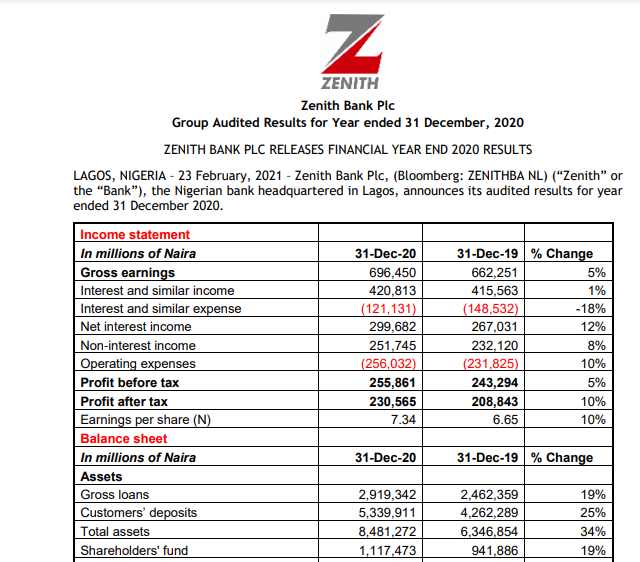
Can we say that the New Category-King is now evident? I think in the FUGAZ world, Zenith Bank has clearly overtaken GTBank as Nigeria’s leading financial institution. The impressive ascension of Zenith Bank is a case study for everyone: service excellence will win trophies in banking. Zenith’s technology leapfrogged and the balance sheet responded.

And there is a historical perspective to that: the best of Nigerian banking began when the new generation banks imposed new or higher  fees – commission on turnover (COT) – and accelerated service in early 1990s. They reduced what used to be three hours of wasted time, in bank halls, to fifteen minutes – and Nigerians responded. Yes, Nigerians paid the fees but got out of the bank halls faster!

From that experience, it is evident that the most profitable bank customers want service, not just low costs. In other words, if your fees increase marginally and you deliver value, good moments will come.

Zenith Bank’s FY 2020 results broke records: the Profit After Tax (PAT) of N230.6 billion, a 10.4% increase compared to 2019’s N208.8 billion, made it the first Nigerian bank to cross N200 billion on PAT. Hail the new king!

Now, everyone wants to be at the zenith now that Zenith is there; expect new playbooks from other members of FUGAZ.