Greetings and happy weekend. This is a quick reminder that we will begin the Tekedia Live session today at 7pm WAT. When you log into the school portal, the Zoom link is in the Program News & Zoom Schedule, below Lessons. Our Lead Faculty, Prof Ndubuisi Ekekwe, will begin today.
Next week, our Innovation & Design Thinking and Agile Methodology faculty members are scheduled; the specific Zoom links for those will be up on Monday in the Board when we populate the Week 3 courseware.
Tekedia Institute runs 24/7; daily short videos are shared in the Hub – hub.tekedia.com on latest business news and insights (MTN/Mastercard, Paystack payout to investors, etc). We encourage you to check as the Institute uses such to deepen learning outcomes. More so, you can join and share your insights and perspectives; all of us are learning and that is why we use “Co-learners”; we have no “students” here.
In this video, I discuss the new playbook between MTN and Mastercard. This is a new basis of competition depending on how regulators play along as the two firms integrate their technologies. If Mastercard and MTN integrate very deeply, it may be a radical new product evolution in the mobile money nations: “Through this strategic partnership, MTN customers with a Mastercard virtual payment solution linked to their MoMo wallets can make payments to global online merchants through a seamless and secure digital payment experience on websites and mobile applications.”
If you are in the fintech space, do not ignore this playbook. Why? What matters is controlling and influencing demand, and with MTN controlling millions of users, it changes the ordinance on launch.
“This significant milestone will enable millions of MTN customers to benefit from global digital commerce and drive digital and financial inclusion across Africa through easy and secure access to financial services,” said Amnah Ajmal, Executive Vice President for Market Development, Mastercard Middle East and Africa.
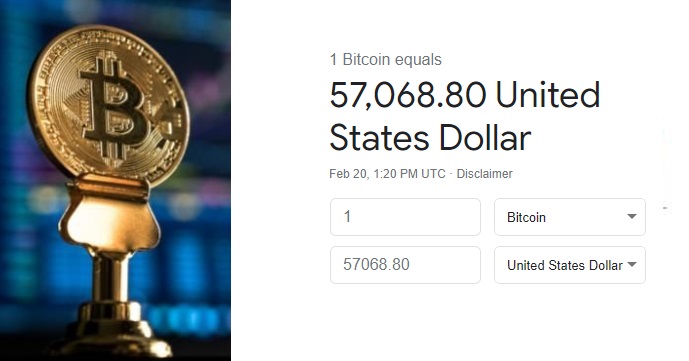
Hello Central Bank of Nigeria. This Bitcoin thing is scary. I mean the little BTC we made from Tekedia Mini-MBA payment is growing daily. What kind of economy would that engineer where people will wake up, after a few weeks, to see 2X returns? People, the United Nations Security Council needs to call an emergency meeting on BTC! No matter how you see this, there is a valid reason for concerns.
Somebody paid you $140 for a product, and within two months, that $140 turns into $210, just for leaving it in a “bank” account. How would the world run like that?
Bitcoin and broad cryptocurrencies are banned in Nigeria.
The Central of Bank of Nigeria’s (CBN) circular of January 12, 2017 ref FPR/DIR/GEN/C1R,06/010 which cautioned Deposit Money Banks (DMBs), Non-Bank Financial Institutions (NBFIs), Other Financial Institutions (OFIs) and members of the pubic so the risk associated with transactions In crypto currency refers.
Further to earlier regulatory directives on the subject, the Bank hereby wishes to remind regulated institutions that dealing in crypto currencies or facilitating payments for cryptocurrency exchanges is prohibited. Accordingly, all DMBs.
NBFIs and OFIs are directed to identify persons and/or entities transacting in or operating crypto currency exchanges within tier systems and ensure that such accounts are closed immediately. Please note that breaches of this directive will attract severe regulatory sanctions. This letter is with immediate effect.”
Comment: I’m wondering, Prof. What would the UNSC be suggesting to members in such a meeting, bTW?
My Response:This is a global security concern! If this hits $500,000 human nation-states can emerge for doing absolutely nothing except holding some bits and bytes. At least in the past, people got there for building real companies that solved people’s problems. But here, NOTHING. That is a risk to any economy because it will distort economic equilibrium and trigger crises. That is a security matter!
Next comment: isn’t that how start up investment works. You invest, you wake and it is doubled. In this case the collective is working, it’s not all the time you need to work to make money. This is decentralized wealth.
My response: startups build products and services, and are solving problems. The hodling* you are doing with BTC is not building any business or solving any specific friction. That is the difference. Hold ABC Ltd, you can get 10x but ABC is solving a problem. Hold BTC and get 10x, how did you help the world fix its problems as you are compensated? As I look at our wallet, it makes no sense that someone paid us $140 about four weeks ago, and that money is now above $200. That is not sustainable if we want to have a decent world.
In this video, I made a commentary on the implication of Investors Distribution Day for Paystack, a Lagos-based fintech company which was acquired by Stripe for a rumored $200 million.
Berlin, Germany - February 27: In this photo illustration the logo of transportation network company Uber is displayed on a smartphone on February 27, 2019 in Berlin, Germany. (Photo Illustration by Thomas Trutschel/Photothek via Getty Images)
Uber was handed a blow in London on Friday, after the Supreme Court ruled that its drivers should be classified as workers, upholding their rights to work benefits such as holiday pay, minimum wage and health insurance. Business Insider broke the news.
The legal tussle, which started in 2016, after two Uber drivers, Yaseen Aslam and James Farrar, who were later joined by 22 others, filed a lawsuit against Uber for denying its drivers basic work rights. The trial court had ruled in their favor in 2017 but Uber appealed the ruling.
Uber has been fighting to define itself as a tech platform serving only as an intermediary between drivers and riders, which should not be seen as an employer of labor. In its home market California, Uber had argued that counting drivers as employees will significantly affect riding cost, as the state’s AB-5 means that drivers will be paid minimum wage.
The prop.22 ballot which took place Nov. 3, allowed people to decide if they want Uber to continue with the gig economy through vote, since the court had earlier ruled against the taxi app.
In London, the story turned sour after Uber’s several attempts to get a favorable ruling.
“I understand the implication of how important today’s ruling is for millions of precarious workers” Yassen Aslam, co-lead claimant and App Drivers & Couriers Union President, told Insider after the ruling.
“These companies, like Uber, rely on vulnerable people they could exploit who don’t understand the law or they don’t know how to assert their rights,” he said, adding that the government also has to take responsibility on this abuse of rights.
Farrar, co-lead claimant and App drivers & Couriers Union General Secretary said the ruling will “re-order the gig-economy and bring an end to rife exploitation of workers.”
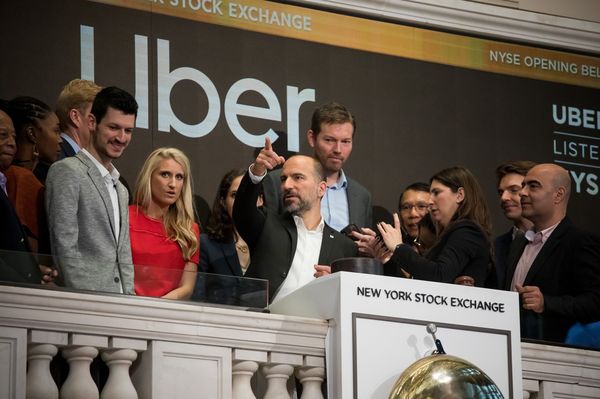
Dara Khosrowshahi rings the opening bell during the Uber’s IPO on the floor of the NYSE in New York on May 10. Photographer: Michael Nagle/Bloomberg
“Uber drivers are cruelly sold a false dream of endless flexibility and entrepreneurial freedom. The reality has been illegally low pay, dangerously long hours and intense digital surveillance,” he said.
Last year, Uber won a legal battle to restore its operating license in London. A judge ruled the California-based company is a fit and proper operator and should be allowed to operate in the UK capital. The ride-sharing company’s license was taken away in 2019 over “historical failings” that involved gross misconduct and breaking of the rules.
Friday’s judgment means London Uber drivers will henceforth be entitled to employment benefits. Insider quoted Daniel Barnet, an employment lawyer at Outer Temple Chambers, as saying in a bulletin after the ruling: “Uber drivers are entitled to claim minimum wage [including backpay for minimum wage], with their minimum wage claims being based upon their entire working day, not just when they had a rider in their cabs.”
He added that they can claim up to two years backpay and 5.6 weeks annual leave each year, including whistleblowing and other rights.
Jamie Heywood, Uber’s regional general manager for northern and eastern Europe said Uber respects the court’s decision.
“We respect the Court’s decision which focused on a small number of drivers who used the Uber app in 2016,” he said.
“Since then, we have made some significant changes to our business, guided by drivers every step of the way. These include giving even more control over how they earn and providing new protections like free insurance in case of sickness or injury.” He added.
The 25 drivers who brought the case against Uber will have to go back to tribunal, where it will be determined how much they will be awarded in damages.
However, the ruling has set a dangerous trajectory that will not harm only Uber’s business, but the gig economy in Europe, if other European nations decide to follow it.
London is one of Uber’s largest markets, its shares fell as much as 2% on Friday following the ruling.