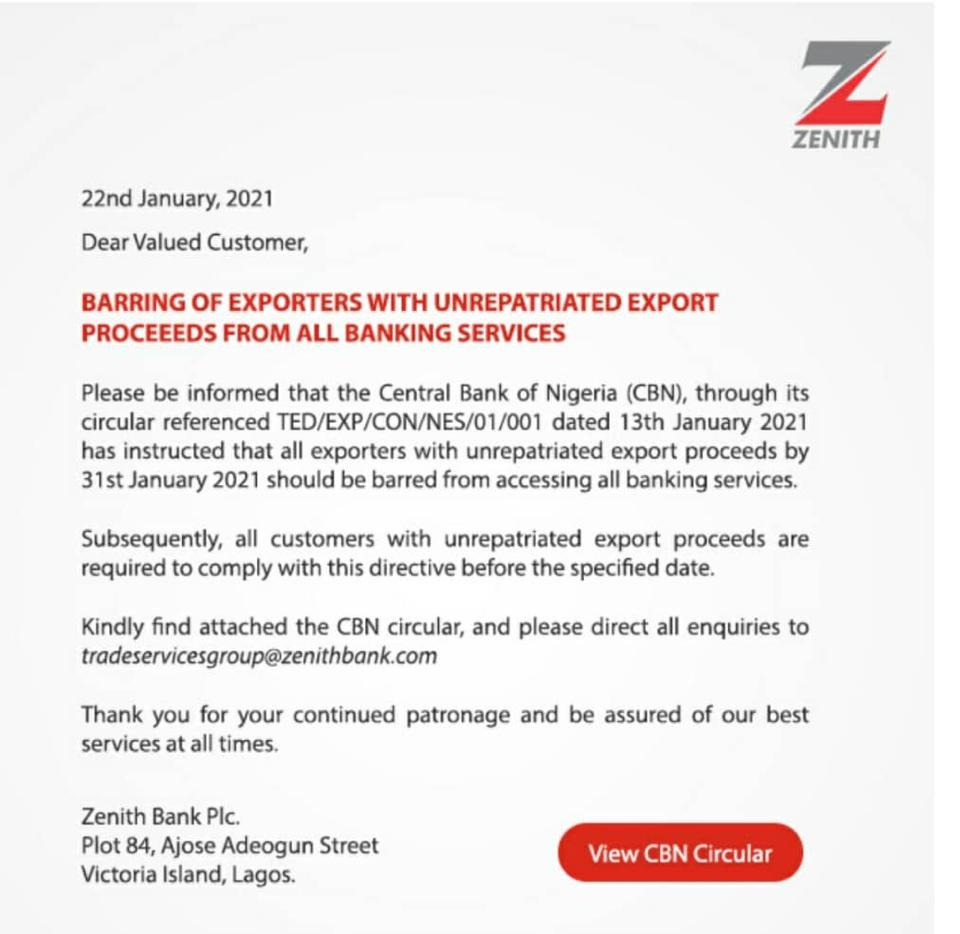
The Central Bank of Nigeria is always fighting moving targets. The latest is that the apex bank wants to bar exporters who do not repatriate their export proceeds from participating in Nigeria’s banking services. I am happy the CBN now understands the “voodoo” in the system where some companies exist to “export” exchange rate arbitration and make tons of money on it.
Nigerian exporters that have not repatriated export proceeds will be barred from all banking services from Jan. 31, the central bank said. The new directive applies to exports up until June last year, central bank spokesman, Osita Nwanisobi said by text message on Saturday. “Proceeds for oil is to be repatriated within 90 days and non-oil within 180 days.
The measures are part of an effort to defend the country’s currency by targeting importers and exporters with tougher regulations. That’s after a plunge in oil prices and the coronavirus pandemic led to dollar shortages in Africa’s largest crude producer resulting in a wide spread between the official exchange rate and the parallel market. The differential of about 25% has created an incentive for exporters to divert forex income to unofficial channels.
Yes, someone wants to “ship” money out of Nigeria to New York. He comes to you who exports palm oil from Umuahia to London; he credits you. The person paying you in London instead of wiring money to you in Lagos pays the person in New York. Magically, that New York company has moved money and the apex bank has no trace of it. Do that many times, the Naira remains beaten down.
Of course, companies are resorting to that because CBN gave them a really bad choice: The CBN expects exporters to sell their export proceeds through the I&E window. I&E window currently trades at N395/$1. No exporter will sell their foreign exchange at that rate when they can get willing buyers at N485 to N495.
So, most exporters have gone to open overseas accounts or alternatives, and CBN has lost control! Now, you see this letter (below)
The Tekedia Live recorded video has been prepared. Thanks for joining us for our first open webinar of the year. We will continue on all the questions all through the year once we begin Tekedia Mini-MBA, starting Feb 8. As always, we thank everyone for sharing the Saturday with us. If you missed it, click and watch.
Happy New Year once again. At Tekedia Institute, we expect 2021 to be a year of accelerated growth. There are many leverageable factors which have been unlocked as the world digitizes and new business frameworks evolve, while confronting Covid-19. Productivity is expected to improve as technology accelerates the efficiency on the utilization of factors of production.
In our 2021 Outlook – Growth After a Redesign webinar (video below), we shared some anchors and pointers. A new Tekedia Live is planned to discuss the Winning Playbooks we need to pay attention to, as we formulate business strategies in the new year. The virtual event, comprising presentation and Q/As, is scheduled as follows:
Topic: The 2021 Winning Playbooks
Presenter: Prof Ndubuisi Ekekwe, Lead Faculty, Tekedia Institute
Date: Saturday, Jan 23, 2021
Time: 4pm – 5.30pm WAT
Zoom Link: click here to join
Registration for Tekedia Mini-MBA (Feb 8 – May 3, 2021) continues. Click here to register and get the early bird benefits – https://school.tekedia.com/course/mmba4/ . Please tell your friends, colleagues and associates!
As part of graduating from a university program, you are required to do a project. In Tekedia Mini-MBA, we added the capstone-based certificate program to give members the opportunity to do research under our supervision. So, you have attended our program and mastered the mechanics of business systems, we expect you through the capstone, to apply those concepts in real business problems.
Those problems keep evolving – new product plans, new business plans, new business strategies, etc – and members are advancing their firms. If you have attended Tekedia Mini-MBA or plan to attend, I challenge you to also register for our Capstone-based certificate program.
Yesterday, I spoke with a microfinance Executive Director who just promoted one of our co-learners (a staff there). The member had sent a growth strategy to the bank. That strategy was a capstone she did under us. She is now tasked in the Strategy unit to execute it.
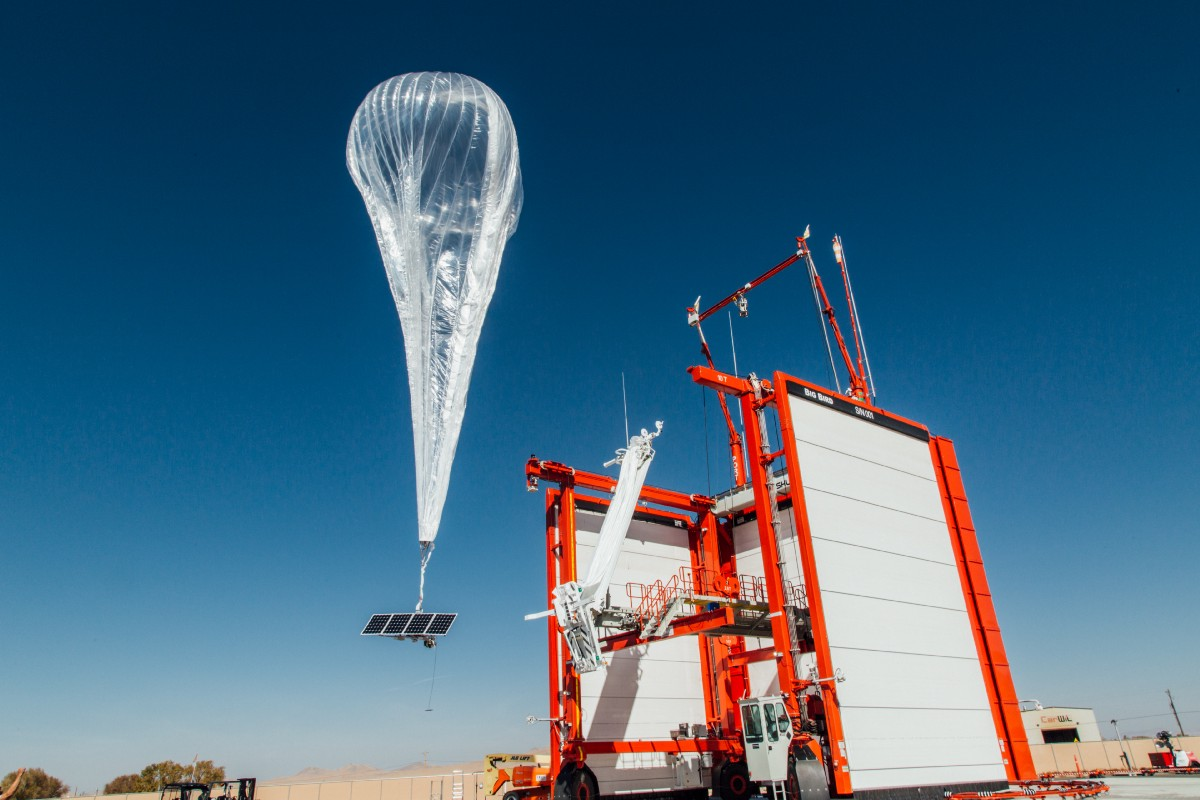
Good night, Google Loon: “The Google’s balloon-internet project aimed at providing internet services for the underserved is getting shut down. The subsidiary announced the project is winding down because it’s no longer sustainable”. Blame Elon Musk’s Starlink for this. As we teach in our Tekedia Mini-MBA innovation course, when a company sets a new basis of competition, incumbents could just lose hope and give up. That is what happened here: Loon has no future and any product iteration would be hopeless because Musk’s SpaceX has recorded numbers which many thought were not possible.
“We talk a lot about connecting the next billion users, but the reality is Loon has been chasing the hardest problem of all in connectivity – the last billion users: the communities in areas too difficult or remote to reach, or the areas where delivering service with existing technologies is just too expensive for everyday people,” Alastair Westgarth, Loon CEO wrote on Medium.
“While we’ve found a number of willing partners along the way, we haven’t found a way to get the costs low enough to build a long term, sustainable business. Developing radical new technology is inherently risky, but that doesn’t make breaking this news any easier. Today I’m sad to share that Loon will be winding down,” he added.
Last July, Loon launched the internet balloon in Kenya in partnership with Telkom after many trials, and recorded a measure of success that kept hope alive that the project will be successful.
This testimonial did it: “Hall [a British user] had been getting download speeds of only 0.5 megabits per second with BT internet, he said. Now with Starlink, he’s averaging 85 Mbps.” With that, many providers would be shutting down very soon because Musk has changed the game even before he starts!
There has never been in the history of the world where a man focuses on dealing with many big problems, at once, and making tons of money doing so. He is peerless, and the world is better that he is here.
But his work has been largely esoteric when it comes to places like Africa, the land of his birth. But that is changing very soon. Yes, Elon’s other company – SpaceX, the rocket one – is now shipping his Starlink kits to selected customers in Europe: “Hall had been getting download speeds of only 0.5 megabits per second with BT internet, he said. Now with Starlink, he’s averaging 85 Mbps. “Within the hour we ran a Zoom quiz with grandchildren — it was wonderful,” he said.”
All these balloon-based companies will fade as the satellite era begins for rural broadband. Satellite has better unit economics and the technology will just keep getting better. Some GSM operators would be on this crosshairs also.
Comment #1: Of note, rural dwellers tend to be at the bottom of any national average household income. It will be interesting to see how affordability will come in to play with Starlink’s setup cost at about USD 500 and a monthly recurring cost of USD 100.
Comment #2: This is why I have issues with Silicon Valley perspective. The RISE of one thing is always literally interpreted as the DOWNFALL of another. Starlink is not the reason Loon went down. When most people were busy here celebrating the launch of Loon just few months ago, I made it clear that the thing “ain’t gonna fly”. It was so obvious then, not because of Starlink, but because of the nature of those businesses (and the way the Future is shaped). They were designed to fail from the beginning. The e-commerce drone hype is next, it will take longer to collapse, and to be fair, even though it won’t be a total collapse like the Loon, it’s still going to be a collapse. It won’t take off in the manner people are expecting it will. There’s a cap on its Promise.
One thing is clear to me, and it’s the fact that Siliconites don’t usually have Clarity of Purpose and or Process before doing anything. They just run it like an experiment. If it works, good, if not, good. Google Loon is exactly that, an experiment. It was never serious, by design. Loon puncturing isn’t anything to be surprised about. Starlink didn’t kill it, it killed itself by Design. A time will come when you all will start taking the things I say very seriously.
My Response to #2: Great insight – but would there still be Loon if there is no Starlink? I do think so. Loon was heading to win a rural broadband connectivity contract with US government. That was Loon’s deal. But just from nowhere, Starlink took it. I still believe this: without Starlink, Loon would have picked that close to $1 billion and it would still be here. That Loon’s issue does not mean it could not serve “niche” rural areas the big telcos have forgotten. But with Starlink there, from US to EU, Loon’s sees no future.
Comment #3: He is selling 100Mbps/ 20 Mbps (monthly information rate) at $99. He has killed terrestrial telecommunication companies. Behold here comes the satellite based internet with no line of sight challenge and at low earth orbit less latency challenge. The speed means the stock market will be his friend soon. And the whole fiber thing will be like a past glory. Then he will begin to deliver 5G. And with his space ship he can do robotic repairs and replacement easily. Musk is the future of business.
Loon, Google’s balloon-internet project aimed at providing internet services for the underserved is getting shut down. The subsidiary announced the project is winding down because it’s no longer sustainable.
“We talk a lot about connecting the next billion users, but the reality is Loon has been chasing the hardest problem of all in connectivity – the last billion users: the communities in areas too difficult or remote to reach, or the areas where delivering service with existing technologies is just too expensive for everyday people,” Alastair Westgarth, Loon CEO wrote on Medium.
“While we’ve found a number of willing partners along the way, we haven’t found a way to get the costs low enough to build a long term, sustainable business. Developing radical new technology is inherently risky, but that doesn’t make breaking this news any easier. Today I’m sad to share that Loon will be winding down,” he added.
Last July, Loon launched the internet balloon in Kenya in partnership with Telkom after many trials, and recorded a measure of success that kept hope alive that the project will be successful.
The service was designed to cover a region of about 50,000 sq.km of rural Kenya.
In the past, Loon had been used to provide internet services in times of distress. For instance, in 2017, during the massive flooding in Peru, and after Hurricane Maria in Puerto Rico, it helped provide the internet for about 200,000 people.
Founded in 2011, Loon works by beaming internet connectivity from ground stations to balloons 20 km overhead. The balloons are linked to the ground stations that have been connected to Telkom’s network. The ground stations use millimeter wave spectrum to send connectivity from the ground to the balloons overhead.
However, there were challenges. For instance, in Kenya, Loon acknowledged that impediments like the wind patterns and restricted airspace would hinder internet service. And because the balloons are solar-powered, users will only have the 4GLte internet service from 6: 00 am to 9: 00 pm. But the companies hope that the technology will get better as they gain more experience flying in Kenya, and dispatching more balloons to the service region.
The shutdown means that the 2019 partnership between Loon and SoftBank’s unit, HAPSMobile, who invested $125 million into the internet company, to bring more people, places, and things online, may have ended.
Loon was created using what engineers called a “garbage bag-looking” balloon for early stage prototypes. After years of tests, in 2018, it became Alphabet, Google’s parent company subsidiary.
Loon’s failure means that Africa now lost a close chance of filling its wide internet deficit. A 2019 report by the Alliance for Affordable Internet said only about 28% of Africa’s over 1.3 billion people have access to the internet. Majority of those who lack access to the internet are rural dwellers, and that made Loon their only viable option to get online.
Google and Facebook have satellite and undersea cable projects aimed to provide internet service for the world’s underserved, but they have been dragging feet.