President Biden has one key challenge in his presidency: China. Yes, everything is going to come around China as China opens a playbook to “overtake” US economically, and disintermediate the US dollars. China is creating a digital Yuan, and if that happens, and it reduces transactional friction in commerce, China can scale that mission through its global sovereign lending apparatus.
China has begun the third round of its digital currency testing. The exercise took off on January 20, in Shenzhen, as part of a larger scheme to introduce the E-Yuan in mainland China. As part of the project, a total of 20 million digital yuan will be issued to residents of the local Longhua District.
Pandaily reported that up to 100,000 so-called “red envelopes”, each with an amount of 200 yuan, will be given out to those who have purchased social insurance from the commercial entities they work for and intend to stay in the jurisdiction for the upcoming lunar new year holiday.
While dislodging the US dollars may not happen in North America and Europe easily, Africa and Latin America could easily fall into place, faster. And if that happens, you could see a new equilibrium on currency emerge.
Sure, people do argue that China cannot assume that position due to its recent history. Possibly, but we need to understand one thing: technology reduces the trust burden by making it easier for demand and supply to attain new equilibrium faster through removal of information asymmetry.
A digital yuan will do what Uber did on our fears (allowing strangers to give us rides), and Airbnb did on grandma’s warning (comfortably sleeping in a stranger’s house). So, while the analog Yuan may not have been trusted, the digital yuan can tap into the pervasive digital trust-enhancing systems to elevate its acceptability in global commerce.
So, as we thank Mr. Biden for taking Nigeria out of that dreaded 13-nation “ban” list which his predecessor lumped Nigeria alongside Yemen and Somali, he has work to do to keep his national currency the default for global commerce.
For Nigeria, I have long maintained that if we move fast, we can make Lagos the epicenter of the new (digital) currency in Africa. The opportunity remains for that. We need to watch both frontal and flank attacks from mid-size and smaller nations like Rwanda and their positioning on this. The US has largely not bothered on the potential dislocation from cryptocurrency but the fact remains that Bitcon may not be its challenge, rather e-yuan may be the real threat to the US dollars.
Jerome Powell, the U.S Fed Reserve Chairman, spoke on Bitcoin and cryptocurrency, among others. Here are excerpts. The full video below.
“Since we are the world’s reserve currency, we actually think we need to get this right, and we don’t feel an urge or need to be first,” he said. “We effectively already have a first-mover advantage, because we’re the reserve currency.”
“We’ve been very focused… on potential regulatory answers for global stablecoins, in particular,” said Powell in response to a question about CBDCs, or central bank digital currencies.
“So that’s been a high-level focus, and that will continue to be a high-level focus because they could become systemically important overnight and we don’t begin to have, you know, our arms around the potential risks and how to manage those risks, and the public will expect we do and has every right to expect that… It’s a very high priority.”
Comment on LinkedIn Feed
Comment #1: Prof. Bitcoin is a liquidity blackhole; and every enlighten government is aware of the inherent threats it poses to her hegemony of its economy. China is not the first to go this route. Venezuela came up with the Petro (digital fiat) in 2017, but it flopped.
While creating a digital Yuan is one thing, the nature of the currency is another. Will it be inflationary or deflationary; will it have a limited supply, or it will be infinite printing like the traditional fiat of every nation state is today.
Digitization of fiat currencies by any sovereign state is, for me, an attempt to compete with Bitcoin or other digital protocols and assets like Ethereum. The missing pieces are decentralization, trust, freedom and perception.
Bacause a sovereign state is always susceptible to the financial priest, governments, politicians, and most of all, inflation; I don’t see the people adopting any of her copycat digital currency for long, as these are the antithesis of, e.g. Bitcoin.
As more of these smart contract platforms continues to scale in usage, economic bandwidth and more technological advancements like we’re witnessing with the rise of DeFi on Ethereum, the digital Yuan or any similar nation state currency, will be dead on arrival.
My Response: I am not sure we can compare Venezuela with China in anyway. Unlike the South American nation, China has leverages at global level: it is the world’s factory. If China digitizes Yuan, buyers from China will save between 10-15% lost via USD intermediation. Doing that is not rocket science: have fintech and banks (OPay, Flutterwave, GTBank) as agents where people can use Naira to get E-Yuan with wallet credited. Go to Alibaba website and pay Chinese merchants (who will not list on Yuan, not USD) directly. Because transactions are cleared in Beijing, USD goes. It does not need to be decentralized at origination but it needs agents to work.
China is on the 3rd trial after the 1st and second trials went fine. E-Yuan is not crypto, it is avoiding clearing global transactions from New York and London via wallets maintained in Beijing. The deal is eliminating inter-border frictions but warehoused in China. People will use it to save 15% on cost. Visit NAU Awka, Igbo traders are learning Chinese in the Confucius school to help them cut-out merchants in China and buy directly from factory who typically speak only Mandarin. Tell those men by removing USD, they can save more, you will be surprised.
China has begun the third round of its digital currency testing. The exercise took off on January 20, in Shenzhen, as part of a larger scheme to introduce the E-Yuan in mainland China. As part of the project, a total of 20 million digital yuan will be issued to residents of the local Longhua District.
Pandaily reported that up to 100,000 so-called “red envelopes”, each with an amount of 200 yuan, will be given out to those who have purchased social insurance from the commercial entities they work for and intend to stay in the jurisdiction for the upcoming lunar new year holiday.
The pilot run will be conducted in the form of a lottery, similar to former experiments. At 10:00 a.m. on Jan. 26, the event will draw lots to select 100,000 winners, according to local media Yangcheng Evening News.
This is the third round of digital currency experimentation going on in the city.
The first test was held in Luohu District, where the central bank issued 10 million e-yuan in October 2020. When a second round was conducted in Futian District at the beginning of this year, transactions rose to as much as about 18 million yuan in the ten days between Jan. 7 and 17.
The second round also expanded the e-yuan use scenarios, increasing participating merchants and shops from 3,000 to more than 10,000. Among the fields covered were transportation, medical, entertainment and retailing.
The newly-launched round also added two more supporting banks – the Bank of Communications and the Postal Savings Bank of China.
Besides Shenzhen, the central bank last year carried out closed tests in Suzhou and Beijing.
Pandaily reported that the digital currency frenzy is not confined to the mainland, as Hong Kong is also looking forward to testing digital currencies in the near future.
On Dec. 4, 2020, the city’s Monetary Authority began working with the Central Bank’s Digital Currency Research Institute to study technical tests for the use of digital currency for cross-border payments, and make corresponding technical preparations, according to the official former’s website.
Since 2014, China has been studying merits and demerits of digital currency and how best to roll it out so that it doesn’t disrupt existing financial structure. Developing a national digital currency involves complex technicalities that take time, and if done wrongly, would make users lose their money.
China is pushing to become the first major country in the world capable of monitoring economic activity in real-time through digital currency called e-yuan, and the central bank governor, Yi Gang wants to learn real-time data management from the private sector to guide the growth.
The e-yuan, called Digital Currency Electronic Payment (DC/EP), will facilitate e-wallet payments in place of fiat, allowing citizens to carry out financial transactions digitally. The Chinese central bank is speeding the project up as it aims to develop a cashless economy.
Former IBM executive, Richard Turrin who is writing a book on China’s digital currency said “the time table has been sped up by the coronavirus and the realpolitik of US-China relations.”
But apart from that, China recently has increased its oversight on its online industry, including the fintech sector which has blossomed without government’s regulatory interference over the years. The recent clampdown on big players in China’s online financial space, including Ant Group, shows the government’s growing interest in the sector. And the launch of e-yuan which is supposed to be in partnership with big players in the fintech, is believed to be part of the government’s ploy to keep an eye on the industry.
Moreover, China appears keen to lead the world of digital currency by being the first country to launch national digital money that is widely used across the country. The plan is believed to have been accelerated by the outbreak of COVID-19 and US’ disapproval of Libra.
“China is positioning itself as a trailblazer when it comes to the future of money,” said Henri Arslanian, a cryptocurrency mogul and adviser to central bank. “Libra was the catalyst, and COVID-19 has accelerated central bank activities.”
However, there have been concerns about how a national digital currency will affect the banks.
The PBOC told the IMF that the e-yuan will be likely limited to small retail transactions by setting maximum daily and yearly limits on payments and that it will only process large amounts by appointment. It added that it may apply charges for large sum or high-frequency transactions, and will not offer interest on accounts.
The central bank conducting the third digital currency trial indicates that a promising amount of success has been recorded, and that China is on the verge of releasing e-yuan for national use.
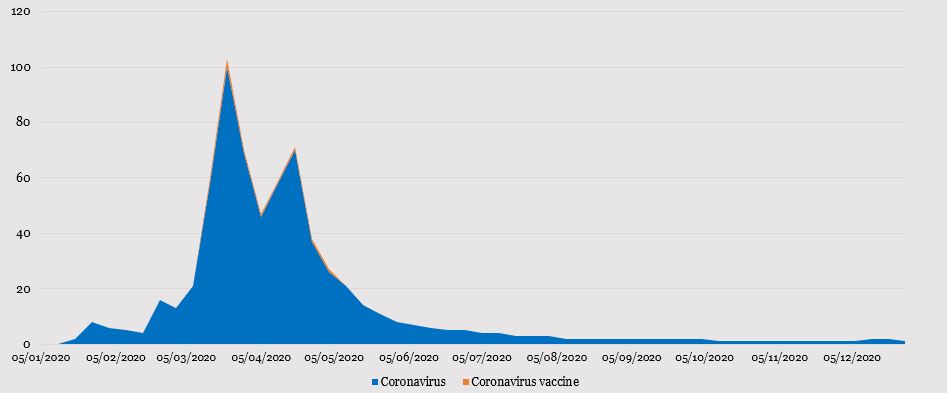
In 2019, no one imagined it. No one believed it that coronavirus would emerge and overwhelmed everyone. From late 2019 to the end of 2020, people and businesses were disrupted. Interest in knowing the genesis of the disease and how the stakeholders, especially government officials were managing it was high on the digital and physical spaces. Attention was paid to why governments and drug manufacturers should speed their vaccine production for the disease. Comparative analysis of the interest in coronavirus vaccine and the disease indicates a wide gap [see Exhibit 1].
Exhibit 1: Public Interest in Coronavirus and Vaccines in 2020
Source: Google Trends, 2021; Infoprations Analysis, 2021
The Disease Related Messages Deconstruction
From the public to the private sector, efforts were made during the first wave of the disease to enlighten people and businesses on the best practices to prevent the spread of the disease. Despite this, Nigeria recorded a number of cases and deaths. The Coalition Against COVID-19, a public sector collaboration organisation, developed and disseminated various messages in addition to what state and federal governments communicated to the public. Surprisingly, our analysis of over 1,000 messages from the social media platforms of the organisation and others in 2020 revealed a wide disparity between stakeholders’ intent of preventing the spread of the disease and the readiness of the citizens to apply the messages.
Our analyst examined messages that had the purpose of educating citizens about the preventive measures and informing them about cases and deaths being recorded every day. The focus was also on the messages that stressed the need to stop the spread of the disease. From 439 messages mined from the social media platform of the CACOVID, 28.01% messages were reinforced by the followers. The reinforcement, according to our definition, is the follower’s acceptance of the message and readiness to apply lessons from it in the physical sphere. Over 63% of 193 messages from the Lagos State Ministry of Health were reinforced. On the social media platforms of the Lagos State Government and the National Centre for Disease Control, 47.18% and 35.79% messages out of 426 and 1,123 were reinforced respectively. Over 25% of 362 messages from the social pages of the Presidential Task Force were reinforced by the followers. The Federal Ministry of Information and Culture had the least percentage of message reinforcement. According to our analysis 11.02% of the Ministry’s 390 messages were reinforced. Over 20% of 1,022 messages from the pages of the Federal Ministry of Health were reinforced.
With these results, our analyst notes that the ongoing negative reactions towards the use of foreign and local vaccines should not surprise concerned stakeholders because the responses to the public communication during the first wave had clearly shown that the introduction of the vaccine would attract negative reactions from the public.
We Want, We Don’t Want
It is not really a surprise that Nigerians are contemplating on being vaccinated or not. The divergent view is a global one. From the Europe to America, people are doubting the efficacy of the first vaccines from manufacturers. More than 71% of 13,426 people surveyed in 19 countries that they would be very or somewhat likely to take a COVID-19 vaccine, and 48.1% reported that they would accept their employer’s recommendation to do so.
In Nigeria, 80% of 465 people studied by a team of researchers from Babcock University were unwilling to participate in the COVID-19 vaccine trial, while 20% were willing. According to the researchers, age, gender, educational level, religion, occupation, nature of monthly income and geopolitical zone had no significant impact on the perception and readiness to participate in the COVID-19 vaccine trial. Over 17% were against the COVID-19 vaccine trial, 15.3% were in support and willing to participate if given a chance, while only 6.2% of the respondents indicated interest in participating in the vaccine trial even if it will affect their daily life activity. 9.7% and 52.3% of them opined that vaccine trials should be initiated in residential homes and isolation centres, respectively. More than 39% (185/465) feared that the vaccine may not be affordable and accessible for the common man.
Eighty percent (80%) were afraid of adverse effects/complication that may be associated with the vaccine, 30.8% were afraid of the vaccine been used as a medium for implantation of microchips, 11.8% were afraid of disruption of daily routine, 26.9% fear that the vaccine may be used as a biological weapon, while 50.5% are afraid of vaccine related death.
Superior Participatory Community Engagement
From the messages deconstruction to the views expressed about the vaccine, it is glaring that Nigerian stakeholders need superior participatory community engagement in the digital and physical spheres. Government actors with adequate knowledge of the efficacy of the vaccines and explication of adverse effects must be deployed as influencers on social media. They also need to participate in community sensitization at Town Halls and other places deemed appropriate for spreading vaccine related messages. The identified Ministries and Governments in our analysis of message deconstruction need to work on their reply approach to messages being posted on the social media platforms. Inclusive interaction and engagement on the platforms matter now as the second wave continues.
Nigerian Communications Commission (NCC) said on Thursday that the number of active telephone subscribers across the country has risen to 208 million, in the latest data indicating continuous month-on-month growth in the telecom industry.
NCC’s Executive Vice Chairman, Umar Danbatta, was at a briefing for the new Permanent Secretary of the Federal Ministry of Communications and Digital Economy, Festus Daudu, on the functions and regulatory activities of the commission, when the achievement was announced. Danbatta through the commission disclosed this among other developments in the telecom industry.
“As at November 2020, active telephony subscribers stood at 208 million with teledensity standing at 108.92 per cent while active internet subscriptions were 154.9 million and a broadband penetration of 45.07 per cent, among others,” he said.
The EVC said that third generation (3G) and fourth generation (4G) base transceiver stations deployment in Nigeria had increased from 30,000 to 53,460. He added that fibre optic transmission cables expanded from 47,000km to 54,725km in the last five years, resulting in improved broadband/telecoms service delivery to Nigerians.
NCC HQ
“The BTS, fibre optic cables and other related infrastructure are central to the provision of improved service experience for Nigerians by their respective telecoms service providers,” he said, adding that the licensed Infrastructure Companies (InfraCos) are also expected to add 38,296km to optic fibre cables when they commence full operations.
Before the latest figures announced by the NCC, industry operators had put the number of telephone subscribers in Nigeria at about 207 million.
Danbatta said the commission had introduced various interventions such as the issuance of directives to mobile network operators to protect consumers from being shortchanged. According to him, they include the declaration of 2017 as year of the Telecom Line for lodging and resolving consumer complaints and the provision of the 112 Emergency number and activation of 19 emergency Communications Centers (ECCs) across the country.
Others include the enforcement of mobile number portability as well as the introduction of the Do-Not-Disturb 2442 to check cases of unsolicited text messages, and issuance of various directions to protect the consumers from being short-changed, ensuring smooth transition of Etisalat to 9Mobile, and enforcement of mobile number portability.
He said the number of subscriptions to DND service had hit over 30 million as the service empowered Nigerians to be able to protect themselves from the menace of unsolicited text messages.
Danbatta promised that the commission will do more to ensure that the telecom industry attain greater heights that will contribute to the growth of the economy.
“The Commission will continue to put in its best in the discharge of its mandates, especially in facilitating the deployment of broadband, which is central to diversifying the Nigerian economy and national development.
“Also, it is our belief that the communications industry, under the leadership of the Ministry of Communications and Digital Economy, will experience more quantum leaps and retain its current leadership role in the telecommunications space,” he said.
Speaking on the progress, the new permanent secretary said the contribution of the telecoms sector to the country’s Gross Domestic Product had been impressive.
Daudu, however, urged the commission to increase its collaboration and teamwork with the communications ministry, other agencies and industry stakeholders towards achieving the Federal Government’s objective of a digital economy.
“I want to thank NCC for its contribution to the Nigerian economy so far. I am not exaggerating about the achievements of NCC, in terms of contribution to GDP and how NCC’s effective regulatory role has been helping the economy in so many ways,” he said.
The Nigerian Bureau of Statistics (NBS)’ Q3 report listed the telecom industry among the top six contributors to the Nigerian economy. The order of contribution to GDP is as follows: Agriculture 30.77%, Trade 13.88%, Info & Communication 13.47%, Manufacturing 8.93%, Mining & Quarrying 8.91% and Real Estate 5.58%.