Congrats Tope Awotona, the Founder and CEO of Calendly which just raised $350 million in new funding, valuing the event scheduling startup at more than $3 billion. We use this solution and it is the best in the world.
Calendly, which helps users schedule and confirm meeting times, has raised $350 million from OpenView Venture Partners and Iconiq.
Until now, the Atlanta-based startup had only raised $550K, but the company says it has 10 million monthly users, with $70 million in subscription revenue last year.
“Calendly has a vision increasingly to be a central part of the meeting life cycle,” said OpenView’s Blake Bartlett.
It’s a platform that provides a quick way to manage open spaces in your calendar for people to book appointments with you in those spaces, which then also books out the time in calendars like Google’s or Microsoft Outlook — with a growing number of tools to enhance that experience, including the ability to pay for a service in the event that your appointment is not a business meeting but, say, a yoga class. Pricing ranges from free (one calendar/one user/one event) to premium ($8/month) and pro ($12/month) for more calendars, events, integrations and features, with bigger packages for enterprises also available
Great owambe in Atlanta coming (lol).
How you wish this story was baked in Lagos, and not Atlanta for Tope! The beauty of America continues.
WASHINGTON, DC - JANUARY 25: U.S. President Joe Biden signs an executive order related to American manufacturing in the South Court Auditorium of the White House complex on January 25, 2021 in Washington, DC. President Biden signed an executive order aimed at boosting American manufacturing and strengthening the federal government's Buy American rules. (Photo by Drew Angerer/Getty Images)
Just started reading a nice book from our leadership faculty, Dr. Ayodeji (Emmanuel) Oyebola, Ed.D. The book is titled CARING: The Soul of Leadership.
The book overview: “… As the soul is the essence of humanity, caring is the essence of leadership, and a care-less leader cannot lead. If the leader does not care, then the leader is not leading, and leadership dies at that point. Many leaders have good intentions but unconsciously neglect some aspects of their establishments. This book examines how leaders can care for their establishments to lead successful teams and achieve the desired results.”
I have got mine and I ask you to get yours here.
WASHINGTON, DC – JANUARY 25: U.S. President Joe Biden signs an executive order related to American manufacturing in the South Court Auditorium of the White House complex on January 25, 2021 in Washington, DC. President Biden signed an executive order aimed at boosting American manufacturing and strengthening the federal government’s Buy American rules. (Photo by Drew Angerer/Getty Images)
WASHINGTON, DC - JANUARY 25: U.S. President Joe Biden signs an executive order related to American manufacturing in the South Court Auditorium of the White House complex on January 25, 2021 in Washington, DC. President Biden signed an executive order aimed at boosting American manufacturing and strengthening the federal government's Buy American rules. (Photo by Drew Angerer/Getty Images)
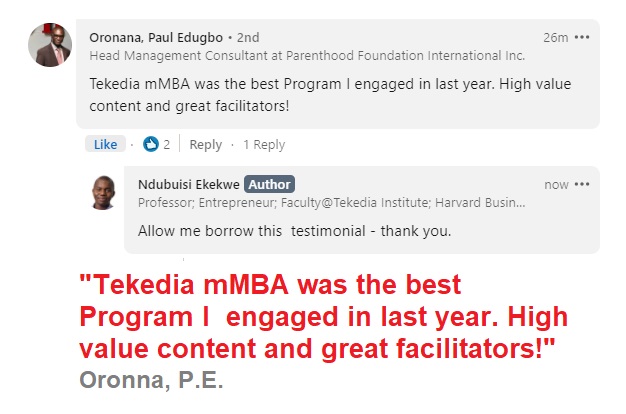
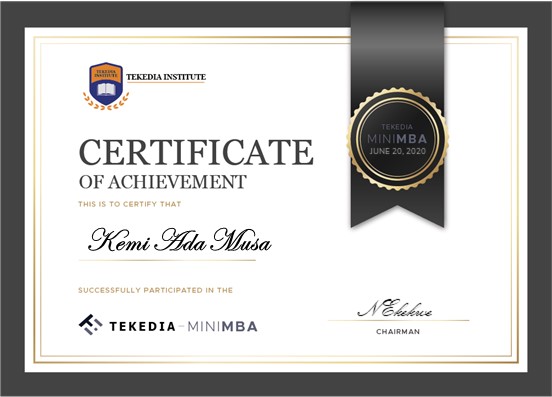
From bank managers to CEOs, founders to directors, and beyond, this is the conclusion: Tekedia Mini-MBA is transforming careers and making companies better. Click and read some of our testimonials.
Tekedia Institute offers an innovation management 12-week program, optimized for business execution and growth, with digital operational overlay. It runs 100% online. The theme is Innovation, Growth & Digital Execution – Techniques for Building Category-King Companies. All contents are self-paced, recorded and archived which means participants do not have to be at any scheduled time to consume contents.
WASHINGTON, DC - JANUARY 25: U.S. President Joe Biden signs an executive order related to American manufacturing in the South Court Auditorium of the White House complex on January 25, 2021 in Washington, DC. President Biden signed an executive order aimed at boosting American manufacturing and strengthening the federal government's Buy American rules. (Photo by Drew Angerer/Getty Images)
Sure, some will be disappointed – now, he is supporting banks! I wrote and praised a public servant yesterday and many were disappointed. That was really strange: if we truly want to bring change, we need to be fair, and focus on the data. I am not an activist – I am an engineer; I use facts to make my calls. If you do well, I praise you. But if you do wrong, I offer my perspectives which may not matter.
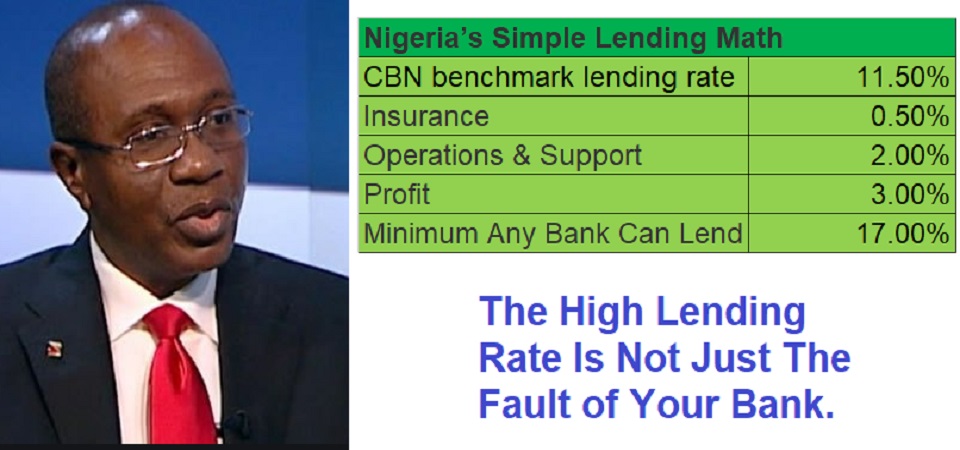
I read how people are abusing banks, on how they are frustrating SMEs in Nigeria. Before you accuse me that I am defending banks, I want to show you this table. I made it because I understand the business. I worked as a banker in Lagos!
Banks “borrow” from the Central Bank of Nigeria at 11.50% (latest number) and they have to insure that money. They have staff and operations to run. Then, they need to make profit to stay in business. By the time they are done, realistically, they should not lend below 17%!
For them to lend below 17%, it means that money is not coming from CBN, but from other sources which might be cheap (donor agencies, DFIs, etc). You may argue, what of the customers’ deposit which is “free”? There is nothing free there since if they lose your money, you will NOT take any excuse. In short, the risk has to be balanced.
With the CBN lending-deposit-ratio where they need to lend a certain percent of the customers’ deposits to avoid fines, some banks prefer to pay the fines instead of losing your money. See it this way, a fine on N10 billion may be N50 million if the ratio is not hit. That is well better than trying to hit a ratio and lose N1 billion on a bad loan. Now, you can see why CBN fines have not drastically made your bank beg you to come and collect loans anyhow!
My point is this: for CBN to reduce that rate, inflation has to become manageable. If not, it cannot reduce the benchmark. Interestingly, there are many factors that come into play to manage that inflation and to a large extent, you need to be producing things and having a better economy.
Nigeria has a long way to go and everyone is a victim. And that is why we need to work harder. The U.S. can lend its banks at near zero-rate because its inflation is well under control. Nigeria does not have that privilege at the moment. So, we should not be abusing banks, but rather go and build our Amazons, Googles and Teslas, to strengthen the economy and make it possible to lend at 6%. Cursing and abusing bankers will not fix the rate!
WASHINGTON, DC - JANUARY 25: U.S. President Joe Biden signs an executive order related to American manufacturing in the South Court Auditorium of the White House complex on January 25, 2021 in Washington, DC. President Biden signed an executive order aimed at boosting American manufacturing and strengthening the federal government's Buy American rules. (Photo by Drew Angerer/Getty Images)
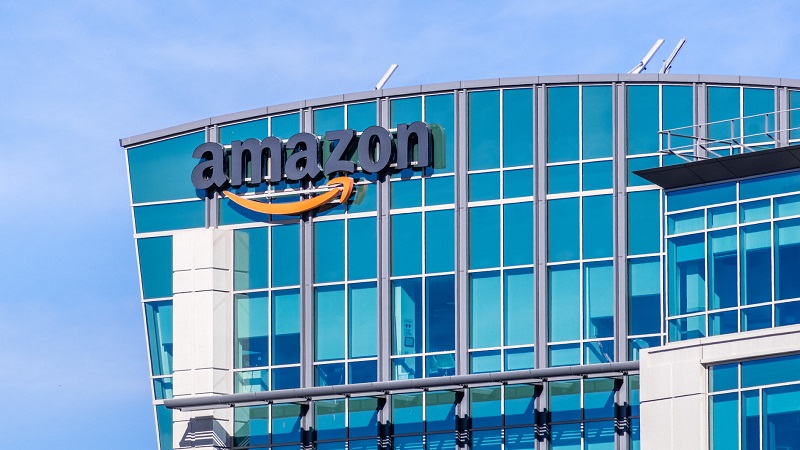
This is simply magical – Amazon now employs1.1 million around the world. In the United States, it comes behind Walmart as the private sector largest employer of labour. Today, Amazon is a digital conglomerate with tentacles in ecommerce, web cloud services, robotics, logistics and voice recognition. And in these domains, it is one of the top three, if not the category-king.
Amazon will add 3,000 more employees to its books — this time in Boston. The online giant is expanding the technology and software development teams that work on Alexa, Amazon Web Services, Amazon Robotics and Amazon Pharmacy. After Walmart, Amazon is the country’s largest employer, employing more than 800,000 people just in the U.S. The company has experienced “unparalleled growth” in the last 12 months, says The Wall Street Journal, hiring over 400,000 employees in 2020. Its global workforce totals more than 1.1 million.
What is happening here is typical: the most important element in modern companies is building the fundamental stack. Yes, spend the fixed cost, and once that is done, other things can be added on top. It takes out the old construct of core competency, since adding new services today does not require extremely new capabilities, once the fundamental stack is there.
Yes, if you have a cloud infrastructure, you can add music services, voice recognition technology, web metric technologies, and more, largely because the core investment has been done and these ones are not evidently onerous. That is why Facebook can do many things today since the hard work has been done. Facebook Local, check. Facebook Portal, check. Facebook fintech, loading.
If Amazon has logistics infrastructure to move books and office supplies, why not add drugs by opening a pharmacy? If Amazon has a supermarket chain, why not offer pick-up? Amazon does some of these things already and they are connected under symphonic innovation.
Symphonic Innovation is innovation that is not domain-specific, but is anchored on a unified and harmonious approach in the deployment of technology components to accelerate productivity gains and cushion competitiveness. With Symphonic Innovation, you do not deploy and launch for one technology area like blockchain only to be tripped by AI or big data; you launch with a mindset that these technologies are like extended musical compositions which must be carefully organized to make the orchestra an unforgettable experience.
There is one core lesson for emerging regions like Africa: the vision can start as a digital business, but can quickly grow into the meatspace, providing huge societal benefits besides fixing market frictions, but also providing jobs to the citizens. Scale has value because, most times, only big companies tackle extremely challenging problems. Amazon is serving America, Nigeria needs its equivalent.