DD
MM
YYYY

PAGES

DD
MM
YYYY

spot_img

PAGES

Home Blog Page 5951

Are You Paying Attention To Observe The Burning Bush In That Company?

1

He was on Horeb, and saw a burning bush: the bush was on fire but it did not burn up. So he thought, “I will go over and see this strange sight—why the bush does not burn up.”

First, his attention was needed for a very important message. He needed to be consumed by something uncommon. Secondly, his bravery was tested: he went over instead of running away when he saw the burning bush.

Then, his God called him “Moses! Moses!” and revealed a mission.

In companies, only undistracted and attentive people are typically called to execute higher missions. These are people who can unlock new market opportunities and extract values from shifts in customer preferences. Companies typically put the selected ones through tests with uncommon KPIs and targets to see how they respond. 

Some workers give up while others take the challenges. Usually, in the middle of that challenge, glory comes [Moses was chosen to lead his people]. In business, the role could be a CEO, Executive Director, etc!

What is the burning bush before you in that company? Without awareness and observation, you may not even know the company is asking for your attention to be called to LEAD.

China Announces New Rules to Counter U.S. Trade Policies

0

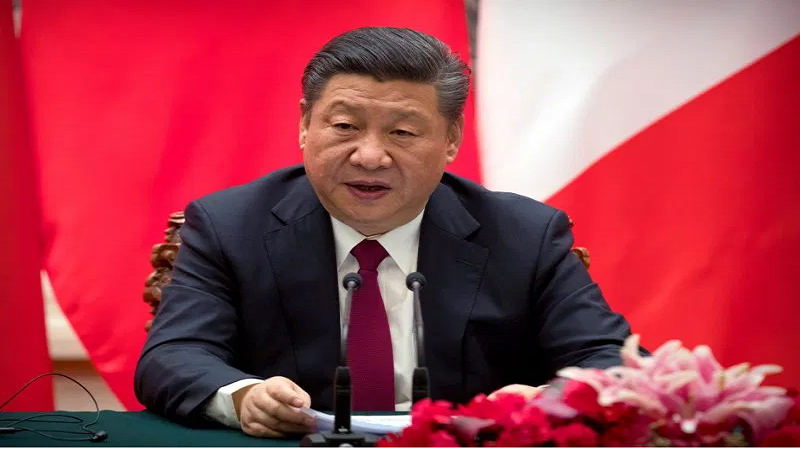
Amidst the continuous efforts by Washington to kick prominent Chinese companies operating in the United States out, over fears that they are harvesting data for the Chinese Military, Beijing has drawn up reciprocity laws to counter the moves and protect Chinese companies.

China’s Ministry of Commerce on Saturday published new rules for countering “unjustified” laws and restrictions imposed by foreign countries on Chinese companies and citizens.

The rule which were published on the Ministry’s website established a “working mechanism” to assess the legal implications of such incidents, enabling the Chinese government to determine if it would enact retaliatory law.

The rule says a Chinese person or organization that is restricted by foreign legislation from “engaging in normal economic, trade and related activity with a third State or citizens,” may report it to the commerce department within 30 days.

The Ministry of Commerce will then assess a case for its potential violation of international law, impact on China’s sovereignty and national security, and impact on Chinese citizens.

“When a citizen or other organization suffers significant losses from non-compliance with foreign legislation, relevant government departments may provide necessary support,” the notice says, adding that the Chinese government might also enact “necessary counter-measures” in response.

Last year, Chinese companies faced heavy backlash from other countries following the US sentiment. China’s telecom giant Huawei, which was leading the global 5G roll out suffered a huge setback after it was banned by the US, the UK and several other countries in Europe and North America.

To cap Huawei’s woes, Washington extended the ban to microchips, restricting semiconductor companies with access to US technology from supplying the telecom vendor with chips. The decision is thus threatening to cripple Huawei as lack of chips limit its smartphone production.

The lingering trade conflict between the world’s leading economies also affected app-based businesses of Chinese origin. TikTok and Wechat got caught on the web last year when President Donald Trump signed an executive order giving the short-video app 90-day ultimatum to sell to a US company or get banned.

It took the court’s ruling to restrain the order and keep the duo in business in the United States, but Trump’s administration said it would appeal the ruling.

The recent move by Washington to delist China’s telecom companies, China Mobile, China Unicorn and China Telecom from the New York Stock Exchange appears to have spurred Beijing to enact the impromptu law.

In November, Trump issued an order to bar 31 companies that Washington believed to be owned and controlled by the Chinese military.

The November order prohibits American companies and individuals from owning shares – outright or through investment funds – in companies the administration says help the advancement of the People’s Liberation Army.

The US Commerce Department added a list of Chinese companies to a trade blacklist in December, over allegations that Beijing is using them to harness civilian technologies for military purposes.

The list includes large state-run aerospace and construction companies, as well as technology and communication companies such as Inspur Group, Huawei and China Telecommunications Corp.

Moreover, the Trump administration is also considering adding tech giants Alibaba and Tencent to the blacklist already containing other Chinese companies. The news caused the companies’ shares to slump 4% on Thursday.

China’s commerce ministry has condemned US actions, saying it violates market rules and it will take action to protect its firms.

“This kind of abuse of national security and state power to suppress Chinese firms does not comply with market rules and violates market magic,” the ministry said in a statement.

“It not only harms the legal rights of Chinese companies but also damages the interests of investors in other countries, including the United States,” it added.

The new rule appears to be the action Beijing promised to take to “protect its firms,” the same step it took to prevent the United States from singlehandedly determining the future of TikTok.

Taxing Nigerians In Diaspora To Improve Nigeria’s Revenue Base

6

The innovators are back – and Nigeria has the finest in the world when it comes to finding how to collect money from its citizens and companies: stamp duty on electronic transfer, multiple levies, etc. Yes, when it comes to taxes, fines, levies, etc, Nigeria is innovating just fine. What we have struggled with is how to boost the economy with growth policies. 

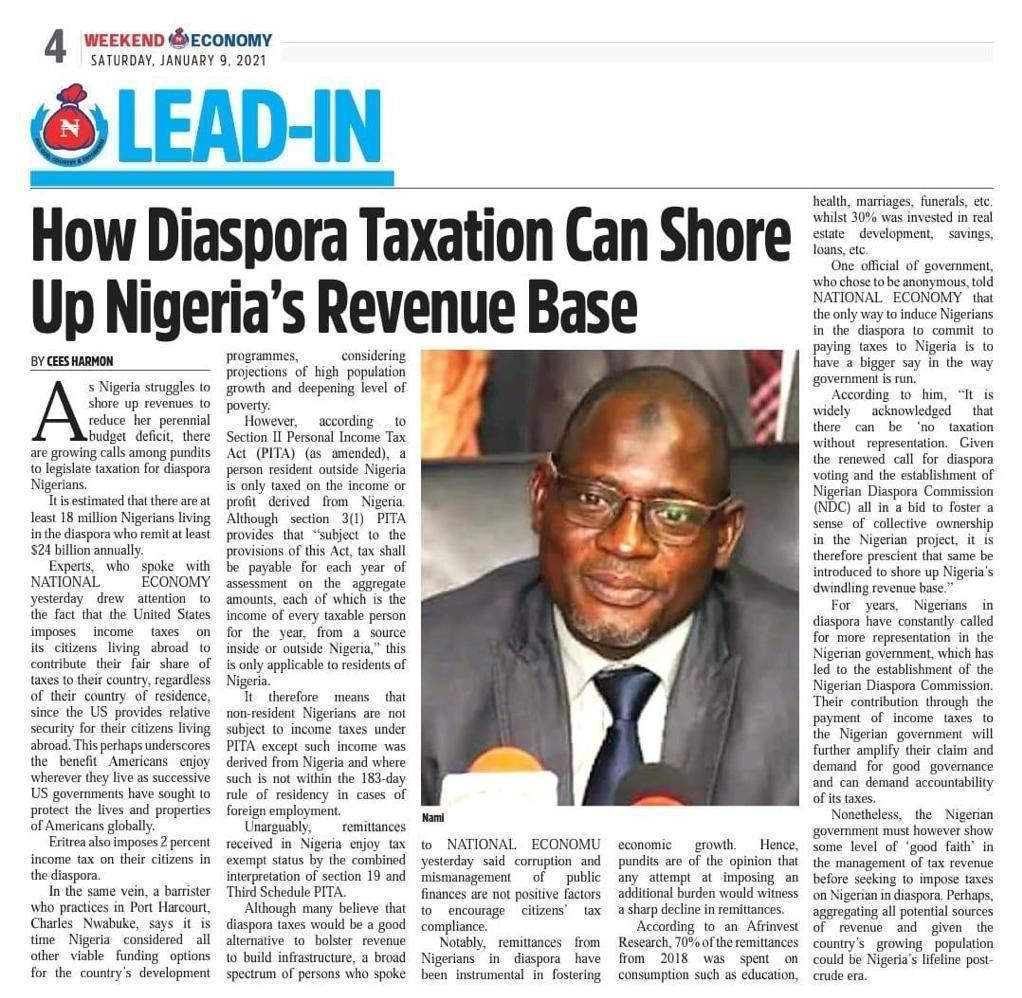
Now, the latest conversation is to tax Nigerians in diasporas. I must confess that it is not a bad idea provided the money would not be managed by politicians. I prefer we channel the tax money to venture funds, private equity funds or investing ecosystems to build a new economic architecture of Nigeria. Of course, if you do it that way, it is no more a tax since politicians will not be deciding how the funds are used! 

Nonetheless, if they have a tax treaty where other governments would recognize the Nigerian diaspora tax, to avoid double taxation, it is a slam dunk. Simply, instead of sending $1,000 to the American government as tax, you can send $100 to Nigeria and keep $900 in the US. The payer cannot and should not pay more than $1,000 to avoid double taxation. If you do not make it that way, it would be challenging to expect the diasporas to respond.

Yet, I expect Nigeria to have a remittance tax since taxing diasporas via the typical tax legal ordinance has no chance. Government can simply have a regulation: if you send $1,000 from the US to Nigeria, the Central Bank of Nigeria will keep 3% of that money as a remittance tax. 

Yes, once we are done with pension funds, then dividends & dormant account balances, and finish selling some campuses (other assets like power, etc are already gone), there would be nothing left. The only remaining option then would be remittance taxation. So, Nigeria will tax remittance but via a different protocol within this decade unless something changes in our economic system.

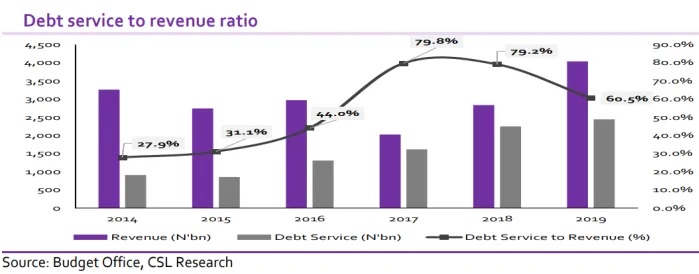
Simply, we cannot use 60% of our revenue to service debts and expect to have a future as a nation.

In 2014, the ratio was about 28%; then it rose close to 80% during the recession and now we are at 60%. When 2020 data comes out, it may be close to 90% considering that revenue was severely affected during the lockdown.

debt service ratio
Nigeria data


Everyday Life: How Nigerians Spent Their First Days of 2021 on the Internet

0

When a year is going to an end, it is a tradition among people throughout the world to make resolutions for the coming year. Over the years, the argument has been that people do abandon their resolutions. A recent study of 800 million activities of the people who made resolutions at the end of a year for the coming year indicates that most abandoned their resolutions on January 19 of the new year. Another research linked this to too much ambition. Though, the focus of this piece is not about giving insights on how to make resolutions, it is imperative to make reference to it as it has been established that the first days of a new year are better utilised for seeking information on resolutions realization.  For the people who want to implement new processes towards business and personal development, being on the Internet, exploring information, is essential.

Background

In this regard, our analyst examines information seeking behaviour of people in Nigeria between January 4 and January 8, 2021. Like other countries in the developing world, the Internet is being used for information seeking, gaining knowledge and understanding a specific topic in Nigeria. This has been made easy with the various search tools developed by companies such as Google, Bing, Yahoo among others. While on the Internet, some people receive information, gain knowledge and understand a problem or an issue consciously or unconsciously. Indeed, the Internet is critical to human survival on the digital sphere. In 2020, there were 85.26 million mobile internet users in Nigeria. This figure is projected to grow to 151.3 million by the end of 2025.

A number of the Nigerian users employ different phrases while seeking information on the Internet. In our previous analysis, these users were found to have a strong preference for ‘how to’ and ‘what is’ phrases than ‘who is’ phrase. The preference for the ‘how to’ and ‘what is’ is an indication that the phrases were better in delivering the relevant information during the period. In our 2018 analysis, we discovered that 42% of Nigerians’ searches were on how to kiss a girl in the last 24 hours. These results are not quite different from what we found within 5 days of 2021.

Analysis

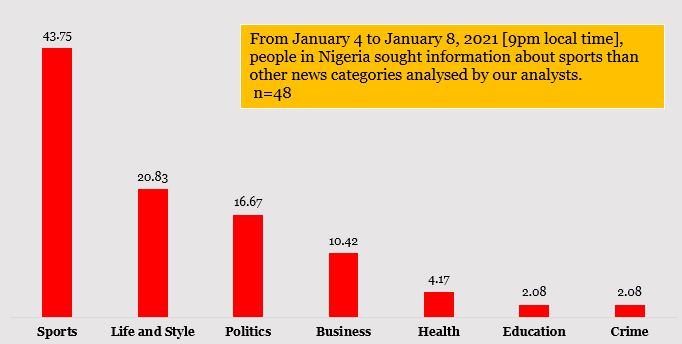
From January 4 to January 8, 2021, people in Nigeria searched sports, life and style related information or news more than other categories, our analysis reveals. On the first day [January 4, 2021], the match between Southampton and Liverpool was considered most important, followed by the news that Jack Ma’s, whereabout was not known for two months. Other three information/news were on business, life and style and sports [football]. On January 5, 2021, English Premier League matches were searched mostly including Georgia runoff election in the United States of America, denial of breach of agreement with the Academic Staff Union of Universities in Nigeria by the Federal Government. During the day, people also developed interest in knowing UK lockdown due to a second wave of COVID-19. Nigerians and other nationals ended the day with the interest in understanding FA Cup matches.

Life and style information/news occupied the public mind. Charlie Charlie Challenge, a social media event, enveloped the searches. Political information [Trump’s refusal to accept Joe Biden’s victory] followed and then sports [football]. Surprisingly, interest in health information surfaced. A number of the Internet users want to know brain aneurysm, a life-threatening condition.  In all, the users developed interest in 17 trending issues during the day, mostly sports, life and style and politics. Elon Musk and his company, SpaceX occupied first and third top searches on January 7, 2021. Like the other days, sports, life and style and politics dominated the day and the majority of the information/news sought and read related to these categories. On January 8, 2021, the interest in life and style, and politics surpassed other categories our analyst examined.

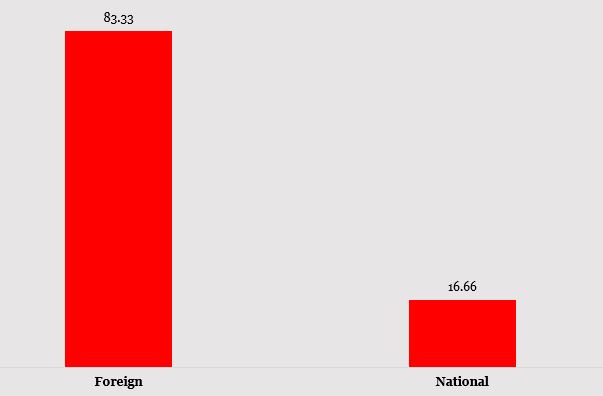
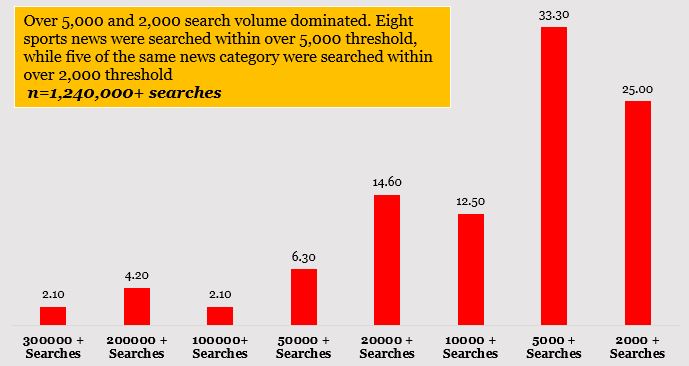
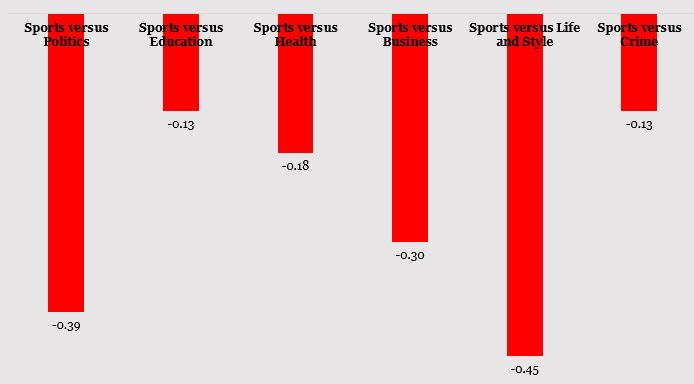
In spite of the high search volume of these categories, our analysis indicates no connection between information/news category and search volume. We discovered the same result for foreign information/news seeking and reading, and search volume. From the first day of our analysis to the last day, analysis suggests growth of passive information acquisition about issues and needs in Nigeria [see Exhibit 1].

Exhibit 1: Category of News Searched by People in Nigeria

Source: Google, 2021; Infoprations Analytics, 2021


Exhibit 2: Trended Information/News Categories

Source: Google, 2021; Infoprations Analytics, 2021

Exhibit 3: Search Volume

Source: Google, 2021; Infoprations Analytics, 2021

Implications

These results have suggested that people searched and read what appealed to them during the period of analysis based on their needs. It is understandable that everyone has right to information seeking and use them in personal and business life using his or her discretion. However, there are implications of what our analysis reveals.

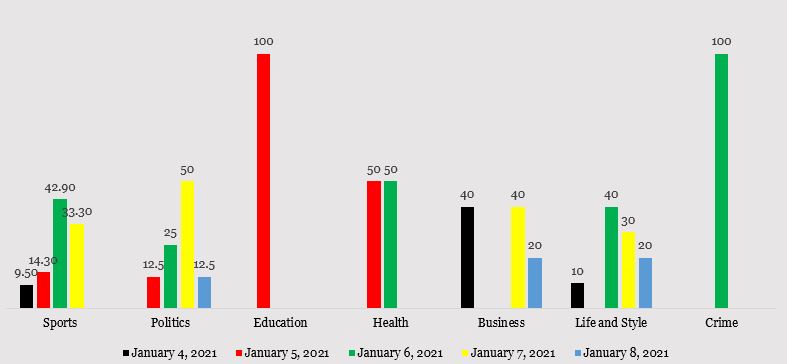
It is clear that people prioritised self-esteem and belongingness over physiological, safety and self actualisation needs. Everyone to watch foreign football matches, understand American politics and active in the social media space at the expense of knowing one or two things that could lead to business creation or investment opportunities exploration. Looking at data on Exhibit 4, it is glaring that Nigerian public was passive on critical information/news categories. It is appalling that a significant information was not sought and read about education, health, business and crime. Linking the interest in sports with the searching of betting and gambling shows that interest in understanding betting was high on January 6, 2021, the day the interest in football was also high. Mostly, people in Osun, Oyo, Rivers, Lagos and Federal Capital Territory had interest in betting. For gambling, people in Abia, Akwa Ibom, Osun, Oyo, Rivers, Lagos and FCT had interest in it on January 4, 2021 than people in other states across the country.

Exhibit 4: Active and Passive Information/News Seeking

Source: Google, 2021; Infoprations Analytics, 2021

Exhibit 5: Category of Information/News by Day

Source: Google, 2021; Infoprations Analytics, 2021
Note 1: Sports (n=21), Politics (n=8), Education (n=1), Health (n=2), Business (n=5), Life and Style (n=10), Crime (n=1)
Note 2: Numbers on the Exhibit are in percentages

How Did 2020 Change Your Strategy – And Your Outlook On Nigeria, Africa?

0
Team at work

What is your business strategy? No matter what it is, it must give you the most optimized way, to combine and recombine factors of production, to deliver products and services to customers, to fix their frictions, at the least possible cost, while in return, enabling you to capture rewards, as revenues and more, from those customers.  You got business objectives, your strategy must provide the course of action or decision mechanisms to actualize them. 

Do them right, the total efforts, financially quantified, of  all the factors of production will be less than what the customers have paid you for those products and services; the delta is your “profit”. 

So, there is an optimization for that delta: maximize what the customers can pay or/and reduce the total cost of those factors of production, ceteris paribus.

How has 2020 changed your strategy – and your outlook in Nigeria, Africa? I have a video below.