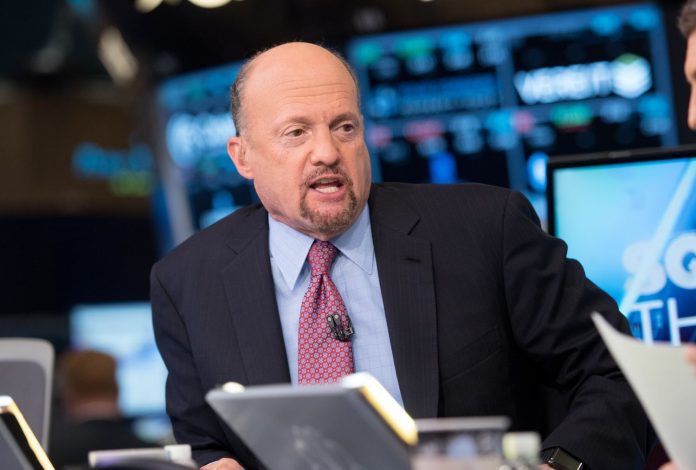
CNBC’s Jim Cramer has warned investors that the bond market is becoming increasingly difficult to ignore as rising long-term Treasury yields, persistent inflation and heavy corporate borrowing linked to the artificial intelligence boom put additional pressure on U.S. equities.
“Normally, I don’t like to talk about bonds, because you don’t want to hear about bonds,” Cramer said Monday on CNBC’s “Mad Money.” “Unfortunately, it’s very important now that long-term interest rates are on the rise.”
The 10-year Treasury yield has climbed from below 4% in February to nearly 4.7%, while the 30-year yield recently moved above 5.3%, its highest level in almost two decades.
The rise in yields has become a growing concern for investors because it changes the relative attractiveness of stocks while increasing the discount rate applied to future corporate earnings. Higher Treasury yields can also raise financing costs for companies, potentially reducing investment and profitability.
The pressure has increasingly appeared in equity markets. The S&P 500 has fallen in five of its past seven trading sessions as investors reassess the outlook for interest rates and corporate earnings.
The bond market’s deterioration has also raised questions about demand for U.S. government debt. A recent 30-year Treasury auction attracted weaker demand than the previous month’s sale, even though yields remained elevated, adding to concerns that investors may require higher returns to absorb the government’s expanding borrowing needs.
The Treasury Department attempted to address some of those concerns last week by announcing that it would more than double planned purchases of longer-dated government securities. The announcement initially pushed Treasury yields lower and stocks higher, but the improvement quickly faded. Yields rose again on Thursday and Friday, suggesting investors remain focused on the underlying forces driving long-term borrowing costs rather than Treasury’s debt-management operation alone.
Cramer said the Treasury has limited ability to address those fundamental pressures.
“The only real solution to this problem is to either cut spending or raise more revenue and the Treasury can’t do either of those things on its own,” he said.
The size of the U.S. government’s debt is central to the concern. With the national debt now around $40 trillion, the government faces enormous financing requirements, meaning Treasury must continue issuing large quantities of securities to fund deficits and refinance maturing debt.
But Cramer pointed to two additional forces that could keep long-term rates elevated: higher oil prices and a surge in corporate borrowing to finance AI infrastructure.
Oil prices have risen sharply during the war with Iran, adding to inflationary pressure across the economy. Higher energy prices feed into transportation, manufacturing, and consumer costs, complicating the Federal Reserve’s efforts to bring inflation back toward its target. That creates a problem for both ends of the yield curve. Persistent inflation can keep short-term rates higher for longer, while investors may demand higher yields on longer-dated Treasurys to compensate for inflation risk and the government’s borrowing requirements.
The AI investment boom is adding another layer of pressure through corporate debt markets.
Technology companies and major hyperscalers are committing enormous sums to data centers, computing capacity, electricity infrastructure and other equipment needed to expand AI services. Some of that spending is being financed through debt issuance.
That means Treasury securities are now competing with corporate bonds for investors’ capital.
“As more incremental dollars go to shares or bonds from a hyperscaler, Treasury yields have to creep higher in order to stay competitive,” Cramer said.
The dynamic creates a feedback mechanism for equity markets. Higher Treasury yields make government bonds more attractive relative to stocks, while higher corporate borrowing costs make it more expensive for technology companies to finance AI infrastructure. That could become essential as investors demand evidence that the enormous capital expenditures associated with AI will eventually produce sufficient revenue and profits.
The issue is not simply the amount companies are spending. The cost of financing that spending matters as well. If interest rates remain elevated, the time required for large infrastructure investments to generate attractive returns can become longer, putting additional pressure on valuations.
Cramer said a sustained decline in long-term rates ultimately depends on reducing the inflation pressures that are keeping yields elevated.
“We want long-term interest rates to go lower, but that’s only gonna happen if we can get inflation under control by reopening the Strait of Hormuz, and that’s a tall order,” he said.
He also argued that the Treasury’s intervention may have unsettled investors rather than reassuring them.
“The Treasury Department’s attempts to get this under control I think have only made investors more nervous,” Cramer said.
The broader concern is that Treasury can alter the composition and timing of government debt issuance, but it cannot by itself eliminate the structural forces pushing yields higher. Fiscal deficits determine how much debt ultimately needs to be financed, while inflation, economic growth and monetary policy influence the returns investors demand for holding it.
That leaves the stock market vulnerable if long-term yields continue rising even without a recession.