DD
MM
YYYY

PAGES

DD
MM
YYYY

spot_img

PAGES

Home Blog Page 600

What’s on Your Mind? The Illusion of Digital Freedom in a Surveillance Age

0

When Facebook asks, “What’s on your mind?”, it feels like a warm invitation to speak freely. The phrase is casual, familiar, and seemingly harmless. It suggests a space where thoughts can be shared without consequence, where personal reflections can become public conversations. But in many parts of the world, including Nigeria, this question has become a loaded one. It no longer represents freedom of expression but rather a potential gateway to legal scrutiny, social backlash, or even imprisonment.

In Nigeria, several individuals have faced prosecution for expressing their thoughts on Facebook. From defamation charges to cyberstalking accusations, the consequences of answering that innocent-looking question have been severe. Gambo Saeed was sentenced to nine months in prison for defaming a state governor. John Danfulani, a former lecturer, was detained for posts critical of political leadership. These cases reveal a troubling paradox: the very platforms designed to amplify voices are increasingly being used to silence them.

This raises a critical reflection: not every message is an act of liberation. Sometimes, it is a digital footprint that leads directly to punishment. The assumption that posting equals empowerment ignores the reality that speech, especially in volatile environments, can be weaponized. In such contexts, the act of sharing becomes less about freedom and more about risk.

A Global Metaphor for Censorship

The metaphor of “What’s on your mind?” shifts dramatically depending on geography. In societies where political criticism is met with repression, the question becomes rhetorical. It asks not what you think, but whether you dare to say it.

In India, Facebook users have been arrested for sharing memes or criticizing religious figures. Though Section 66A of the IT Act was struck down, other laws continue to be used to suppress dissent. Here, the prompt becomes a test of boundaries. It asks users to weigh their thoughts against the risk of legal action.

In Egypt, activists have been jailed for posts deemed harmful to national security. The question becomes a trap, inviting speech that is later weaponized against the speaker. Even in countries with strong free speech protections, like the United States, the metaphor is not immune to distortion. Employers, schools, and courts have increasingly scrutinized social media posts. The question still feels liberating, but it is now accompanied by a silent warning: your thoughts may be free, but they are also permanent and searchable.

These examples remind us that freedom of speech is not just about the ability to speak—it’s about the conditions under which speech is received. A message can be sincere, constructive, or critical, but its interpretation depends on who is listening and what power they hold. In this light, not every message is a declaration of freedom. Some are acts of defiance. Others are cries for help. And many are simply misunderstood.

Nigeria’s Legal Landscape and the Chilling Effect

In Nigeria, this crisis is compounded by outdated laws and vague statutes. The Cybercrimes Act and sections of the Penal Code are often used to prosecute online speech, despite calls for reform. The result is a chilling effect. Citizens begin to self-censor, not because they lack opinions, but because they fear the consequences of sharing them.

Facebook’s prompt, once a symbol of openness, now serves as a mirror. It reflects the contradictions of our digital age. It shows us how platforms can simultaneously empower and endanger. It reminds us that freedom of expression is not just about having a voice, but about being allowed to use it without fear.

This is where reflection becomes urgent. We must ask: is the message truly free if it is shaped by fear? Is it authentic if it is filtered through anxiety? The mere act of posting does not guarantee freedom. In fact, it may signal the opposite, a desperate attempt to speak before being silenced.


How Ozak AI’s $2.6 Million Fundraising Surge Sets the Stage for Explosive Growth as Presale Investors Lock In at $0.01 Before the Next Increase

0

Every once in a while, a project sneaks up and grabs everyone’s attention. That’s what we’re seeing with Ozak AI, a protocol that mixes blockchain grit with artificial intelligence brains. It has already pulled in over $2.6 million during its presale, and investors are still piling in while the token sits at just $0.01.

The fifth presale stage feels less like a warm-up and more like the real show. More than 840 million tokens have been sold, and that kind of momentum tells us one thing: people aren’t waiting around. With a listed price lined up at $0.05, the early backers believe they’re getting in before the door swings shut.

Ozak AI’s Presale Surge and What It Means for Early Supporters

The presale isn’t just raising funds. It’s also building a community-powered network around a product that sits at the crossroads of two of the fastest-growing industries: blockchain and artificial intelligence. That combination has teeth. Ozak AI says its DePIN (Decentralized Physical Infrastructure Network) architecture allows it to store and manage data across different nodes, removing single points of failure. In plain terms, it means fewer weak spots and a system that can run without stalling.

We believe this structure suggests real staying power. Smart contracts govern the flow of data, every transaction is locked on-chain, and the result is reliable, secure, and ready for real-time use across industries that can’t afford downtime. That’s not hype—it’s design.

Why Investors Are Watching Ozak AI Closely

Here’s the thing: presales come and go, but not many land on CoinMarketCap and CoinGecko while they’re still unfolding. Ozak AI already has that visibility, which makes its fundraising less of a backroom affair and more of a public scoreboard. On top of that, the project has been featured on popular media outlets. This attention doesn’t guarantee success, but it does shine a brighter light on the project’s moves.

That said, the $2.6 million milestone shows more than just investor curiosity. It shows conviction. Investors are treating this like more than a short-term play. With AI and blockchain blending into a decentralized stack, the protocol is positioning itself as an infrastructure layer in industries hungry for scale and security.

The Bigger Picture

This presale isn’t happening in a vacuum. Global interest in AI tokens has surged as traders search for the next project that actually ties artificial intelligence to usable blockchain systems. Ozak AI’s approach is far from perfect, but it’s practical, and sometimes that’s the winning edge.

Whether it’s seen as a bet on AI, on blockchain, or simply on early adoption, Ozak AI is carving out its place in the conversation. For now, investors locking in at $0.01 are doing so with the belief that the next chapter could look very different.


For more information about Ozak AI, visit the links below:


Website: https://ozak.ai/

Twitter/X: https://x.com/OzakAGI

Telegram: https://t.me/OzakAGI

Salesforce CEO Marc Benioff Confirms 4,000 Job Cuts as AI Agents Replace Customer Support Roles

0

Billionaire CEO Marc Benioff has revealed that Salesforce has cut about 4,000 customer service roles as artificial intelligence agents step in to take over much of the workload, per Fortune.

The $248 billion cloud software giant is the latest tech heavyweight to openly embrace automation at the expense of human workers, a shift that underscores how quickly AI is reshaping the corporate labor landscape.

Just like Klarna and Microsoft, Salesforce is now leaning heavily on generative AI agents that can handle over a million consumer conversations, cutting support costs by 17% since the start of 2025. Benioff, once skeptical about AI-driven layoffs, now says bluntly that he “needs less heads.”

“I was able to rebalance my headcount on my support,” Benioff said on The Logan Bartlett Show podcast. “I’ve reduced it from 9,000 heads to about 5,000, because I need less heads. If we were having this conversation a year ago and you were calling Salesforce, there would be 9,000 people you’d be interacting with globally on our service cloud. Today, those same interactions are happening, but 50% are with agents, 50% are with humans.”

The shift highlights a dramatic change of tune. Fortune notes in the report that when ChatGPT launched only three years ago, leaders, including Benioff and Nvidia CEO Jensen Huang, repeatedly argued that AI would augment workers rather than replace them. In fact, as recently as last year, Benioff told Fortune that mass layoffs “weren’t on the table,” insisting that AI lacked the precision to displace humans.

Now, the reality looks very different.

Salesforce’s Hybrid Workforce Model

Benioff insists that Salesforce’s hybrid workforce—half human, half AI—shouldn’t be seen as dystopian. “I don’t think it’s dystopian at all,” he said. “This is reality, at least for me.”

Salesforce confirmed that its in-house platform, help.agentforce.com, has been a key driver of the changes.

“Because of the benefits and efficiencies of Agentforce, we’ve seen the number of support cases we handle decline, and we no longer need to actively backfill support engineer roles,” a Salesforce spokesperson told Fortune.

The company added that it has redeployed hundreds of employees into professional services, sales, and customer success.

Still, customer support remains the sharpest casualty. Benioff himself has repeatedly identified support and sales as the two functions with the highest potential for automation. Already, agents complete 30–50% of Salesforce’s customer interactions. By pushing further into automation, the company has slashed costs while maintaining service coverage.

Benioff also hinted at broader ambitions. “I’m looking at every single function to see how it can become an agentic business,” he said.

Industry-Wide AI-Driven Layoffs

Salesforce is not alone. Across Silicon Valley, firms that once dismissed AI job displacement are now actively reshaping their workforce.

Microsoft has announced 15,000 job cuts this year—including 9,000 in July—despite posting an 18% year-over-year increase in net income last quarter. Many of those roles are customer-facing, echoing Salesforce’s pivot. Meta eliminated 3,600 roles in February, with CEO Mark Zuckerberg forecasting that AI could serve as a “mid-level engineer” before the year ends. Google has also axed hundreds of roles across its Android, Pixel, and Chrome teams, citing the need to redirect resources into AI.

Klarna, often seen as one of the earliest adopters of large-scale AI customer service, has shown how radically the technology can scale. Its digital agents now handle the equivalent work of 700 staffers. But in a notable reversal, Klarna recently announced that it is redeploying workers back into customer-support roles after its CEO admitted that earlier AI-driven cost-cutting went too far. The move highlights both the promise and the pitfalls of automation—while AI can slash costs, an overreliance risks eroding the quality of customer experience.

The Salesforce layoffs mark a sobering inflection point in the AI adoption curve. When generative AI systems like ChatGPT, Claude, and Bard burst onto the scene in late 2022, the narrative from industry leaders was that AI would primarily augment human tasks. CEOs pointed to collaboration models where humans supervised AI outputs, maintaining a sense of security for white-collar jobs.

But as the technology rapidly matured, the business case for cost-cutting proved irresistible. Customer service and sales—two of the most labor-intensive corporate functions—have emerged as the first frontiers. For Salesforce, the result has been a 17% reduction in support costs, achieved in less than a year.

Benioff frames the moment as one of excitement, not despair. “There’s also an omni-channel supervisor now that’s helping those agents and those humans work together,” he said. “And this is the most exciting thing that’s happened in the last nine months for Salesforce.”

A Familiar Silicon Valley Shift

Salesforce’s pivot mirrors historical moments when new technologies displaced entire categories of work. Call centers were once the backbone of customer engagement, but cloud-based automation and chatbots have already eroded their dominance. Now, generative AI is accelerating that erosion, enabling scalable, personalized conversations that were once the domain of human agents.

As AI moves deeper into sales and support, two of the most people-heavy business units, the corporate promise of AI as an “augmenter” is giving way to a harsher truth: companies are embracing bots because they’re faster, cheaper, and tireless.

And the cuts may only be beginning.

Understanding 2017 Federal Government-Academic Staff Union of Universities Agreement

0

In 2017, the Federal Government of Nigeria and the Academic Staff Union of Universities (ASUU) signed a Memorandum of Action that was meant to end a prolonged strike and restore stability to the country’s public university system. Examination of the MOA establishes familiar calls from the Union, demanding better funding, fair compensation, and institutional autonomy. The response was a partial concessions and promises of reform. Analysis further reveals series of lesson about how complex problems are resolved in Nigeria through a patchwork of negotiations, compromises, and shared responsibilities.

At the heart of the crisis was a breakdown of trust. ASUU had long argued that the government had failed to honour previous agreements, particularly around revitalizing university infrastructure and paying earned academic allowances. The union resorted to strike action, not just as a bargaining tool, but as a way to force public attention on what it saw as systemic neglect. The government, facing mounting pressure, responded with a mix of financial releases, committee formations, and policy adjustments.

One of the most main features of the agreement was how many different actors were involved. Beyond ASUU and the federal government, the resolution process drew in the Ministry of Education, the Ministry of Finance, the Office of the Accountant General, the Central Bank, the National Salaries Commission, and even the Nigeria Labour Congress. Each played a role, whether it was releasing funds, issuing circulars, coordinating audits, or offering moral support. This wide cast of players reflects the reality that no single institution can fix a broken system alone. It takes collaboration, even if that collaboration is messy and slow.

The government’s actions were largely reactive. It released N20 billion for university revitalization, disbursed N23 billion for earned allowances, and promised to include future payments in the national budget. It also agreed to fast-track the registration of NUPEMCO, a pension fund tailored for university staff, and to address salary shortfalls that had plagued many institutions. These were important steps, but they were also stop-gap measures. They addressed immediate concerns without necessarily solving the deeper structural issues that caused the crisis in the first place.

ASUU, for its part, showed strategic discipline. It submitted nominees for committees, provided documentation for audits, and engaged in multiple rounds of negotiation. But it also held firm on its core demands, refusing to call off the strike until concrete actions were taken. This balance of pressure and participation helped move the needle, even if only slightly.

What the agreement ultimately reveals is a system that responds best under pressure. The strike created urgency, and that urgency forced institutions to act. But it also exposed how fragile the resolution process can be. Many of the promises made in the agreement were conditional or delayed. For example, the forensic audit of earned allowances was to be completed before further disbursements could be made. A committee was formed to explore sustainable funding, but its recommendations were not immediately binding. A memo was promised to the National Economic Council to address the proliferation of state universities, but it remained a future task.

This kind of incrementalism is not necessarily a failure. In a country as complex as Nigeria, where resources are limited and institutions often operate in silos, progress often comes in stages. What matters is whether those stages build towards lasting change. The 2017 agreement laid a foundation, but it did not finish the house. It showed that dialogue is possible, that compromise can be reached, and that multiple actors can work together when the stakes are high.

Our analyst notes that resolving crises in the education sector requires more than emergency funding or political promises. It demands a coordinated approach that brings together all relevant institutions, listens to the concerns of stakeholders, and follows through on commitments. For unions, the takeaway is that persistence pays off, but it must be matched with constructive engagement.

Our analyst stresses that the FGN-ASUU agreement is not just a document. It is a mirror reflecting the strengths and weaknesses of Nigeria’s approach to public policy. It shows that while the road to reform is long and uneven, it is not impassable. With the right mix of pressure, participation, and accountability, even the most entrenched problems can begin to shift.

Why Bitcoin And Ethereum Investors Are Accumulating Avalon X

0

Bitcoin and Ethereum have been around long enough to prove their staying power. People who believed in them early and held through all the ups and downs have seen that patience can pay off. Now many of those same investors are wondering how to put a slice of their gains into something new, something that feels a little more immediate, mainly Avalon X.

Avalon X (AVLX) is a project built around its token, AVLX, but it does not just talk about future potential. It has created two promotions that give token holders clear and simple opportunities. One is a million dollar AVLX prize pool and the other is a luxury townhouse in the Eco Avalon development. Both of these are rewards people can imagine right away, which makes them very different from the usual promises seen in crypto.

Bitcoin Price Prediction: BTC Market Performance

Bitcoin has been the leader of the market for more than a decade, and it continues to set the tone. Right now it is trading around one hundred and seven thousand dollars after a late summer pullback.

Some traders worried when it dipped, but analysts say this kind of pause is normal and could set up a rebound toward one hundred and fourteen or even one hundred and sixteen thousand. Large holders, often called whales, have been adding more to their wallets, which usually means confidence is still high.

Institutional demand is also stronger than ever. Analysts point out that buying pressure from both retail and big institutions is running well ahead of new supply. Since Bitcoin has a limited number of coins, this kind of imbalance often supports long term price growth.

A recent example came from Japan where Metaplanet, a listed company, approved plans to raise $880 million to buy even more Bitcoin. That shows how deep corporate interest has become.

Some people even think this current market cycle will go on for years and strength will last till 2027. Whether that’s true or not, the bigger picture is that Bitcoin is being taken as a serious asset by individuals and companies.

For holders that’s a solid base to build from and it opens up the door to explore new projects like Avalon X without giving up their foundation.

Ethereum Price Prediciton: ETH’s Recent Performance

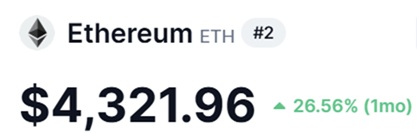
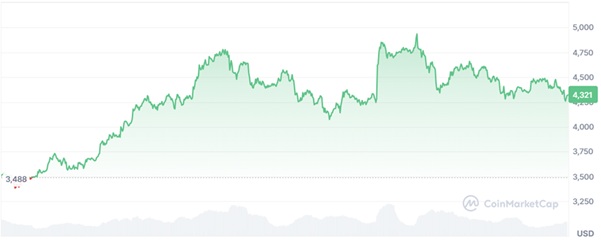
Ethereum has had a strong run. In August Ethereum price went up over 20% and network liquidity hit over 140 billion.

Even after a small pullback that followed, confidence in ETH is still solid. Investors are encouraged by the steady growth of staking, more coins are being locked into contracts that support the network and inflows into exchange traded funds.

It shows that Ethereum has become an asset used by serious players who are building the Web3 ecosystem. For long term holders that’s a big plus that ETH will continue to play a central role in the market.

The Avalon X Token Giveaway

With Bitcoin and Ethereum providing a solid backdrop, Avalon X is offering something different. The first promotion is a one million dollar AVLX giveaway. Ten winners will each receive one hundred thousand dollars in tokens.

The process is simple. Add your wallet address to the Avalon X dashboard, buy at least one hundred dollars of AVLX, and you are in. If you want better odds, you can refer friends. Every referral gives you ten extra entries.

This format works well for BTC and ETH investors because it feels familiar. It is built on wallets, token ownership, and a clear structure. There are no complicated hoops to jump through.

The Townhouse Giveaway

The second promotion goes beyond digital rewards. Avalon X is offering one person the keys to a townhouse in the Eco Avalon development. To qualify, you need to buy at least two hundred and fifty dollars of AVLX. The steps are the same as the token giveaway, and referrals once again give you extra entries.

This prize is about more than numbers on a screen. It is about the dream Avalon X highlights on its site. The images show modern spaces, stylish interiors, and the idea of city living within reach. It helps people connect the idea of holding a token with something they can picture themselves enjoying in the real world.

Why Investors Are Paying Attention

What makes Avalon X appealing is how straightforward it is. The rules are clear, the process is quick, and the outcomes are easy to imagine. A million dollars in tokens or a new home are rewards that do not require complex explanations. Investors in Bitcoin and Ethereum are comfortable with wallets and token transfers, and Avalon X fits right into that routine.

Conclusion

Bitcoin and Ethereum continue to anchor the market, supported by strong fundamentals, institutional demand, and ongoing upgrades. For many investors they remain the base of a portfolio. But with Avalon X, there is a way to take some of those gains and put them into opportunities that feel more immediate.

Through its AVLX token, the company has created two promotions that connect the digital with the tangible. A one-million-dollar prize pool of tokens and a luxury townhouse are rewards that people can understand and aspire to.


Join the Community

Website: https://avalonx.io/

$1M Giveaway: https://avalonx.io/giveaway

Telegram: https://t.me/avlxofficial

X: https://x.com/AvalonXOfficial