DD
MM
YYYY

PAGES

DD
MM
YYYY

spot_img

PAGES

Home Blog Page 6002

Airbnb Thrives on IPO Debut, Valued At Excess of $100 Billion

1

Airbnb, the craziest and most unbelievable business model of the century – yes, someone will rent his room to a stranger for peanuts – has reached the mountaintop. Airbnb has gone public, and is now worth over $100 billion, and possibly by the end of next week, would have a market cap that is bigger than $111 billion IBM. How do you explain turning a lemon into a lemonade through the combinatorial power of software?

Hail the innovators who can find value in anything. The Airbnb business model on paper would have scored “D” from me, but people, it is an A+ company, in the real world. Nations advance when innovators rise! America creates many of them at scale.

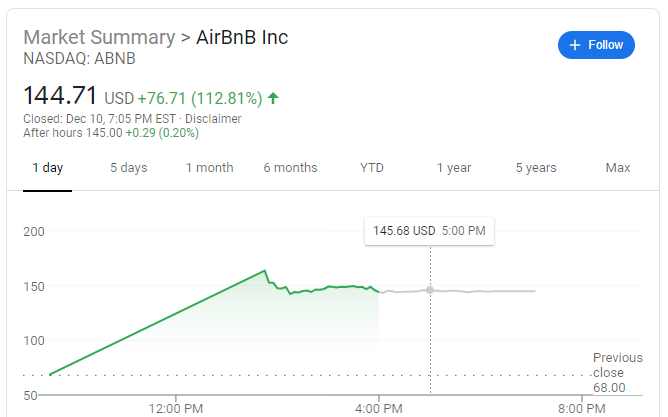
Shares of Airbnb soared in their debut Thursday, closing slightly lower than their opening price at $144.71 in the home-sharing company’s IPO. Airbnb’s market value shot past $100 billion and makes Airbnb the 10th best debut in 2020 based on price gain from its IPO, CNBC reports. It’s the latest sign of 2020’s hot IPO market as Airbnb follows DoorDash, which began trading Wednesday. While the pandemic has decimated the travel industry, Airbnb posted a $219 million profit in the third quarter due to an uptick in local bookings. Airbnb acknowledges local laws and opposition from neighbors could slow its growth. Cities like Boston, Denver and Santa Monica, California, have tightened rules on vacation rentals. (LinkedIn)

Airbnb is an aggregator and runs a potent business model of the 21st century.

Under the aggregation construct, the companies that control the value are not usually the ones that created them. Google News and Facebook control news distribution in Nigeria than Guardian, ThisDay and others. Because the MNCs tech firms “own” the audience and customers, the advertises focus on them, hoping to reach the readers through them. Just like that, the news creators have been systematically sidelined as they earn lesser and lesser from their works. But the aggregators like Facebook and Google smile to the bank. The reason why this happens is because of the abundance which Internet makes possible.

Everyone has access to more users but that does not correlate to more revenue because the money goes to people that can help simplify the experiences to the users who will not prefer to be visiting all the news site to get any information they want. They go to Google and search and then Google takes them to the website in Nigeria with the information. Advertisers understand the value created is now with Google which simplifies that process.

In the hospitality industry, Airbnb reduces the friction between the landlord and renter by using software to build trust and remove information asymmetry. More than 80% of the leading technology companies in the world run a bit of aggregation.

Airbnb Hits $101 Billion In IPO, In A Big U.S. Flotation of 2020
Airbnb Hits $101 Billion In IPO, In A Big U.S. Flotation of 2020
0

The latest company to join the season of initial public offering, Airbnb, made its debut on Thursday recording more than its targeted share price to raise about $3.5 billion.

In an unprecedented manner, the shares soared in the stock market on Thursday, valuing the home rental firm at $101.6 billion in the biggest U.S. flotation of 2020.

Shares opened at $146 on the Nasdaq, far above the initial public offering (IPO) price of $68 apiece that raised $3.5 billion for the company. The stock hit a high of $165, rising 142.6% after the debut.

Airbnb’s IPO came just hours after DoorDash debuted on the New York Stock Exchange with $3.37 billion offering, beating expectations.

The duo has enjoyed significant growth in business following a demand surge that yielded a rebound from the pandemic-fueled slump.

The company’s offering is led by Morgan Stanley and Goldman Sachs group Inc. and its shares are expected to begin trading Thursday on the Nasdaq Global Select Market under the symbol ABNB.

But the jolly ride propelled by the pandemic has limitations that may undermine Airbnb’s valuation. Bloomberg noted that for the company to hang on to any lofty valuation, it will need to grapple with a litany of threats, as outlined in its IPO prospectus, ranging from a surge in party houses that carry liability risks to an increase in professionally run properties that lack the charm that made Airbnb rental famous.

Bloomberg analysis divided the factors that drove Airbnb’s growth into two: the pandemic crush and the domestic boost.

The pandemic crush stems from a bounce back in domestic bookings since the outbreak of coronavirus plummeted demand for house rentals.

The analysis noted how in the past 13 years, the San Francisco-based company has upended the travel market, given people an opportunity for income and created a whole new market for services related to real estate and hosts. The ingenuity has placed Airbnb in the high spot of the travel industry.

Airbnb planned its IPO in early April, but was immobilized by the outbreak of the pandemic which saw its shares dive 72%. The company rolled out a blanket refund policy and gave out more than $51 billion in cancellation fees.

The rebound that reinforced the IPO started in June as city dwellers began moving to mountain areas to fight off boredom that ensued following the lockdown. Many of the travelers settled for as long as a month, working from home and adapting to virtual life.

Domestic boost according to the analysis stemmed from a surge in short distance trips and stays outside of the top 20 cities as an alternative to international travel.

The rebound became noticeable in the third quarter, when Airbnb recorded only 18% decline compared to other companies like Expedia group Inc. and Marriott International Inc. who recorded 60% decline respectively.

Bloomberg said Q3 was also the most profitable period ever for Airbnb, based on earnings before interest, taxes, depreciation and amortization.

In the first nine months of 2020, Airbnb had a net loss of $697 million on revenue of $2.5 billion, compared with a net loss of $323 million on revenue of 43.7 billion for the same period in 2019, the filing statement said.

Airbnb funding in April put its valuation to $18 billion, indicating huge loss as it falls well below the $26 billion it cited as internal valuation in early March.

Airbnb revolutionized the hotel industry since it was founded in 2008. The company allows individuals to rent out rooms in their homes for travelers and get paid accordingly. The startup thus became one of the most innovative and lucrative ideas in the hotel industry, reaching at one point in its early stage, $31 billion in valuation.

Cost of Data – The Irony in South Africa

0

The #3 rarely makes money in most economies. But economies need them to keep #1 and #2 under checks. Yes, in the global telecommunication industry, you need a fairly strong #3 if you want to keep the price of telecom services to be optimal. In U.S., Verizon and AT&T ruled the domain but the old Sprint and TMobile were there, and can now become a combined stronger #3.

In Nigeria, there are fairly strong three players in MTN, Airtel and Glo. And even the presence of #4’s 9Mobile cannot be discounted. The implication is that price stays fairly optimal.

So, when you have strong two players and your laws are open and free, allowing market forces to run the system (in other words, you cannot rule by fiats and mandates), lack of a strong #3 will hurt.

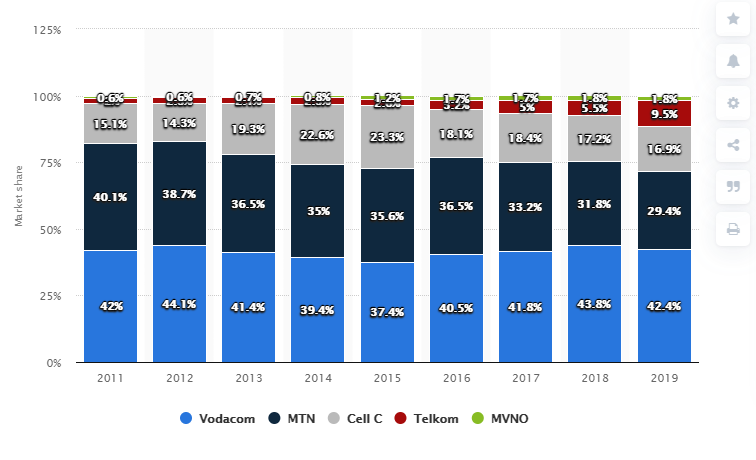
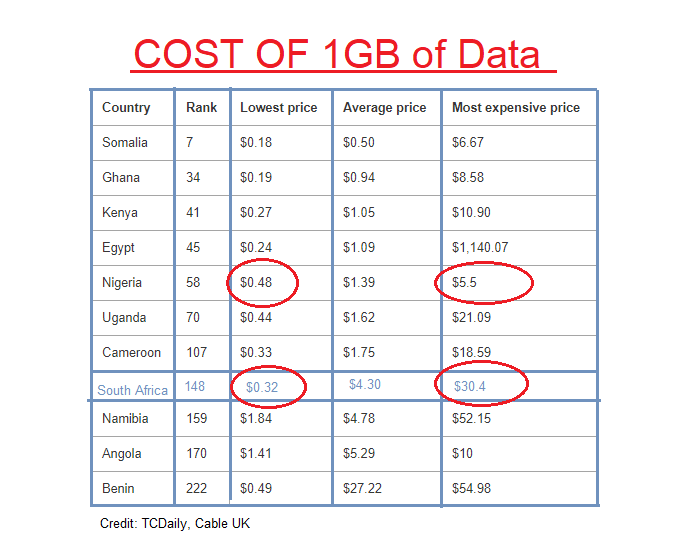
That is what is happening in South Africa where data cost is out of order. Vodacom holds close to 43% of the market. MTN follows at 29% while Cell-C is at 17%. The implication is that Vodacom cares about MTN. See the distribution on click https://www.tekedia.com/cost-of-data-the-irony-in-south-africa/ In Nigeria, MTN has to track Airtel and Glo at the same time as both are largely strong #2 and #3.

Every market needs competition. Yes, it is a big irony that the most developed economy in Africa is the one that seems to have data cost which is out of order.

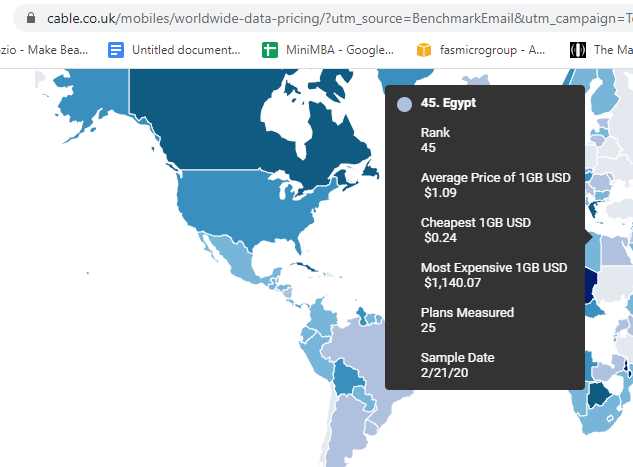
The Egypt data is not a typo.

https://www.cable.co.uk/mobiles/worldwide-data-pricing/?utm_source=BenchmarkEmail&utm_campaign=TechCabal_v1_10%2f12%2f20_-_Live_Final&utm_medium=email

Tax Law & Compliance in Lagos State – A New Course At Tekedia Institute

0

As one of the largest economies in Africa, Lagos is a heart of the African continent, and most of our members in Tekedia Mini-MBA have activities therein. In our program, feedback does indicate that a tax paralysis is evident. So, to do something on it, we are introducing a course on Tax Law & Compliance in Lagos State.

We are honoured that Abimbola Abdur-Rahman Lekki, a Tax Attorney, and Head of Station in Lagos State Internal Revenue Service (LIRS), is developing a course on Tax Law & Compliance in Lagos State. My desire is that after this course, our members will understand Lagos and its tax systems, and together everyone will do his or her part to advance the economic center and the continent.

Of course, the Federal Inland Revenue Service (FIRS) through one of its managers is also helping. But we are focusing on Global Tax Treaties and Benefits, primarily to educate and inform innovators and builders in Nigeria, Africa and globally, on how tax treaties could be used strategically.

Tekedia Institute is a modern school and we teach relevant things. Visit our new classroom: http://school.tekedia.com/

Thank You Nigerian Society of Engineers

0

Thank you the Nigerian Society of Engineers. I am proud to serve the world as an engineer. It remains like yesterday when my mathematics teacher, Mr Bukar, in JSS3, asked “what would you like to be?” I said: “an electrical engineer; I like the electricity part of Integrated Science”. We build nations.