Nigeria’s electricity grid collapsed a few hours ago,leading to a major failure in the system: “We regret the inconvenience this has caused electricity consumers. Investigations would be conducted to establish the immediate and remote cause(s) of the multiple trippings as soon as the grid is fully restored”, noted TCN, the electricity transmission company. They have gotten some sections back as I write.
Meanwhile, the President of the Manufacturers Association of Nigeria (MAN), Mansur Ahmed, has noted that made-in-Nigeria products have lost competitiveness in the ECOWAS due to the closure of the border: “The increased traffic through our seaport as a result of the closure has increased the perennial congestion at the Apapa and Tin Can Island Ports, leading to greater challenges for exporters and increased demurrage cost, as well as other port levies...”
“Major manufacturers of beverages, polypropylene bags, tobacco, cement, toiletries, and cosmetics industries were losing markets they had worked very hard to secure in the West and Central African region.
“These manufacturers were hoping to leverage their market share to secure a strong position in the African Continental Free Trade Area, which kicks off in January 2021.
Simply, Nigeria closed land borders and made the seaports challenging for asking everyone to ship via the sea. Certain things in Nigeria do not make sense: you do not have capacity via the sea, and yet you are asking everyone to use the sea when the land is free! Can somebody explain what is happening in Nigeria?
Of course we have lost our mojo according to data from the IMF and World Bank.
Top 10 Fastest Growing Economies in Africa in 2018 (World Bank, IMF….)
[1] Ghana >>>>>>>8.3%
[2] Ethiopia >>>>>>8.2%
[3] Cote d’Ivoire>>>7.2%
[4] Djibouti >>>>>> 7.0%
[5] Senegal >>>>>>6.9%
[6] Tanzania >>>>> 6.8%
[7] Sierra Leone>>>6.3%
[8] Burkina Faso>>>6.0%
[8] Benin Rep>>>>>6.0%
[9] Rwanda>>>>>>>5.9%
[10] Niger Rep>>>>>5.2%
——————
[41] NIGERIA>>>>>>1.9%,
Note: Nigeria was Number [1] in 2012, 2013, 2014 and 2015. Also, Nigeria was the 3rd Fastest growing Economy in the World in 2014 now, the 88th. (Source: World Bank, IMF)
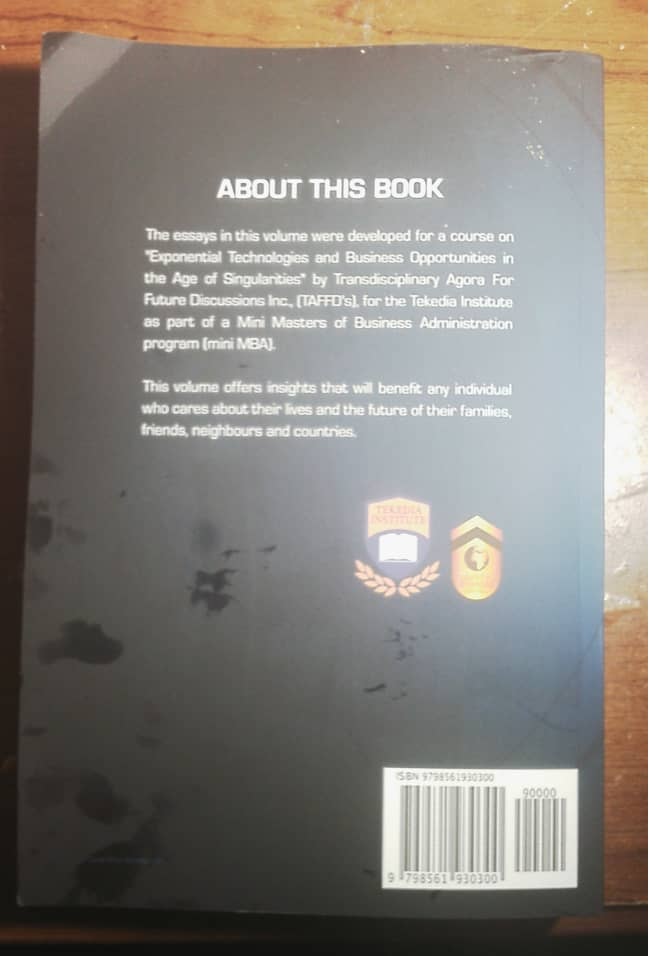
“Seizing Our Singularity Future” is out at Amazon. Four of our Faculty members, at Tekedia Institute, are the authors: Edward Hudgins, PhD, Chogwu Abdul, PhD, Gennady Stolyarov II and Brent Ellman. We want to thank Transdisciplinary Agora for Future Discussions Inc. ( TAFFD’s ) Georgia USA and its leadership for developing our course on “Exponential Technologies and Business Opportunities in the Age of Singularities”.
More books are coming: “Personal Finance and Wealth Management” and “Leadership and Knowledge Management”. Largely, if you prefer the courses over Written Materials, you will get them. My 57-page tome on our business models course, titled “The Grand Playbook of Business”, will be ready next year as a book also.
Would it not be good if you look for the Tekedia Institute’s logo before you buy another management book?
Tekedia Institute: “to discover and make scholars, noble, bright, and useful”.
One of the things my years of empirical studies have taught me is never to depend on media houses for unbiased information. Unless I am seeking people’s opinions or perspectives regarding an issue, I steer away from media reports. As absurd as this might sound, it should be noted that media owners are usually affiliated to political parties, or are sympathetic to certain causes. Hence, their reports usually tilt towards exaggerating or undermining issues to favour their affiliates. Nevertheless, several lawsuits have reduced the rate at which media houses report false information but it has not yet been totally eradicated.
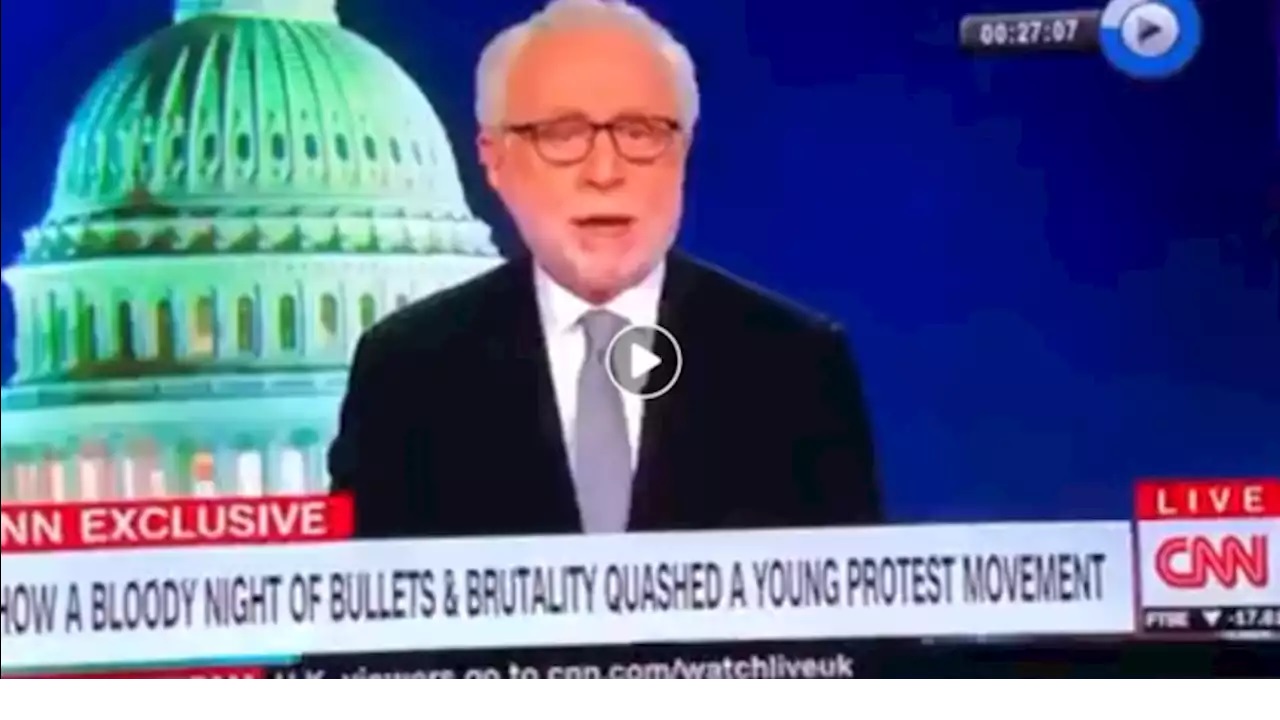
For reasons best known to Cable News Network (CNN), they picked Nigeria as one of the places ripe for speculation and spread of unverified information. Without considering the implication of their actions, the media house speculated that tens of people were shot dead at the Lekki Toll Gate incident, which happened on October 20, 2020. On October 23, 2020, CNN Africa used their Twitter handle, @CNNAfrica, to insinuate that more than 38 persons were killed by soldiers at Lekki Toll Gate on that said night.
In their tweet, CNN Africa stated, “At least 38 persons were killed in Nigeria on Tuesday when the military opened fire on peaceful protesters. But the President failed to address the carnage during his speech on Thursday, drawing criticism from protesters who accuse him of failing to show empathy and unify the nation.”
Of course, as expected, many Nigerians fell for this because, to them, CNN is a reputable media house that cannot report unverified and unverifiable news. But unfortunately for CNN, many Nigerians revisited that tweet when it released itsr “exclusive” investigation report that did not only present old videos that have been under debate for long but also failed to provide evidence of the killings. In this “mind-blowing” report, CNN could only “prove” that one person died after the Nigeria Army shot into a crowd of more than five thousand protesters at close range with live ammunition. Of course, they must have realised that Nigerians are not stupid as the world made them seem because people started making jokes with the irrationality of live bullets failing to slaughter people in their thousands. Even you would agree that it is impossible to shoot AK47 live ammunition into a crowd at close range without people flying straight to hell in their numbers. But this video could prove no such thing.
Anyway, after the release of this “exclusive” report by CNN, some well-meaning Nigerians began to ask for the CNN satellite video that shows the killing of more than 38 persons as was insinuated by the organisation on 23rd October. When it became apparent that CNN had been shoved to a tight corner because it shot itself on the foot, it became defensive. Instead of providing evidence on the killing of people at the toll gate, they tried to prove that the video provided from the Lekki Toll Gate CCTV was doctored. They also tried to justify their claim by saying that Brigadier-General Taiwo has proved, at the Lagos Judicial Panel of Inquiry, that men of the Nigeria Army went to Lekki Toll Gate with live ammunition. Well, they must have found out this latter claim did not prove the killing of people because soldiers would not have been deployed without live bullets to protect themselves and other citizens in case an assault happens.
It became apparent that CNN has no evidence to back up their claims when on 26 November, they took to their CNN Africa Twitter page again to twist their initial claim on the number of people killed on 20 October at Lekki Toll Gate. In this latest tweet, they said, “Clarification: This tweet from October 23 did not attribute the death toll from protests in Nigeria to Amnesty International. The tweet also did not make it clear that the death toll was for protests across the country.” In the news report attached to this tweet, it says that, according to Amnesty International, 38 people were “killed across the country on Tuesday alone…” In order words, these people were not killed at the Lekki Toll Gate “massacre”.
With this, it has become quite glaring that CNN had no evidence in the first place but went ahead to release defamatory information about the Nigerian government and the Nigeria Army. They knew the tension in the country during that period but they sent out more malicious information that could intensify the uprising. They knew that Nigerians believed so much in anything “foreign” but it didn’t deter them from dispensing these lies into the country. They seemed bent on seeing Nigeria burned down to the ground.
Today, CNN has caused a lot of damages to the image of the country. They incited more people into causing harm to others. People lost their lives, properties and sources of income because of the fake news that flew about during that period. Peace was disturbed and the economy became more destabilised; all thanks to the bearers of false information.
No matter what CNN does, no matter how it tries to manipulate information, it owes Nigeria and Nigerians an apology. It should look into its reports on ENDSARS protest and the ensuing violence and publicly retract anyone that has no objective and well verified evidence to back it up. They should carry out proper investigative journalism and stop using subjective materials in issues as delicate as this. Hopefully, when CNN learns its lessons, other media houses will follow suit.
Topic: Accumulation of Capabilities – How Indomie Noodles Won Dangote Noodles
Greetings. We now run the largest management training institution in Africa with thousands of members. Besides our daily perspectives at Tekedia.com, I will be reaching out twice weekly via this medium to engage our community on the mechanics of business systems. Each piece would be prepared to pass across a business lesson.
Business Lesson: When companies acquire and accumulate capabilities, they move upstream and create new competitive advantages which anchor growth. More so, because of the capabilities, they protect their market shares through strategic moats against competitors and new entrants.
Video Case: Indomie Noodles was a pioneer, and an industry category-king in the noodles business in West Africa. Dangote Group saw the opportunities and launched Dangote Noodles, tapping into its accumulated capabilities as an industrialized conglomerate. But Indomie did not fold, it defended its castle, won the battle, and later acquired Dangote Noodles. In this video, I share what happened, and what we can learn.
News: Tekedia Institute has launched the 4th edition of Tekedia Mini-MBA (Feb 8 – May 3 2021). It runs for 12 weeks, 100% online and costs $140 or N50,000. Faculty includes business leaders from Microsoft, KPMG, Shell, Flutterwave, Coca Cola, Infoprive, LaCasera, MTN, etc, under the coordination of Prof. Ndubuisi Ekekwe. To learn more and join, click https://www.tekedia.com/mmba4/
(If you received this via a forward, sign-uphere.)
The mobile telecommunications industry in Nigeria existed in the last millennium with limited reach Code Division Multiple Access (CDMA) network operations by companies like Multi-Links, Mobitel and Intercellular. However, it was not until 2001 when a limited number of Global System for Mobile Communication (GSM) licenses were made available though deregulation of the industry that a federal alternative to the prohibitively expensive, managerially dysfunctional and technically impotent state enterprise NITEL became credible.
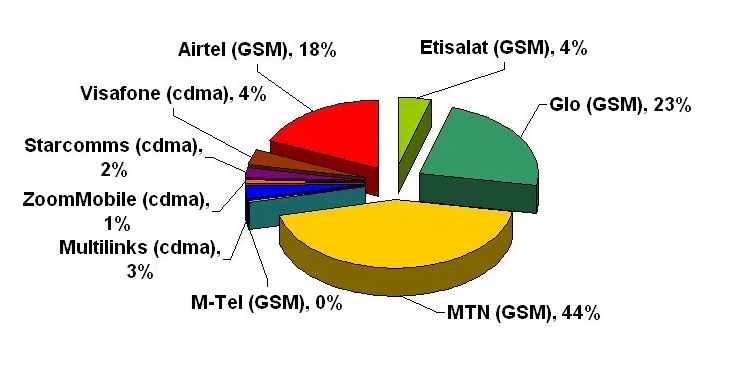
Market split between GSM and CDMA operators circa 2007.
CDMA MNOs (Mobile Network Operators)
CDMA operators were confined to a number of very inflexible operational specifications, including geographical reach at point of initial licensing, so obtaining license/permit changes to allow expansion and service variations was inflexible, time consuming and costly. CDMA operators therefore remained confined to a fairly short operational reach. The licenses under which GSM companies operated offered far more freedom, especially concerning geographical expansion.
Many of the technical aficionados are of the opinion that CDMA was a superior and more cost effective protocol and Central Bank of Nigeria advocated this protocol for use with ATMs.
By the time 4G/LTE technology became available it was realistically only GSM MNOs were in a position to roll a service out federally.
CDMA MNOs continued to operate with limited reach for many years to come, alongside GSM, and offering cheaper rates – other well known providers were for instance, Zoom and Starcomms. The last surviving was Visafone, which was acquired by MTN in 2016, and the CDMA services it provided, closed down.
The Nigerian Infrastructure Ecosystem and ‘Wholesale MNO’ concept
No Infrastructure company in Nigeria owns complete end-to-end capacity to provide end user services. Most started in one niche area and expanded their reach through a combination of leasing capacity from complimentary providers, and expanding their own infrastructure beyond their core product. Examples of Infrastructure can be ‘mast and shelter’ sites, collocation/data centre sites, metro mesh networks (fiber and/or microwave) Federal fiber backbone (high capacity fiber trunk inter-connecting cities and large towns), International Submarine Cable (connectivity to the world and to Tier 1 ISP’s), Satellite capacity leasing, and ‘Last Mile’ service providers.
‘Last Mile’ service providers rarely own infrastructure. ‘Mile’ is a metaphor for the last ‘hop’ of service from an infrastructure node or PoP (Point of Presence) to a customer or end user. It can take many forms. For an MNO, it can involve a rigger climbing a mast and mounting the equipment that will reach Smartphones within a given service radius. It may involve equipment installation or recalibration in the shelter. For other types of users and customers, it may involve microwave radio installation at mast, and also at customer side, with additional cabling and CPE (Customer Premises Equipment). If there is a JB (junction box) roadside to which fiber can be patched, it can involve digging a trench, laying short distance customer fiber and again, additional cabling and CPE. If the service is over satellite it may involve the installation of a VSAT antenna or adjustment of the Elevation and Azimuth to re-provision an existing one, and of course, cabling and CPE. When a DStv technician visits a location, installs equipment and gets it up and running, this is probably the simplest implementation of a ‘last mile’ service. While DStv and MNO’s last mile implementation is fairly ‘rinse/repeat’, when it comes to innovative solutions and first-to-market deployments for VIP customers, technical challenges almost always arise at the ‘last mile’ end rather than at the backbone side. While many established players in the Nigerian Infrastructure Ecosystem have their own Field Operations Units, even those frequently need to engage a third party provider for ‘last mile’. Most Infrastructure Companies have a field team in Lagos and maybe Abuja and one other, but for distant deployments like Zaria, Jalingo or Gombe, it’s cheaper to partner with ‘Last Mile’ providers locally. Even the largest MNOs however, experience field service spikes driven by promotions, expansions or technology upgrades so some contracting out for them is also inevitable.
For many companies also, word of mouth, extremely powerful in Nigeria, brings more remote business as a result of the work of their ‘Last Mile’ contractor. Many ‘Last Mile’ service providers also become resellers in a region, to local ‘enterprise clients’. ‘Last Mile’ technicians are some of the most resilient, tenacious and undaunted of individuals in Nigeria. They operate in challenging remote and urban environments and are accustomed to conflict with touts, bandits, area boys, armed robbers and political militants through the ordinary course of their work.
Often under acknowledged, it is important to record the ‘last mile warrior’s’ contribution to the infrastructure ecosystem.
Wholesale MNOs – don’t sell sim card based services direct to consumers. They are infrastructure companies with carriers as one of their customer segments, either new to market, or MVNOs or for redundancy. Companies in Nigeria that may consider themselves to have a Wholesale MNO Profile, have ranged from Netcom Africa, to Gateway Communications, for a period, while partnered with the SA Vodacom, and Multi-Links while partnered with the SA Telkom. Phase 3 Telecom could be considered a unique Wholesale MNO Service Provider which operates on the Federal Electricity Grid. It is almost infinitely redundant due to the mesh nature of the grid.
Data over 4G/LTE is now getting more important than voice. Main One (Submarine Cable provider and a route to overseas Tier 1 Internet Peering with people like AT&T, Lumen Technologies, Tella Carrier and Cogent) has been digging up roads and laying fibre everywhere over the last decade. If WACS and ACE get in on it too… they might enter the Wholesale MNO arena end to end, making MVNO (see below) more feasible.
MVNOs
Mobile Virtual Network Operators (MVNOs) are companies who purchase capacity on circuits wholesale from MNO’s to then retail that capacity via the services they offer through consumer end sim cards to users. True MVNO’s can really only sustain operations in mature markets where there is lots of competition and a saturation of capacity on MNO circuits that goes beyond a few key urban areas. MVNOs generally pick up substantial business by targeting niche customers the typical MNO cannot or choose not to prioritize in terms of offering competitive rates. Examples of this would be Lyca Mobile and Lebara in the UK who target the immigrant market by providing calls to distant locations at a fraction of what typical UK MNOs charge. Probably the only true UK MVNO offering competitive standard services nationally would be Virgin Mobile, whose name was changed to Virgin Media after being purchased by NTL Telewest in 2006. Virgin Media now rides on EE networks, a company formed from the merger of Orange UK and T-Mobile UK in 2010. In Nigeria at the moment, it is difficult to sustain an MVNO long term.
Any plan to ROI for an MVNO start-up in Nigeria would probably be making some porous assumptions. It would be very difficult right now to make a profitable case for sustained operation as an MVNO, for a number of reasons:
Limited numbers of MNOs with strong pan federal footprint. It is likely MNOs would collectively guard their networks against an MVNO bringing products to market cheaper than them while operating on their networks. It is unlikely they would try to compete with each other for MVNO business to allow a Virgin Media MVNO business model to become successful in Nigeria.
Insufficient carrier agnostic MNOs circuit owners (Wholesale MNOs) and other service providers through which it would be possible to roll out a pan Nigeria carrier independent service to support a Virgin Media MVNO business model in Nigeria.
Too expensive to source separate carrier independent managed ‘lastmile’ connectivity solutions to customer devices to support a Virgin Media MVNO business model in Nigeria.
No mass immigrant or foreign diaspora population. Bureaucratically, routes to Nigerian Citizenship through naturalization are arduous and impregnable. The conditions for the development of a mass foreign diaspora population customer base with a globally distant ancestry are not favourable in Nigeria. These are the customer bases that support the sort of business model that has made Lyca Mobile and Lebara successful in the UK. Additionally, Nigerians with family abroad expect to be receiving their calls, not making them. Revenue potential from the social interactions between Nigeria based individuals and those in non-African countries is not a lucrative untapped market a Nigeria based MVNO can exploit.
When distinguishing between textbook MVNO and MNO models, an ex Core Engineering Department Head at Netcom Africa Ltd once suggested: ‘Sometimes we have to be careful about what we are willing to consider a REAL ‘Mobile Network Operator’…. Just because a company can put SIM Cards with their brand on it, into a mobile device, and it will work, doesn’t necessarily make them a Mobile Network Operator…. Just because a company does not, doesn’t mean it isn’t! If a company owns, manages, maintains, upgrades and innovates……. end-to-end physical infrastructure….. without which mobile devices cannot work, then they are a Mobile Network Operator. If they do not… they are just another retailer!’
Top Management and the Technical Leadership Team in Mature Market MVNOs don’t translate well to MNO management in an emerging economy like Nigeria. A CEO who had previously lead an MVNO in the UK was hired to head up a major player in a Sierra Leone MNO with the usual infrastructure roll out challenges typical of this kind of market and the disaster presided over was fairly spectacular.
When looking at traditional models of product/service creation and distinguishing this from distribution and retailing, it is easy to consider an MVNO simply a retailer or distributor of the infrastructure communities capacity. Nevertheless, navigating the statutory and licensing landscape in Nigeria can be challenging, and with all credit to the view of the Core Engineering Department Head, having the operators license and control over assigned spectrum may be the elephant in the room.
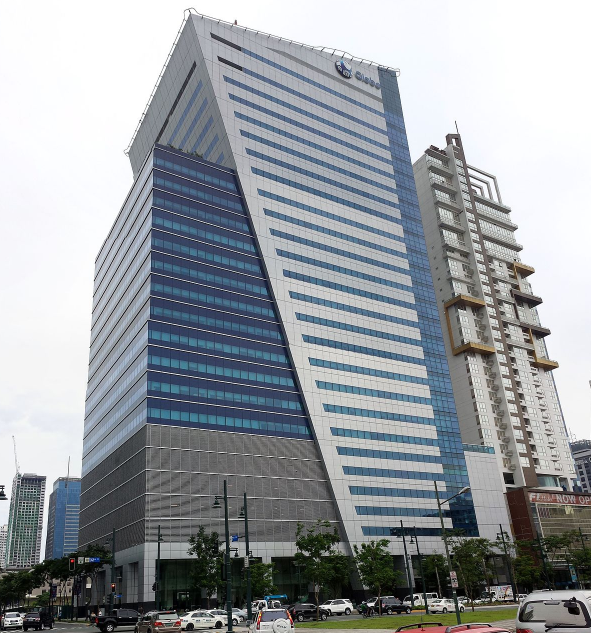
GLO HQ
MNOs > Global System for Mobile Communication (GSM) license path (now 4G/LTE) The Big 5: MTN, Glo (Globacom), Econet (Bharti Airtel, Etisalat (now 9Mobile), ntel (former NITEL).
MTN came to market almost instantaneously with Econet from the licenses made available since 2001. It was criticized in the early days for having prohibitively high charges to purchase sim cards, and for failing to have per second billing. Both these issues became naturally resolved over time by market drivers. MTN still remains the network with the broadest pan Nigeria reach and resilience, and has managed to create a perception of federal reliability. Following a brush with the regulator, MTN Group has moved significantly towards divesting itself of Nigerian investment. It is difficult to now consider MTN Nigeria a ‘South African’ company. There is some plurality of investment between stakeholders in MTN, 9Mobile and IHS.
Airtel have a substantial network. They were also criticized in the early days for failing to have per second billing. Econet has been plagued with a variety of funding, stakeholder support and management dynamics challenges since inception. It has held five different names, Econet, Celtel, Zain, Airtel and Bharti Airtel.
Glo/Globalcom/Glomobile is the only indigenous company that rose from the GSM license issuance, founded by the Nigerian serial entrepreneur Mike Adenuga. The company is the most independent MNO in Nigeria owning almost all of its backbone and last mile infrastructure and significantly, owning its own Submarine Cable. This means it can peer directly with Tier 1 internet providers abroad. There is currently no internet mirror on the African Continent. With services like Whatsapp, Viber, Skype etc (OTT) starting to become favoured over traditional voice services, in addition to all the typical browsing and apps requiring smartphone based internet, this gives Globacom Group a huge advantage.
Etisalat was a latecomer to the GSM (now 4G/LTE) party only arriving in 2008. It has been rebranded 9mobile. It is quite vulnerable in some ways, being the second most reliant on third party networks to deliver services to some consumers. This limits the portfolio of services as it needs to focus on VAS as reselling of physical layer infrastructure services wouldn’t be competitive. But infrastructure ownership is a double edged sword. Etisalat had been in the market for a buyer. Bharti Airlines (parent of Airtel), owned the most federal network of the bidders, so technically for them it would have a mass migration of customers to their networks. However, Airtel at the time was muted to have over extended its liquidity. Orange isn’t a player in the Nigerian market right now, but was the only bidder to have landed fibre. This was through ACE in Lagos in which it has part ownership. Since the closure of that process, Orange instead took up an investment in Main One, giving them additional submarine cable options and their position has changed. Vodafone, another interested party had no footprint at all, and was additionally battling poor image issues in its core markets. Since the withdrawal from market, a new CEO, Alan Sinfield has been appointed, who is resurrecting the fortunes of the carrier.
A table below indicates how the five compare approximately on a range of indicators:
% infrastructure ownership
Redundancy provision
Federal reach
Independent Cable to Tier 1
MTN
2
1
1
No
Glo
1
3
2
Yes
Bharti Airtel
3
2
2
No
9 Mobile
4
3
4
No
ntel
5
3
5
?
ntel is a company raised from the privatization of the former state enterprise NITEL. It was previously branded ‘Natcom’. The infrastructure it has in Nigeria (Federal Backbone) as a starting point was practically nonexistent so it continues to have challenges with achieving a comprehensive new federal infrastructural roll out. It can probably succeed in the short term as an MVNO but the race is on to get its own solid infrastructure. It currently claims to have quality services in Lagos, Abuja and Port Harcourt. It has the same challenges Etisalat had in 2008, but this is 2020 and things will have to be done faster, more efficiently, cheaper, for it to contest this market. ntel experienced some leadership challenges following the departure of CEO, Kamarr Abass some years back.
One of the big plusses for ntel was the jewel in the crown of NITEL architecture: the Submarine Cable SAT-3. It had integrity issues, and though ntel claim to have refurbished it, it is unclear what the technical details of this are. ntel for a period went on a price war offering STM1, 4 and 16 capacity over SAT 3 at a huge reduction to Main One which were not sustainable. Two CEOs later from Kamarr, Babatunde Omotoba is now the force driving ntel to work towards a more impactful presence in the market.
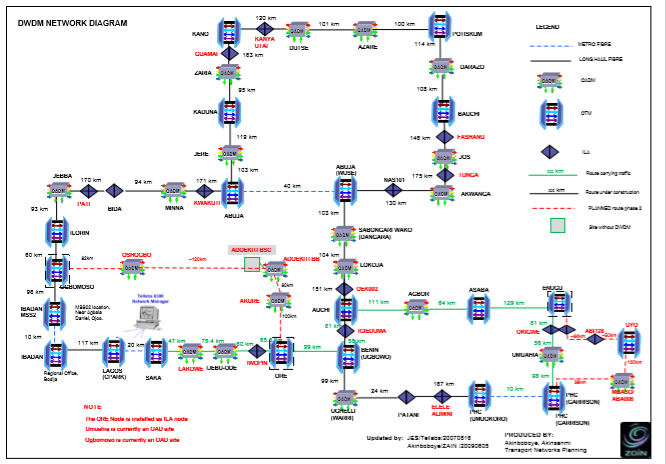
Draft Zain DWDM architecture from circa 2007
Other MNO Infrastructure players in Nigeria
Medallion Communications
Own the ‘preferred’ co-location sites for the industry at Saka Tinubu, Victoria Island, Lagos and off Durban Street, Abuja. Everybody that is anybody in the industry co-locates with them. They are the melting pot where anybody credible can hand off connectivity to anybody else. However, in particular Saka Tinubu is over-congested. A case can be made for a new defacto central point for co-location in Lagos. The dynamics of getting a seismic shift on this is as much pseudo political as it is technical. Ikechukwu Nnamani, Medallion Communications CEO and founder has been elected the new President, Association of Telecommunication Companies of Nigeria (ATCON).
The Tower Companies
Since IHS did a deal some years back to take all Helios Towers stock in Nigeria, Federally, for a while, they were really the only show in town. The biggest player in the arena historically was Alan Dick West Africa Limited, who handled most of the MTN roll out within their scope in the early days, and went bankrupt muted by difficulty regarding timely MTN payments. Even a decade later, liquidators for Alan Dick were still in court in Nigeria with MTN. In the early part of the millennium, the only alternative appearing to show promise was MTI but this company has now adopted a more contracted footprint since being purchased by Worldwide Ventures, and only a few sites around Lagos ‘islands’ now remain The enlarged IHS saw liquidity challenges to support payments to keep the network fit for purpose. Shifts in foreign exchange rates haven’t helped, nor has an investment dynamic that links IHS with MTN and 9Mobile. Parts of planned upgrades to the e-site product by a Swedish company ‘Flexenclosure’ were put on the ‘slow train’ and other parts have been put on hold indefinitely. IHS towers is a critical element of the carrier agnostic Wholesale MNO network, and if they are in trouble, then any company with MVNO aspirations for the Nigeria market may be in trouble, and any company with long term MNO plans but needs to hit the ground running with MVNO model may also be in trouble. Gaps in markets don’t stay indefinitely and since then two significant players, American Tower Company (Nigeria) and Pan African Towers arrived. ATC acquired Airtel’s towers mid way through the last decade, though the deal has Airtel getting tariff waiver up to 2025. Pan African Towers, an indigenous telecom infrastructure company has won big at the 4th Nigeria Tech Innovation and Telecom Awards (NTITA) earlier this month (November 2020). CEO of Pan African Towers, Wole Abu has been elected as the new Publicity Secretary for ATCON. Independent sources vary on infrastructure capacity but both are muted to have somewhere between 2000 and 5000 sites. This is significantly below the 25000+ towers IHS have in their portfolio. If IHS sneezes, a lot of the community will catch colds.
The battle of the datacentres
Rackcentre: Rackcentre is a Tier 3 standard datacentre facility provided by a Lebanese-Nigerian family business – The Jagal Group. It was built by Jagal Construction, which this author partnered with on the Netcom AIS Project. It is MNO agnostic, so its owners are not in any other part of the industry that might give them a conflict of interest for any particular customer. They promote this point heavily on their website.
Rackcentre was one of Jagal Groups efforts to diversify income streams to reduce exposure to Oil and Gas. Maher Jarmakani made what was intended to be a ‘groundbreaking’ speech to a packed audience at Nigerdock 2015, though the group as a whole struggled the next year and dropped employees from around 4000 to 500. ntel were one of the first to have a presence at Rack Centre through SAT 3. WACS followed, and so did Dangote. Rackcentre has since received a major shot in the arm from PE company Actis (a privatization of the former UK Commonwealth Development Corporation), to the tune of $250m USD. Actis has a strong focus on Africa and South America and regularly sniffs around big markets like Nigeria. In 2018 following the demise of Pakistani tycoon Arif Naqvi’s Abraaj Group, Actis snapped up all its African holdings which included its stake in Austin Okere’s CWG. In the same year, Rackcentre, was named the winner in the Best Data Centre Innovation category of Capacity Europe Global Carrier Awards in London, beating competition from UK, US, Canada and Sweden.
MDX-i: A data centre with a plethora of services on par with Rackcentre. Not as neutral as Rackcentre as they are owned by MainOne. This is a double edged sword . Main one owns its own Submarine Cable over which it achieves Tier 1 peering. It has also built up an intercity fibre backbone in Nigeria and has several metro fibre networks in key cities, principally Lagos.
When we see that Funke Okeke’s Main One is also achieving an MDX-i standard facility in Accra. Ghana’s Silicon Valley – Appolonia City, we know that this is fast becoming a Pan African footprint. Ok – MainOne doesn’t have a tower company and doesn’t have licensed MNO spectrum. But they can easily barter, (common in Nigerian Wholesale MNO/Infrastructure community) to get the former, and with Orange now having a significant investment in Main One, they can leverage them to achieve the latter. But while they can almost be a one stop shop for everything, in the early days Main One simply sold submarine cable capacity to all comers, with no interest in the downstream business. As it diversified its own infrastructure it began to gradually drill down to reach different user communities which had been the sole bread and butter of its most ardent and long standing customers. For to reduce competitor visibility on a network, avoid adding business capacity to a potential competitor, and in some cases, reacting to the experience of owning ‘the hand that fed which got bitten’ some customers may be reluctant to use MDX-i, preferring instead for service from a company that so far has stuck to solely offering datacentre services, such as Rackcentre.
However, the rate at which Main One is building out on its network and showing signs of moving beyond a vision for Nigeria, but a vision for Africa, MDXi may ultimately find its business dominated by one internal customer (Main One), with customers from the external market reduced to being the icing on a very deep layered cake.
As Orange further develops its regional infrastructure, nothing is beyond possibility. And remember… Orange OWNS a Tier 1 facility – ‘Open Transit’
Orange’s ‘Djoliba’ was achieved through bringing a new terrestrial regional backbone to enhance the already existent subsea fibre network landing overseas connectivity throughout West Africa. The new regional backbone reaches eight countries – Burkina Faso, Côte d’Ivoire, Ghana, Guinea, Liberia, Mali, Nigeria, and Senegal ; 16 points of presence. The Djoliba terrestrial fibre network spans over 10,000 km. Note that one of the three subsea elements depicted is Main One
21st Century Limited (21CTL): 21CTL has recently built the very first Tier 4 compliant Datacente in Nigeria. This puts it technically on a different plane to competitors in the category. The company was originally founded in 1997 and by the early part of the new millennium had the best fibre metro network from the original business hub around Marina Lagos to the newer commercial buildings and fashionable urban residences of Ikoyi and Victoria Island. They extended to GRA Ikeja and evolved the network in tandem with construction development of the Lekki Peninsula While 21CTL provides an enviable array of enterprise services, it is unclear to what extent it has succeeded in expanding its network beyond metro coverage of Lagos business districts. It is equally unclear what the difference between Tier 4 and Tier 3 will mean as monetizing impact for the current customer landscape.
It’s therefore difficult to compare the potential of 21CTL with the extensive infrastructure MDXi can leverage through Main One, on the one hand, and the impartiality and independence from enterprise offerings claimed by Rackcentre on the other. . 21CTL received Fiber Optic Company of the Year at BoICT Awards, 2015. Its founder and CEO is Wale Ajisebutu.
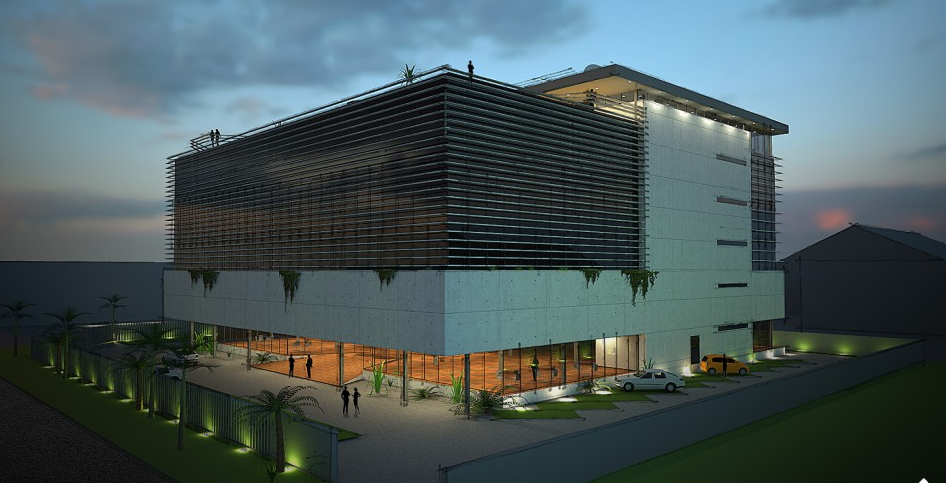
21CTL HQ in Lekki is as much a prime corporate real-estate landlord, and a tech hub as it is, a home for 21CTL.
Others:
Galaxy Backbone is intended to be the appointed provider of communications solutions to FGN, its civil services, devolved agencies and quangos. It is located in Abuja. In reality it has very little of its own infrastructure and invites external providers to tender for opportunities issued to it. It is supposed to have a mandate as the ‘required’ route to such opportunities and act like a gatekeeper. This author however has executed multiple proposal presentations to for instance: NNPC, NLNG, Nigerian Police High Command (including the IG) and in 2009, even the ex Nigerian Minister of Information and Communications herself, the late Professor (Mrs.) Dora Nkem Akunyili. Were it, that peer agencies in and associated with Civil Service, were in full acceptance of Galaxy Backbones’ supposed ‘Gateway’ mandate, these kinds of direct business development approaches would not have been possible.
Submarine Cable Owners (Needed to get international access and peer with Tier 1 internet providers) – SAT-3 Suburban, (ntel) Main One Cable, WACS, ACE (Glo has its own). Google and Facebook both have Submarine Cable in development.
Broadbased Telecom. – Metro Lagos fibre networks. Nigeria Tech Innovation and Telecom Awards 2020 awarded Broadbased Telecom ‘Wholesale Telecom Provider of the Year ‘ ( see section higher up on The Nigerian Infrastructure Ecosystem and ‘Wholesale MNO’ concept.) and ‘Metropolitan Fiber Infrastructure Company of the Year’. Separately the award for ‘Outstanding Contribution to the Telecom Industry was awarded to its MD/CEO, Prince Henry Iseghohi, for the third time.
Bitflux : A current license holder of Nigeria spectrum for 4G/LTE, muted to be interested in MVNO, but no movement to market as yet.
VSAT Services available to Nigeria
Operators in Nigeria can supplement their terrestrial networks and submarine cable access through the use of VSAT technology to access foreign teleports, as well as providing connectivity solutions to remote locations. The following are examples of providers who have a footprint that can serve Nigeria:
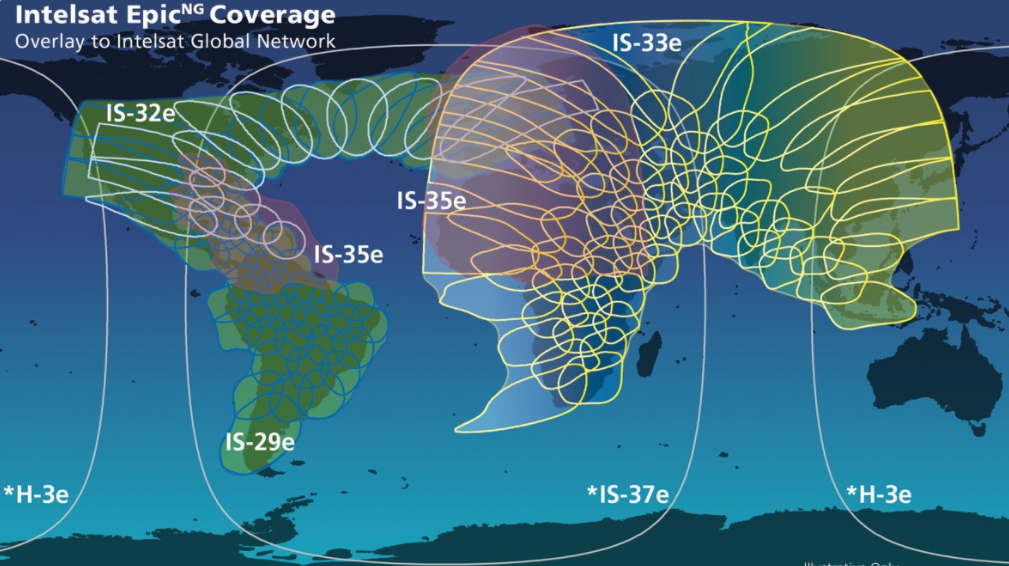
Intelsat : C Band VSAT service footprint over Nigeria.
An illustration of Intelsat global coverage.
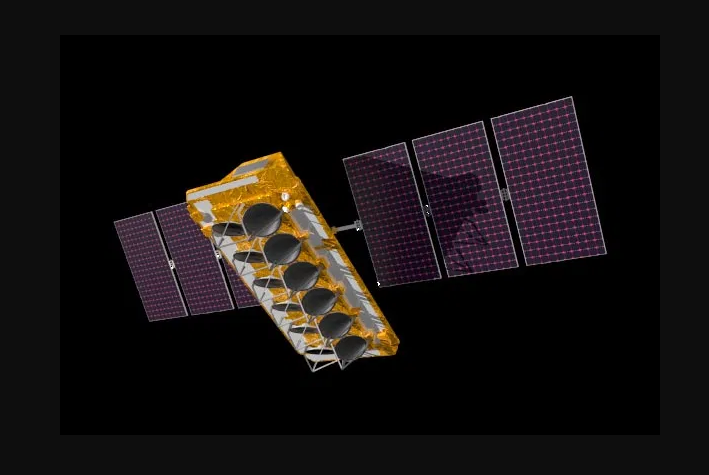
SES: Aside from C Band VSAT service footprint over Nigeria, SES also purchased O3b a medium orbit VSAT provider which while less vulnerable than fibre, has lower latency than service from a typical VSAT satellite because of its proximity to earth. It is a constellation of 20 at an altitude of 8,062 kilometres (5,009 miles), less than one quarter of the altitude of typical geostationary satellites. The low orbit reduces latency to the point it is comparable with fibre.
An artists visual of a deployed SES O3b satellite
Cost can be an issue here as a lower orbit means thicker air, which causes greater headwinds and thus greater friction, having a knock on cost to operational maintenance.
Space-X. Elon Musk currently has a plan involving a medium orbit of around 1000 satellites to cover Africa. However, there isn’t sufficient detail at this stage to compare it with SES/O3b 20 unit constellation on either total space segment available or what proportion of the service will cover Nigeria or what its performance will be.
Gilat – Ku Band VSAT service footprint over Nigeria. They also provide Ka – band customer hubs and terminals for O3b VSAT services.
A parting word MNOs vs. MVNOs
No provider has full network independence. In Nigeria, Glo probably comes closest. Where is the line drawn that distinguishes between when a Telecoms Services Provider has enough of its own infrastructure to be labelled an MNO rather than an MVNO? This is akin to the proverbial ‘how long is a piece of string’!
It is really down to the business model, objectives, strategy, and the operators’ term business plan, and, at commencement of operations, if all this is realistic in the context of the venture capital available.
A new MNO while it is in the process of rolling out infrastructure will almost certainly be an MVNO to start with but has genuine intent to become a network independent MNO as per the business plan. This is different from a company which always intends to have an MVNO operational model.
Redundancy, Redundancy and Redundancy.
When circuits fail, data in transit needs to find an alternative path. ‘Redundancy’ is the term for ensuring these paths exist, and are operationally fit for seamless migration of moving data in real time.
Most of the fully fledged independent infrastructure MNO’s will go to Wholesale MNOs to get redundant circuits on their backbones. Sometimes they will even swap capacity on circuits with each other. If the mother of all melt downs scenario is considered, the one with enough leased capacity to support their networks, at least on the short term, will be the one least likely to go down.
Link Redundancy and Path Redundancy: If fibre passing through underground ducting is achieving redundancy through cores in two cables, or worse, two cores in the same cable, and some activity perforates right across the duct, both the link and redundancy are lost and the connection goes down. If two microwave radios are put on two poles on the same high rooftop, or worse, both on the same pole, and a new high rise building is constructed blocking the primary link, again, both the link and redundancy are lost and the connection goes down (They will have identical Fresnel Zone). Path redundancy involves validating that the redundant link takes a completely different physical route than the primary link. In Nigeria, fully resilient path redundancy end to end is difficult to achieve and expensive.
Another issue is that MVNOs in mature market are accustomed to managing their deals with their wholesalers, and performance outages through SLAs, but in Nigeria it will be the company with their name on a sim card in use by a customer that will suffer brand damage. If a person wants to wish their aged grandmother in a village happy birthday and there is network failure.. even if they are on a post-paid tariff, a 100 Naira re-credit doesn’t restore that moment.
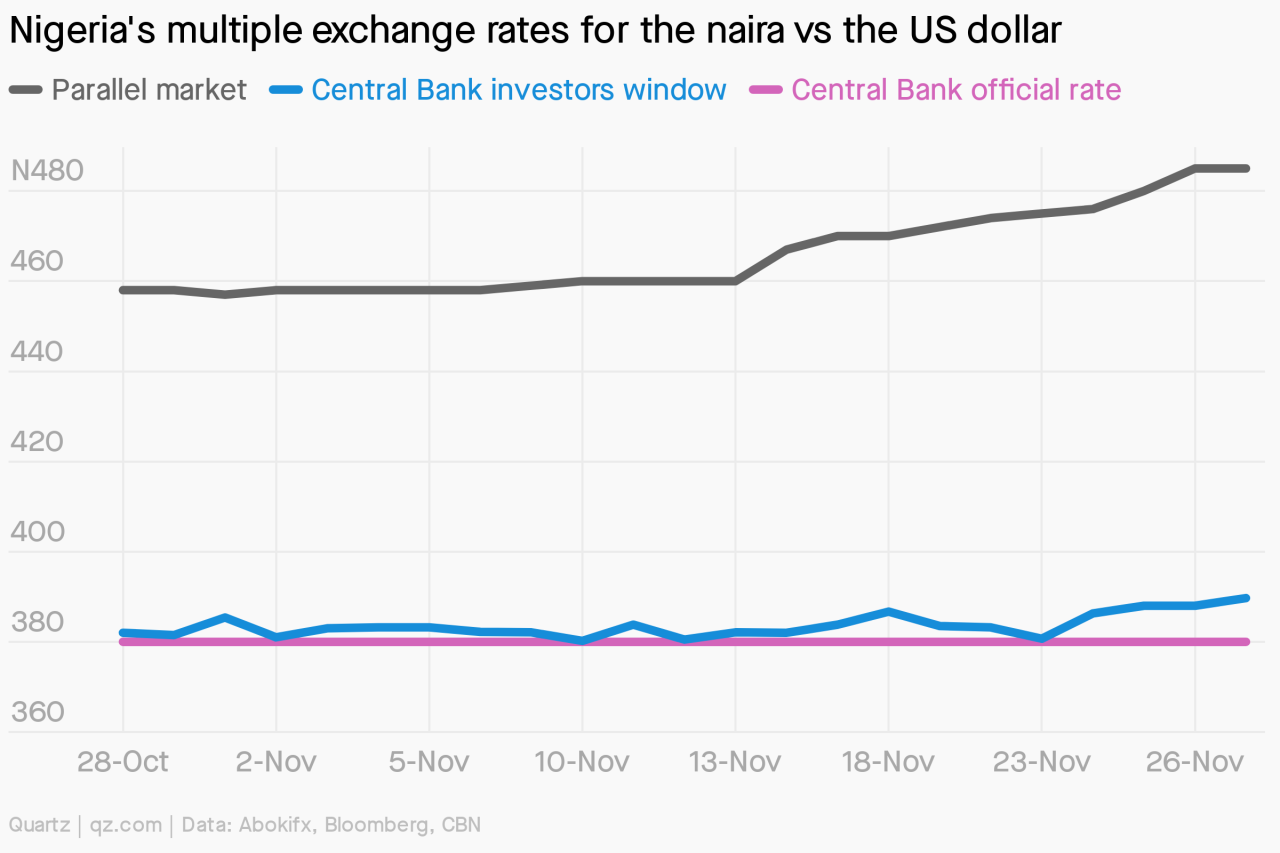
Currency exchange rates are also an issue. Specialist infrastructure hardware is not made in Nigeria. While the Naira is far from being in freefall… the overall prevailing trend is down. If capital reserves for overseas purchases are already abroad, it isn’t relevant, however if the reserves are in local currency then executing the overseas purchase process or interim solutions for capital reserve management need to be looked at.
Finally, while infrastructure is an asset, it’s important to acknowledge this asset isn’t dynamically realizable. Few predicted the fall of Murmar Gadaffi in Libya in 2011 and the ensuing chaos. Even less the end of the rule of President Hosni Mubarak in Egypt later the same year, and a level of civil disobedience that saw what was the second country by GDP on the continent, drop like a stone to number six. It is established that unsecured Libyan light arms found their way to Boko Haram. Without over-reacting, it is important to acknowledge potential risk regarding political stability when making investment decisions. Additionally, many feel Nigeria has moved beyond ‘Biafra’, but less than two years ago, there has been incidents around the incarceration of the protagonist for Igbo self-determination, Nnamdi Kanu. We have also seen unease around the rise of Oodua Action Movement and Reformed Niger Delta Avengers and most recently, the uncertainty around #ENDSARS. Elsewhere in the region there is instability with the genocide involving school children in Cameroon, Military Rule in Mali, election unrest in Guinea and Cote D’Ivoire, and most recently, the escalation in Burkina Faso.
Towers cannot be folded up and put in a neat little suit case. Fibre can’t be dug up out of the ground, magically translated into its value in hard currency, and sent by electronic transfer to a bank account at a secure foreign location or converted to Crypto currency!
MTN Nigeria
OTT and the Tariff Future
‘An over-the-top is a streaming media service offered directly to viewers via the Internet. OTT bypasses cable, broadcast, and satellite television platforms, the companies that traditionally act as a controller or distributor of such content. It has also been used to describe apps for phones that transmit data in this manner’ – Wikipedia.
Examples :
Kik, Viber, WhatsApp, Apple’s iMessage, Skype, WeChat, Google Allo – smartphone messages
Netflix, HBO, Hulu, YouTube, Amazon Video or Apple TV – video streaming
Facetime, Viber, WeChat, WhatsApp and Skype – video or voice calling World of Warcraft, Google’s Twitch, Xbox 360 and YouTube – gaming
While adoption of OTT for some services has been strong, usage has only reached a fraction of its full potential. The main obstacle has been metered data services to smartphones. While many in Nigeria will claim they, their family, friends and colleagues use OTT by preference all the time, the reality is the Nigerians that will get the chance to read this article are not fairly reflective of the general population.
It is a bit like modern trade in Nigeria. Regular patronage of a Mall is only possible for a few million out of a population that is headed for the 250 million mark. These are probably the same people that get to use OTT services on demand. The rest use open air markets, kiosks and localized small vendors for food and household. They don’t get Wifi access through work or social movement, and they have to be fairly frugal with the intermittent purchase of pre-paid credit that can have some data allowance bundled.
On July 26 this year, the day after National Nigerian Diaspora day, President Buhari thanked the Diaspora for the $25bn sent to relatives. The Annual Diaspora Remittance Exceeds 80% of the Yearly Budget
This correlates roughly to the magnitude of regular overseas diasporas contact with Nigerians many of which are in need. Those overseas will generally be too busy to take calls on demand and will then want to call at a time of their choosing, at which time, the Nigerian side will invariably have insufficient data left to accept the call over OTT.
This then forces the overseas caller down the MNO network route, which triggers punitive International Termination Rates (ITRs.) These punitive ITRs have been preventing Nigeria from being included in unmetered packages offered by SME MVNOs and third party access card operators in North America and Europe. Nigeria is one of the least ‘bundleable’ countries for call deals.
In September this year, the EVC of NCC, Prof. Umar Danbatta committed to reviewing the ITR regime, saying ‘where ITR is not properly regulated, it tends to have a negative effect on a market like Nigeria with major supply-side challenges and associated socio-economic implications’
Clearly the Nigerians locally that hail the perceived eclipse of normal calls by OTT, are not one of the masses with dependency on overseas help.
The Minister of Communications and Digital Economy, Dr Isa Ali Ibrahim Pantami, during an address at a Webinar organised by Lead Inspire Network also committed to a new National Policy on zero rating on educational websites which would allow the consumption of contents without charges to normal data plan.
These are all measures heading in the right direction, and with the headway made earlier this year in securing positive response from different state governors on reducing ROW (Right of Way) charges, also championed by former President of ATCON, Olu Teniola, the pressure is now on the big 5 MNOs to make something happen for economically disadvantaged and hitherto poorly serviced rural communities. There is however, a considerable journey between headline announcements and actions that are seen to work.
In the meantime, MNOs seem addicted to the practice of selling metered data as a painkiller for their revenue challenges. Yet this is the one obstacle that stands in the way of a mass explosion to over 200 million users in Nigeria.
While MNOs will be keen to move forward to deliver 5G to their most lucrative and demanding of customer geographies, the political debate will continue to ramp up on ensuring that all of Nigeria has at least some form of service. These two competing demands for investment may become a double whammy pressure on revenue. MNOs need a ‘third way’.
Perhaps the MNOs need to send their brightest minds to Tekedia Institute, where Ndubuisi Ekekwe can introduce them to the concept of building category-king brands by mastering how evolving business models like One Oasis, Double Play and Aggregation Construct can be effectively deployed in the industry to create leverage-able anchors to unlock opportunities and growth.
Through this, perhaps they can develop a strategy with a uniquely Nigerian flavour, to give unmetered access to users willing to on-board some kind of service app, either MNO owned or third party partnership? This can then be the new revenue stream to compensate for the loss of metered sales. This way everyone wins.