DD
MM
YYYY

PAGES

DD
MM
YYYY

spot_img

PAGES

Home Blog Page 6028

One Policy That Will Change Nigeria For Good – Abolish “State of Origin” for “State of Residence”

9
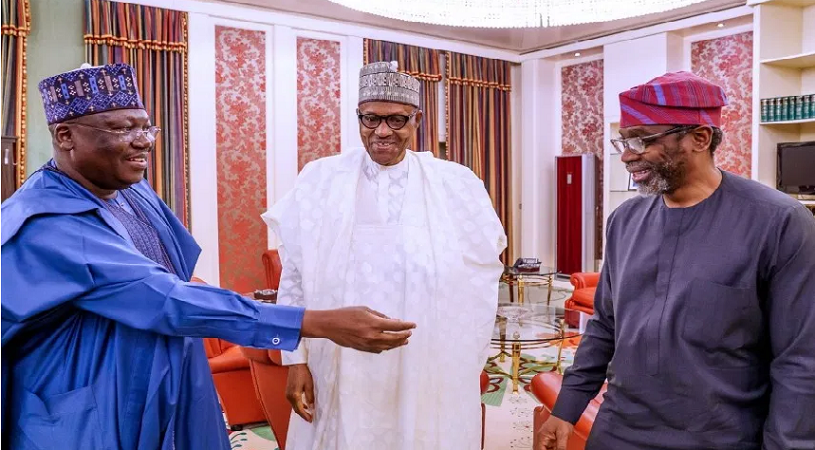
Nigeria leaders

To President Buhari: “Mr. President, thank you for the opportunity to be in your presence. I have come here to tell you to build a New Nigeria by working with the National Assembly to abolish “state of origin”. More than 90% of our national problems are connected to that line in our national forms where irrespective of where one has lived, that individual remains tethered to his or her biological ancestral roots.

“Sir, I have a cousin, Kelechi “KC”. He has lived in Katsina state for 33 years. He was born there. His children are all born there also; none speaks Igbo language. I was with them during Christmas: “Katsina is home” and Hausa is the first language. Despite KC’s family connection to Katsina, his children and his entire family will still have to fill Isuikwuato LGA (Abia state) as a local government area of origin in everything in Nigeria. Largely, Nigeria makes it impossible for KC to participate in a community he was born in!

“We need you to change this abnormality of “state of origin” to “state of residence”. Through that mechanism, what would matter is where you live and how many years you have lived there to establish residence. 

“If we build that structure, we will drive to make people see where they live as their eternal community, and that would make them do everything necessary to make it thrive. With this, KC can run for electoral opportunities and explore opportunities like scholarships available in Katsina. The same will happen in Abia state for many people from Kano state who have made Umuahia home for decades.

“Until Nigeria does this, we will continue to underperform and our racial lines will not be blurred. A child named Kunle Abiola, born in Aba (Abia State) by native Ogun state citizens, and whose parents moved to Sokoto after his 12th birthday, but applying for a university admission will simply put state of residence “Sokoto”, with no connection to Abia state or Ogun state. Nigeria will treat him as a citizen of Nigeria, living in Sokoto, enjoying all rights which are available to other kids in Sokoto who have lived at least 3 years to establish residence in that state. Kunle after graduation can move to Enugu, establish residence, and compete for electoral office to represent Enugu state.

It is time for Nigeria to make this leap. Do it and have a legacy because it would make Nigeria better and advance the wellbeing of everyone.” 

Ndubuisi

(Mitt Romney, a US politician, was born in Michigan state, became a governor of Massachusetts state, and today is a Senator from Utah state. Nigeria needs to make such possible through state of residence, and not state of origin. We need to be Nigerians, and nothing more.)

Notes From My GTBank Case Study

2

My personal philosophy in regards to entrepreneurship is really very simple: create value for as many people as you can sufficiently extract value from. Creating value for few people and not being able to extract enough value from them to keep your business afloat and growing is not true entrepreneurship.

Creating value for customers and being able to extract value is the true definition of entrepreneurship. Anything else is really just philanthropy or marketing.

So, I’ve spent the last couple of weeks writing case studies on some of the most successful businesses operating out of Africa, and I’ve observed two things; one is that most of these businesses tend to ride a wave – they either create a solution in a market filled with ineffective solutions (GTBank, Transsion Holdings), create a solution after observing a need no one has bothered to solve (SystemSpecs), or outright build their own solution/platform to a problem people have, but don’t necessarily see a solution to (Interswitch). In my opinion, the worst approach to innovation and building a business is Jumia – Jumia entered a market to solve a problem no one thought they had, a price sensitive market that had no existing eCommerce infrastructure, and tried to copy a paste a model that has worked elsewhere in eCommerce ripe markets. eCommerce is legit as a niche product, but as a mass market product as Jumia has proposed, it isn’t ready yet. Jumia is really only alive because of venture capital. Jumia is the perfect example of what you shouldn’t do when starting a business.

The second thing I’ve observed is that all the businesses I’ve studied were either profitable from the get go, or very early on. I seriously doubt if the Western model of burning capital for years chasing growth before finally becoming profitable works here. Jumia is well poised to capture extreme amounts of value, become the undisputed market leader and eventually end up becoming profitable when eCommerce eventually picks up as a mass market solution in Africa, if they’re still around.that is.

Jumia’s focus on burning capital to nowhere is a Western model that apparently doesn’t work here. Learn from their example.

Last week I worked on a case study on GTBank, one of the leading Tier 1 banks in Nigeria, and apparently a model that every entrepreneur should pay serious attention to.

These are my notes from that case study.

P.S: this is not the case study.

The Magic of Numbers

The Bible says one shall chase a thousand and two ten thousand, can you guess how many 40 will chase? Let me give you a hint – 96 poorly managed old generation banks.

The ideal co-founding team is usually 2 (the guy with the vision, and the tech guy), if you want to push the strings a little further, it could be 3 (the guy with the vision, the product and tech guy, and the marketing guru), GTBank on the other hand figured that taking on the dysfunctional Nigerian banking system at that time with 2 or 3 co-founders was just not enough, so they opted for 40, like 40 – four and zero. I wonder how early co-founder meetings were like: 40 men in their mid to late 30s in late Mr Tayo Aderinokun’s First Marina Trust office strategizing on how to take the banking industry by storm. They’re very lucky that SARS hadn’t started misbehaving then (1990), SARS would have probably busted into their office one day, accused them all of internet fraud (with no tangible evidence), called Mr Fola a liar when he tries to tell them they’re trying to establish a technologically advanced and customer centric bank, maybe even slap him for using the word tech, and probably cart them all to some police station (or bush) to extort money from them. We obviously wouldn’t have GTBank today, and we’d all be stuck with mentions a Nigerian bank whose customer experience is so bad, it should be illegal. But I digress.

Always build a team of like-minded people that compliment your weaknesses, and augment your strengths. The purpose of having 40 co-founders was to raise the minimum capital requirement (N2 billion (US$16 million) then) to start a bank.

Note: Don’t go starting a business with 40 co-founders; I’m still wondering how they were able to successfully share equity without any serious misunderstandings.

Personality of A Business

Every business has a personality, it’s the image a business automatically brings up in your head when you remember it, and yes, personalities are very similar to brands, but they’re still personalities anyway.

So I like to personify businesses – InterSwitch is that sharp guy that knows how to make money from places people don’t even know exist, Jumia schooled abroad and is high on drugs (venture capital), Transsion Holdings is that Asian guy that has lived in Lagos so long he can now speak Yoruba, SystemSpecs is that quiet rich low-key man that wears a brown suit and has an extremely aggressive money making Boerboel dog as a pet called Remita, Gtbank on the other hand is that almost perfect guy in class; tall good looking guy, always came to class early, always got good grades, all the teachers (CBN) liked him, and apparently when he was done with high school, he went straight to London for his undergraduate degree (US$750 million Global Depositary Receipt listing on the London Stock Exchange).

Gtbank has etched out a name for itself by its consistent investment’s in its brand image. To be frank I really don’t know how they do it (I actually do), but the name GTBank always rings a positive bell, and that’s good for any business. Think about The Nigerian Police, PHCN, and even the Federal Government. Do these ring good bells in your mind? Probably not. If The Nigerian Police was a private business, they would have closed down by now. The horrible brand image/personality is enough to kill any business. Personally I don’t bank with GTBank, but every time I remember their name, or see their logo, I see youthfulness, agility and ease, even though none of that is really written anywhere in plain sight.

Market Segments

The market segment you innovate for, especially in Africa will determine how profitable you and your business will be in the long run. Nigerians are extremely price sensitive, and I would therefore not recommend building a mass market consumer product in a nonessential sector. Look at Uber for example; they solve the transportation friction (bless Kalanick I don’t have to stand by the road to wave a cab anymore), they’re a supposedly mass market service serving the Nigerian market (200 million+ people), but they’ve only got 9,000 drivers in Nigeria. Compare this with the U.S market (350 million+ people) where there are approximately 900,000 drivers, a hundred times what we have in Nigeria. Africa as a whole, where Uber operates in 15 countries (including Egypt and South Africa), really only has about 60,000 drivers. Don’t get carried away by what you saw on HBO’s Silicon Valley, or what you see in the US, this is Africa; the market segment you innovate for will either make or break you.

GTBank started by innovating for the middle market segment, the SME’s, the small businesses.

I personally believe that some of the biggest business opportunities to create and extract value in Africa are in the middle market segments, the SME’s, the small businesses, I’m not talking about tech powered startups, but the real small businesses. From Janet, CEO of Janet wears whose corporate office is her bedroom, and whose WhatsApp always replies with an automatic message that says something along the lines of “we will get to you”, it makes you wonder who “we” is, because to the best of your knowledge, Janet runs a one man (in this case, one woman) show. “We” must mean Janet’s spirit, Janet’s soul, and Janet’s body, to the Chijioke from Mighty God Electrical Enterprises whose head office is probably not bigger than my bathroom, and who is a general contractor that can supply anything.

Unemployment has made almost every Nigerian a self-proclaimed entrepreneur. The market opportunity here is huge. My sister was telling me the other day that there are now more people selling clothes on WhatsApp than those buying them. She’s right. The quicker your startup/business can find a meaningful friction in this market, innovate around it, and design an effective business model that allows you to extract value from them, the better.

SystemSpecs has already started this with PayLink.

I’ll say this again; one of the biggest business opportunities to create and extract value in the Nigerian (and by extension African) space is the middle market SME segments.

International Networks

It’s always smart to have an international affiliation; either a shell company based somewhere in Europe, or some kind of foreign affiliation. It usually pays off in the long run, especially if you consider raising capital.

No African startup has raised (and burnt) as much money as Jumia has (US$823 million+), and I doubt if any African startup has as much of a foreign affiliation as Jumia has – Jumia is essentially a white guy wearing a black mask.

Foreign affiliations are important.

Some of the biggest opportunities to create and extract value are in markets where horrible customer experiences and flat out ignoring customer needs have become the norm. Find them, innovate for them.

Unstoppable Elon Musk, Now Shares Second Place with Gates in the Billionaires Index

0

Elon Musk’s fortune flight took to a new height this week by the surge in Tesla’s shares. The Tesla and SpaceX CEO briefly overtook Bill Gates to occupy the second position in the world’s richest index.

Tesla’s share price recorded an unprecedented surge this week and added $7.2 billion to Musk’s fortune, bringing his net worth to $127.9 billion. Musk has added $100.3 billion to his net worth this year, moving him from no. 35 where he was in the billionaires’ table in January, tied 2nd position with Gates, after Bloomberg index put the men on $128 billion each.

Musk 49, has seen his fortune skyrocket alongside Tesla’s that is now valued at almost $500 billion. Tesla’s stock has shot up almost 524%, increasing the entrepreneur’s wealth unprecedentedly. Tesla’s stock jumped 6.6% on Monday, closing at an all-time high of $521.9 per share.

Musk owns 20% of Tesla stock and has prudently reaped more than many other investors through his model of payment.

In 2018, Musk got Tesla’s shareholders to approve a pay package that does not involve salaries or cash bonuses. The deal means that Musk will be paid through 20.3 million stock options over the course of 10 years, in 12 equal blocks of 1.7 million options. His stock payment happens whenever Tesla achieves its operational and market value goals.

Last week, Musk toppled Facebook founder and CEO, Mark Zuckerberg to become the third richest person in the world. But that was just the beginning of a fortune-filled week for both Musk and Tesla that was inducted into the prestigious S&P 500.

To be included in S&P 500, a company must post positive fully audited profits for four consecutive recent quarters. Tesla could only achieve that feat this year, making it eligible to join the S&P elites. The electric vehicle maker’s shares rose 8.2% last week Tuesday, following the news of its inclusion in the index.

The year of the pandemic has been kind to Bezos, Gates, Zuckerberg and Musk, who have seen their net worth increased in defiance to the global health crisis that has battered economies globally, and disproportionately created misfortune.

In August, Bezos became the first person ever to worth $200 billion, despite going through the most expensive divorce in history that took $30 billion from his net worth.

Each of the centibillionaires has kept his place in the top 5 of Bloomberg Billionaires index, a ranking of the world’s 500 richest people.

Gates would have moved further up in the second position but for his donations to charity foundations, including the Bill and Melinda Gates foundation that has gulped more than $27 billion from net worth.

Bloomberg index said its members have collectively gained 23% — or $1.3 billion since the beginning of the year, despite the strains of the pandemic. The index said those in the electric vehicle industry have been particular beneficiaries.

The combined fortune of Zeng Yuqun and Huang Shilin, Chairman and Vice Chairman of China’s biggest electric-vehicle battery maker, Contemporary Amperex Technology Co., has soared by $18.8 billion year-to-date, the index said.

Tesla will join the S&P 500 next month, and with the rising interest in electric vehicles, the automaker’s value is expected to jump again before the end of the year.

Outside Tesla, SpaceX, another of Musk’s companies is increasing its mission to space. The company has raised $1.9 billion in new funding due to emerging interest in SpaceX rockets, which has surged since the successful trip of the Dragon Crew to space, and the company now has oversubscription of nearly $2 billion.

The global space economy is expected to be worth at least $1.1 trillion in 2040, according to Forbes. SpaceX’s Starship will have the capacity to accommodate 100 passengers per trip at the cost of about $50 million per seat.

The imaginable progress in these top notch companies means Musk will only have Bezos to beat in the billionaire index.

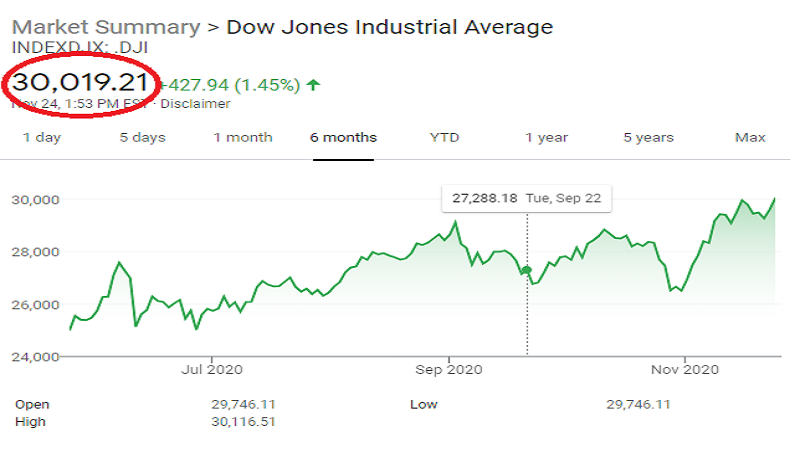
The Bull Welcomes The Goddess of Productivity As Dow Hits 30,000

1

The Dow,  a stock market index that measures the stock performance of 30 large companies listed on stock exchanges in the United States, was inaugurated in 1885. It took 72 years to hit 1,000 points in 1972. But from 20,000 to 30,000 points, it was under 4 years. 

Simply, there is a massive acceleration on wealth creation at an unprecedented level in this age where Amazon, Apple, Google’s Alphabet and Microsoft have touched the face of T-alpha. Yes, $1 trillion market cap and more in multiples. 

The T-alpha is unified by one thing: technology, the goddess of productivity. Sure, there is a concern that the wealth may not be distributed fairly and equally, but that does not mean the goddess did not create or accelerate wealth creation.

Note this: the future is one of abundance. It is largely irrelevant how pessimistic you are. Simply, Dow will get to 40,000 and keep rising because the new ideas of today will seed the growths of the future, and provided that new ideas are being created, abundance will rule the future

The bulls are in the street: do not run.

The Nigeria’s Negative Treasury Bills Interest Rates

1
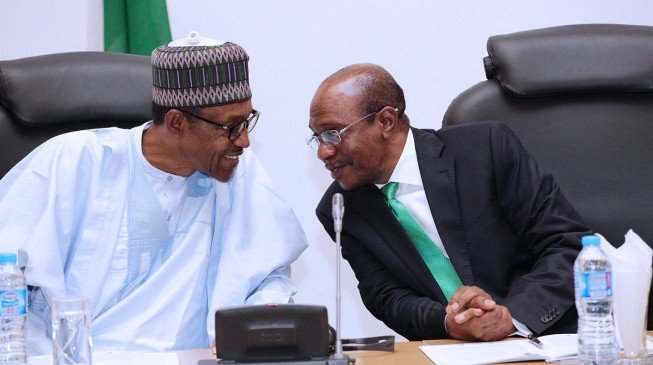
President and CBN boss

In our Live discussion on markets in our program,  a member asked a largely hypothetical question: “does Nigeria have any risk of negative interest rates?” Negative interest rate happens when you receive less than money you have put in a financial investment. For example, if you put N1,000 and there is a negative interest of 1%, you will receive N990 at the end of the year. While it is not common in Africa, some EU countries have used negative interest rates to encourage people to spend, and not to save! Saving means you lose money.

Today, Nigeria has a new record, we recorded a negative interest rate on treasury bills (TB): “The Nigerian Interbank Treasury Bills True Yield went negative [last week] with a 90-day treasury bill trading for -0.0109%. … Interest rates on treasury bills sold on the primary market sold for as low as 0.5% for a 9 months tenor as investors scampered or yields in the low yield market.” The current rate is here.

Indeed a lot of things are happening. Even fixed deposits do not really move the needle. The old savings account strategy is totally unhelpful since everything has been eaten up by inflation. These issues have been well discussed in a course on Capital Markets where our Faculty expounded on this redesign. But he did that during the period when TB was a fair play; he is updating the courseware to capture this evolving scenario of negative interest rates.

What is happening here is consequential. Just a few months ago when the TB interest rate was more than 13%, we agitated for the government to work to push it low. Without that policy, lending to SMEs was impossible as lenders through the high paying TB had a largely risk-free instrument to invest at double digit yield. In other words, why risk on anything when you can bank on the Nigerian nation via TB at 13%? Government worked and reduced the rates, opening up a fairly improved lending climate in the nation. A+ for the Central Bank of Nigeria on that execution; it was its finest policy implementation.

Treasury Bills are short-term debt instruments issued by the Federal Government through the Central Bank to provide short-term funding for the government. Put simply, anytime you participate in T-Bills primary auction, you are borrowing government money for a fixed and certain return.

The return on T-Bills is so sweet, yourself and banks would rather invest in T-Bills rather than start a business or lend money to SMEs. In Nigeria, anytime you borrow government money, you starve an Entrepreneur the needed funds to start or grow a business, you deplete the real sector. It’s not your fault neither is it the Banks’ fault, Government asked you for money in exchange for fixed returns free from risk and you gladly obliged as a logical being.

However, burdened with the rising cost of debts and unimpressive economic performances, the Government is on a mission to reduce her debts and encourage lending to the real sector. How can Government discourage Investors and Banks from lending her money? One of such ways is to reduce T-Bill rates.

But negative rate? Where do we go from here?