DD
MM
YYYY

PAGES

DD
MM
YYYY

spot_img

PAGES

Home Blog Page 6034

The Ghana’s Playbook On Foreign Vehicles for West African Market

0

Ghana seems to have cooked a really nice playbook on how to become the hub for foreign car assembly for the West African market. Recall my initial opposition to AfCFTA, the African trade agreement, until the “rule of origin”  clause was strengthened.  Yes, under AfCFTA, nothing stops Nissan or other foreign brands to operate in Ghana and target Nigerian customers since running factories in Nigeria is harder. 

The Manufacturers Association of Nigeria (MAN) has suggested to President Buhari not to sign the agreement establishing the African Continental Free Trade Area (AfCFTA).  The major concern is that with Nigeria’s largely subpar infrastructural capacities [mainly electricity], most Nigerian factories could relocate to other African countries to produce items they sell in Nigeria. The implication would be massive manufacturing unemployment in the land.  Also, the risk of dumping goods in Nigeria is also high.

[…]

Nigeria should SIGN but must make sure the “rule of origin” clause is strong. We cannot afford goods produced outside Africa to be repackaged in a treaty member state and then shipped to Nigeria at a low tariff that is exclusive to member states.

Nigeria’s poor infrastructure makes it a slam dunk for these firms to make Ghana home. It was on a similar concern that India did not join other countries in the recently signed Regional Comprehensive Economic Partnership (RCEP). Nigeria needs to watch carefully as John MC Keown notes in this piece.

Whether AfCFTA actually becomes a reality on ground remains to be seen. The West African Regional Economic Community ECOWAS is just a little bit bigger than the European Union. It has countries of much closer proximity than the expanse of all Africa, with many of the peoples having tribal or cultural commonality with each other, and direct dealings going back centuries.

While ECOWAS has a common market in theory, non-compliance and summary suspensions have happened from time to time at official level between individual countries in response to tensions over unrelated matters. These actions have never incurred economic penalties for nations in violation levied by ECOWAS as a collective afterwards.

This is not a simple matter – the National Assembly needs to look into this matter.

Does Kenya Have A Safaricom Problem?

0

Kenya’s Safaricom is exceedingly dominant.  It holds at least 60% of the voice & messaging market. It also rules the data market with at least 60% of the market share. It’s one oasis, mobile money product, MPESA, controls 99% of the local money market. My questions are these: does Kenya have a problem in Safaricom? And should this company be broken into two, as the Kenyan Senate is pushing for?

Kenya is simply a Safaricom nation.

Some years ago, the CA sought the services of Analysys Mason to determine if the carrier business needed some form of adjustments to level the playing field for everybody. The British consultancy firm revealed its findings and recommendations, such as the separation of M-PESA from Safaricom.

‘The two businesses would be required to operate in separate offices, with separate staff below board level, separate branding, separate accounting and separate business operations and support system, customer support systems and management information systems,’ read a report from the firm.

While the recommendations were never really implemented, the discussion appears to have come up again following a Senators meet that maintains Safaricom is a dominant player.

Comment on LinkedIn Feed

Comment #1: Is the company experiencing governance issues as presently constituted? What kind of splitting, down the middle, or creating another entity and migrating assets? Or they just want to break the monopoly of Safaricom? A lot of things you have to share with us, prof.

My Response: I think it is the monopoly at play here. 99% is absolute market dominance!

Comment #2: This is an interesting topic here in Kenya, and many feel with its dominance, it needs to be split and let MPesa scale out and expand beyond Kenya.

My Response: I agree also. MPESA alone would be a fintech. Today, MPESA is mobile money which is not a phrase many care about in the Western World. Breaking MPESA from Safaricom will make Safaricom suffer locally but it would open MPESA to an unbounded global future.

Comment #3: Safaricom doesnt need to be split. It would be a blow to innovation ingenuity hardwork and business savvy. Safaricom started of as a minion but has grown its way up.

The market cap of Safaricom is so low that if MPESA is a separate company, it would be worth all of the current number. While Senate of Kenya is concerned on monopoly, I think a separate MPESA would serve Kenya and Africa better. Think of PayPal under ebay and the new separate PayPal. The current one has outperformed and eclipsed the total worth of old eBay before the split.

Ghana – The New Backdoor Into Nigeria For Foreign Vehicle Manufacturers

2

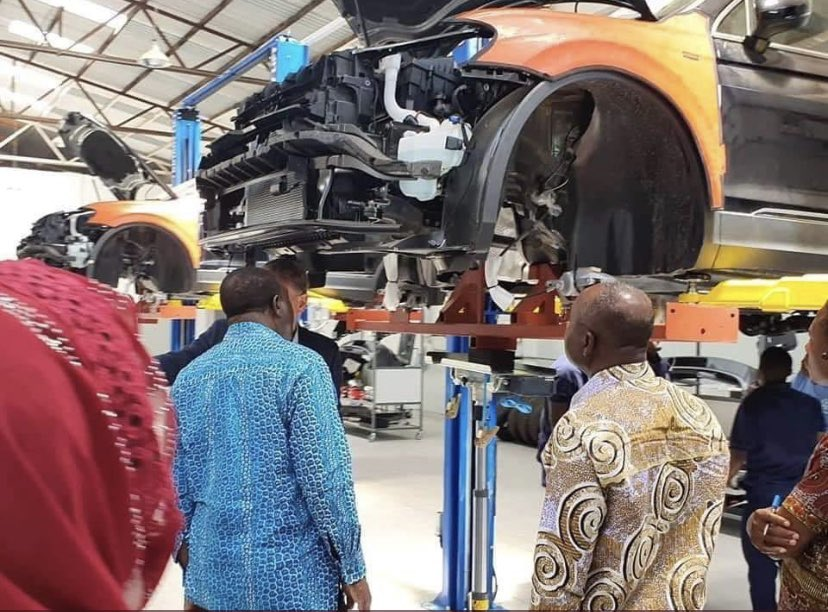
As The African Continental Free Trade Area (AfCFTA) edges closer, Ghana is offering 10-year tax breaks to the automotive manufacturing industry.

With the imminent abolishment of trade barriers under the African Continental Free Trade Area (AfCFTA), Ghana is poised to overtake Nigeria by becoming a gateway to the rest of West Africa, and a market leader in new car sales. The government of Ghana is also offering 10-year tax breaks to the automotive manufacturing industry in a bid to make Ghana the regional hub for car assembly and boost car sales in the local and regional markets.

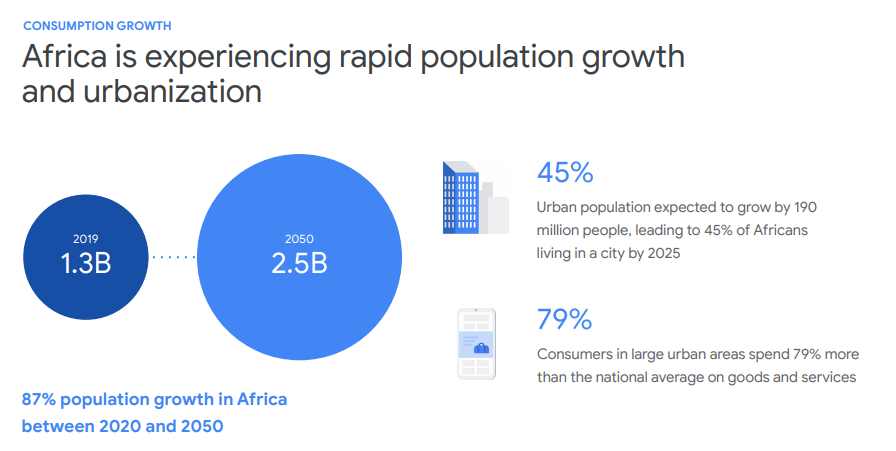
And a lot of international car makers are considering Ghana government’s invitation very seriously. Toyota, for instance, is aiming to collect 30% of the corporation’s total annual revenue, currently at $60 billion from Africa in coming 20 years. Industry experts forecast that Africa will account for one-third of the world’s population by 2050, up from 17% now.

Whether AfCFTA actually becomes a reality on ground remains to be seen. The West African Regional Economic Community ECOWAS is just a little bit bigger than the European Union. It has countries of much closer proximity than the expanse of all Africa, with many of the peoples having tribal or cultural commonality with each other, and direct dealings going back centuries.

While ECOWAS has a common market in theory, non-compliance and summary suspensions have happened from time to time at official level between individual countries in response to tensions over unrelated matters. These actions have never incurred economic penalties for nations in violation levied by ECOWAS as a collective afterwards.

Informally, there has always been some form of levy or tariff action happening on ground at entry points, for example, Nigeria’s land borders. The status of ECOWAS as an FTZ has always been fairly fluid since conception. With AfCFTA expected to include 55 countries, then by comparison, the instinct would be to consider it an insurmountable task to make work.

However, there does seem to be some optimism in Ghana that AfCFTA  WILL become a reality.

German Manufacturer Volkswagen, who also own Audi, Seat, Bentley, Bugatti, Lamborghini, Skoda, Porsche,  SCANIA and MAN, came to assemble in Ghana in April this year.

The models intended to be produced in Ghana are ICE versions of the Tiguan and Tremont SUVs ,the Passat, Polo, and the Amarok pickup.

Since Ghana has an extremely mature second hand automotive import industry, its domestic market is not enough to make such an enterprise viable, so they need AfCFTA to convert.

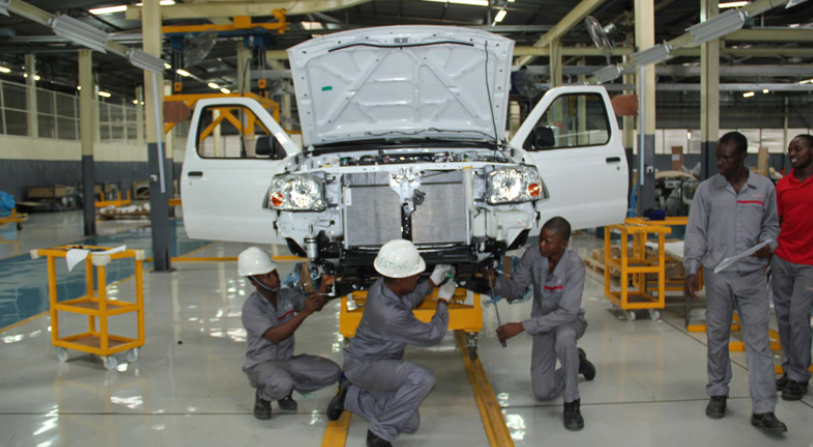
The latest to announce commencement of manufacturing in Ghana has been Nissan, today.

They intend to initially focus on the new model Navara, but should Nigerians be concerned about the future of the Nissan plant in the country?

Both Volkswagen and Nissan have different manufacturing/assembly activities positioned across disparate parts of Africa as a whole, so it’s clear activities in Ghana are intended to serve the regional market.

Should AfCFTA  become a working reality, it may be that FRN will need to come up with some stimulation packages in order to support indigenous companies such as INNOSON MOTORS.

By 2025, Africa’s Internet Economy Could Hit $180 billion – IFC/Google

1

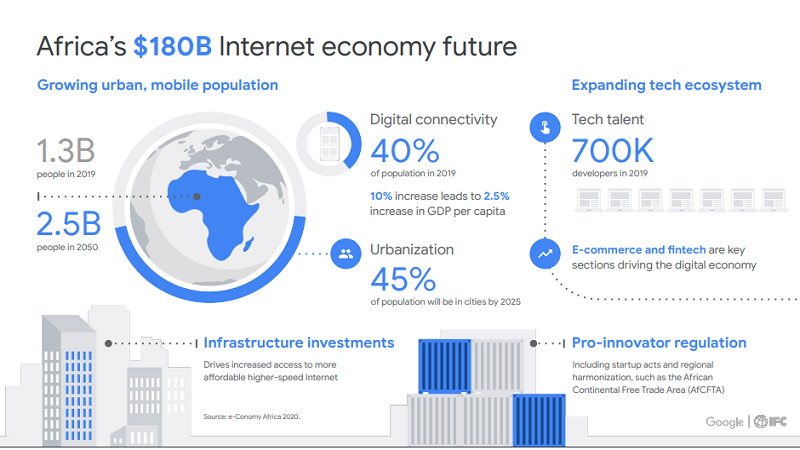
According to a new report from Google and International Finance Corporation (IFC), the internet economy of Africa has the potential to contribute $180 billion to the continent’s GDP by 2025. That would give about 5.2% in the gross domestic product (GDP).

By 2025, the Internet economy has the potential to contribute $180 billion to Africa’s economy growing to  $712 billion by 2050 . Over the next five years, COVID-19 is expected to delay economic growth both in Africa as well as the rest of the world. However, the resilience of the Internet economy, coupled with private consumption, strong developer talent, public and private investment, investments in digital infrastructure, and new government policies and regulations will continue to drive this growth in Africa.

Largely, it is time to have a strategy for your internet-anchored future, in both professional and business domains. Like the Abia State government (Nigeria) which abandoned the state college of education after it went on a strike, I expect Nigeria to give up on about 10% of tertiary institutions in the nation by 2025. Simply, the government will not fund them, and they will just disappear! A redesign is coming due to the application utilities era of the Internet, and dislocation and disruptions will happen at scale.

Now is the time to plan: from the voice telephony decade to the mobile internet decade, we just got into the application utilities decade, things are changing. The internet will play a major role in everything we do. If you are not clear on how to navigate this future, now is the time to join me for a three month journey.

ASUU Strike: Nigerian Federal Government Needs to Divest from Tertiary Education- Elda Kehinde Samuel

1

Elda Kehinde Samuel is a Resident Policy Fellow at the Nigerian Global Affairs Council  (NIGAC). He shares his opinion on how the frictions in the Nigerian education such as its inability to produce employable graduates, infrastructural deficit, funding and incessant industrial conflicts in the sector. Here are his thoughts….

An Economics Undergraduate studying in a University in New York pays about between 4.8 – 6.5 Million Naira when converted to our Local Currency per annum as School Fees. In a private University in Nigeria, an Economics Undergraduate pays between 800k – 1 Million Naira as School Fees per annum. Bring that down to an Undergraduate in a Federal University who pays an average of 30k per annum as School Fees as a returning Undergraduate. If you attend a State University, you might probably pay between 70 – 100k per annum as school fees. Now, looking at the difference, can we see why Nigerian Universities can never ever compete with their counterparts across the globe or even in Africa?

To make matters worse, ASUU has taken on an Industrial Action (Since March 2020) with no end in sight, our Undergraduates in Nigeria have effectively spent one full year at home doing and achieving nothing – even with the forced lockdown of our Universities, Nigeria was and has never been equipped to deliver learning to our undergraduate community using virtual tools or platforms. What’s the way forward for Nigeria? The Federal Government needs to divert from our Tertiary Educational System and set up a quasi Public/Private Partnership System where it owns a 30% Stake in our Universities then OPEN up the Industry for Private Sector Players to establish private Universities through the length and breadth of this Nation.

I believe that our Universities should charge a minimum of 1 Million Naira per annum, Government 30% ownership stake should strictly focus on providing for Research and Innovation through an Innovation Fund managed by an Independent Board. The Federal Government of Nigeria through the Central Bank of Nigeria will then set-up a single-digit interest percentage Education Fund that enables prospective Undergraduates to access Student Loans whilst studying – part of the package these school fees covers is a brand new laptop, smartphone, and unlimited access to Internet whilst on campus. Students will also be given accommodation with two students per room and this room comes furnished with mattresses, microwave, and small fridge. The School Fees also comes with daily nutritious feeding (Breakfast, Lunch, and Dinner) – Enabling these basics will reduce the incidence of student-led prostitution or cheating, I didn’t say stop but reduce drastically as everyone will be able to focus primarily on why they were admitted in the first place.
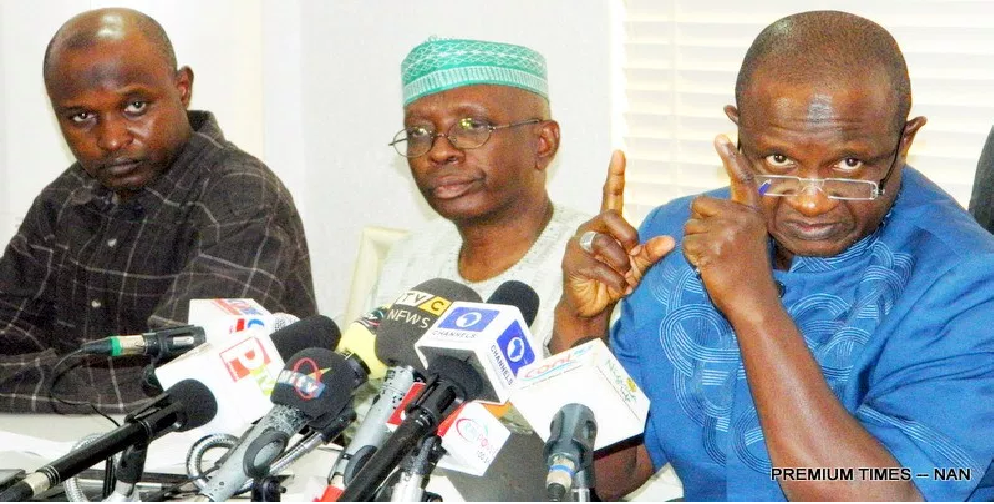
Members of ASUU

The loan package should also provide for a minimum monthly allowance for those whose parents can’t afford it – these monies will go a long in ensuring that Nigerians can have a stable academic life, yes, it is a loan, they pay back upon graduation and the single-digit interest rate will begin to count immediately they graduate, they also get to enjoy a 3 years moratorium before they begin to pay back the loan (this is to ensure that those without a job immediately can afford to stabilize whilst the moratorium also covers folks who want to further their education with a Masters or Ph.D., they can do so immediately and still access further student loans.

An average of 1.9 Million Students wrote the University Entrance Exam in 2019, less than 650,000 earned admission not because the other failed but because the system can only take such numbers in – imagine, if our Universities are quasi-privatized and quasi-owned by the private and public sector, it means an average state can have up to 10 Universities or more dependent on the attraction put in place by the State Government.

Let’s talk about the economic advantage of running a quasi-system of Ownership. At a minimum of 1 million Naira as school fees, our Universities will become centers of innovation as they have the funds to go through the entire life-cycle needed for Innovation to strive (Research, Build (Develop), Prototype, Test, Pilot, and Scale)- imagine the ideas and solutions our Undergraduates will churn out because the system has the tools and wherewithal to support their innovations. Companies both nationally and globally will begin to pay more attention.

Our Academics will better compensated as Professors and Senior Academics can negotiate their terms of service based on their perceived VALUE, they can also shift their services to other tertiary institutions, the system can also allow for an Academic with years of built-up expertise to teach in a maximum of 3 schools thereby earning extra income for years of experience, number of innovation and likely patents attached to their names.

We will never ever see an Industrial Action again although the system will encourage Unionism and active engagement in an organized format with the stakeholders so that issues are resolved quickly and efficiently.

Imagine the number of vendors that would be engaged and the number of folks they will employ (Cleaners, Gardeners, Security, Caterers, Electricians, Plumbers, Mechanics etc) – all these folks will be guaranteed a job and money gets to flow in the economy because people are engaged and paid regularly.

Even our undergraduates will begin to think from an entrepreneurial point of view because the system has been tweaked in that regards – we can not continue to operate an educational system that is taking the nation backward moreover freeing up billions of Naira on salaries and operational cost will enable our Federal Government concentrate on funding Innovation through its Independent Fund Board.

The Federal Government needs to also think of the benefits by way of tax that this model will bring to its purse – we are also convinced that a University system tweaked to work as a Private Entity will create jobs and opportunities for our teeming graduates but more importantly, it will create Innovators cum Entrepreneurs who also create jobs and employ people.

Whilst the very thought of a student loan might seem scary, the truth is that our tertiary educational system is at a precipice at the moment and we have to advocate for deep-rooted reforms that starts with our Federal Government divesting in a major way from the running of our University Education.

Along the line of these thoughts, our Federal Government can begin to sell and convert of its Polytechnics and Colleges of Education to these private entities, anyone seeking for specialized education as a Teacher or Technical Person can easily assess the newly set-up education and technical centres across our quasi-owned private-public universities – the current model of polytechnic and college of education system we have has outlived its purpose and they are no longer centres of excellence.Lastly, let’s imagine the impact having almost 20 private/public Universities in Lagos with an average of 30,000 students will have on the economy of that town or local government – the economic benefit will be massive and lifelong.

Our Private Universities and the standards they have set should be an eye-opener that this can work – it will impact on the quality of graduates Nigeria churns out. Will our Government ever summon the political will to make this happen?