This only applies now to Tekedia Capital startups which Tekedia Capital invested in. Attending Tekedia courses does not qualify.
As you begin your week after the restful weekend, let me remind you. Besides all, Tekedia Mini-MBA is a quasi startup accelerator, extending the school core innovate & grow mindset to support innovators. That means, innovators and companies can have access to resources which our Fund provides. If you are in our program, and need support, we will help. We have credits to support founders and companies in Tekedia Mini-MBA who are bootstrapping or have raised small money. Then, as you grow, we will offer you more credits.
I run an investing fund – and that fund has grown so well that Amazon has shown huge support. When we partner with you, we help you grow. I continue to look for great ideas to support. If we invest, you can also get up to $25,000 worth of Amazon AWS credit. We got an elevation from $10,000 to now issue $25,000 as many of our companies are growing. We can do even more if you need more resources.
From San Francisco to London, Lagos to Berlin, and beyond, we are empowering innovators of the future. Tell me what you are building, and let us see how we can assist you to get to the next level. We have close to three dozen companies in our portfolio and together they have created thousands of jobs, generating $millions of dollars.
If you are building GREAT things, contact Admin. We are here to support you. After a recent elevation by Amazon, we can now give $25,000 AWS credit, originally from $10,000 only to great companies, in any sector, to support their digital playbooks and executions.
AWS is the leading cloud provider in the world.
Have a profitable week ahead from Tekedia Institute.
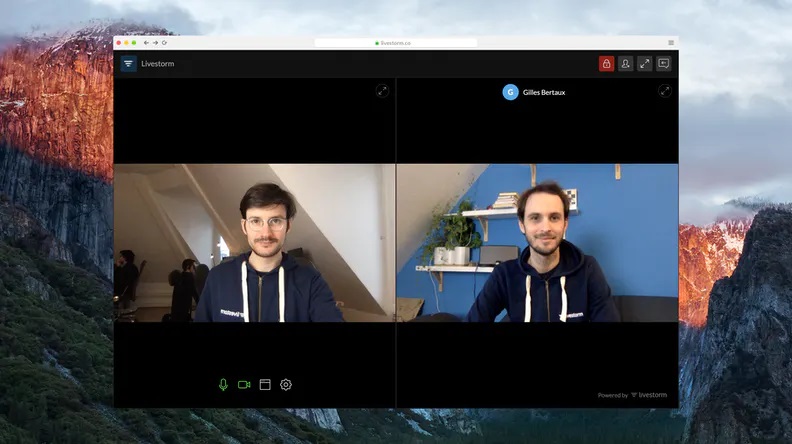
Livestorm, a video communication startup has announced that it has raised $30 million in Series B funding to expand its video meeting services.
“I’m pleased to announce our latest funding round. We’ve raised a $30 million Series B to accelerate product development and our expansion into North America,” said CEO Gilles Barteux.
The round was raised by Aglae Ventures and Bpifrance Digital Venture, with participation from Raise Ventures and IDInvest. The latest funding brings Livestorm’s total amount raised to date to $35 million.
Founded four years ago, Livestorm has been the preferred solution for rapidly changing industries like state and local governments, healthcare, education, and more.
The company said it will be using the latest funding to expand its technology to accommodate more companies and users.
“We’ll be using this latest funding round to develop new features and functionalities to support larger companies. We will create an ecosystem of integrations entirely dedicated to video communication. We believe that the next wave of video communication platforms will focus on more than just video distribution,” it said.
Zoom
As part of its expansion plan, Livestorm said it will increase its marketing presence and scale go-to-market strategies toward mid-market and enterprise clients in Europe and the United States, while hiring aggressively globally.
The company said it has multiplied its revenue 8x since last fall when it raised its €4.6 million Series A fund. It now has a customer base of over 3,500 customers, including Shopify, Honda, Sephora and Fortune 500 companies.
Bertaux told TechCrunch’s Anthony Ha that Livestorm moved from Webinars that it started with to video meeting services.
Livestorm is using an approach different from the traditional teleconferencing technology. The company had used the technology for conducting interviews and sees the product as different from Zoom, Skype and Webex.
“The way we think about it is, webinars and meetings are not use cases,” said Bertaux.
He argued that it’s more meaningful to talk about whether you’re having a team meeting or a training demo or whatever else, and then how many people you want to attend, with Livestorm supporting all those use cases and meeting sizes through different templates.
“We’re trying to remove the semantic distinction of meeting and webinar out of the equation,” Bertaux added.
The video conferencing service is browser based, a sharp contrast with other video tools. It does not require installation of software to be used by presenters or attendees.
While Bertaux acknowledges the dominance of Zoom, saying the company may have built “the best video meeting technology,” he suggested that there has been a shift in the status quo. “The thing is, we’re entering a period where video is becoming a commodity.”
The twist in the technology is that Livestorm is less focused on the core video technology and more on the experience around the video, with in-meeting features like screen sharing and virtual background, as well as a broader suite of marketing tools that allow customers to continue delivering targeted message to event attendees, TechCrunch explained.
Bertaux said it’s like Hubspot, which “didn’t reinvent landing pages” but put the pieces of the marketing stack together around those landing pages.
“In 2021, we want to have the biggest ecosystem of integration on a video product,” he said.
The company is poised to cause disruption in the video conferencing space where Zoom reigns supreme.
The Aglaé Venture partner Cyril Guenoun called Livestorm storm “the HubSpot for video communication.” He added that “video and online events have become essential in 2020, and are here to stay. The Livestorm platform thrives in this environment, providing a seamless solution for meetings and events with all the connectors that marketing, sales, customer service and HR pros need to make video a tightly integrated part of their communications,” he said.
Ayo Ojebode is a professor of Applied Communication, University of Ibadan and member, African Digital Rights Network (ADRN). This piece is his keynote speech during the recent webinar on protests and information disorder in Africa organised by the Centre for Research on Development of African Media, Governance, and Society (CEREDEMS) in partnership with institutions in the Russian Federation and some African countries.
Protests are acknowledged globally as an important aspect of democracy. This cannot be otherwise: democracy, however we define it, is a collaborative venture among diverse and, sometimes, opposing forces. Often, some groups or viewpoints feel marginalised or unfairly treated, and when the other avenues for expressing this feeling fail, they resort to protests. Protests should be welcomed and encouraged, therefore, as a major way of expressing discontent. It should not be ignored; it should also not be punished or repressed. If we kill protests, we kill democracy.
This is not to say that, for us in Africa, protests came only with the emergence of Western democracy. Far from it. The Aba women’s protests of 1929 remains a landmark in women’s kicks against oppressors. Twenty years after that, the irrepressible Mrs Olufunmilayo Kuti led the Abeokuta women against unkind taxation and denial of civil rights – so well that the king had to temporarily abdicate the throne even though he had the support and protection of the colonial government. One can cite numerous other examples of protests in the precolonial, colonial and early independent days.
The 1980’s and 1990’s for Africa remain the decades of protests. It was at that time that over 35 African nations became multiparty states – and this transition to democracy (allow this narrow use, pls) was not without protests. The scars of Nigeria’s anti-military protests are still visible on individuals and groups in Nigeria to this very day. So, for us, democracy came through protests, and has been sustained through protests.
The second leg of our discussion is information disorder. Broadly defined, information disorder is any attempt to tamper with the sanctity of a piece of information. Wardle (2019) noted that it comes in seven forms: satire or parody; misleading content; imposter content; fabricated content; false connection; false context, and manipulated content.
Like protests, this is not new. However, the explosion in social media access has made it a major component of our daily challenges. Information disorder affects protests in three ways. One, it may trigger protests. Many have embarked on protests only to discover that they had been fooled by fake news. Two, information disorder may fuel protests. When protests begin, lies and fabrications and exaggerations are sometimes used to sustain them. Three, importantly, information disorder has been used to discourage protests and split protesters – even turn them one against the other.
Information disorder is one of the great enemies of democracy. Governments now use trolls and bots to manipulate public opinions against protesters. Cambridge Analytica was a known devourer of democracy but there are millions of such companies worldwide yet to be known. So you make a post (say about a protest) and you get a hundred rejoinders refuting your post within an hour. You feel like an ignorant person, and you keep quiet – thinking those responding to your post had superior information. But they do not. They are programmes – bots and trolls; they are not humans! Non-human objects now share the democratic space with humans. From that point, the narrative about the protests gets influenced in favour of the non-human crowd and the government or whoever is funding them.
In thinking about the narrative of protests, we must also pay attention to the fact that protests in Africa hardly deliver on their full potentials because protesters sometimes lack plans for post-protests eventualities. When should a protest be called off? What should we go on doing after the protests? Importantly, what name should this protest be called and how should it be represented in the news? All these are hardly thought through at the start. And this is because protests sometimes erupt in response to unforeseen aggression from government – such as sudden fuel price increase or cancellation of food stamps.
Before protesters articulate these things, the government is already ahead of them with its narrative. And as you know, he who gets to the media first has the media. How does this play out? Often in the narratives, the dog is given a bad name in order to hang it. So protests are called riots, and genuine protesters are lumped up with hoodlums who foment trouble, arson and murder! All these are called rioters! It is the criminal height of information disorder.
This is what I found unfortunate about the #EndSARS narrative in Nigeria – in October 2020. Long after the protests had been called off, and after the hoodlums have taken over the cities, breaking jails and burning businesses including hundreds of private and government vehicles, the narrative remained “#EndSARS protests persist…”. These criminals were reported as #EndSARS protesters. Yes, we know there was a big difference between the protesters – decent, well organised, articulate young people whose protest was described as “a gift” by Prof Wole Soyinka, and the hoodlums that came to kill, steal and destroy. Yet, the journalists and government lumped them up as one. This is an attempt to punish and pulverise the decent protesters and teach them a lesson. Unfortunately, even established journalists were (un)willing collaborators in this demonisation process.
To ensure a fair narrative of protests in the information ecology disorder that we have found ourselves, it is important that protesters also take a firm hold of the process and product of narration. There should be more integrated cooperation between protesters and the media that report them. There should also be a think-through on the aftermath or aim or target of a protest – and this should not just keep increasing from five demands to seventeen demands and so on to “the president must resign”. Endless and uncoordinated elasticity gives room for infiltration, and the twisting of the narrative of a genuine protest.
Reference
Wardle, C. (2019). Understanding Information Disorder. First Draft. https://firstdraftnews.org/wp-content/uploads/2019/10/Information_Disorder_Digital_AW.pdf?x76701
From the north to the east and south to the west of Africa, emerging and established entrepreneurs are facing many legal challenges. Some the challenges have been documented when they appeared in the courts. A number of the problems are not known because the parties muted about them.
In our research, we discovered that few African entrepreneurs have an employee in charge of legal activities or having a legal department that oversees legal affairs. In our experience, we have seen how many businesses signed contracts without proper understanding of the clauses and requirements. In most cases, the lack of understanding emanated when legal terms were misunderstood or misinterpreted.
In line with background, our analyst notes that setting up a legal department for business in Africa is as important as choosing a business partner, one has to carefully set up such legal department in a way that it is effective, useful and serve the necessary purposes it ought to serve. Legal department tends to maintain and prevent legal issues that arises then plays a crucial role in reviewing and drafting contracts, employee policies and handling court cases. Basically, it ensures that the company’s properly discharge its business affairs.
Where are the Issues?
In East Africa, there is a legal guide providing an overview of legal issues and requirement. This guide review aspect of investment and its essential that investors have a basic understanding of issues and challenges. It is important to know the prevailing law such as the common law jurisdiction and the types of business entities. Level of liability and form of taxation should be considered here.
There should be compliance with national laws, regional standards and international norms. The land tenure issues could be complex, significant social and political implications. In Kenya, an East Africa country, foreign investors are out-rightly prohibited from owning or holding title to agricultural land and owning land with tenure in excess of 99 years. Foreigners are also prohibited from owning land in Uganda.
Specific legal and regulatory issues will impact current and future investment transaction. Precise requirements also outline numerous registration requirements. West Africa, North Africa and South Africa also have similar legal guidelines just like East Africa and Africa as a whole.
Core Strategic Requirements
It is glaring that Setting up a legal department for business around the world would have been the same like that of Africa only if the regulations were not made to be difficult and other challenges like corruption were minimized. There are certain things to be cognizant of. These requirements are expected to be fulfilled by business and employees in charge of the department.
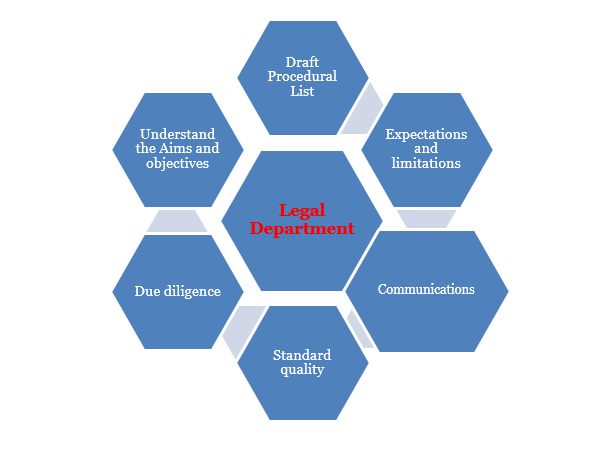
Communications
Communication with the senior management to know the roles in the company and understand what the company entails. This enables one to know if the company is fit for you. It is very important that the lawyers understand who and what they represent, and what is expected to be done in the company.
Understand the Aims and objectives
It should be understood that business people are immersed in business problems and what they want is to help solve their business problem and find business solutions. In most scenarios, they care less about how the problem is solved. They just want it solved. They are concerned about how you are getting the problems solved and not be an impediment for their particular way of solving it.
Due diligence
By doing this, you are making a conscious effort to research on your prospective employee. The question here is how well do you know your clients as an employer? How comfortable are the employees and the sanity of the environment?
Expectations and limitations
It is important while setting up a legal department for business, the expectations must be known and clear. It has to be certain, specific and well defined. Understanding the business and business expectation is very important to setting up a legal department for such business.
Standard Quality
This encompasses discrete skills and attributes such as legal training, negotiations, skills, client service and so on.
Draft a procedural list
Here, moving in as an organization’s counsel is not as simple as showing up for work at a different law firm or at another established professional legal setting. It should be decided whether the legal department should be another organizational unit or it should be incorporated as a mini company.
Budget
Having a budget is a way of planning and it helps in focusing on what is necessary.
Efficiency and Productivity
This implies that the employees should be efficient, productive and proactive.
Structure
When setting up a legal department, one should not choose the wrong legal structure because choosing the right business structure is like choosing your business partner. Registration and incorporation of the entity or structure should be completed within the required time frame. All the regulations should also be complied with.
Africa’s legal and regulatory environment ranks amongst the least business-friendly in the world. African entrepreneurs face more hurdles to register businesses and obtain various permits than other regions. Twenty of the bottom 25 countries ranked in 2010 doing business report are in sub-Saharan Africa.
Out of 10 countries in the world, where starting a business is the easiest, there is only one African Country (Rwanda). There is no single African country among the 10 economy countries where getting construction permit of registering company property is the easiest. African Countries are the bottom 10 in several indicators. Africa is part of 7 most difficult countries to register a business, 4 most difficult for getting construction permit and 5 of the most difficult for registering property.
The major constraint to the operation and growth of African business is at least one regulatory issue. The top cited reasons are corruption, custom and trade regulations, getting operations permits and licensing. Collectively, overall regulatory challenges are perceived as more severe than infrastructure and access to finance.
End Notes
Exhibit 1: Core Requirements in African Context
Source: Infoprations Analysis, 2020
Legal department is as important as the business itself. They are being asked to perform more like a business than a law firm. They provide more value to the organization, reduce risk and operate with greater efficiency while producing the best work possible. The setup helps in conformity with laws and regulations. It spreads the importance of respecting laws. Organizations with no legal department will definitely not enjoy the benefit that comes with having a legal department and will be prone to several issues. This is not good enough for a business that aims at progress or growth.
It is crucial to note that setting up a legal department for business is as important as making such legal department effective. Business can thrive and there can be growth when there is a sound, legal and regulatory environment. Regulatory issues have over the years seen to be one of the major problems. This should be faced and resolved.
For any business that intends to set up a legal department, it is important that they take necessary steps in setting it up well and understand what it entails to set up a legal department. It is also necessary to understand everything that has to do with the business as this will serve as a guide to setting up an effective legal Department for business in Africa.
He came to our program, and he has improved his consulting practice. At Tekedia Institute, we make it possible for our members to have access to business executives from Shell, Coca Cola, Microsoft, Flutterwave, MTN, Access Bank, KPMG, and some of the leading brands in the world. There is no program in Africa that offers that level of capabilities at the cost model we deliver this! Congratulations Mutiu Iyanda, mMBA, ASM.
“Initially, I was confused about doing the programme because many people have told me that MBA is better when it’s done in the classroom. That’s why I contacted you before registering for the Tekedia Institute’s mini MBA. Now, I realised it is not a matter of physical classes but having a platform that ensures knowledge co-creation and sharing.
I just delivered a number of strategic business documents to some clients. The beauty of the execution was that I was able to apply atoms and neuron of the programme.
Thank you. “
Change happens here at Tekedia Mini-MBA; register for the next edition.