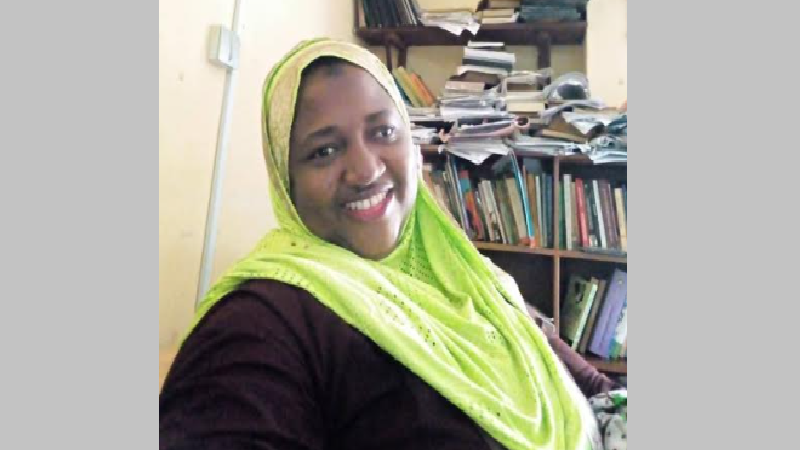
She was born and bred within the premier university environment. She holds a PhD in History from the University of Ibadan, Nigeria. She is highly concerned by the pains that exist in the society and seeks ways through which research could help solve the problems. She has a chat with Rasheed Adebiyi. Here are the excerpts…
Tekedia: Could you please tell us about yourself?
Mutiat Oladejo: Yes, I am Mutiat Titilope Oladejo. First of all, I am a lecturer in the Department of History, University of Ibadan, Nigeria. Let me tell you a bit about my background. I grew up in the University of Ibadan, Senior Staff Quarters. I attended Staff School, University of Ibadan, for my primary school. For my secondary education, I attended Abadina College, University of Ibadan. Of course, all this has to be within the University of Ibadan because my father retired as an accountant in the bursary department of the University of Ibadan and my mother retired as a teacher with the Teaching Service Commission of Oyo State. I grew up in the University Quarters where we have people from various parts of Southern Nigeria. I attended University of Ilorin. I studied History Education. After graduation, I came back to the University of Ibadan for my Master’s in History at the Faculty of Arts. Afterwards, I had a PhD grade and I proceeded to do my doctoral studies, which I completed in 2014 and did my convocation the same year. I developed interest in the academics and scholarly endeavours precisely during my master’s program. I feel honoured to be mentored by two of my professors in the Department of History, University of Ibadan. Professor Rasheed Olaniyi was the first person that took interest in me. He just gave me some books on women and gender issues and he said I should read them to have ideas. He was actually mentoring me then to just read books and then have ideas on how to fit into the academic world. I guess that is where it started because I remember in 2007, there were two conferences in the department; one on Intergroup Relations in honour of Professor Obaro Ikime at 70 and the other, an international conference on globalization, migration and identity in conjunction with Institute of Global Initiatives, Kennesaw State University, USA. Then he just told me submit abstracts. I was like, what?! As a master’s student, what am I going to write? And he said, just go and think. I’ve given you some books to read, so come up with something and for the first time I made attempts. Well, eventually when he went through the abstract, he made comments for correction and he said, okay, it’s fine, you can start developing your paper for presentation. The papers from the two conferences were my first set of publications. I realized that I began to take interest in women and gender issues from there. Of course, in the master’s program you’ll be expected to read and read wide, understand African historiography and other courses we study in history but the specific interest in gender issues came up from the kind of mentorship and motivation I experienced. When it was time for me to proceed to start my PhD, Professor Olutayo Adesina was assigned my supervisor. Professor Adesina is an excellent mentor that took his time and paid attention to develop me, he made sure that we were on the same level, and he ensured that I did the right thing. Though it wasn’t smooth along the line because at times, doctoral research is technical and tough. I enjoyed his mentorship because at the end of the day, I won a Dissertation Completion Fellowship for my PhD thesis from the American Council of Learned Societies. Immediately after my PhD, he also encouraged me to apply for the postdoctoral fellowship of the American Council of Learned Societies African Humanities Program (AHP) again, which I won. Presently I am a co-investigator in the GCRF/UKRI funded research on shifting notions of motherhood and fatherhood and improved children well-being in Africa in collaboration with the School of Women and Gender Studies, Makerere University, Uganda. The co-investigators are drawn from various universities in Africa. We have collaborators from University of Western Cape, Moi University, University of Rwanda, University of Ghana, and Makerere University. We are two collaborating from University of Ibadan, Dr. Sharon Omotosho who is the coordinator of the Women Research and Documentation Centre. Incidentally, I and Dr Omotosho, are working on a collaborative research grant with the Council for Development of Social Research in Africa (CODESRIA). In the CODESRIA programme, we are working on women encounter of mob justice and implication for security in Nigeria. We are almost rounding up on that. We are three in the group, Dr. Temitope Bello of Crescent University, Abeokuta is the third scholar. Very recently, I won a postdoctoral fellowship of the Islamic Development Bank to work entrepreneurship. While I was studying for my PhD, I enrolled for a Master’s in Business Administration at the Obafemi Awolowo University and I really liked the experience then because I am the type that likes to think out of the box. Being a historian, I still feel that even though I have a lot of things in my mind about what I want to do in future but I just felt that I should obtain the MBA, of course, my father is an accountant and for that we have a lot of accounting and business management books stacked in my father’s shelf. Out of curiosity, for the kind of person I am, I just felt that I should enrol for the MBA program. Then I just got married, it was in 2009 while my husband was having his residency at the Obafemi Awolowo University Teaching Hospital. While he was in Ife, I decided to enrol for MBA and I really loved the courses we did then. We did courses related to human resources, entrepreneurship, general management, finance and ICT. We were stuffed with studying management and business theories. In fact, I really enjoyed the entrepreneurship class, because, for me, it was an opportunity to have case studies, where you look at various businesses, why businesses thrive and/or fail, we studied businesses in the context of Europe, Asia, and Africa. When it was time write dissertation, I analysed women entrepreneurs in the garment industry, and how it is affected by global technological changes. Eventually, the project was published in an international journal with two of my lecturers in Ife. In 2010, I got employed at Emmanuel Alayande College of Education, Oyo, Lanlate campus, I was there from 2010 to 2015 before I joined University of Ibadan in 2015 as a lecturer in the Department of History. While I was working as a lecturer in the College of Education, I was doing my PhD and I had my first child, so I was juggling a lot of things together. I have tried to do a lot of multitasking, that’s the kind of person I am, I think those are some of the things I can say about myself.
Tekedia: As an administrator of a page on Facebook with Development in Africa, you appear to post countless times. Where do you get the energy from as a wife, mother and scholar?
Mutiat Oladejo: Oh, well, I love this question but I want to answer by using it to discuss the stereotype the society has about women, I can actually change this question and say, if I were to be a man, how do you get this energy to do this as a husband, father and a scholar because one thing is, I usually tell people, when I go for workshops on gender issues, I tell people that the brain created for men is not different from the one for women. So, if that is the case, why try to make it look like women are different and probably there is something spectacular that men do, that women cannot do. At times, it’s very stereotypic and it boils down to how we look at the social side of gender in Nigeria and Africa. However, because of the way we have been trained to think about gender relations in our society, religion takes a part of that, and cultural beliefs also affects perceptions. There is a tendency to say, as a woman, you have some primary roles in the house so it may be difficult for you to perform other roles outside the house. Really, I understand some of these factors affect some women, and affect the way the society thinks about women. I appreciate the fact that I’m able to create this Facebook group Development in Africa. I remember sometimes in 2018, the Centre for Democracy and Development in Abuja, invited me to conduct a research. This kind of research is not the typical academic research we are used to. It is a research that is meant for development practice and policy and it’s about looking at women and taxation issues, and how it affects women’s participation in politics. I was able to do this research then, I feel honoured that I was invited to do that research and we came up with a technical report from that research. Taxation was one of the issues market women contended with in the colonial era. From the research, I realised that there is a disconnect between the academics and the society. As a scholar, it is a way of engaging with the public. Of course, I have passion for books, I read books a lot and so for me, creating Development in Africa is a way of connecting what we do in the academics as scholars with the society. Development in Africa is a facebook platform for a not for profit scheme; Obinrin Afrika Initiative for Research and Development. I discovered that there are several reasons why Africa is different from other continents in the world. Fine, colonialism played a role in this and ever since colonial rule ended, we have always seen Africa as somewhere development is almost a curse. The kind of development we have in Africa is different from the kind of development we have in other parts of the world. While we can endlessly interrogate it, Africa is not doing bad among other continents in the world. There are several creative things about Africa, there are several resources and knowledge systems in Africa. At times, we are even caught up in the ideas of differentiating between what is traditional and what is modern in Africa because a number of things we regard as primitive or traditional are actually, things we can use technology to develop to have the modern outlook we all look out for. If that is the case, I feel that the knowledge produced in the academia is less mirrored in Nigerian society because government is disconnected from the academics. Government rarely make use of knowledge produced from the academic world in Nigeria, and the synergy between town and gown is low. So the society too encounters little, the impact of the knowledge from universities. All our journal articles and books end up on the shelves and afterwards nobody bothers about what findings you have from your research, and how these findings can impact on the society. So for me, I develop a passion around this and it is just about knowledge construction and creation. How can I, in my own little way, based on the passion I have, connect with the society? For me, Development in Africa as a Facebook group is a way of connecting with the society and it’s also a way of learning for me. While I want to learn, it is a way of making others learn about something, because for us in the humanities and social sciences, you discover a lot every day. All the things I post, I scrutinize them critically, and they are themes to evolve research questions. For anything I post, in my mind, I’ve already found research questions on it and it is a learning model because when I want to engage my students about some things that they can research on, or engage not necessarily only the students but in other spheres, it enables me to have a wider knowledge of what is happening in the society. When I talk about knowledge construction and creation, it all boils down to the fact that the outcome, or the output will come in the form of books. If you look at the group, there are people from the academics, development experts, government officials, policy experts, scholars in diaspora, students, non-governmental organisations among others. So I believe that I’m trying to make sure books are available, because there is still a way to objectify knowledge to a book form and it will become a reference point to solve other problems in the society. For me, it’s a platform to engage the society.
Well, as a wife and a mother, What’s different? It is no big deal; it is just a matter of mastering time management. There is time to be a wife, there is the time to be a mother, and there is the time for my career. Well, at this point I’m going to give kudos to my husband because he has been supportive. He is not the type that follow the stereotypes as it is in our society. He believes so much in me.
Tekedia: Your research and scholarship focus development, especially from the angle of gender, or the African woman, what is the plight of African woman now compared to when you started?
Mutiat Oladejo: Yes, of course, that’s very right because initially, the scholars that have worked on women in Africa, especially women’s history, they have been able to unravel biography as a tool to understand women in Africa of the past. Scholars like Professors Bolanle Awe, Nna Mba, La Ray Denzer, are female historians that worked on women. They unravelled a number of things about African women, using biographies. But now, there is a shift to examine more of gender issues in a number of researches and that’s why the idea of analysing motherhood and fatherhood arises because it’s a new perspective to unravel. In the pre-colonial era, how did fatherhood and motherhood play out? and how did this affect upbringing of a child in that, we are very interested in analysing how colonialism and urbanization affect the ideas of fatherhood and motherhood, was there really an African way to understand fatherhood and motherhood? how did colonialism change this? Of course, capitalists’ orientations affected economies of the colonies and then even after colonial rule, there are new shades of colonialism, how did all these things intertwine and then are shaped by global and local changes, has the African perception changed? These are the kind of dynamics considered and has it really changed? Nothing has really changed. It’s just that we are having a society that is becoming complicated, because we have new cosmopolitan cultures and abnormal deviations in the society. As a historian, I may not be too interested in looking at some of these contemporary changes as it is, but, they are not new. For example, the phenomenon of baby mama, or baby daddy as it is now, had been forever. In contemporary times, we have situations where a man before he gets married in a lifetime must have had like three or four children from different women and afterwards settles with a woman and start a family and same for women. We have single mothers now, when you interview a number of girls now, they are just going into marriage just to conceive, have a son or a daughter. And after a year or two, they become tired of the marriage and they seek for divorce, to become single. In Yoruba society of the past, those kind of scenarios are rare, but if you look at most of the cities in the Yoruba societies of Lagos, Ibadan, you see a number of single mothers, and then they tell you they are doing well with life, they are not pressured to be under a man, and as much as the society wants to paint some of these women as irresponsible women, it’s not about them alone, what was the kind of upbringing the men were also given, those are the kind of challenges we have in our society. For a boy, is trained to think that he is a man in the sense that he is supposed to be served, he feels entitled without the foresight of a balanced life with women around him. The sense of entitlement comes with the perception that any woman that is going to be around them should be a kind of a slave so to speak in form of a wife and that’s what leads to broken marriages, and yes, the economy is also not too fair. A lot of men are also frustrated, because they don’t have the kind of wealth to actually sustain a lifestyle that is conducive to maintain a marriage. As a result of that we have a complicated society and that’s why the question of fatherhood and motherhood now arises as a significant factor in children’s well-being. This is not typical to Nigerian societies alone, look at South Africa, East Africa, these are issues that are emerging as much as we can see that things are changing, we also notice that technology is also changing lifestyles, a number of women find it convenient to just be a single mother, almost in a lifetime, because they are able to make money and fend for themselves and the child they have, and they don’t feel obligated to be under any man that may feel threatened by their status, there are a number of men that feel threatened by fact that their wives are involved in money making ventures. Religion is also taken as a shield to entrench toxic masculinity and domestic violence in marriage is also a big deal in our society, it has always been, but it is now very rampant, things are complicated. Nothing has really changed, but the paradigms are different. In my book, The Women Went Radical: Petition Writing and the Colonial State in Southwest Nigeria 1900 to 1953, I discovered the petitions written by women to seek for divorce, or to appeal for judgments on divorce that was not favourable to them in the colonial era. In the colonial era, a number of women encountered domestic violence, and as a result of that, they sought for divorce, their sources of livelihood were threatened by their husbands, their husbands cart away their properties and belongings, they had to seek for divorce so that they could become independent and take care of their children. Invariably, it’s only that globalization and technology is changing, giving us a new version of some of these problems. I realized that nothing has really changed, the challenges are still there. The beauty of being a historian is that it gives me the ability to analyse the changing patterns. In my first book on Ibadan Market Women and Politics 1900- 1995, that is actually my PhD thesis, I revised and published as a book with Lexington books. I was able to look at how market women engage in politics, not party politics alone, how their action itself meant politics within and outside the markets and in relations society and government. Findings in the book was the basis of further research on women and tax issues, intertwined with political participation. (see here) Market women agitated against payment of tax in the colonial era but at a point in time, they opted to pay tax and used it as a process to demand accountability and participatory governance. This is evident in how Funmilayo Ransom Kuti mobilized Egba market women to struggle against the colonial State in the late 1940s and the early 1950s.
Tekedia: Your book on gender, politics and governance in Africa is your latest addition to scholarship on women. Could you tell us the takeaways from the book?
Mutiat Oladejo: Thank you. In my encounter with Nigerian Women Trust Fund, issues of women’s political participation emerged and in interactions with young women we were able to do round table discussion and discerned the major issues that affect women’s participation in politics, it was from those workshops that I birthed idea, of looking at the triad of gender, politics and governance in Africa. For instance, if you look at other African nations, few women have been able to become presidents of countries. I think by luck a woman became president of Malawi. Helen Johnson Sirleaf emerged in Liberia, if you look at her biography, she struggled, she had been part of the Liberian government, and the fact that there was conflict and the society needed peace was a leverage for her. She was able to use market women and other female stakeholders in society to pave way to become the president of the country, that Liberian example was novel. In Zimbabwe, we have Joice Mujuru in Zimbabwe. Of course, she was a fighter in the military; from there she negotiated her way through the political party system in Zimbabwe and with the support of her husband she became the vice president to Robert Mugabe. She was entangled in the political web of Zimbabwe, which, affected her ambition to become the president of Zimbabwe even before Mugabe’s death. Be that as it may, women who had become presidents, vice presidents, ministers across nation states in Africa, had gone through lots of challenges and I realize that nobody talks about a number of these challenges. However, the research funds are not there, it may not even be convenient for women to even research some of these things. Coming up with the idea of this book was a passion. The book gives in depth analysis of women encounters in politics and governance in Africa and in spite of this challenge, few women have been able to emerge. It’s not really about saying that women are the only ones that have struggled so far to put themselves in power but also to prove a point that men are also part of the success stories of women who had been part of the political or governing system in Africa. There are fourteen chapters in the book, some contributors to the book, focused on a female legislator, some analysed the way women had been deputy governor’s in Lagos State in the past, and the dynamics have mainstreamed women out of power. Other chapters in the book, analyse various reasons for power and powerlessness women encounter and the cost of participation in politics, not in party politics alone, through markets associations, Furthermore, the book examines the social, political and economic factors that accounts for abilities or inabilities to participate in politics, or be part of the governance or how the politics and governing system itself has affected women’s empowerment in Africa. These are some of the things in the book and it is useful for people in the humanities and social sciences, especially postgraduate students, who are interested in having ideas about issues related to gender. The conclusion or summaries are useful for people interested in understanding the nuances of women’s involvement, challenges or the success stories women have made so far in participating in politics and governance in Africa.
Tekedia: What is your advice for young and early career woman researchers?
Mutiat Oladejo: Well, this is a recurring question. No doubt, a number of women seem to be discouraged from being a researcher or being part of the academic space, but they shouldn’t be. I and some of my diaspora colleagues felt we should do something to motivate and groom young female researchers. But the COVID-19 pandemic could not allow us do that. We were planning to organize a workshop to sensitize and create an avenue for post graduate students who are interested in pursuing a PhD and we got some support from Institute of African Studies, Barnard College, USA to hold the workshop in Nigeria. We were supposed to have the workshop in March, but unfortunately, it had to be suspended. We had completed the selection process to choose participants for the workshop. We know that there is a need to influence women to take interest in academics but it could be frustrating at times, because it’s also a primetime when most women aspire to probably get married, or some are interested in working to make ends meet. So, the question of becoming a researcher, without funding and moral support system is problematic. For instance, at the Women Research and Documentation Centre, University of Ibadan, mentorship for younger women to have interest in the academics is constant. I think about three years ago, WORDOC organised its 30th anniversary conference. At the conference, the questions of ‘what women should want and how to want it’, formed the theme of the conference. For me, apart from the fact that I am a historian and researcher in women and gender issues. I’m also involved in various forms of advocacy or the other for women empowerment. I am also involved in advocacy to mentor younger girls and women to have interest in research. I remember vividly that I discussed a topic with a post graduate student and there was a competition we had to pitch for, she developed her pitch deck from the title. I was very happy that she presented a number of things I discussed with her and I’m impressed that she had the confidence and the bravery to use the idea.
Like this:
Like Loading...