DD
MM
YYYY

PAGES

DD
MM
YYYY

spot_img

PAGES

Home Blog Page 6059

Private Schools, Costs and Value Derivable for Students and Parents

0

The Igbos will say that “ala adi mma bu uru ndi nze” to show that people benefit from the calamities that befell others. There is no crisis that doesn’t have beneficiaries; just as many crises have sponsors. This may explain why certain bad situations get worse instead of better. A good example of this is the Nigerian education system.

During our days, every Tom, Dick and Harry sends their children to public schools or missionary ones. Then, education was a vocation. Schools were opened to nurture souls and develop skills. Government schools were not made for the poor but for every Nigerian child. Missionaries then used their own schools to propagate religion so that they can “capture them young.” But today, the opposite is the case – education has become a business venture.

I am not against the establishment of private schools, please don’t get me wrong. But the fact that public schools are quick going down the drain while private schools spring up in every nook and cranny calls for concern. It is beginning to look as if some people are deliberately killing the public school system so that the private ones could rise. I once predicted that Federal and State tertiary institutions will “enjoy” the same status quo as the present public primary and secondary schools but people misunderstood me. But from all I can see, there is a deep reason behind the underfunding and mismanagement of public schools in Nigeria.

Like I mentioned earlier, people benefit from every bad situation. In Nigeria today, entrepreneurs that know nothing about nurturing and forming the younger ones are establishing schools. Today, many schools are not there to build the Nigerian future but to rip it off. Right now, our children go to school not to learn but to grease the pockets and bank accounts of some greedy entrepreneurs, who answer “proprietors” and “proprietress” even though they know nothing about the vocation called education. All that these people care about is that their “businesses” grow and that more money enters their accounts. What goes on in the school is not their concern.

But today, I am not looking into how our schools – both private and public – unlearn and ‘mislearn’ our young ones, but how they rip off parents. We know that many people these days wish the best for their children and so they turn to private schools. But ironically, some parents believe that the more expensive a school is, the better its teaching and learning environment. Many parents felt that all the money they pump into their children’s school fees are used in shaping their future. Well, I am here to let them know that they are actually enriching the school owners and not their children’s future.

Yesterday, a close relative sent me the school fees breakdown of her two-year old that will enter preschool and I couldn’t help but scream. I know that things happen but this one was so out of place. In this list she sent, the young boy will have to buy books worth thirty-five thousand naira (#35k) and uniform of forty-thousand naira (#40k). Then every term, he will pay 5k for first aid, 5k for diction and 5k for PTA. Now, these are just the ones that made it so glaring that the school is “stealing” from the parents. Don’t worry, I will explain this.

Now, let’s talk about books. Please, what sort of books will a two-year old buy that will be up to 35k? I mean, this is somebody that is going into PRESCHOOL, where children learn through playing. They basically don’t use books because at this stage, books are for tearing and for chewing. So even if the school wants to supply books to these young souls, it will be one for colouring activities, one for lettering and one for number works. And these are just for exposing them and not for them to perfect their skills. Well, let’s leave the one for books and go to the other aspects.

Ok, let’s see what we have to say about uniforms. I told my relative that maybe the school is importing custom-made silk from the moon and that’s why a two-year old will wear uniforms of 40k. Those of us that enter the market know that the highest quality material for uniform does not sell more than 1k a yard. It is even not up to that. But here we have a toddler, whose uniforms may not require more than half a yard to sew paying 40k. Please, remember that staff salaries are paid from tuition fee and not from all these ones. Besides, how much do these schools even pay their staff?

Without wasting much time, let’s quickly review the other fees noted above. Now, what is in a first aid box that requires a child to pay 5k for the services every term? Does that money include insurance or something? What about PTA, that holds meetings once in a year, if at all it does? Why collect such an amount of money? What is the money for? Why do parents need to sponsor a forum like that in a private school? Why will private schools expect parents to pay heavy fees and still pay for PTA, which is usually used to sponsor projects in schools? I don’t know if I am being dramatic, but I know that PTA levy in public schools is justified but it is wrong for private schools to collect that money. The simple reason here is that public schools belong to everybody but private schools don’t. PTA levies in public schools are used to build things that will make teaching and learning easier for the children. This is done as a contribution to developing what is “ours” unlike in private schools, which is “theirs”.

But the most hilarious fee in that list is “diction” levy. I asked my relative if her son is having a speech problem; she answered in the negative. So, what exactly does the school mean by collecting money for “diction”. Does it mean that the child will have to pay for listening to the way the teacher speaks? I mean, children at this stage pick up languages and language varieties from people around them – both at home and in school. So why would parents be asked to pay because their children pick up languages even after paying heavily for tuition?

You see, most “nonsense” happens because we don’t ask questions. We are so busy with the pursuit of wealth that we haven’t looked back to ask for accountability. Note that I am not against school owners making profits, but it shouldn’t be done in glaringly extortive ways. Parents need to start now to demand for the use of money they paid for. Their children’s future requires that.

Tekedia Partnership Opportunities

0

We have set our target for 2021 and it is huge for  Tekedia Institute’s programs (Tekedia Mini-MBA, Tekedia Mini-MBA for Corporates, Advanced Diploma, Tekedia CollegeBoost, etc). To execute that playbook, we will be exploring strategic partnerships with universities, polytechnics, alumni associations, media, governments, consulting firms, companies and individuals.  

We have divided our markets into 4 domains: 

  • Consumers & Individuals: Co-training citizens
  • Public sector & governments: deliver training and educational programs to government workers, government programs and government institutions.
  • Schools: Working with universities and other post-secondary institutions to embed our products as non-credit programs in their missions.
  • Companies: Facilitate and co-train innovators and project champions in companies.

Geographically, we have three core markets: Nigeria, Africa and Global. 

We welcome partners across the globe and are looking for institutions which can help us meet and exceed our targets. We have three classes of partners and we welcome you to work with us to take Tekedia Mini-MBA and Tekedia Advanced Diploma programs to more markets and territories:

  • Silver
  • Gold
  • Platinum

If you are interested to work with us, email us at tekedia@fasmicro.com with a short description of your capabilities in your market.


Tekedia Mini-MBA 4th Edition Early Registration Begins


2020 Career Week Day 5

0

Notes: only the first 100 will be on Zoom. Others will connect via YouTube Live here. You can leave comments below and the moderator will still pick them. Links for Live Sessions Fri | 12noon -1pm  WAT| Nurturing Innovators & Career Planning – Elizabeth (Ayeni) Nyah – Tekedia Live | Zoom link Fri | 7pm – 8pm […]

To access this post, you must purchase Tekedia Mini-MBA (Feb 9 – May 2, 2026) | $170 or N120,000.

US Justice Department Puts Plaid on Visa’s $5.3 billion Plaid Deal

1

The United States Department of Justice has sought to block Visa’s proposal to acquire Plaid, an API fintech company that makes it possible for institutions to connect with bank accounts of users: “The DOJ claims Visa’s acquisition of Plaid would violate two federal antitrust laws — the Sherman Act and the Clayton Act — and allow Visa to maintain a monopoly in online debit transactions”.

This singular action could kill the party in the global fintech space. Yes, it is now evident that the U.S. government would not allow industrial age firms to use cheap money, during this age of low interests, to buy out competitors. A world without Plaid is one where there are fewer thorns for Visa, and the government does not want that.

A federal antitrust lawsuit filed November 5 by the U.S. Department of Justice seeks to block Visa’s proposed $5.3 billion purchase of fintech startup Plaid, a San Francisco-based fintech that enables applications to connect with users’ bank accounts.

In the court filing, the Department of Justice (DOJ) complained that Visa is buying Plaid to wipe out a competitor in the lucrative business of online debit transactions.

The DOJ claims Visa’s acquisition of Plaid would violate two federal antitrust laws — the Sherman Act and the Clayton Act — and allow Visa to maintain a monopoly in online debit transactions.

“Visa seeks to buy Plaid—as its CEO said—as an ‘insurance policy’ to neutralize a ‘threat to our important US debit business,” said the Justice Department in its lawsuit.

The government is changing its playbook after it allowed Facebook to pick properties like Whatsapp, Instagram and others. No matter how you see it, the government may be right: the idea of extremely rich companies buying out competitors does not usually favour consumers in the financial sector. Plaid has a promise of being the future Visa, and unless Visa is ready to go back to the lab and innovate, cheap money should not save it.

Months ago, Visa had put a $5.3 billion acquisition deal for Plaid: “Visa in January announced plans to acquire Plaid, which makes digital infrastructure linking financial data from people’s bank accounts to the apps they use to manage their money such as Venmo, Coinbase and Expensify.”

Australia Reeling at the Mercy of China as Their Face-off Deepens

0

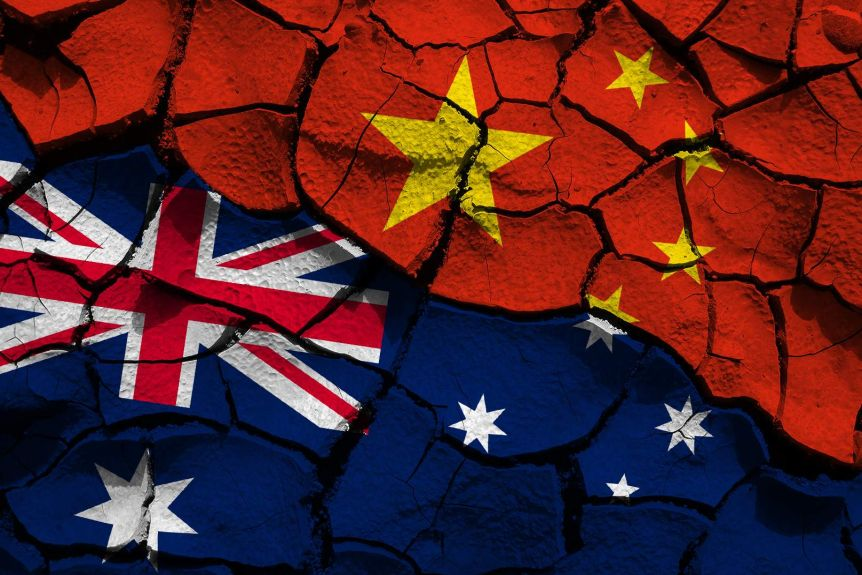
The faceoff between Australia and China is escalating. The two countries have been caught up in a diplomatic dog fight that escalated from Huawei ban to COVID-19 utterances, and it is now ripping their bilateral ties apart.

In early October, China had announced the ban on Australian thermal and cooking coal imports. The move though subtly, was a significant add-on to events that have followed their soured relationship, which consequently, was aggravated by the outbreak of coronavirus.

In February, Australia Dumping Commission was weighing in on a possible continuation of dumping duties on Chinese aluminum extrusions. The Commission started an inquiry into the sales of aluminum micro-extensions, which are used for domestic window flyscreens and television aerials, made by Chinese companies Guandong Jiangshen Aluminum and Guandong Zhongya Aluminum.

By the end of February, Australia concluded that it would continue to impose anti-dumping duties on Chinese deep drawn stainless steel sinks. The decision added further strain on the already fragile relationship between the two countries.

However, Australia and China were still reeling on relationship-amendment hope until April, when the issue of COVID-19 came into their squabble.

In April, when Australia backed the United States’ call to investigate the source of coronavirus, it became a dagger driven deep into the wound that China was already licking. The south Asian giant counted it among the many sins Australia has committed against Beijing, which it was contemplating whether to forgive or not. Among them, Australia’s swift ban on Huawei which was seen as a frontal attack on Beijing, and has set the two countries on the path of rivalry that has kept taking a new turn since then.

As the Guardian puts it; china sees Australia as frontrunning – yet again in Beijing’s eyes – on an issue deliberately constructed to isolate, condemn and humiliate China.

“The Chinese public is frustrated, dismayed and disappointed with what you are doing now… if the mood is going from bad to worse, people would think why should we go to such a country why it’s not friendly to China.

“The tourists may have second thoughts. Maybe the parents of the students would also think whether this place, which they find is not so friendly, even hostile, is the best place to send their kids to. And also, maybe the ordinary people will think why they should drink Australian wine or eat Australian beef,” China’s Ambassador to Australia said in May, signaling that Beijing intends to take the fight further over the coronavirus comment.

To Australia, Chinese response appears a dramatic overreaction to an entirely legitimate international concern to understand the origins of COVID-19 outbreak. The same logic was applied to the Huawei ban, which was done in the interest of national security that China is not ready to do anything about.

Spicing the inferno with embers was Yang Hengjun, Australian pro-democracy writer who has been incarcerated by China. Then there is the dispute over the South China Sea, continuing allegations of espionage; all came in bulk and spilled over into economics ring fight that no side is willing yet to throw in the towel.

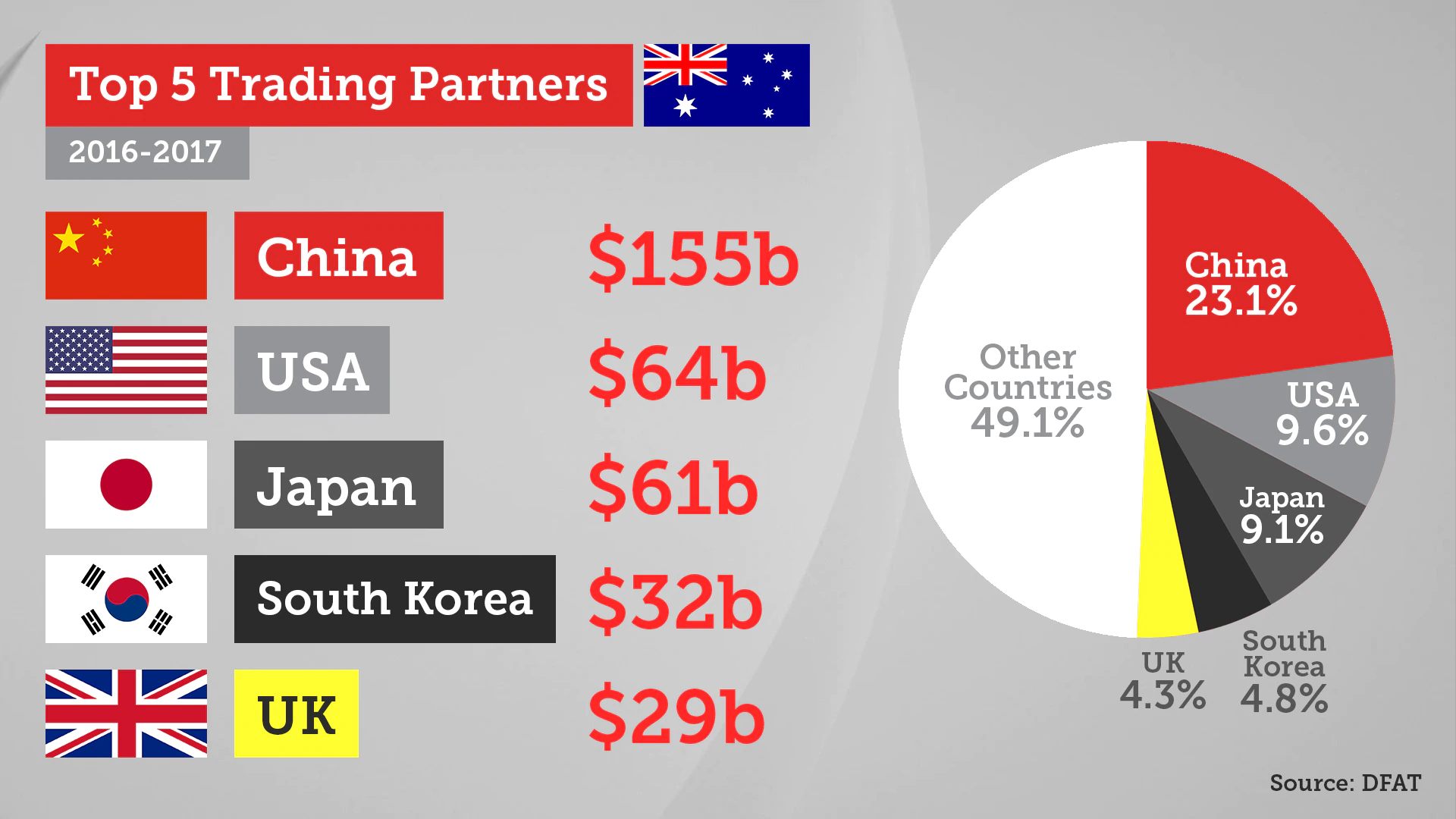
China has upper hand, with Australia’s economic dependence on Beijing, it moved to exert “economic coercion”, a move Australia quickly called out.

“We reject any suggestion that economic coercion is an appropriate response to a call for such an assessment, when what we need is global cooperation,” Australian foreign minister, Marise Payne said.

China and Australia have the largest two-way trade partnership in goods and services, representing more than a quarter of all international trade. As of 2018-19, the two-way trade has reached $235 billion, 20% up year on year to record the highest amount ever.

The trade was notably boosted by goods from the food sector. Australia exports foods such as beef, seafood and diary, with a $12 billion value. But it is about to go down the drainage of the lingering dispute.

China is expected to ban Australian wheat on Friday, a $394 million trade deal. But it is just among other Australian goods being added to the list of new blocks on Australian products, according to SCMP.

The report said from Friday, barley, sugar, red wine, timber, coal, lobster, copper ore and copper concentrates from Australia, are expected to be barred from China even if the goods have been paid for and have arrived at the ports.

“Chinese importers have been told to obey these rules strictly and suspend all orders for commercial reasons,” a trade source in China who is familiar with the matter said. “Shipments arriving at the port before Friday will be released, but those arriving after will stay at port. It does not matter if it is already in the bonded area.”

Australia money

China is expected to up its food importation, especially wheat to 6 million tonnes, an addition of 4 million tonnes from the previous year, as it “looks to meet internal demands and ensure stable domestic reserves amid a backdrop of uncertain market factors like food supply scare and trade tensions,” but Australia is not in the import plan, as China has begun to look elsewhere for the import of goods and services it has been importing from Australia.

There have also been reports of stockpiling of timber, lobster and other goods, much more than needed by China; a development analysts see as a warning to Australia that the worst is yet to come.

As more Australian ships get impounded in China, it confirms the suspicion that a full-scale trade war is looming between the two countries, and Australia will suffer its consequences.

“It’s been very tough for Australia. We have reached out continuously over a number of years to Chinese ministers and senior leadership and they’ve shunned us for various reasons. They’ve chosen to try and bully us at different times,” said Joe Hockey, Australia’s former treasurer.

Australia had earlier in the week, taken the matter to the World Trade Organization (WTO), where its officials criticized China’s investigation into whether Australia was dumping barley on the market. The officials called the probe “flawed” and claimed it has led to miscalculation of the duties charged.

Australia said the investigation had been “improperly initiated” and the products involved were not properly involved. Moreover, they claimed that Chinese authorities did not acknowledge receipt of information supplied by Australian producers, nor did it carry out verification visits, according to SCMP.

China’s WTO representative’s response to the claims is that Australia’s concerns had been noted. The complaint was continuation of the pursuit Australia made in early May in the WTO, which includes threat to sue China, though it has yet to make the move.

Reeling on the mercy of the mightier hand of Beijing, some analysts believe that Australia may use one area it has an edge over China – international education.

Australia has the largest proportion of international students in higher education. Almost a third of all higher education students in the country are international students. In the number, Chinese students make up the biggest share of the international students, with over 260,000 students, according to data from Statista.

A fight-back from this terrain will mean expelling over 260,000 Chinese students in Australia, but yet, it will do more harm than good.

In the wake of the tension between the two countries, China had sent warning to its students to rethink Australia. This also came on the heels of warning to Chinese tourists to avoid Australia.

China appears to have made advance preparation for the confrontation, leaving Australia waiting in a state of inaction.

A trade law professor at the Chinese University of Hong Kong said there is only one way to put an end to it.

“Australia seems set to pursue this – they need to tame China’s use of trade remedy investigations. Experience shows that waiting and hoping for a change of behavior does not work. Action speaks louder than words,” he said.