For more than three months, the stakeholders in the University of Ibadan and the general public have had the cause of understanding who is likely to become the new Vice Chancellor of the country’s oldest University. The position becomes vacant because the current Vice Chancellor, Professor Idowu Olayinka will cease to be the Chief Executive Officer of the University in November, 2020.
From application stage to the public debate, issues have emerged and addressed by the concerned stakeholders. With the less than a few weeks to the announcement of a new Vice Chancellor, a local campus news organisation reports that 6 out of 18 candidates have been shortlisted for final screening.
“The UI VC race reached its climax as 6 aspirants have been shortlisted to proceed to the final stage of the screening. The 18 aspirants for the position of the highest office in the University was pruned down to 6 at the screening conducted yesterday, Tuesday.
The shortlisted candidates include: Prof. Femi Mimiko; lecturer at the department of Political Science, OAU, Prof. Kayode Adebowale; DVC (Admin), and former DVC (Academics), Prof. Abideen Aderinto. The other three are Prof. Olusegun Ademowo of the College of Medicine, Prof. Olatunde Farombi; a professor of Biochemistry and Molecular Toxicology and Prof. Babatunde Salako; former Provost of the College of Medicine, UI,” organisation says few hours ago.
Our analyst had earlier conducted a series of analyses on the selection processes and concluded that the University needs a strong leader who will advance the current gains and bring more achievements for every stakeholder.
As the screening commences today, our analyst notes that the University must screen and select the best three candidates for the Presidency. This is imperative considering pre-screen allegations and counter allegations from some stakeholders. It is also important that the University sets the right pace for others in terms of choosing a new Vice Chancellor based on merit and capability to deliver the needed change to the University community and Nigerian higher education in general.
Congratulations Madam. Ngozi Okonjo-Iweala is largely and essentially the new director-general of the World Trade Organisation (WTO). She will wear many crowns, among them, the first woman DG of WTO. This is good for Team Nigeria – we need more wins out of this nation.
Yes, it is not official but it is actually official! Yes, since she has won more votes than her competitor, she is the new DG. The official announcement while necessary does not change the fact that she is the new DG. It is on this premise that we write that Sister Ngozi is the new DG of WTO, The official protocol will happen but the outcome is known: Dr Okonjo-Iweala is the new boss.
Yes, while a game remains 2 minutes and home team is winning by by 7-2, it is fair to write that home team has won even though 2 minutes remain in the game. It is factually incorrect but contextually valid.
Like other countries that gained independence from the United Kingdom, France, Germany, among other countries that scrambled for African nations and partitioned them into different protectorates, Nigeria has been led and still be led by a mix of baby boomer generation and generation X.
In the Nigerian context, the modern Nigerian state, according to a number of sources, was laid by the baby boomer generation [born between WWII and country’s independence in 1960]. Those born between 1960 and early 1980s, popularly known as Generation X, [including those in the baby boomer generation] have been constituting the bulk of people at the helms of affairs in the last two decades.
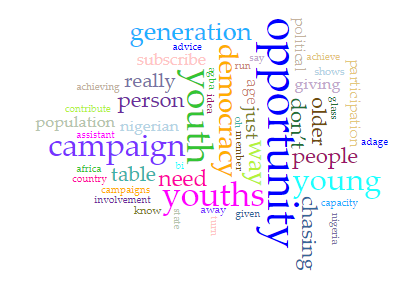
According to a number of youths, including Abideen Olasupo, who speaks with our analyst, believe that Generation X is finding it difficult to change the existing governance structure. This is largely due to the fact that the baby boomer generation still holds on to power. Generation Y, those born between 1981 and 1999 do not pay much attention to politics until recently when unemployment rate and socioeconomic issues started staring at their faces. Some weeks ago, they held protests across strategic cities in the country, calling for generational shift. Instead of the shift, Abideen Olasupo, a youth advocate is of the view that the youths only need to call for realignment of the generational balance of power not generational shift.
Excerpt
Abideen Olasupo
Tekedia: With the youth leadership ecosystem in the last two decades, how you would describe the youth’s readiness for sustained contribution to development?
Abideen: More than ever, the Nigerian youthful population assumed that if they work together, regardless of ethnic, religious or political belief that they can achieve a just cause. So, as soon as am concerned, the youth’s readiness for sustainable consideration is on the increase on a daily basis. We have seen it with different campaigns that has been started by youths and are achieving the results.
We have the “Enough is Enough campaign”,
We have the “Not too Young to Run campaign”,
We the “Vote Your Future campaign”,
We have the “Make Naija Stronger campaign”
We have the “OpenNass campaign”
All these campaigns have been talking about has yielded results and it really shows that among the youths who are looter and who are corrupt. We still have inter-generational youths who are intelligent and brilliant and ready to chant a way forward for the betterment of Nigeria, Africa and the whole world at large.
Tekedia: Now that youths have led one of the significant protests in the country’s history, can they be considered by the older generation for inclusive political participation henceforth?
Abideen: That’s why I’m proud as a person and as a member of the campaigner and a state coordinator for the “Not Too Young to Run campaign”. The time is now for us to encourage youth full political participation. It’s beyond just giving youth, senior Legislative Assistant or a Personal Assistant.
Give them the opportunity to be a member of the Parliament, give them the opportunity to govern a State, give them the opportunity to hold a local government, but there is a caveat in giving them platforms, give youths the track record and opportunity to rule.
Don’t just because youths have been clamouring for youth political participation and then use a methodology of reward for loyalty to give youth who don’t have capacity, so that there will be an opportunity for the older generation to tongue lash us. There is politics in everything. Given them the opportunity without giving the right youth who will really change the trend of things. They will only give the youth whom they know does not really have that capacity, so that, they will have opportunity to tongue lash the young person tomorrow. The older generation will come, oh you asked us to give you the opportunity.
Tekedia: Do we need to totally send older generation out of the leadership positions? What are the likely gains and losses?
Abideen: I think this is democracy, I don’t subscribe to the advice of chasing the whole generation and people out of the space, this is democracy, we are just trying to say, if young person contributes more than 60% to the Nigerian population, they should be given an opportunity to contribute to their own quota in a meaningful way. Look at the age bracket, the median age of Nigerian governor, it is more than 30 and at the national youth policies is saying the youths age stops as 29.
So, it shows as a country, we are not really serious with the definition of our youth or involvement of people. If democracy is all about participation, if democracy is all about engagement, if democracy is all about involvement, then the youths who contribute to the largest majority of population should not be edged out. I’ve always told people, if you are not called to the table as a young person, we need to strategize on how we are going to force our way to that table, break that table and ensure that we are on that table as well in an ethical way.
Personally, I don’t subscribe to the idea of sending older generation away. We also need them. We need their guidance. We need them to exchange and cross fertilize ideas together as well. So, gains of chasing them, out of course, we have the opportunity to say, oh we now have young people, but the loss of chasing them out is also there.
There is always an adage in the part that I came from in Nigeria, “Eniyan le laso bi Agba, kole ni Ekisa bi Agba”. This adage means that the experience of the older generation still matters to us. Therefore, I wouldn’t subscribe to the idea of chasing them away. They are needed as a partner in progress as well. We can all build this country together.
GE (General Electric) used to be the gold standard on the development of management systems and processes. At its zenith, GE was known as a factory where some of the finest business leaders were incubated, nurtured and prepared for leadership. With peerless business management and training systems, GE supplied a generation of CEOs to corporate America. The company pioneered and scaled many industrial age management systems and sold them across the world.
One of those systems is the Six Sigma: Six Sigma was invented in Motorola, GE through its former leader, Jack Welch, popularized it when the company adopted it. As Toyota perfected its Kaizen and Japan pursued Total Quality Management, GE gave America management systems for growth and success. But that was the old GE; the present GE is sick. A new CEO, Larry Culp, is at work, to fix GE, which has crumbled from market cap of about $600 billion in its golden era to about $60 billion today
Few challenges in the business world are of the magnitude that Larry Culp faced when he took over as chairman and CEO of GE in 2018. The ailing multinational was a shadow of its former self, in the process of shrinking in market cap from $600 billion in its heyday to around $60 billion today, and shedding dozens of business units along the way.
For a company that prides itself as a center of management system to collapse in this way is unfortunate. The implication is that GE may be out of sync with the tenets of modern business processes. The industrial age may be passing, and now it needs to learn what works. The strategic mistakes over the last ten years have been constant, and if GE does not stop making them, this iconic American company may go.
But note one thing: the tribes of great managers have evolved; Amazon, Google and Nvidia offer better ones today than the descendants trained on the books of Six Sigma in GE. Yes, sometimes, you can be really good, doing bad things. GE had it bad: sold a financial service subsidiary, GE Capital, just as financial services were becoming the money that grows on trees. It also went big on centralized power plants through the acquisition of Alstom’s power and grid businesses, when the world was moving towards decentralized power via renewals.
This is a huge lesson – if you are running in the wrong direction, you will lose. Yes, even if you execute well on the business playbooks, the end goal would be catastrophic since the thesis would be out of phase with markets. GE might have operated the businesses “well’ but the market-fit was not there, and accordingly, it missed the ability to fix the right market frictions.
The past is history, what matters is today. IBM has a market cap of about $98 billion while Microsoft, an old peer, is worth excess of $1.6 trillion today. Yes, Microsoft can buy IBM and still have $1.5 trillion remaining! That was a case study in my Grand Playbook of Business in Tekedia Mini-MBA – and it is worth reading. Has you management evolved for modern markets?
Topic of the article: A stable Family System – A Panacea for a deteriorating society.
Objective (what is the piece supposed to achieve? To enlighten the public about the indispensable role of family in the society.
Audience (who is the piece targeted at?) The Nigerian government, parents and social educators.
What is the audience looking for? How the society can be better structured through creating a firm family system for proper breeding.
Thesis/Argument: The family is the bedrock of the community. Families are of paramount importance to the Nigerian society, because they are considered to be the basic unit of society. The future of Nigeria society depends very much on successful parenting and marriages. Parents must raise children according to prevailing societal norms and ways of life
A stable Family System – A Panacea for a deteriorating society.
The family is an integral piece of the society. Society is a mirror image of our family system firmness. Since family plays a fundamental role in the formation of a functional society; it is expedient for a growth oriented society to place great emphasis on building a sturdy micro unit of the society (family). Most developed nations recognize the vital role of the family system in building a developed and balanced nation for their citizens. Thus, a large proportion of resources are allocated to the process of creating a good family system, most especially in the area of family institutions empowerment and family orientation programs.
Aptly put by sociologists, societies that hope to boom must nurture offspring dutifully. This is because an unbroken family helps children build up strong moral disposition and gain access to quality education compared to children from wrecked families who are more probable to behave as social deviants. It is pertinent to recognize that children who exhibit deviant behavior pose a greater threat to the leadership and general development of the country.
The family’s greatest threat is divorce. Divorce is one of the social phenomena that no human society is devoid of, because of its close association and intricate ties with social relations between individuals and groups. The family being the children’s first port of call and a catalyst for integration of individuals into social life, families must be shielded from fundamental issues like divorce, in order for the primary goal to be achieved. In 2010, Centre for Social Justice in the United Kingdom posited that; an individual’s physical, emotional and psychological growth develops within the family milieu. This connotes that our family is the bedrock that shapes our knowledge of unadulterated love, morality, ethics, empathy, respect for dignity and hard work. These traits integrate us positively into school life, work life and the society in general.
Taking a periscopic look into Nigeria’s social environment today. It is unmistakable to point out that the greatest menace of our society is irresponsibility. This great virtue lacking in our society today is the end product of our failing family system. The current family system we have will not just hinder our development at the moment, but also disrupt the future of this great nation. Presently, there is no reliable data on the rate of disjointed family units in the country and it is overt that there is an upsurge in the rate of rambling family units, even though we are prone to living in denial as a society that none of such exist. Though data from the National Bureau of Statistics indicate that just 0.2% of men and 0.3% of women have separated legally. Likewise, well below 1% of couples own up to being separated. This data is in sharp contrast to reality and greatly underscore the high volume of family disunity in the country.
Protecting the future of the nation
It is vivid that most of our children today lack the virtue of respect, honor, responsibility and hard work. These virtues are essential for proper growth and development of an individual in order to prevent failed adulthood. It is of essence for us to acknowledge that failed adulthood comes with unbalanced childhood developmental stages or processes. The calibers of leaders we have in our country today are artifacts of different family units and households. So if our dream of an inclusive and better Nigeria is to see the light of the day, then our family system should start inculcating or instilling the culture of diligence, hard work, responsibility, compassion and respect in their children as they pass through the developmental stages of life.
Conclusion: Nigeria needs to pay more attention to activities (family institutions and orientation programs) that will trim down the rate of family discord, family and parenting delusion towards creating a stronger family system.
References
Durkheim, E (12956) Education and Sociology. Glencoe: Free Press.