DD
MM
YYYY

PAGES

DD
MM
YYYY

spot_img

PAGES

Home Blog Page 6093

Nigerian Governors’ Divided Stands On #EndSARS, a Pointer to State Police

0

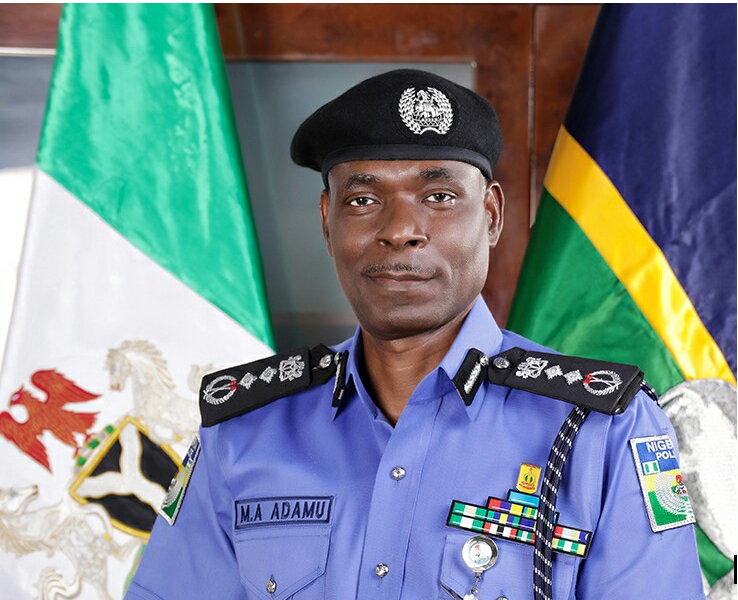
On Wednesday, the Nigerian Governors Forum (NGF) held a meeting over the ongoing nationwide protests against police brutality. The NGF had ended the meeting agreeing with many demands of the protestors, including the demand to #EndSARS and to halt the attempt by the Inspector General of Police (IGP), to replace the defunct rogue unit with a SWAT team.

The governors, at the end of their meeting, issued a communiqué of their agreement on proffered solutions to many of the questions raised during the demonstrations.

Among the agreements of the NGF is that the IGP needs to immediately convene a meeting of all stakeholders and agree on a format of engagement with all State officials in order to address concerns emanating from SARS brutality; and that State leadership should meet simultaneously nationwide, to address matters arising.

The matters to address include reforming the police to be service-driven and to respect people’s rights.

The Governors agreed that reforms must include the training and retraining of operatives on the rules of engagement with the general public; and policing in Nigeria must ensure freedom for all Nigerians to carry out their lawful and legitimate businesses anywhere in the country without fear of harassment, intimidation or molestation.

Those were some of the agreements of the members of the NGF, which is made up of the 36 States Governors.

However, while some States like Lagos and Anambra have already set the ball rolling on implementing the agreements, by setting up panels of inquiry, the Governors of 19 Northern States made a U-turn and reneged on the agreements reached by the Forum.

The Governor of Plateau State, who doubles as the Chairman of the Northern Governors Forum, Simon Lalong, led other members of the Forum to a meeting with President Muhammadu Buhari, on Thursday. Following the meeting, he issued a statement contradicting what the NGF had agreed on. He said that “SARS has been useful to the North” and should not be disbanded.

“We had a meeting yesterday (Wednesday), the Nigerian Governors Forum. I’m sure my chairman addressed the press. When we see issues like this …their complaints vary from one state to the other. In one aspect, some people said they don’t want SARS, some said they want SARS but a reformed SARS.

“They want a reformed SARS because as far as they concern, some of these SARS operatives help them in addressing insecurity. If there are bad ones under, holistically, bring them together and reform them. Then, you work for them. So our opinion and conclusion at that stage was that let us not just say that we are throwing away the baby with bathwater.

“If there are good ones, you don’t chase them away. So, as SARS is banned, we are now looking forward to … because most of the States in the North said no. They want SARS because SARS helps them. Borno (state governor) said without SARS, he would not have been surviving today. Niger also wants SARS,” he said.

Although some Northern States including Kano and Plateau have joined the protests, refuting the claims of the Northern Governors, their reneging on the earlier agreement has questioned the oneness of the Nigerian Governors Forum. It has also cast doubt on the implementation of the NGF recommendations in Northern States.

The National Executive Commission (NEC), presided by the Vice President, Prof. Yemi Osinbajo, on Thursday, has reached the NGF’s decisions by directing that judicial panels of inquiry be set up in each state, and each state should also set up fund to compensate victims of police brutality: Which can be interpreted that the presidency aligns with the Southern governors stand to end SARS.

Although compared to the South, the North has lower cases of SARS brutality; a situation many believe instigated the Northern Governors’ late decision to oppose the dissolution of SARS. With the current stand of the Northern Governors Forum, the implementation of 5 of 5 demands of protestors may likely suffer setbacks in northern States.

Upon the news that the Northern Governors have turned around from the NGF’s agreements, security agents in the north have resorted to using brute force to quell protests.

In Jos, the plateau State capital, there are reports of police firing live ammunition into crowds of protestors, and many have been killed. Taraba State shares the same situation which defies the logic of central police and tells terribly on the IGP’s promises to change the dreaded status quo.

With the state governors’ divided stand on SARS, and the police personnel’s defiant breach of IGP’s orders, state police has become a choice in the police reform menu.
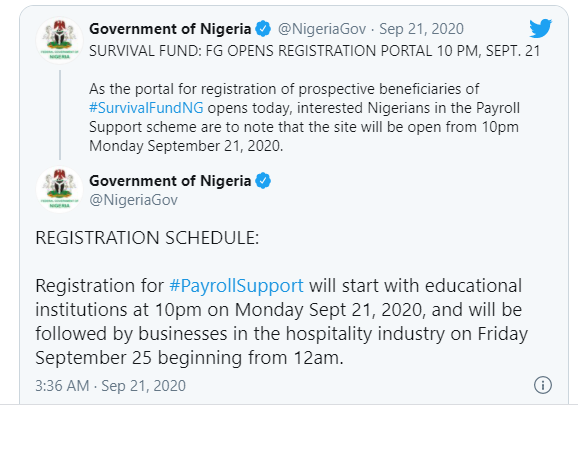
Website for Nigeria’s N75 billion Youth Investment Fund at 5% interest Is Live [Apply]

0
Naira

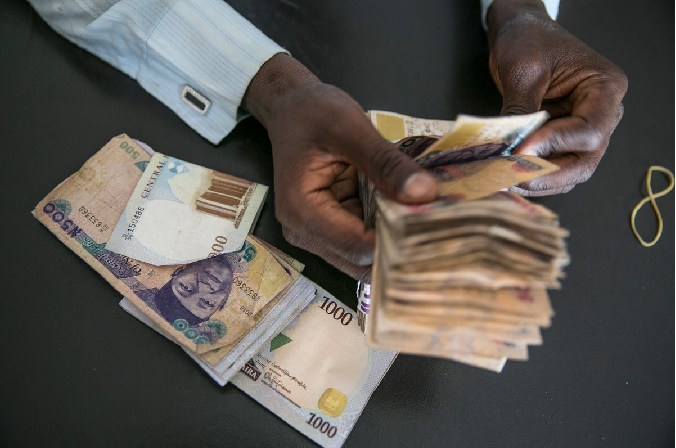
Last month, the Federal Government of Nigeria released instructions on how to access the N75 billion Micro, Small and Medium Enterprises (MSME) Survival Fund. The loan, provided under the  Nigeria Youth Investment Fund (NYIF), has an interest rate of 5% per annum and maturity of 5 years with a moratorium of up to a year.

The program took effect from September 21, 2020. This fund is part of the N2.3 trillion stimulus package of the Nigerian Economic Sustainability Plan. The links are now live (the sites are crashing due to traffic; so, patience please. Update: They have pulled them down with “coming soon”. But according to the youth minister, the links are below.):

  • NIRSAL Microfinance Bank’s site, www.nmfb.com.ng;
  • Ministry’s website, www.youthandsport.gov.ng 

Application Link for the Federal Govt of Nigeria’s N75 Billion MSME Survival Fund

Nigeria’s Treasury Bill Rates of 2% And Opportunity for a Startup Nation

1

Today, the Treasury Bills (TB) rate in Nigeria is about 2%, and Nigerian investors who have typically depended on that fixed income are now forced to take risks on something instead of free “profit” with largely no risk. When TB was near 14%, we all criticized the Central Bank of Nigeria for “de-investing” in Nigeria. Largely, at a high TB rate, most investors would just park their monies in TB, denying startups and companies funding and lending liquidities. Sure, there was that argument that high TB would fight inflation!

Right now, if you are feeling the antenna signals, angel investing has ramped up in Nigeria since TB fell below 6%. And with the news of Paystack acquisition, expect more investors to open their wallets to startups.

The latest data from Nigeria’s Treasury bill auction shows that Nigeria’s 364-day reduced by 2%. On the other hand, Stop rates moderated slightly for the 91-day tenors and 182-day tenors. The 91-day bills had stop rates of 1 % and 182-day bills also went by 1%.

At the auction, the Debt Management Office (DMO) sold N12.76 billion on the 91-day paper, N4.5 billion on the 182-day, and N107.6 billion on the 364-day bill despite huge demand from Investors.

The next thing we need from CBN and the tax agency (FIRS) is to unlock more capital from venture capital, and private equity firms. The goal here is to accelerate access of capital to growing companies in the nation by providing more incentives to investors to take risks on Nigerian companies. I have explained the plan here.

Fixing Nigeria’s Lackluster Venture Capital Funding

The Sustainable Development Goals: How Development Actors Could Put People in the Driver’s Seat

0

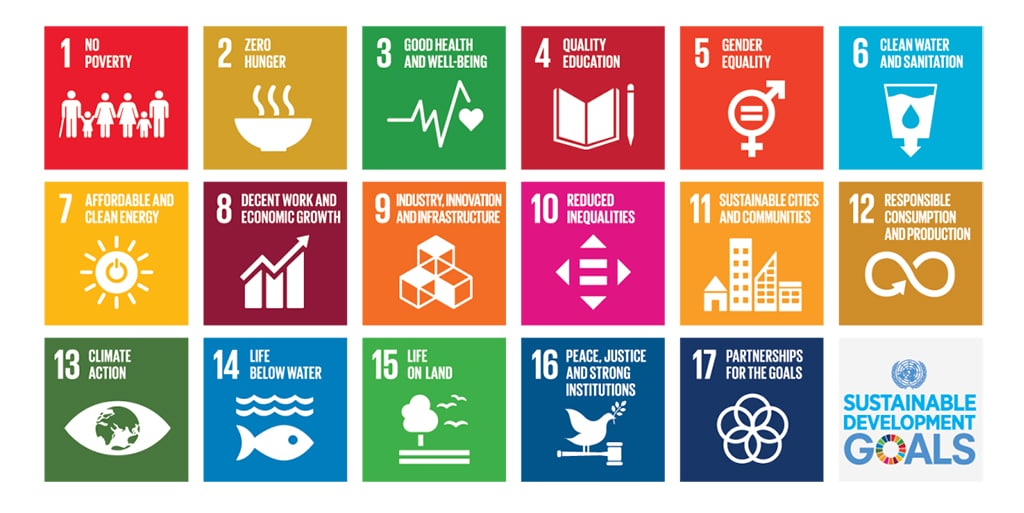
There is just a decade left for countries of the world to attain sustainable development goals. These are 17 in all, yet they capture most of the problems bedevilling the world. So much still needs to be done to fast track a development infrastructure that leaves no one behind. Every day, the statistics are frighteningly staggering. 615 million people are suffering from water stress with 2 million others displaced across the globe by extreme weather. 1 million important plants and animal species are being lost in seconds. In 2019 alone, 80 million people were forcibly displaced by war while almost 1 billion of the world’s population is starving. The stats keep rolling and urgent steps need to be taken to tackle these problems globally.

However, in doing this, the people for which the development solutions are meant    should not be left behind. People driven development interventions should be the focus of development workers. Otherwise, a development effort could go awry. Here is a story of development interventions that went south.

An Awful Development Intervention Story

There was a community where development intervention was undertaken by a development agency. According to their survey, access to water supply was considered as the major need of the community. This was due to their observation that the community children usually trek miles to get water.

In a bid to alleviate this perceived challenge of the community, the agency erected a borehole for the community and expected it to solve the challenge of travelling a long distance to get water. However, to their surprise, the community members detested the borehole, refused to fetch water from it and the children continued to trek miles to get their water.

The development agency was apparently surprised by this reaction. This was not acceptable to the agency so they decided to enquire about the issue. Below was what they found out.

Majority of the houses in the community are a single room apartment. Consequently, the father, mother and children sleep in the same room. This sleeping arrangement somehow impedes the father and mother from having sex in the night. In a bid to satisfy their sexual desires, children are usually sent on the long journey of getting water early in the morning. This period allows their parents to have sex and helps the community children to socialise better. Hence, the adults in the community considered the borehole project as a threat to their sexual need because the children will return early from getting water from the borehole and might discover the age long secret.

In order to prevent this, the community head openly placed a curse on the borehole thereby prohibiting people from fetching water from it.

There are lessons to be learnt from this funny but real story. One, so much resources were wasted constructing what the development interventionists felt the community needed. There was a mismatch between an observed need and the real need of the community. Perhaps, the community was not carried along in the process of looking for the problems, planning the solutions to the problem and in the implementation of the solution.

One of the key hurdles to the attainment of the SDGs in Nigeria is lack of awareness and information about the goals. When people are not aware, no one should expect them to key into the achievement of the goals. A study conducted in a city in the Southwest in 2019 indicated that low awareness of the global goals. How would the goals be achieved when no one knows about them?

It is also apparent that there is no concerted and coordinated efforts to ensure the global goals are achieved as the target year counts down. In Nigeria, the governments both at the national and sub national levels have different scattered plans to achieve the global goals. The highest political mechanism put in place to attain the global goals across the nation is the appointment of special assistants or special advisers in charge of the SDGs. There is a need for a coordinated national, sub national and local government strategies to drive the global goals to attainment.

Finally, educational institutions are the best channels through which the opportunities inherent in the attainment of the goals could be passed across the length and breadth of Nigeria. Courses on SDGs should be factored into the curriculum of the educational systems from primary, post primary to tertiary institutions. This would ensure the percolation of the ideals, ideas and opportunities inherent in the SDGs.

In all of these, the people must be carried along. They must be in the driver’s seat of their own development. Community ownership of development issues and collective efforts towards addressing these gaps are the solutions to a development plan that leaves no one behind.

Mobile Edge Computing (MEC) – Meeting The Latency Requirements for 5G networks

0

In a recent article, I wrote about the use of multiple frequency bands to achieve a careful combination of coverage and capacity, to achieve connectivity over large geographic areas, faster speeds, exponential and intelligent connectivity, ultra high bandwidth, etc, in 5G networks.

Besides the above promises, 5G networks also hope to achieve a low latency of less than or equal to 1ms; this is critical for applications like immersive entertainment, remote/robotic surgery, autonomous cars etc., where a delay could have damning consequences.

Latency here refers to delay, and is primarily governed by physical laws. Using the speed of light (3×10⁸ m/s), light or electromagnetic (em) waves would travel over a distance of 300m in 1µs. this means for a content to be delivered in 1ms, the content should be located within a distance of 300km. Through careful research, GSMA estimates that the content should be 1km away from real communication networks, in order to achieve a latency of 1ms. In essence, a low latency gives the users the perception of infinite capacity.

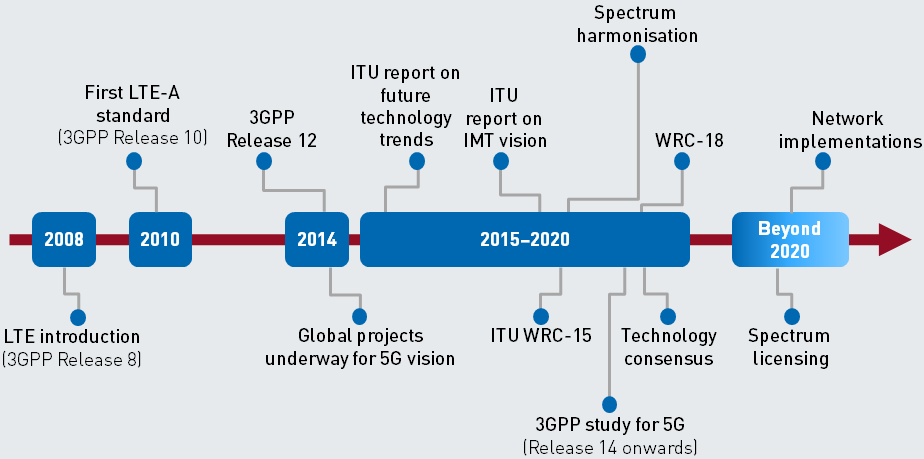
Timeline towards 5G [Source: Analysys Mason, 2014]
Edge computing, the distribution of computing and communication resources closer to the edge of the network or user, has been proposed for use in 5G networks, to help address the low latency requirements. Interestingly, this is an area that has been dominated by the cloud computing providers like Google, Microsoft, amazon etc. The use of edge computing in 5G networks has also been seen as a market opportunity for telcos looking to diversify their offerings beyond connectivity but they know they would face an uphill battle from the cloud computing operators.

Interestingly, it seems this would be a partnership opportunity rather than a competition, contrary to industry speculations. This is because the cloud computing operators, no doubt own the cloud platforms, but are also actively looking for ways to deploy closer to the user by integrating into IoT devices, supporting private and hybrid cloud deployments etc., in order to diversify their offerings beyond public cloud offerings.

Telcos, on the other hand, have various physical locations, to their advantage, where the edge computing resources could be deployed. They also know that they would benefit greatly from partnering with cloud computing operators to provide a distributed computing environment within their markets. Furthermore, they could equally largely benefit from specific applications, mandated by local laws to store and host data locally. Besides, this would significantly reduce the required investment (and expertise) needed to benefit from this market, should telcos decide to venture on their own.

Though, it looks like both parties (telcos and cloud computing operators) would benefit from partnerships, rather than competition, telcos however need to have a clear long term strategy when formalising such partnership arrangements and constantly stay ahead of the trends within the industry. This is because the cloud computing operators are known to be very innovative in meeting new and future customer demands and have proven to be very agile and flexible in the delivery of their services. Telcos, on the other hand, are known for being generally slow to react to varying customer demands. Only time will tell how this would eventually play out.