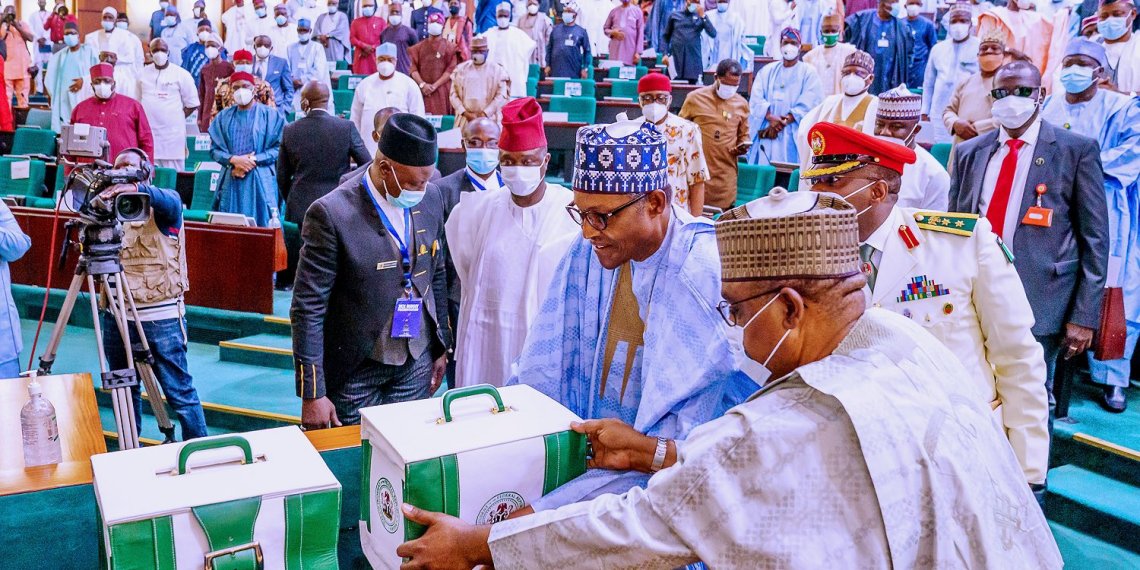
Looking at the 2021 Budget Proposal placed before the National Assembly by President Muhammadu Buhari on Thursday, October 8, 2020, a number of issues, very grave and perhaps disturbing issues arise.
I could bring up several of them, but for the sake of its direness and consequence to our economy, permit me to address one very important issue.
The budget deficit in the proposal is 5.21 trillion. This amount is just over 3.5% of Nigeria’s 2019 GDP. This is contrary to the Fiscal Responsibility Act of 2007, which provides in Part II, Section 12, subsection 1 that: “Aggregate Expenditure and the Aggregate amount appropriated by the National Assembly for each financial year shall not be more than the estimated aggregate revenue plus a deficit, not exceeding three per cent of the estimated Gross Domestic Product or any sustainable percentage as may be determined by the national Assembly for each financial year.”
Nigeria had a GDP of approximately $447 billion in 2019. Three percent (3%) of this amount is $13. 3 billion, which at the current official exchange rate of 379 to $1, gives you a figure of 5.07 trillion.
So clearly, the budget deficit of 5.21 trillion, as announced by President Muhammadu, is above 3% of our GDP and is therefore in contravention of the Fiscal Responsibility Act of 2007.
Even more disturbing is the fact that our GDP has fallen sharply from its 2019 figures, and has been projected by the World Bank and other multilateral institutions at somewhere between $400 billion and $350 billion. Meaning that in actual sense, the 5.21 trillion budget deficit is actually far above the 3% threshold stipulated by the FRA.
Presenting the budget proposal
That this escaped the notice of the Buhari administration shows a glaring lack of rigour in the formulation of the Budget. A very disturbing development.
Furthermore, this deficit shows the precarious state of our national finances, which have since been overburdened by excessive borrowing on the part of the Buhari administration.
It has not escaped my attention that the Fiscal Responsibility Act of 2007 makes provision for the National Assembly to raise the threshold of the budget deficit from 3% to a higher figure. However, if this is done, they will be serving this administration’s interests, not Nigeria’s, because the Act says that such a threshold must be sustainable. Is it sustainable when our budget makes almost as much provision for debt servicing, as it does for capital expenditure?
As such, I call on the President, to recall this budget, and recalibrate it to reflect the provisions of the Fiscal Responsibility Act of 2007, and the current economic realities of the nation. To do otherwise will not only be unpatriotic, it will also be catastrophic for our nation’s economy.
EldaDavid Kehinde Samuel is a Resident Policy Fellow of the Nigerian Global Affairs Council – A Technology-based and Digital Media-driven Public Policy and Evidence-based Research Think-Tank. He shared his thoughts and policy recommendations on what the Federal Government could do to fix the tactical squad popularly called FSARS with Rasheed Adebiyi. The FSARS is under serious fire as Nigerians have been on the streets in the last four days demanding it is disbanded. However, a voice of caution from Prof. Ndubuisi Ekekwe had called for reforms in place of total disbandment. Elda seems to have responded with not less than 15 policy suggestions to make the tactical squad of the NPF more community-oriented and citizen-friendly. Here are his thoughts
The FSARS despite the negative publicity and baggage that has damaged their brand identity, they remain an active force committed to rooting hardened criminals and kidnappers, trust us, there are dare-devil elements that live around us all over Nigeria. They will have a field day if the FSARS were banned even for a day, you cannot call on the Military to defend our roads and streets for criminal elements that reside amongst us, that’s the sole responsibility of the Nigerian Police Force and the special tactical squads set up for such purpose.
Some Nigerians have sold their souls to the darkest part of the earth and virtues such as empathy or positive emotions are far-removed from their hearts and souls… The FSARS was created to tame these monsters of hardened criminals so not every Police Officer signs up to become a part of the SARS particularly those without a strong heart that fears no death.
There is no verified or reliable data though to back up the number of robberies or kidnappings they have foiled, there is no data to back-up how many officers they have lost to dare-devil armed robbers or kidnappers. This lack of sufficient data or information makes it a hard nut or cause to defend or commend the impact of the FSARS.
Nigerians have clamoured for the ban of FSARS, that’s the easy part because yes we agree that the brand identity FSARS is damaged but don’t forget that even if a new Taskforce is created with a more polite and community-friendly brand name, the same elements that make up our Police Force will be recruited or volunteer themselves to take on this dangerous job of ensuring that hardened criminals and kidnappers don’t have a field day in Nigeria.
Whilst we are clamouring for the BAN and scrap of the FSARS, keep this in mind, the FSARS isn’t the original problem, the original problem is the make-up of our Police Force, FSARS is simply a victim of the culture that the Nigerian Police Force has indirectly instituted, the FSARS are no different from the regular policemen or women we deal with everyday who are bribe loving and gun trotting elements that damage the brand identity of the Police Force.
The Nigerian Global Affairs Council (NIGAC) is calling for proactive measures to be taken and we will enumerate some of the proactive policy measures Government and the Police Hierarchy can implement. Here are the suggested policy measures the NIGAC proposes to our Federal Government and the Nigerian Police Force:
Retire the FSARS Brand: Like we have postulated at the top, the FSARS brand is damaged, the Federal Government and the Nigerian Police Force Hierarchy must realize that for the populace to believe that any change has taken place, it must start with the rebranding of the Tactical Squad in charge of tough operations. Any change short of a change in name is simply cosmetic and Nigerians will not believe that her Government is ready to effect any serious change.
Select a New Brand Name for this Tactical Squad: The Nigerian Global Affairs Council posits that the new name should reflect a community-oriented and citizen-friendly Police Force that projects its strength as one that works with the citizens to reduce crimes after all Police can work more effectively if the citizens trust them to share intelligence with their Internal Machineries. The brand name to a more community-oriented and citizen-friendly one will also impact on the psyche of the men of that squad as they seem to feel that every Nigerian is a potential fraudster, armed-robber or kidnapper – this has enabled them to recklessly target young people, maim young people and even kill a lot of young people. We believe that a change in brand identity to a community-oriented and citizen-friendly one doesn’t change the objectives of the tactical squad but it will set the pace for a total reset of the mindset and heart of Officers of the Police Force who join or are recruited into this Tactical Squad. One name suggestion we have is: FEDERAL COMMUNITY PROTECTION SQUAD or whatever better names Nigerians can muster.
Offsite Learning and Development Program: All Police Officers to join the newly reformed Tactical Squad must undergo a one year offsite Learning and Development Program – It should not be called Training as the word has been abused and it has become a routine word in the minds of our Police Officers and all the trainings they have gotten has obviously not shown forth their designed results. Our proposed Learning and Development Program for Tactical Squad members should focus on teaching them Community Relations Skills, Emotional Intelligence, Effects of Substance Abuse (Practical) and its Prevention, Conflict Resolution and Crisis Management, Citizen-oriented engagements and Communication Skills etc., if our Officers of this newly reformed Tactical Squad undergo this level of Learning and Development in one year, we can be rest assured that their mind-set and orientation will change because they will be able to see our citizens from a different lens, this approach might not stop the bad eggs but it will have broad-based impact and ripple effect on the entire Police Force Culture.
Quarterly Test for Substance Abuse: To be admitted into the newly reformed Tactical Squad, all Police Officers must be tested for substance abuse. Only a sane and stable mind can effectively and efficiently carry out their Jobs in a Professional Manner expected of a Security Operative. The National Assembly and Police Hierarchy must institute a LAW that makes it mandatory for Officers of all Special Tactical Squad to be tested once every quarter for substance abuse and alcohol level consumption over the period, we won’t advocate against a ban on drink on alcohol but don’t drink whilst at work and if you are going to drink off-duty then ensure it is at a minimum if anyone wants to remain in the Tactical Squad.
Incentivize Good Motivation: Whilst we advocate for reforms, we must also realize that HUMANS are incentivized to do better when there are clearly defined reward systems in place for good behaviour – let’s not forget that the Job they do as Police Officers and as Members of a Special Tactical Squad is very dangerous because they can be Killed-in-Action (KIA) at anytime. A Life Insurance of 20 – 100 Million Naira dependent on years of service should be paid-up for each member of our Special Tactical Squads. Any Officer killed in action in a honourable manner should automatically know that their families will be well-compensated, but this is only if the officer did not get up to 10 strikes throughout his membership of the tactical squad. Strikes should occur when there is serious breach of professionalism or there is proof of dereliction in duties as a Tactical Squad Member. If an officer honourably retires from the Tactical Squad and Police Force, that officer should also have access to that Life-Time Insurance Premium so long they did not get 10 Strikes on their records. This will foster good behaviour.
Call for Disciplinary Action: 10 Strikes means disciplinary action or outright dismissal if offense is criminal in natural as a Member of a Special Tactical Squad.
Welfare: To motivate and engender good behaviour, we must give incentives to maintain decorum as the reward and benefits for acting responsibly as a Member of a Special Tactical Squad is more enticing. All members of a Special Tactical Squad must reside in a largely residential and dedicated estate outside the Barracks that comes with complete and respectable amenities. Members of these Special Tactical Squad must be given decent housing as those are one of the basic determinants of how a human being behaves, if he lives in a decent environment, he acts as one and if he lives in a dungeon looking barracks then they reflect the behaviour of the environment they reside in. Children of Special Tactical Squad should also be provided with Guaranteed Scholarship up to their University Education, this will help reduce the incidence of crimes perpetuated by Officers of the Special Tactical Squad. They enjoy these benefits for the duration of their service as members of the Special Tactical Squad so long they don’t get disqualified by virtue of getting 10 strikes.
Commanders Made to Take Responsibility: Commanders who manage these Special Tactical Squads must provide written approvals for RAIDS to be carried out – a special notice draft note can be implemented across the compound so ORDERS are quickly signed if the attention of the Special Tactical Squad is urgently required. This note can be signed on or immediately after a successful or unsuccessful raid. Any officer who carries out unauthorized raids should be suspended from the Squad and if they don’t carry on 5 more times, they must be disqualified from the special squad and assigned desk duties never to touch a weapon again. Commanders must be promoted or demoted based on the actions and inactions of their subordinates. This will instill DISCIPLINE in the rank and file of the Special Tactical Squad.
Need for Special Operative Uniform: All members of a Special Tactical Squad must ADORN a special BULLET PROOF Uniform, it doesn’t have to be the full regalia of the Nigerian Police Force but it must be a clear cut UNIFORM that makes it easier to recognize them and they must be on their active duty special bullet proof outfit once on duty be it off or on the road. It should be an offense that earns a STRIKE if Special Tactical Squad Members are not on their special outfit, except in rare cases where the commander approves and it is written on the approval notice, tactical squad members can wear plain clothes but with a clear badge that differentiates them. All members of Special Tactical Squads must have their ID cards on full display except in rare cases where they go on raids.
EntireEnforcement of the Banfrom Routine Patrols: Special Tactical Squad Members should only be FOUND on the road when there is a serious breach of peace and security in times of robbery, kidnapping, arson, and destructive rioting that regular Police Officers cannot curtail.
Continuous Learning and Development: Continuous classroom learning and development must be instituted as a measure to inculcate the community-friendly and citizen-oriented approach, special tactical squads should take going forward. We do not want Police Officers who see every Nigerian as a potential criminal, it takes conscious and intentional efforts to reset such a mindset.
Ban on Alcohol and Substance Usage: As Members of a Special Tactical Squad, there must be a certain level of alcohol consumption permitted off-duty and they should NEVER DRINK, SMOKE or even be drunk or intoxicated whilst on duty. As suggested above, Police Officers in these squads must undergo quarterly SUBSTANCE ABUSE test that checks for drugs and alcohol consumption levels. Officers found wanting should be dismissed from the Special Tactical Squad and cease to enjoy its benefits.
Well-kitted Special Tactical Squad Members: Officers who belong to a Special Tactical Squad must be well-kitted as per the advice above, excellent vehicles with unremovable trackers that must be active always must be fixed on each vehicle alongside modern communication gadgets. The movements of special tactical vehicles must be reviewed on a monthly basis and unauthorized movements of these vehicles must be red-flagged and queried as part of the Risk Management Function of the Nigerian Police Force.
Well-paid and well-compensated Tactical Squad: Members of a Special Tactical Squad should be well-paid and compensated way above other Members of the Police Force, this is to ensure that they are not tempted to break their OATH to the Nigerian Constitution and their commitment to protect Nigerians. We need a Special Tactical Squad Unit of high-earning Officers who are not intimidated by wealth or riches on display by Nigerians.
Creation of a Risk Management Department: Lastly, the Nigerian Police Force should create a Risk Management Department within its Special Tactical Squad Unit – this Risk Department should be managed by Risk Professionals within the Security Architecture that identifies risk behaviours and actions that can destroy the reputation of the Nigerian Police Force and Special Tactical Squads if not dealt with immediately. This Department should report directly to the Inspector General of Police and National Security Advisor in all its dealings, recommendations, and findings.
If the Nigerian Government applies these recommendations alongside implementing and enforcing the changes that the Police Reform Act 2020 has made, we will have a robust community oriented and citizen-friendly police force that is respected, loved and admired by all Nigerians.
#EndSars! A call that has been heard over and over again in Nigeria from helpless youths, who have become victims of their supposed protectors, started ringing high once again in October.
The reason for the call has always been the same each time; the Special Anti-Robbery Squad (SARS), whose mandate is to protect the Nigerian people from armed robbery, has turned out to be what they were designed to fight.
The last time the call was near this loud was in 2017, when the horrifying stories of SARS activities became unbearable to the Nigerian people. The End SARS hashtag became top of trends on Twitter and people took to the streets to express what they can’t put out in 280 characters.
The outcry yielded results, and the government promised to reform the unit. In 2018, while acting in the capacity of acting president, following President Muhammadu Buhari’s medical trip to London, Nigeria’s Vice President Prof. Yemi Osinbajo gave marching orders to the then Inspector General of police (IGP), Ibrahim Idris, to carry out reforms that will ensure a service-driven anti-robbery police unit.
Idris went to work, initiating some measures that were geared toward taming the beasts in the men of SARS.
“The Inspector General of police in compliance with the presidential directives has ordered the immediate overhauling of the Special Anti-Robbery Squad to address complaints and allegations on human rights violations against some of the personnel of SARS from members of the public in some parts of the country,” statement from the police said following Osinbajo’s orders.
Among the reform measures taken by the IGP were the change of name for the squad from SARS to FSARS (federal special anti-robbery squad), a new uniform that would include identity tags, medical/psychological evaluation of all FSARS personnel.
According to the reform orders; “FSARS personnel will not perform Stop and Search duties except on distress call to respond to armed robbery and kidnapping offences only.” There was also an arrangement for a training program for the unit, in collaboration with civil society organizations, local and international NGOs and other human rights organizations.
Following this announcement by the Nigerian Police Boss, the voices died down and the hashtag disappeared.
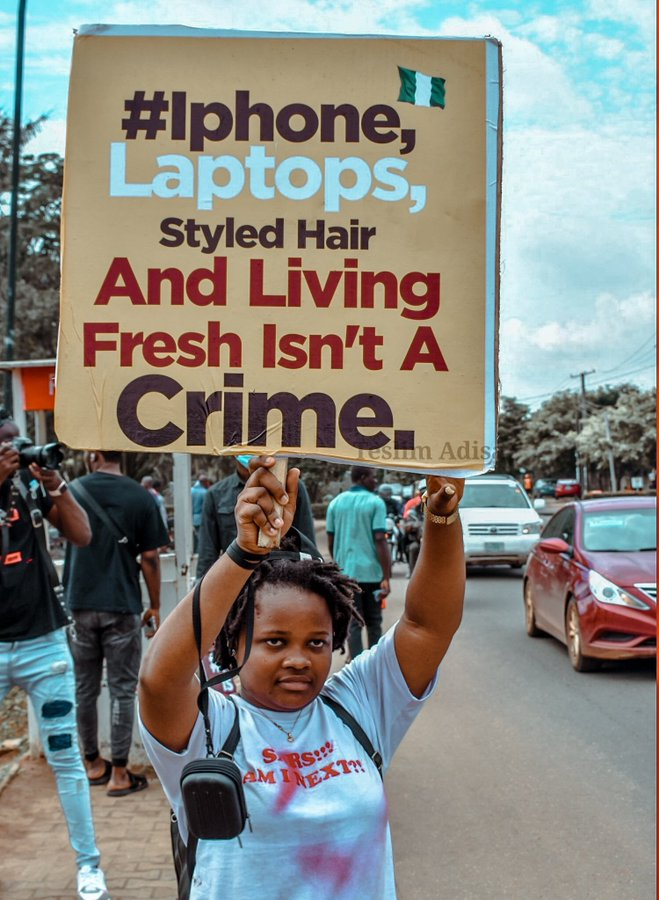
Armed with the belief that the future has come when SARS will not harass, extort or kill anyone for having dread, tattoo, iphone or laptop, Nigerian youths went their daily business with their heads high. But it didn’t last; once again, the reform was short-lived.
The IGP Idris reached retirement age and was succeeded by Mohammed Adamu, who upon ascension to the throne rescinded all the reform measures apart from the new name – FSARS. The squad went back to streets, the outcries began once again and the #EndSARS hashtag crawled back to trends.
It has become a norm of occasional outbursts, emanating from culminating stories of brutality, extortion, killings, and most of all, impunity.
At each of the four times of the major outcries dating back to 2015, there has always been the government’s promise to reform SARS.
So on October 4, 2020, when IGP Adamu, in response to the fresh outcry of Nigerians, issued the ritual orders banning SARS and some other tactical squad units from conducting themselves unprofessionally, the words of the orders were all familiar because Nigerians have heard them many times before.
“The Inspector-General of Police, IGP M.A Adamu, has banned the personnel of the Federal Special Anti-Robbery Squad and other tactical squads of the force including the Special Tactical Squad (STS), Intelligence Response Team (IRT), Anti-Cultism Squad and other Tactical Squads operating at the Federal, Zonal and Command levels, from carrying out routine patrols and other conventional low-risk duties – stop and search duties, checkpoints, mounting of roadblocks, traffic checks, etc – with immediate effect,” the orders partly said.
It is not different from the orders given in the past that were flouted with all impunity, consequently enabling more sad tales of atrocities from members of SARS.
“I lived in the North for years and never lost a finger. Then I came back here (Southern Nigeria) and they (SARS) killed my son. No war. No fight. He wasn’t involved in armed robbery. Just cold blooded, they wasted this boy for me,” cried a man who SARS killed his teenage son.
This was just a tip of the iceberg among the horrifying stories that triggered the current events. The orders from the police chief were supposed to calm the online End SARS campaign, but it instead spurred the youth to hit the streets in united throng, for protests that have unprecedentedly become a global movement.
As the rest of the world lend their voice to the campaign, Buhari who is seen as too slow in responding to domestic matters, was believed to have been forced to make a statement addressing the chaos more than 72 hours after the protests broke out.
“I met again with the IGP tonight. Our determination to reform the police should never be in doubt. I am being briefed regularly on the reform efforts ongoing to end police brutality and unethical conduct, and ensure that the Police are fully accountable to the people.
“The IG already has my instructions to conclusively address the concerns of Nigerians regarding these excesses, & ensure erring personnel are brought to justice. I appeal for patience & calm, even as Nigerians freely exercise their right to peacefully make their views known,” the president said in a statement.
But like the orders of Adamu, the statement failed to calm the avalanche of tweets coming now from all corners of the earth and the accompanying street protests. And the reason could be found in some tweets put out on Twitter in response to the statement.
“There are currently checkpoints in Lagos being manned by SARS while the president is meeting the IG of police to discuss “reforms.”
“Also remember that SARS was banned 2 days ago by same president and IG of police, the 4th ban in 5 years. Enough of empty talks. #EndSarsNow,” Kelvin Odanz wrote on Twitter.
“Show me one SARS operative in prison for killing a citizen?” Henry Shield asked.
The decision of Nigerians not to back down this time stems not only from the ineffective orders in the past, but also current views from members of the president’s circle and the Police, which suggest that the ordered SARS’ reform is all ‘window dressing.’
The president’s media aide, Lauretta Onochie, in response to the campaign said she has no doubt that what is “going on now is a coordinated attack by cyber criminals joined by unsuspecting innocent citizens,” adding that this is not the first time.
It was also a stand taken by the Police spokesman, DCP Frank Mba, who in his defense of the Nigerian Police decision not to scrap SARS, said the unit is also being used in the fight against banditry in Nigeria’s North.
But cyber-related offenses are under the jurisdiction of the Economic and Financial Crimes Commission (EFCC), and the protestors are not calling on the government to end the Commission. On the other hand, there are rarely cases of SARS misconduct coming from Northern Nigeria, where the police spokesman claimed the unit is being used to combat banditry.
In Southern Nigeria, there is the everyday story of abduction, disappearance, maiming and killings. Amnesty International documented over 82 cases of atrocities committed by SARS between January 2017 and May 2020, outside the many more cases that didn’t come to light.
“Repeatedly, Nigerian authorities failed to end atrocities of SARS. This is hardly surprising when many of these officers have bribed their way to SARS in the first place. The police chiefs in charge are themselves entwined in the corruption,” Amnesty said.
The human right organization noted that financial gain, not service, has been the force driving recruitment and posting of the unit personnel, and many of them have criminal records.
“Officers sometimes pay superior officers responsible for transfers as much as N300,000 to influence their posting to SARS, as it is seen as a means of earning a substantial amount of money in a short time,” Amnesty said in a report.
All Nigerian authorities’ promises of reforming SARS have, so far, proven to be empty and ineffective. Restructuring SARS is not enough unless the government takes concrete steps to protect Nigerians. The report added.
Some had suggested ReformSARS
Concerned Nigerians believe that the government’s failure to take drastic action to address SARS’ highhandedness and police malpractices once and for all times means endorsement of the rot in the police. And it stems from the belief that the Nigerian Police as it is was designed to serve the interest of a privileged few, mostly those in the corridors of power.
Therefore, having been overdosed by the consequences of ineffective reform promises, Nigerians seem to have had enough, and are pushing for one line of action they believe will end it all.
Among the nine demands the protestors are making is that all tactical squads formations across board of the police be scrapped and their responsibilities be transferred to proper structures within the police.
“You cannot build on nothing. Neither can you reform what’s not willing to be reformed. Nigerians want what’s best for Nigeria, and the most important at this time is to #EndSARS,” former Senator Ben Murray-Bruce wrote on Twitter.
His assertion that the Police are unwilling to be reformed was traced to the streets and confirmed to be true.
The number of video clips showing police’s use of excessive force on people protesting against police brutality, including the fatal shooting of one protestor, Jimoh Isiaq, indicates that SARS reform is far from the answer to SARS’ menace.
“You see, when an organization has lost credibility in the eyes of the public, it is almost impossible to recover,” former DG of Bureau of Public Service Reforms (BPSR), Dr. Joe Abah wrote on Twitter.
“Now when an organization has gained international notoriety for brutality and criminality, you should not be talking of reforming it. You should dismantle it and start afresh. The need for an anti-robbery squad may always be there. The need for SARS, as we know it, isn’t anymore.”
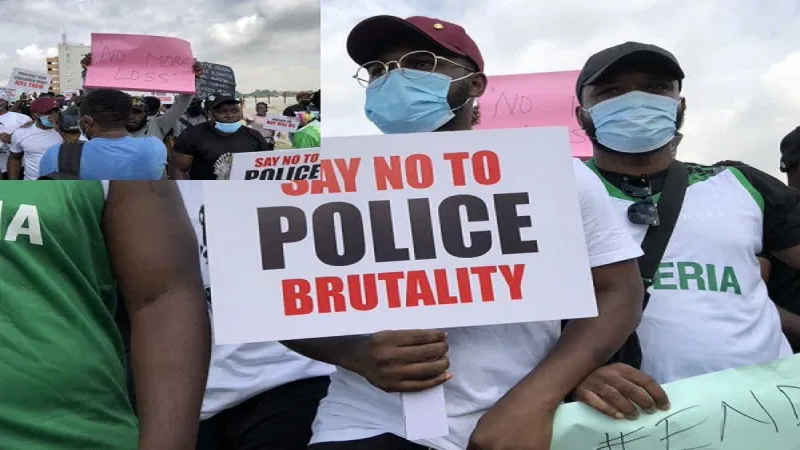
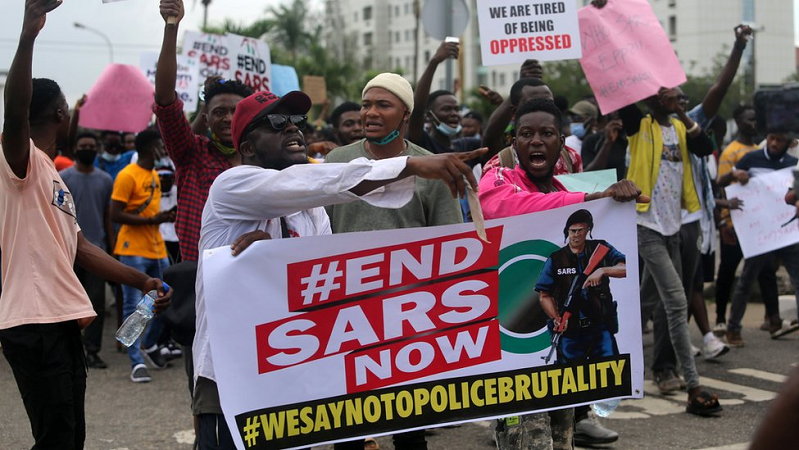
The most trending issue in Nigeria today is the #ENDSARs protest against police brutality and extra judicial killings. Whether online or offline, the song on the lips of most Nigerian youths today is #ENDSARS now! Protests have erupted in most parts of the country. From Abuja to Lagos, Oyo to Osogbo, the Nigerian youths are calling for an end to the Special Anti Robbery Squad (SARS). In Lagos, protesters were even reported to have kept a vigil on the entrance of the Lagos State House of Assembly to demand an end to the brutality visited on them by this SARS. Today marked the fourth day of protests across the country. And it is not abating as calls were being made for heavier protests that could shut down the country by Tuesday 13 October, 2020. One major casualty has even been recorded in this civil protest that is turning the violent. The police were alleged to have killed a protester in Ogbomosho. The police had denied the allegations.
It was not only on the streets that strong calls were being made to end SARs. Even on the social media, especially on Twitter, the voices were extremely loud. Analysis indicates that both ordinary Nigerians and youth celebrities as well as influencers have been involved in the fight to kill the monster of the special arm of the police in order to fight the beast of harassment as well as extra judicial killings to a justifiable end.
The list of celebrities and footballers who had added their voices to the campaign to end the reign of terror represented by the FSARS keep rising. The street protests in Lagos was led by popular musicians and social media influencers such as Runtown, Falz, Tiwa Savage, Tacha, Toke Makinwa and others. On the football scene, Nigeria’s captain, Ahmed Musa, John Ogu, Simon Moses, Asisat Oshoala, Leon Balogun top the list of the agitators as alleged videos of police brutality, harassment and killing of innocent Nigerians surfaced again online on Saturday. These sportsmen and women lend their voices to the protest on their twitter handles.
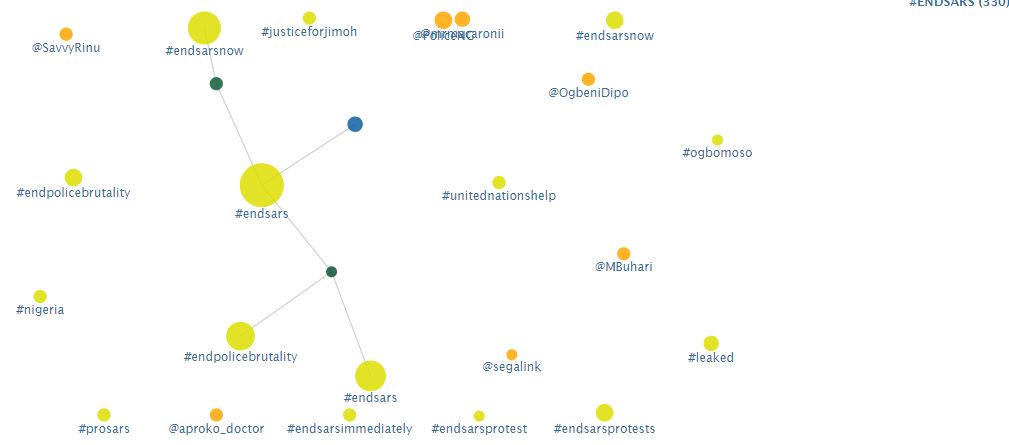
As at 3am local Nigerian time on Sunday 11 October, 2020, the calls were getting louder especially online. Statistics shows that a total of 330 tweets have been retweeted several times, analysis indicates. The major hashtag has continued to revolve around the youth demographics call for an end to the FSARS. For instance, the battle cry has been #EndSARS, #EndSARSnow, #EndSARSimmediately, #Justiceforjimoh and #endpolicebrutality. It has also emerged that major social media influencers such as @OgbeniDipo, @mrmacaroni, @segalink and @savvyrinu have been leaders of the online call out of the federal government and president Muhammadu Buhari in the bid to put an end to police brutality through the total disbandment of the tactical squad (See Exhibit 1).
Exhibit 1: Actors Involved in the #EndSARS Campaign; Source: Twitter 2020, Adebiyi (2020)
In the clusters, Nigerian twitterati are seen gathering to discuss issues around four major topics – the protest not having leadership, unfollowing Buhari, not being tired to retweet and the death of jimoh isiaq who happened to be the first casualty of the physical protest in Ogbomosho (See Exhibit 2). There are implications of each cluster focus as the cluster gathering touches issues as they trend on Twitter.
Exhibit 2: Main Topics of Tweets in the #EndSARS campaign; Source: Tweeter (2020), Adebiyi (2020)
The protests coordinated both online and offline has scaled up to international dimension with the protesters already gaining support from Nigerians and non-Nigerians abroad. Similar protests have been slated to hold on Sunday in the UK, Canada and South Africa. Reports have indicated that the UK government is demanding that the Nigerian government takes a look at the demands of the young protesters. The UK High Commissioner to Nigeria, Catriona Laing was reported to have tweeted @CatrionaLaing1 saying “Significant protests over #SARS demonstrating Nigerina people’s desire for police reform. Peaceful protests are powerful. Police Act recently passed by @MBuhari provides good foundation to build more accountable community police force.”
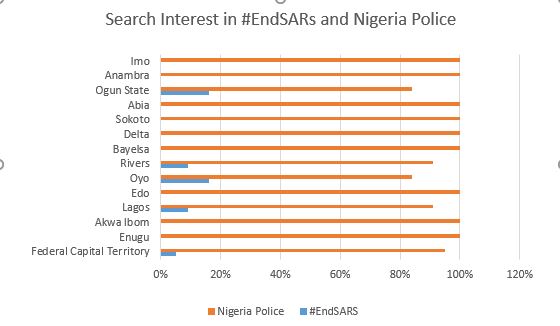
Exhibit 3: Search Interest in the #EndSARS Campaign; Source: Goolge Trends (2020), Adebiyi (2020)
Yet, local interest seems to be more about the Nigeria Police Force than the #EndSARS protests (See Exhibit 3). In an analysis of search interest carried out early Sunday morning, the interest in the Nigeria Police was higher across all the states in Nigeria. Five states out of the 36 states of the federation showed a slight interest in the protests. Perhaps, this higher interest in the country’s police force could be adduced to the lack of information about the men and women in blue. Nigerians sought to understand the NPF more within the demands of the protesters that the anti-robbery squad be scrapped and disbanded. The Force Public Relations unit has a lot on its plate as far as managing the reputation of the force and maintaining a cordial relationship with the public it is paid to police is concerned. Ogun, Oyo, Rivers, Lagos states as well as the Federal Capital Territory are the states with search interest in the protest with interest not even up to 20%. Related search terms included SARS Recruitment, XSquad Nigeria Police, SAR2 and SARZ Nigeria Police.
The need to understand the Nigerian Police Force and how it could be reformed to make it more community-focused and citizen-friendly is critical in this period of public hysteria against the tactical unit of the force. In Prof Ndubuisi Ekekwe’swords – How do you end the fighting police in a nation where insecurity is the order of the day?
They were men of great capabilities. They excelled in their fields. They were masters of waters, having core competencies in navigating sea waves as fishermen. But one day, they were on the Sea of Galilee, legendary for its shallow depth – the lowest freshwater and second-lowest lake on earth. Fed by River Jordan, with the Golan Heights by the side, a wave easily gathered momentum, causing problems along the paths.
On that day, the disciples, masters of waters, had their capabilities tested. Four of them were recruited by Christ while working on that very Sea. The waves were ferocious. Yet, the men trusted their skills. Then, they gave up, and asked for help. “Peace be still” were the words, and the storm stopped.
Our education, networks, and experiences are things we cherish. We use them to navigate careers. But there are things so powerful: preventing storms or when they do happen, having higher mentors (or plans) to stop them.
Today’s labour market is like the Sea of Galilee. Tech-driven dislocation and globalization are major challenges. We require alternate plans just in case the skills become momentarily unhelpful just as the fishermen saw themselves nearly imperiled in a sea. But they were lucky, they were in good company, and the men of waters were saved in water.
Invest to be in the right company!
Note: I have used this story to teach and preach many times. My typical title is “Where is your confidence?”. My focus usually is to call people to the path of humility, as even the things we think we are best on, can disappoint us. Yes, our degrees, our skills, etc could disappoint just as fishermen were nearly imperield in waters. If we know that, how we relate with people will change. Yes, we become humble, with decency and honour, because a storm can change anything. But a higher Mentor becomes our confidence.