DD
MM
YYYY

PAGES

DD
MM
YYYY

spot_img

PAGES

Home Blog Page 6128

The Nigeria’s Fintech Challenger

3

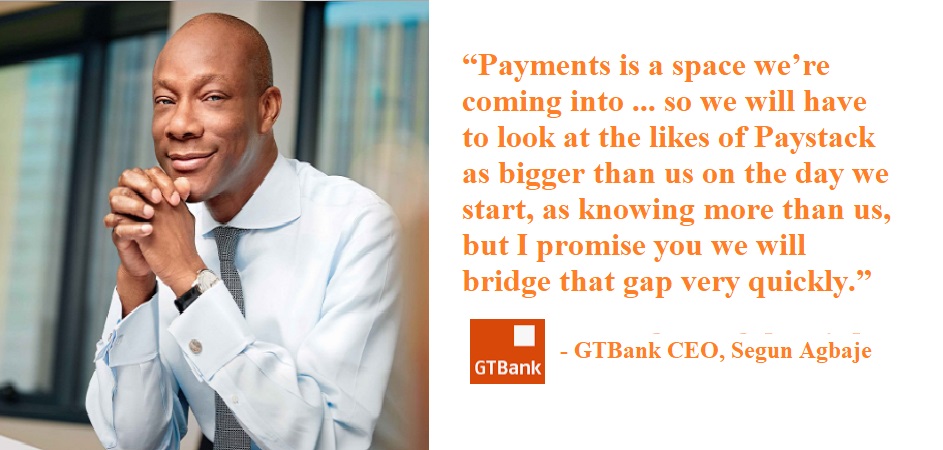
Until recently, GTBank was Nigeria’s money rainer. Zenith Bank holds that title now. But GTBank is not letting go. The CEO, Segun Agbaje, thinks it can fight back to get back to the castle. Of course, his final tenure expires next year, to complete the ten years the regulations allow any bank CEO to stay as the big boss. Do not expect him to go – GTbank will possibly become a holding company. That means it can hire a CEO for GTBank while he manages the holding company. Yes, indirectly, he will continue to run the bank. 

For the work he has done in GTBank, no one can argue against Agbaje. He is a brilliant manager and understands the time. His next playbook is to build a great fintech company, specifically paytech. It makes sense as that is where the money is: any transaction goes with a tax-commission. So, there is nothing like it is not working since fees are guaranteed on day one!

With GTPay which provides API to help you collect money on your digital platforms, it has Flutterwave-like already. It has the ecommerce and app business, Habari, which has struggled despite the publicity and efforts. There is also QuickCredit which companies like Carbon (Paylater) have challenged in the lending space. The GTCollections is a unifier to aggregate payments. Then, as a bank, it does the typical things of treasury services, money transfers, remittance, correspondent banking, etc.

As I noted on Wema’s ALAT, no bank in Nigeria can compete very well against the fintechs if most of their new services are warehoused inside the bank. Had ALAT been outside Wema, it might have been one of the emerging digital banks in Nigeria by now. So, the best path for GTBank would be to acquire a fintech (most are already expensive, though), or simply build a new business which is far from GTBank. 

This is the real deal: “According to research done by The Fletcher School and Mastercard Center for Inclusive Growth, of the $301 billion of funds flows from consumers to businesses in Nigeria, 98 percent is still based on cash.” GTBank wants to be part of the digitizer and also part of those who will collect the commissions on this huge 98%.  This makes it a big fintech challenger.
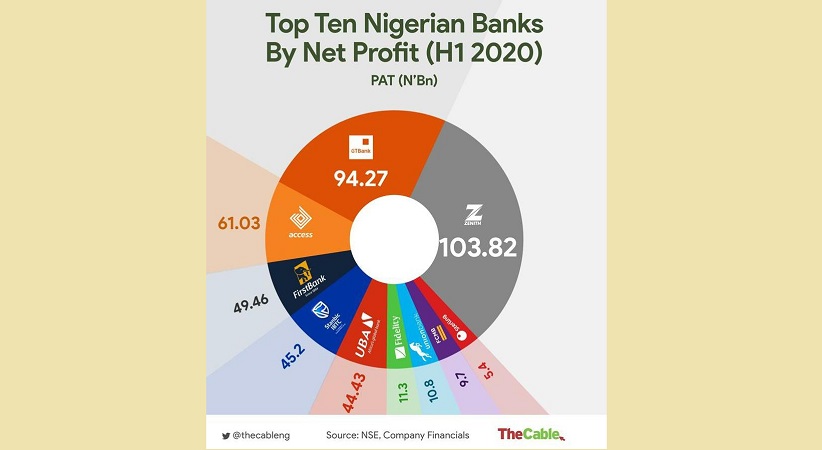
 

This is the Age of Zenith Bank Nigeria

The TikTok’s ‘Partnership’ Gameplay With Oracle that Booted Microsoft Out

0

Oracle has secured approval for the deal to become a trusted technology provider for the embattled Chinese video app, TikTok.

The bidding for the purchase of TikTok’s US operations involving Microsoft, Walmart and Oracle came to an end on Sunday, after Microsoft acknowledged in a statement that ByteDance has rejected its bid, and Oracle confirmed it has struck a deal with the short video company.

The development caused a twist in the existing situation between White House and the Chinese technology. Donald Trump had said earlier he wanted a total sale of TikTok’s US operations and wouldn’t condone anything less. The ByteDance deal with Oracle means it will become a “trusted security provider” not a purchaser of the video app, and Washington seems to be in agreement with the new deal even though it clearly goes against Trump’s executive order.

China has been kicking against forced sale of TikTok’s US operations. Last week, Beijing reviewed its technology export laws to require a government’s license for a deal such as the sale of TikTok, in an attempt to stall the sale.

The US appears to be reneging on its earlier stand on the matter, bowing to pressure from China and tech industry players who have vocally condemned the move to ban TikTok from the beginning, saying it will set a very negative trajectory.

China on the other hand would prefer closing TikTok down in the US to a ‘forced sale’ that would involve transferring its algorithm and artificial intelligence technology to a foreign buyer.

The twist in the plot is said to have come from Oracle’s personal relationship with the White House. CNBC noted that Oracle’s leadership has maintained a close relationship with the Trump’s administration, with the CEO Safra Catz previously taking part in Trump’s transition team and Chairman Larry Ellison hosting a fundraiser for Trump’s reelection campaign earlier this year.

Trump’s attack on TikTok has been based on national security concerns, as the US government is worried that the app may be harvesting private data of American users, and will not hesitate to share it with Beijing at request.

TikTok had tenaciously dismissed the possibility of sharing users’ private information with Beijing. In a bid to avoid a divestment of its US operations, the parent company, ByteDance said it would explore other options, part of it is to lobby the US government to change its position from ‘forced sale’ to partnership.

That appears to be the reason Oracle was chosen over Microsoft, to use its personal relationship with Washington to get TikTok a “no sale” deal. Oracle said the “trusted technology provider” was part of a proposal submitted by ByteDance to the US Treasury Department over the weekend.

But while the deal must have saved the United States a new phase of spat with China, it is causing division within Washington officials.

The deal is currently awaiting a recommendation from the Committee on Foreign Investment in the United States (CFIUS), and the Treasury Secretary Steve Mnuchin thinks it’s a great deal, while Republican senator Josh Hawley is calling for its rejection.

“CFIUS should promptly reject any Oracle – ByteDance collaboration, and send the ball back to ByteDance’s court so that the company can come up with a more acceptable solution. ByteDance can still pursue a full sale of TikTok, its code, and its algorithm to a U.S. company, so that the app can be rebuilt from the ground up to remove any trace of CCP (Chinese communist party) influence,” Hawley said in a letter to CFIUS.

Hawley added that the new deal will not eliminate the threat of national security.

“Perhaps, given constraints imposed by Chinese law, the only feasible way to maintain Americans’ security is to effectively ban TikTok app in the United States altogether. In any event, an ongoing ‘partnership’ that allows for anything other than the full emancipation of the TikTok software from potential Chinese Communist Party control is completely unacceptable, and flatly inconsistent with the president’s Executive Order of August 6,” he said.

Trump is expected to receive the CFIUS’ recommendation later this week and make a decision based on that. The fate of the deal will however lie on whatever he chooses to do.

The President’s Nobel Peace Prize Nomination

0

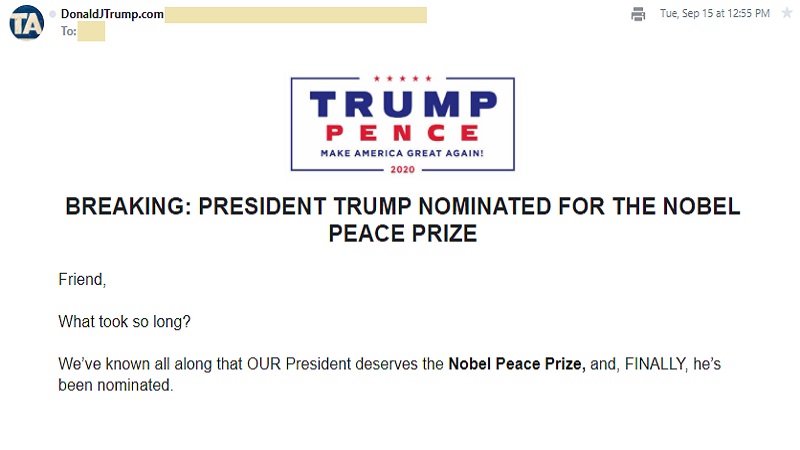
Lol – anything matters: “Have you not heard that President Trump was nominated for the Nobel Peace Prize?” That could add 0.1% to the tally and it matters in a tight election. Interestingly, your senator or house member in Nigeria can nominate you for the Nobel Peace Prize. Even your GST (general studies) 101 professor!

From the Nobel Peace website, nominations could come from  “…members of national assemblies, governments, and international courts of law; university chancellors, professors of social science, history, philosophy, law and theology; leaders of peace research institutes and institutes of foreign affairs;…”

This is the form https://www.nobelpeaceprize.org/Nomination/Criteria-for-nominators and your senator can nominate you so that you can add it on your LinkedIn profile. Yes, you were nominated for the Nobel Peace Prize for “breaking a fight at Ajegunle Lagos between two men fighting over a bigger portion of nkwobi, zobo and amala”. Can I wish good luck?

Do not fall for politicians – I like the mind gaming. Joe Biden can get 50 nominations today if he wants also. But that is why politicking is a game of dynamic strategy. I received this email from the Trump campaign. Biden has also been pushing his own also. When you look deeper, it is all vapour. Yet, it is part of the business. Why? Numbers on elections day.

Understanding the Reason Behind Low Salary Rate in the Private Sector

4

Most times, we tackle private business owners as if they deliberately wished to use their employees without paying them well for their services. I know that many employers are ruthless. Some of them have a way of owing their workers until those workers resign and they bring in new ones, who will not know the organisation’s “no-steady-salary” culture. We also have those that look for every little opportunity to slash employees’ salaries so that they can reserve some of their money. I know all these, but they are not my focus in this article.

I met the son of a former neighbour, who did his house job in a federal medical centre, somewhere in the eastern part of the country, and is now working in a private hospital. When I asked him how he is enjoying his new job, he hissed and said what everybody that works in the private sector says, “They are stressing me yet they won’t pay me well.”

Well, that private sector stresses employees is a cliché; even private business owners are stressed out too. So being an employee of a business owner that wants to make his profit is naturally stressful in itself. What we need to address here is the “not paying me well” ideology.

When my neighbour’s son was done with complaining of how “low” he earns compared to his expectations or allowances during the house job, I asked him one question that threw him into a reflection. I will still mention the question I asked him later, but first let’s look at this scenario.

A private school just opened and it has to employ qualified teachers even before it enrolled its first student. It is almost impossible for a school to open today and be filled with students tomorrow (unless in rare cases where there are no schools in the town). People will give the school a chance to balance first. Within that period, its standard will be scrutinised and when it is found satisfactory, parents will start bringing in their children to the school, gradually. So, it is possible that this school owner will have to run the school from her pocket until it stabilises and starts making profits. Believe me, this can last for years.

Now, for this school to be considered of good standard, it has to employ qualified teachers. But because it is yet to make profits, it will pay them lowly and also overwork them. If the owner decides to start off with unqualified teachers, its standard will be considered low, hence the reputation of the school will be dragged on the mud.

Why am I saying all these? Teachers in this school will complain that their proprietor is “wicked”. People that know how much these employees are paid will say their employer is using them for cheap labour. Those of us out here will say that private business owners do not pay their workers what they deserve. What most people do not sit back to ask themselves is how much the employer is generating from the business.

Another thing you would have noticed from the case given above is that the employer went for qualified staff. This doesn’t necessarily mean that they are graduates. But let’s say they are graduates, is it wrong for this employer to go for the best even when he or she knows that the business cannot afford it? Let’s rephrase it, if you were the employer, will you go for the best even if they come cheap? Your answer is a reflection, which will explain the nucleus of this essay.

The truth of the matter is this, a lot of businesses do not make as much profit as we assumed. Business owners need to pay their employees from the profits they generated and the only way for these employees to make profit is by putting in their best. So when someone says his boss isn’t paying him the salary of a PhD holder, remind him that he has to make profit for his boss like a PhD holder so that his salary can come out.

Finally, the question I asked my neighbour’s son was, “When you open your own clinic, will you pay your workers more than your boss pays you?” I believe we should also ask ourselves this question when next we make comments about “stingy” and “wicked” employers.

Prepare Your Chinese Strategy Even In Your Home Nation

0

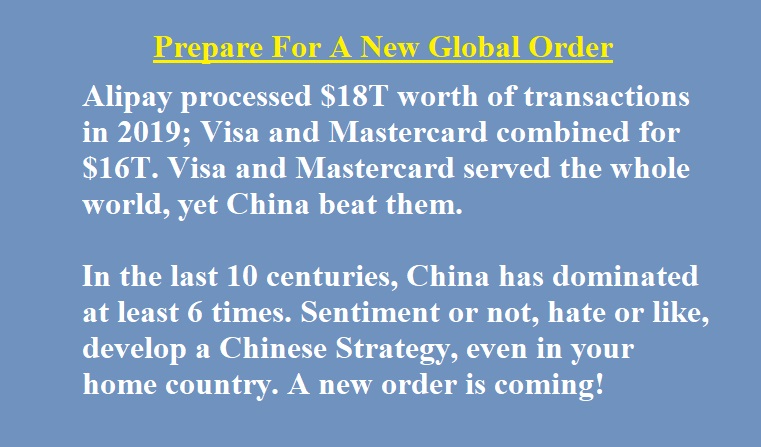
There is nothing ant-like in these numbers. Yes, Alibaba’s affiliate fintech company, Ant Group (of Alipay), does generate more payment volume than Visa & Mastercard combined! Ant does $18 trillion while the American giants bring in $16 trillion. Ant operates primarily in China while Visa and Mastercard run around the world!

China is China. Alipay processed $18T worth of transactions in 2019; Visa and Mastercard combined for $16T. Visa and Mastercard served the whole world, yet China beat them. In the last 10 centuries, China has dominated at least 6 times. Sentiment or not, hate or like, develop a Chinese Strategy, even in your home country.


LinkedIn Comment on Feed

#1 – Comment 1

Different things for different people, so a certain ‘Chinese Strategy’ may not work elsewhere. America created wealth in ways China can only dream of, and most parts of the world benefited from America’s idea of capitalism.

We need options, neither Chinese nor American can work in our case. We need to create our own template and framework, taking some things from each of the successful economies. Chinese strategy requires Chinese mentality, which neither Nigeria nor continental Africa possesses; so it’s a waste of time modelling after them.

Again, that Alibaba processed more payments than Visa and MasterCard doesn’t mean that American entities created less wealth; a certain Apple and Amazon are busy hovering around two trillion dollars each; none adopted Chinese strategy!

Let me figure out ‘Nigerian Strategy’ first, then we can return to advance the conversations.

#2 – Comment 2

Very interesting to see how China can even be overlooked interms of all round growth of an economy. China in 2017 was producing 2 billionaires per week, and a number of millionaires that would shock even the most industrialised economies.

They clearly have found a way to harness technology to improve the lives of their citizens at exponential scales. Its very similar to the rise of Japan decades ago. I see intelligent collaboration as a tool for any nation trying to emulate the example of the growth of the chinese economy, rather than focusing on their weak points. China like Japan is largely becoming a self sustainable economy, and mandarin may become a basic requirement sooner than later.