DD
MM
YYYY

PAGES

DD
MM
YYYY

spot_img

PAGES

Home Blog Page 6129

Understanding the Reason Behind Low Salary Rate in the Private Sector

4

Most times, we tackle private business owners as if they deliberately wished to use their employees without paying them well for their services. I know that many employers are ruthless. Some of them have a way of owing their workers until those workers resign and they bring in new ones, who will not know the organisation’s “no-steady-salary” culture. We also have those that look for every little opportunity to slash employees’ salaries so that they can reserve some of their money. I know all these, but they are not my focus in this article.

I met the son of a former neighbour, who did his house job in a federal medical centre, somewhere in the eastern part of the country, and is now working in a private hospital. When I asked him how he is enjoying his new job, he hissed and said what everybody that works in the private sector says, “They are stressing me yet they won’t pay me well.”

Well, that private sector stresses employees is a cliché; even private business owners are stressed out too. So being an employee of a business owner that wants to make his profit is naturally stressful in itself. What we need to address here is the “not paying me well” ideology.

When my neighbour’s son was done with complaining of how “low” he earns compared to his expectations or allowances during the house job, I asked him one question that threw him into a reflection. I will still mention the question I asked him later, but first let’s look at this scenario.

A private school just opened and it has to employ qualified teachers even before it enrolled its first student. It is almost impossible for a school to open today and be filled with students tomorrow (unless in rare cases where there are no schools in the town). People will give the school a chance to balance first. Within that period, its standard will be scrutinised and when it is found satisfactory, parents will start bringing in their children to the school, gradually. So, it is possible that this school owner will have to run the school from her pocket until it stabilises and starts making profits. Believe me, this can last for years.

Now, for this school to be considered of good standard, it has to employ qualified teachers. But because it is yet to make profits, it will pay them lowly and also overwork them. If the owner decides to start off with unqualified teachers, its standard will be considered low, hence the reputation of the school will be dragged on the mud.

Why am I saying all these? Teachers in this school will complain that their proprietor is “wicked”. People that know how much these employees are paid will say their employer is using them for cheap labour. Those of us out here will say that private business owners do not pay their workers what they deserve. What most people do not sit back to ask themselves is how much the employer is generating from the business.

Another thing you would have noticed from the case given above is that the employer went for qualified staff. This doesn’t necessarily mean that they are graduates. But let’s say they are graduates, is it wrong for this employer to go for the best even when he or she knows that the business cannot afford it? Let’s rephrase it, if you were the employer, will you go for the best even if they come cheap? Your answer is a reflection, which will explain the nucleus of this essay.

The truth of the matter is this, a lot of businesses do not make as much profit as we assumed. Business owners need to pay their employees from the profits they generated and the only way for these employees to make profit is by putting in their best. So when someone says his boss isn’t paying him the salary of a PhD holder, remind him that he has to make profit for his boss like a PhD holder so that his salary can come out.

Finally, the question I asked my neighbour’s son was, “When you open your own clinic, will you pay your workers more than your boss pays you?” I believe we should also ask ourselves this question when next we make comments about “stingy” and “wicked” employers.

Prepare Your Chinese Strategy Even In Your Home Nation

0

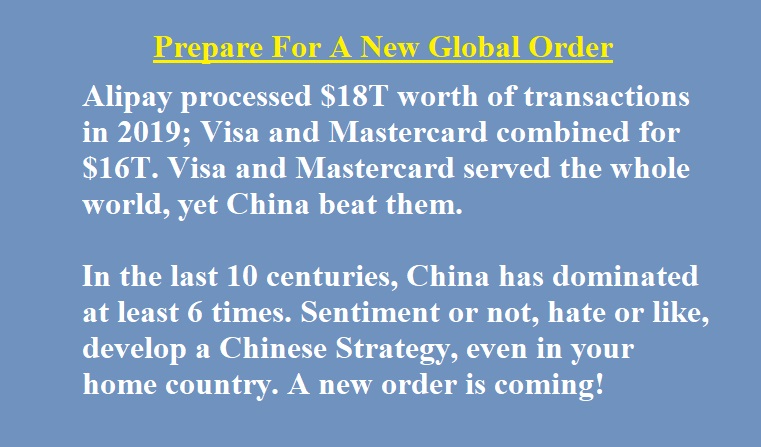
There is nothing ant-like in these numbers. Yes, Alibaba’s affiliate fintech company, Ant Group (of Alipay), does generate more payment volume than Visa & Mastercard combined! Ant does $18 trillion while the American giants bring in $16 trillion. Ant operates primarily in China while Visa and Mastercard run around the world!

China is China. Alipay processed $18T worth of transactions in 2019; Visa and Mastercard combined for $16T. Visa and Mastercard served the whole world, yet China beat them. In the last 10 centuries, China has dominated at least 6 times. Sentiment or not, hate or like, develop a Chinese Strategy, even in your home country.


LinkedIn Comment on Feed

#1 – Comment 1

Different things for different people, so a certain ‘Chinese Strategy’ may not work elsewhere. America created wealth in ways China can only dream of, and most parts of the world benefited from America’s idea of capitalism.

We need options, neither Chinese nor American can work in our case. We need to create our own template and framework, taking some things from each of the successful economies. Chinese strategy requires Chinese mentality, which neither Nigeria nor continental Africa possesses; so it’s a waste of time modelling after them.

Again, that Alibaba processed more payments than Visa and MasterCard doesn’t mean that American entities created less wealth; a certain Apple and Amazon are busy hovering around two trillion dollars each; none adopted Chinese strategy!

Let me figure out ‘Nigerian Strategy’ first, then we can return to advance the conversations.

#2 – Comment 2

Very interesting to see how China can even be overlooked interms of all round growth of an economy. China in 2017 was producing 2 billionaires per week, and a number of millionaires that would shock even the most industrialised economies.

They clearly have found a way to harness technology to improve the lives of their citizens at exponential scales. Its very similar to the rise of Japan decades ago. I see intelligent collaboration as a tool for any nation trying to emulate the example of the growth of the chinese economy, rather than focusing on their weak points. China like Japan is largely becoming a self sustainable economy, and mandarin may become a basic requirement sooner than later.

All Crypto Assets Are Securities, Nigeria Begins Bitcoin, Crypto, Blockchain-ventures Regulations

3

Nigeria’s Securities and Exchange Commission (SEC) will begin to regulate digital currencies and crypto-based companies, the Commission noted in a statement this week. I want to wish the Commission good luck. My understanding is that Nigeria is still struggling on how to collect VAT on digital companies which do business exclusively online; this new playbook may be harder. But it has to be done because Nigeria is a country.  Good luck.

Similarly, all Digital Assets Token Offering (DATOs), Initial Coin Offerings (ICOs), Security Token ICOs and other Blockchain-based offers of digital assets within Nigeria or by Nigerian issuers or sponsors or foreign issuers targeting Nigerian investors, shall be subject to the regulation of the Commission. Existing digital assets offerings prior to the implementation of the Regulatory Guidelines will have three (3) months to either submit the initial assessment filing or documents for registration proper, as the case may be.

The SEC hereby categorizes the following virtual assets/instruments as follows:

S/N VIRTUAL DIGITAL ASSET TREATMENT
1. Crypto Asset- e.g non fiat virtual currency.


Treated as commodities if traded on a Recognized Investment Exchange and/or issued as an investment, and is subject to Part E of SEC Rules and Regulations and any other relevant sections and subsequent Rules which will be enacted in future
2. Utility Tokens or “Non-Security Tokens”
(e.g., virtual tokens. These tokens simply provide users with a product
and/or service.
Treated as commodities. However, spot
trading and transactions in Utility Tokens do not fall under SEC purview
unless conducted on a Recognized Investment Exchange and therefore subject to
Part E of SEC Rules and Regulations and any other relevant sections and
subsequent Rules which will be enacted in future
3. Security Tokens” (e.g., virtual tokens that
have the features and characteristics of a security. Represent assets such as
participations in real physical underlyings, companies, or earnings streams,
or an entitlement to dividends or interest payments. In terms of their
economic function, the tokens are analogous to equities, bonds, etc.
Deemed to be Securities pursuant to PART
XVIII (315) of ISA, “definition of Securities’’. All financial services
activities in relation to Security Tokens, such as operating primary /
secondary markets, dealing / trading / managing investments in or advising on
Security Tokens, will be subject to the relevant regulatory requirements.
Market intermediaries and market operators dealing or managing investments in
Security Tokens need to be registered / approved by SEC as   CMOs, Recognized
Investment Exchanges or Recognized Clearing Houses, as applicable.
4. Derivatives and Collective Investment Funds
of Crypto Assets, Security Tokens and Utility Tokens
Regulated as Specified Investments under the
ISA & SEC Rules and Regulations. Market intermediaries and market
operators dealing in such Derivatives and Collective Investment Funds will
need to be registered / approved by SEC.

Signed

Google Shorts TikTok with YouTube Shorts – Learn To Copy Legally!

0

Google clones TikTok in India, unveiling Shorts: “Google-owned YouTube, which was working on a TikTok alternative, has now joined the party and announced its version called ‘Shorts’. … Shorts is a “new short-form video experience for creators and artists who want to shoot short, catchy videos using nothing but their mobile phones”. Nothing is new – you cannot expect to invent everything to be called an inventor! Yes, an Igbo axiom says, it takes the killing of one tiger to be called the killer of tigers. People, Google copies – and that is a lesson for us, as I explained in this Harvard Business Review article: “copy legally”.

Today we announced the launch of an early beta of YouTube Shorts – a new video experience that lets you create short videos right from the YouTube mobile app! With a handful of new camera tools for you to try out, you can create 15 second videos that are easily discoverable on the YouTube homepage (in the new Shorts shelf), as well as across other parts of the app.

We’re starting off by launching an early beta of YouTube Shorts in India, this includes a new camera and a handful of editing tools that will be rolling out over the course of the next few weeks.

Amazon Joins India Party with $20 Billion in Reliance Retail Ventures

1

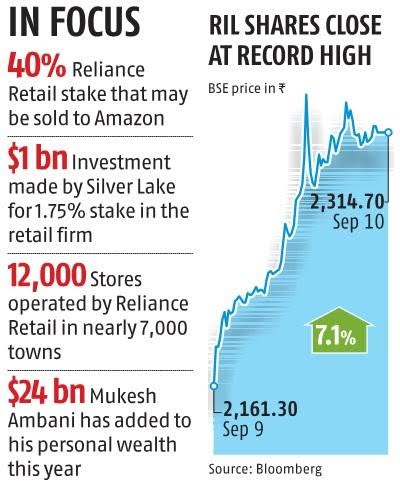
Amazon is investing $20 billion in the retail business of India’s Mukesh Ambani’s Reliance Industries Ltd. The Mumbai-based Reliance Industries is willing to sell as much as a 40% stake in the subsidiary to Amazon, Business Standard reports. People, there is a big party happening in India, and America is attending with tons of cash.

This party extends the one of a few weeks ago, “Qualcomm invests $97m in Reliance Jio, hours Google announced it would ship $10 billion. Facebook had dropped some $5.7 billion already. Amazon continues to ship cash to India. And Walmart’s pen has not dried up. Vista Equity Partners is not left out. People, #India is having a great party of a generation. America goes India!”

Indian billionaire Mukesh Ambani’s Reliance Industries Ltd. is offering to sell a roughly $20 billion stake in its retail business to Amazon.com Inc., according to a person with knowledge of the matter.
Amazon has held discussions about investing in the conglomerate’s Reliance Retail Ventures Ltd. unit and has expressed interest in negotiating a potential transaction, the person said. Mumbai-based Reliance Industries is willing to sell as much as a 40% stake in the subsidiary to Amazon, the person said, asking not to be identified because the information is private.
A deal, if successful, would not only create a retail behemoth in India but will also turn Jeff Bezos and Asia’s richest man from rivals into allies in one of the fastest-growing consumer markets in the world. At $20 billion, the deal would be the biggest ever in India as well as for Amazon, according to data compiled by Bloomberg.
If you check, Amazon has understood one thing: if we digitize retail in India, the top three will capture more than 80% of the value. If you are not in that club, you just have to buy yourself into the party. Walmart is already in through the billions it shipped to Flipkart; Amazon wants to get a seat. Hope, they can buy a ticket to Africa soon.