DD
MM
YYYY

PAGES

DD
MM
YYYY

spot_img

PAGES

Home Blog Page 6132

How Interoperability Works in 5G networks

0

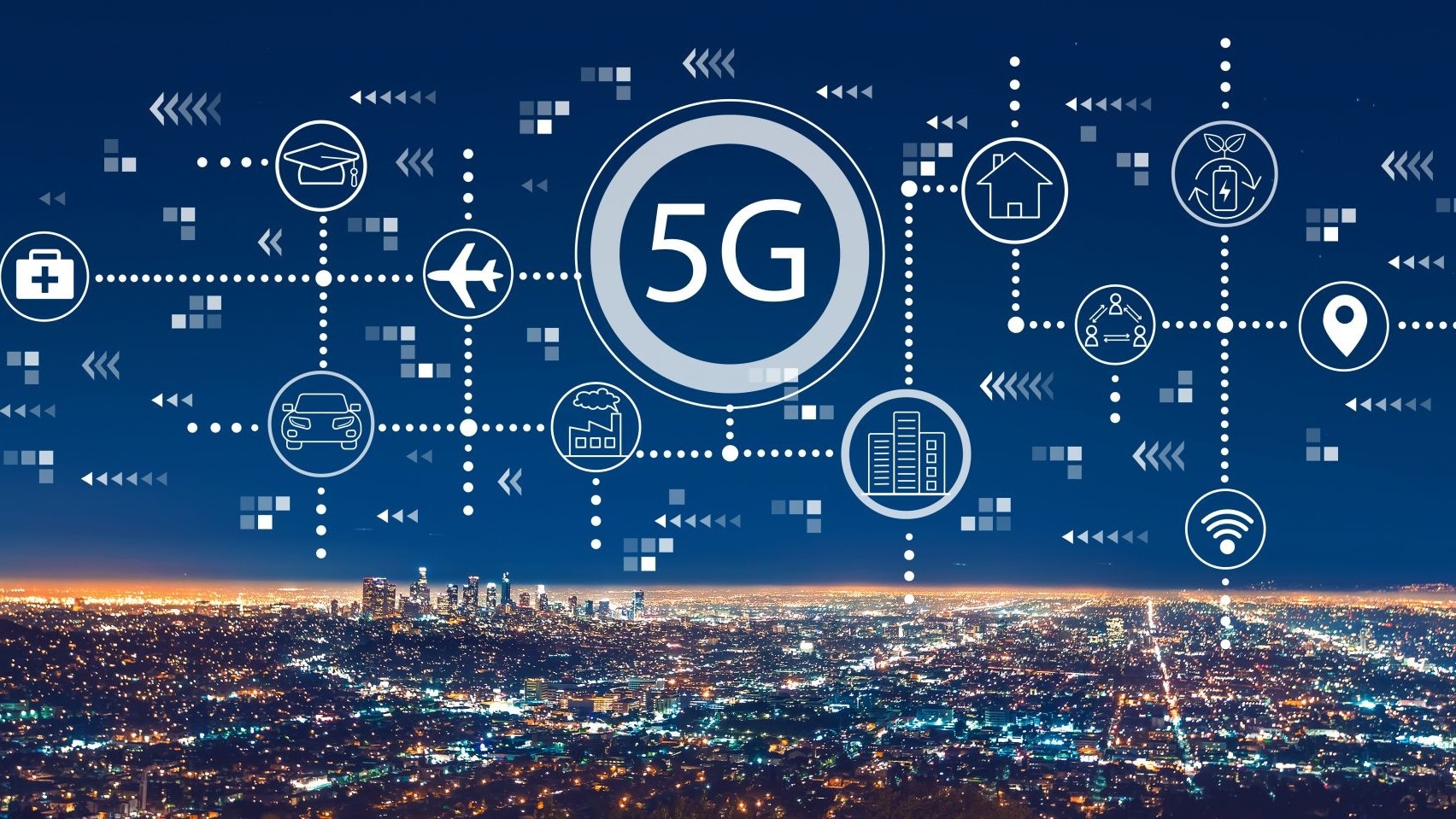
5G networks represent the next generation cellular networks posed to replace 4G networks. The network represents a shift from consumer technologies to industrial technologies and promises to usher in an era of exponential connectivity, low latency, ultra high reliability, seamless connection of high dense machines or sensors spread over geographic locations.

In order to meet the exponential demand, it is anticipated that 5G networks would rely on a combination of technologies from Wi-Fi, LTE (Long Term Evolution), small cells, satellites, relays, various access technologies etc. For this to work, the 5G core has been virtualized and softwarised to allow these technologies work interoperably and seamlessly.

Here, I will look at one of the techniques introduced by the 3gpp (third generation partnership project) , in one of their releases, aimed at facilitating interoperability of these technologies.

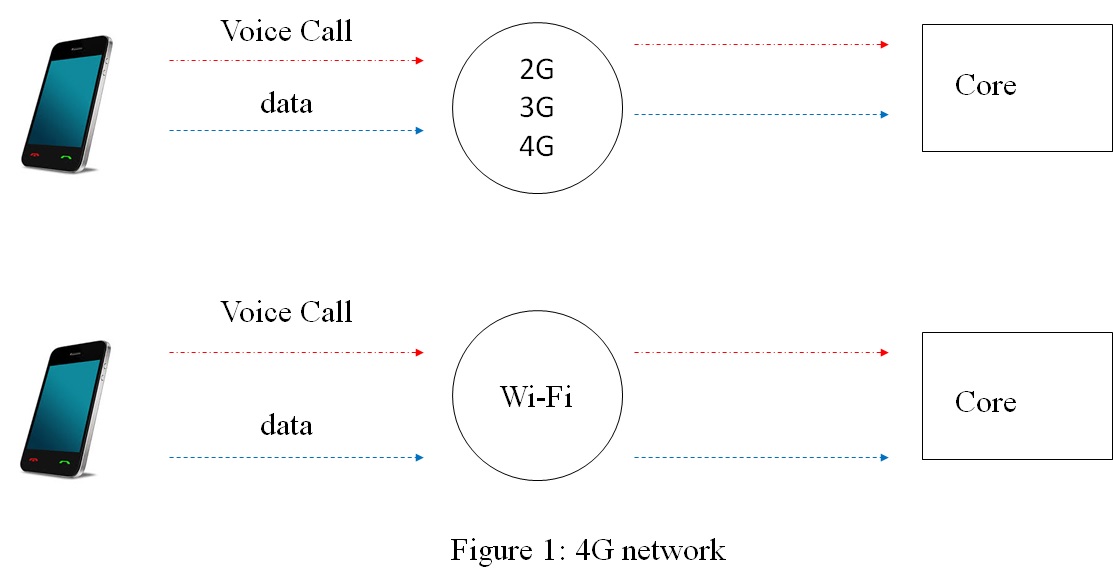
In the 4G network, when a user attempts to make a voice call or connect to the internet, both voice or data connections typically pass through the cellular network. Alternatively, the user could attempt to make the same voice call or connect to the internet using Wi-Fi, from a hot spot, for example, and thereby avoid incurring charges from the mobile operator. Both cases are depicted below in figure 1.

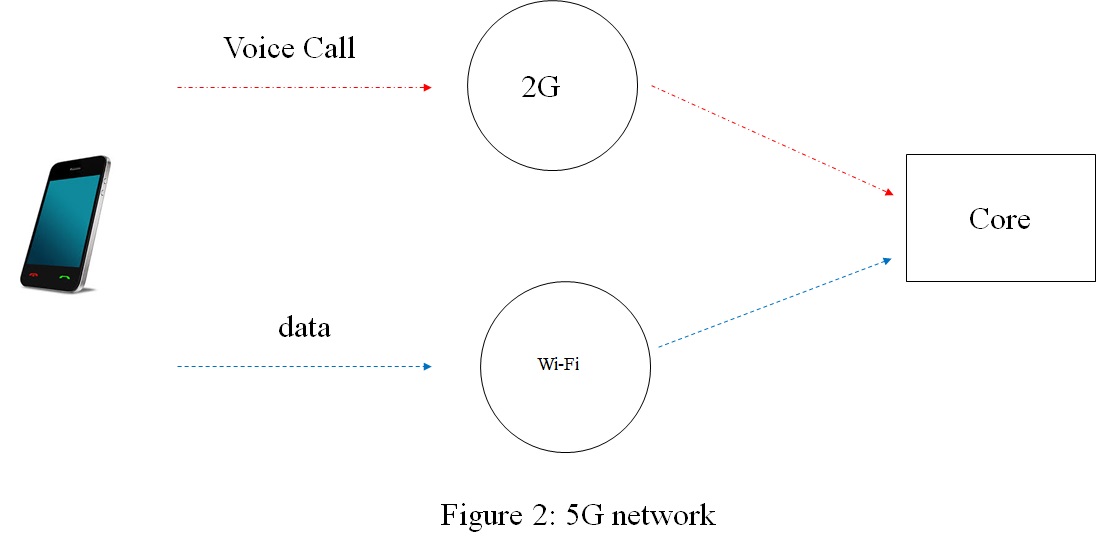
However, in a 5G network, the network could carefully combine the resources of the both cellular network (2G, 3G, 4G, 5G etc.) and Wi-Fi to offer a superior service to the user. As shown below, the voice and data traffic are split and passed over all networks, see figure 2.

The 5G network can perform any of the functions listed below

  1. Steer and select the best network: the 5G network is able to steer the traffic over either the cellular network or Wi-Fi, based on the best network for the user.
  2. Switch traffic: when a user is already using the resources of the cellular network, the 5G network is able to hand over the traffic to a wiFi network and vice-versa.
  3. Split traffic: the 5G network is also able to split the user’s traffic over all available networks e.g. it could direct voice traffic over a gsm network whereas it directs the data traffic over a Wi-Fi network.

These functions would be performed based on certain rules embedded within the network. The steering, Switching and splitting traffic over various access networks may sound trivial until one considers some of the anticipated use-cases of 5G. For instance, consider an autonomous car driving and it encounters a child crossing the road and it needs to make a quick decision on how to avoid the child, then one would appreciate the need for the network to be able to quickly switch network resources, when one access network suddenly becomes unavailable. The same applies to a robot performing surgical procedures, in the wake of a surge in the use of tele-medical applications, due to social distancing directives.

The Agreements that Led to NLC Suspension of Planned Strike, and Why Nigerians Are Disappointed

1

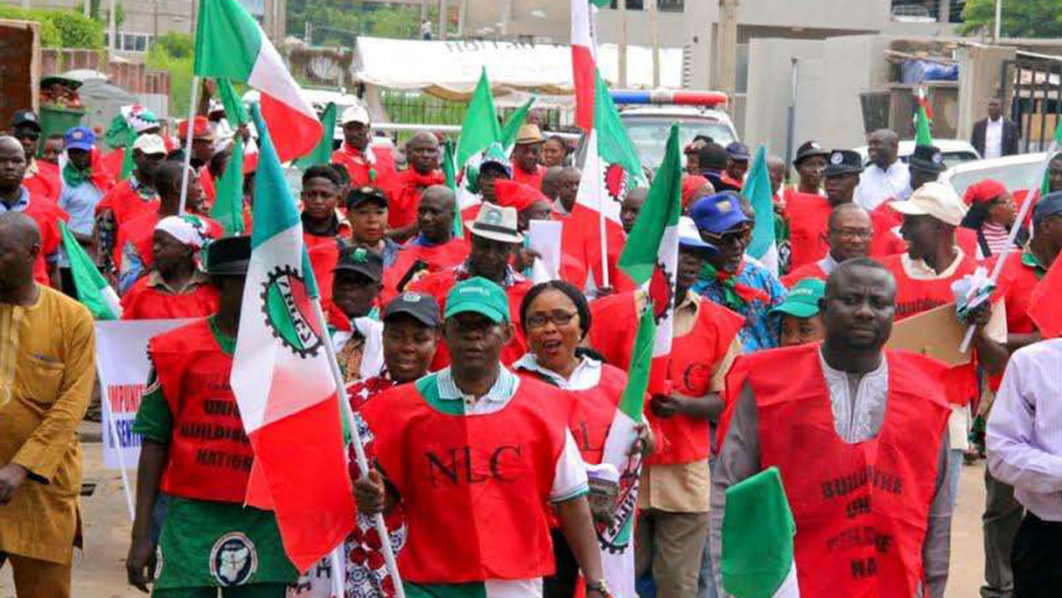
The Nigerian Labour Congress (NLC) suspended the nationwide strike action scheduled to take place on September 28, 2020. The NLC’s decision came after the Federal Government of Nigeria halted the implementation of increased electricity tariff and petrol pump price for two weeks.

Organized labor and Trade Union Congress had mobilized stakeholders in the past weeks to embark on indefinite strike that will force Nigerian government to rescind its decision to increase tariff and pump price. Consequently, the federal government engaged the stakeholders to avert the strike which would deal fresh blow on the already fragile economy.

The meeting was aimed at addressing the issues raised by the NLC and TUC, which includes the minimum wage, building refineries and metering electricity consumers.

The Minister of Labor and Employment, Dr. Chris Ngige said the meeting was fruitful, as the parties reached agreement on the key issues.

Dr. Ngige said the committee agreed to set up a Technical Committee comprising Ministries, Departments, Agencies, NLC and TUC, which will work for a duration of two weeks effective from Monday, Sept. 28.

“The committee is to examine the justifications for new policy in view of the need for the validation of the basis for the new cost reflective tariff.

“The technical committee membership included Mr. Festus Keyamo, Minister of State for Labor and Employment, as chairman, Mr. Godwin Jedy-Agba, Minister of State Power, Mr. James Momoh, Chairman National Electricity Regulatory Commission.

“Others were Mr. Ahmad Rufai Zakari, SA to Mr. President on infrastructure, Dr Onoho’Omhen Ebhohimen, Member, NLC, Mr. Joe Ajaero NLC, Mr. Chris Okonkwo, TUC and a representative of DISCOs,” he said.

Part of the committee’s assignment is to examine the different electricity tariff rates of the DISCOs, and see if they are in compliance with the order of the Nigerian Electricity Regulatory Commission (NERC), and also see if the commission is upholding its mandate.

In the aspect of deregulation, Dr. Ngige said all parties agreed that Nigerian refineries must function in bigger capacities to ameliorate the impact of petroleum importation.

He explained that based on the agreement, the Nigerian National Petroleum Corporation (NNPC), has been given marching orders to expedite the rehabilitation of Nigeria’s four refineries located in Warri, Port Harcourt and Kaduna and to achieve 50 percent completion for Port Harcourt by December 2021, while timeline and delivery for Warri and Kaduna will be established by the inclusive Steering Committee.

Dr. Ngige further explained that the national leadership of the Nigerian Union of Petroleum and Natural Gas Workers (NUPENG) and Petroleum and Natural Gas Senior Staff Association (PENGASSAN) will be integrated into the Steering Committee already established by the Corporation.

“The Federal Government and its agencies are to ensure delivery of one million CNG/LPG AutoGas conversion kits, storage skids, and dispensing units under the Nigeria Gas Expansion Programme by December 2021 to enable delivery of cheaper transportation and powerful fuel.

“A Governance Structure that will include representatives of organized Labour shall be established for timely delivery,” he explained.

On the issue of minimum wage and general intervention, Dr. Ngige said the federal government will facilitate the removal of tax on minimum wage to cushion the effects of deregulation and the pump price and electricity tariff increase. He added that the federal government will provide 133 CNG/LPG driven mass transit buses immediately for labor unions. The buses will get to all states and Local Governments before December 2021.

He said 10 percent of the Ministry of Housing and Finance housing scheme will be allocated to Nigerian workers under the NLC and TUC.

“A specific amount is to be unveiled by the Federal Government in two weeks’ time, which will be isolated from the Economic Sustainability Programme Intervention Fund that can be accessed by Nigerian Workers with subsequent provision for 240,000 under the auspices of NLC and TUC,” he said

Based on these agreements, the strike was called off for weeks. The federal government is expected to live up to its side of the bargain by implementing many aspects of the agreement in two weeks. But Nigerians said that the NLC and TUC have betrayed their mandate by reaching an agreement with the federal government and calling off the planned strike.

This perception stems from the concern that the government always reaches an agreement with striking unions only to avert the strike, and moves on after without implementing any of the things agreed upon. Moreover, none of the demands of the NLC was met in the agreements. People believe that the federal government will renege on the agreements as soon the NLC and TUC sheath their swords. And they have a good reason to believe so.

The Nigerian government is notorious for breaching agreements with civil society groups and unions in the country. The Academic Staff Union of Universities (ASUU) is still on strike instigated by the government’s failure to fulfill its agreement with the academic union.

The trajectory this sets emboldens the notion that the Nigerian government cannot be trusted, and thus, should not be negotiated with on matters affecting the wellbeing of the citizenry.

Thus, it is believed that the NLC has betrayed the people by going into agreement with the government, as the agreements represent the interest of a few. “Are you representing your pocket or the people of Nigeria?” Seun Kuti, Musician and rights activist asked the NLC.

Dr. Ngige said there will be subsequent meetings between Labour and the federal government, to discuss other matters, including the participation in agricultural ventures through the CBN and the Ministry of Agriculture.

Nigerians will have to wait for two weeks to see if the government will keep its promises. While the people feel betrayed by the NLC and TUC, the federal government has succeeded in saving the economy from another shutdown.

Nigeria Has 200 Fintech Companies Which Raised $600 Million in Six Years – McKinsey

0

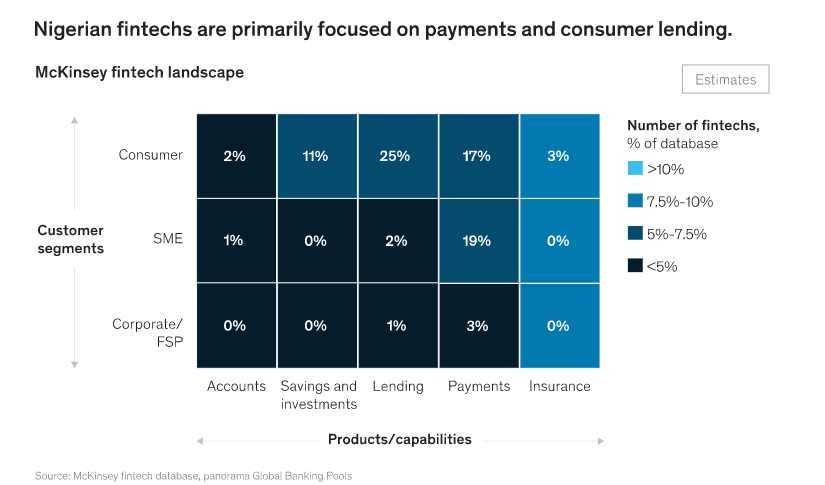
When they write, you better pay attention. McKinsey has written on the fintech landscape in Nigeria. The category-king consultant has it that Nigeria has about 200 standalone fintechs which have raised more than $600 million between 2014 and 2019. For the full report, click here.

At the same time, a youthful population, increasing smartphone penetration, and a focused regulatory drive to increase financial inclusion and cashless payments, are combining to create the perfect recipe for a thriving fintech sector. Nigeria is now home to over 200 fintech standalone companies, plus a number of fintech solutions offered by banks and mobile network operators as part of their product portfolio. Between 2014 and 2019, Nigeria’s bustling fintech scene raised more than $600 million in funding, attracting 25 percent ($122 million) of the $491.6 million raised by African tech startups in 2019 alone—second only to Kenya, which attracted $149 million.

Win like Laycon And Attend Tekedia Mini-MBA

1

We are picking the shines off Laycon, the winner of BBNaija and registrations for Tekedia Mini-MBA Edition Edition 4 (Feb 8 – May 3, 2021)  just ramped up. Yes, we have an offer for Laycon to attend free. Please if you register, our team will send you the two free ebooks – The Dangote System: Techniques for Building Conglomerates, and Africa’s Sankofa Innovation – free. Here is where to pay 

NB: We have many options for payment including Paypal, bank transfer, Flutterwave, etc

Win like Laycon – a UNILAG class best student and BBNaija best. Attend Tekedia Mini-MBA and learn from the best.


This Week In The Nigerian Capital Market: MPR and Your Wealth

0

Like WizKid, smile it’s a new week. Like Israel Adesanya, you need to pick your opponent (government policies) apart so that you can win regardless of the size of the threat posed by your opponent, welcome to this week in the capital market.

  • At its 22nd September 2020 MPC meeting, the Central Bank of Nigeria’s Monetary Policy Committee (MPC) cut the monetary policy rate (MPR) by 100 bps from 12.5% to 11.5%. This is the second cut since lockdown was eased on 4th May 2020.
  • At its 28th May 2020 meeting, MPC reduced MPR by same 100 bps from 13.5% to 12.5%.
  • How does a cut in MPR affect you? We will answer this question by looking at the impact on savings account holders, Banks and Investors in the stock market.
  • Let’s attempt what MPR is before we delve into its impact. MPR is an interest rate at which CBN lends to commercial banks and other clients. Why should you be concerned?
  • MPR goes beyond just lending rate between CBN and Banks. It is the benchmark rate for tracking the movement of other market rates of interest and maintaining economic stability.

Download Slide

Impact on Savings: negative real interest rate widens

As mentioned above, MPR as a benchmark rate tracks other interest rates. E.g, It is used as a benchmark to track the minimum interest rate (“MIR”) on savings accounts, it is used to benchmark what you will earn on your savings deposits with Banks.

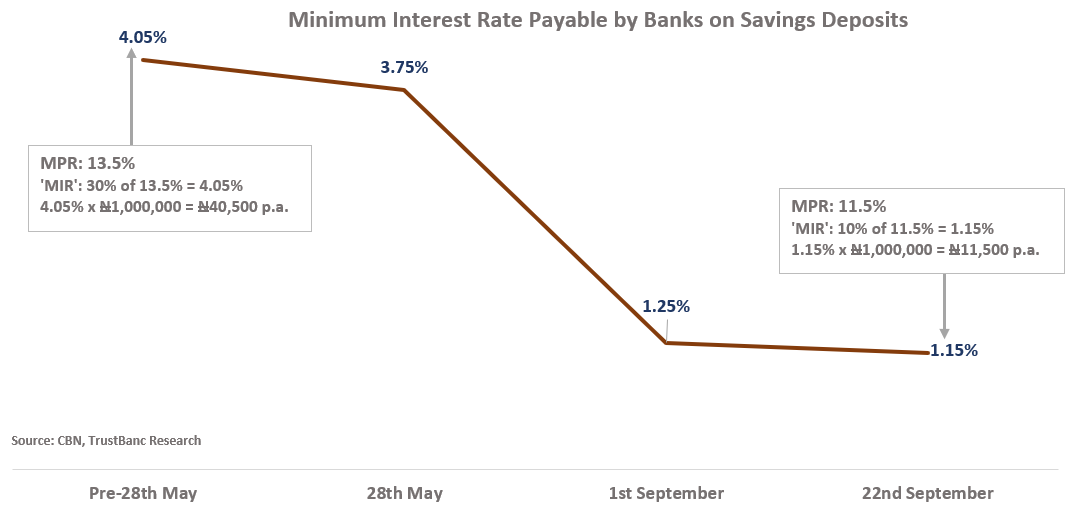
Effective 1st September 2020, you would recall that CBN reduced minimum interest rate payable by banks on savings accounts from 30% of MPR to 10% of MPR.

Please see the illustration on the graph below for a clearer understanding.


  • Earlier in the year, when MPR was 13.5%, you could earn as high as 4.05% minimum interest on your savings deposits compared to the current 1.15%.
  • From the graph, N1,000,000 savings deposit would earn a minimum interest of N40,500 per annum before the first MPR cut. That minimum interest has now reduced by over 71% to N11,500 per annum on the same amount, N29,000 loss. That’s the impact of the reduction of MPR!
  • More painfully, if you consider inflation at 13.22%, your real return on saving with a bank will come in negative at -10.66%.

In this environment of subdued interest rates and rising inflation, there is almost no incentive for saving with a bank.

Impact on Banks: cut in MPR translates to lower funding costs, higher profits

The N29,000 loss by our savings account holder above is a gain to the Banks. Lower interest rate means lower interest expense and higher profits for the banks.

  • The main source of funds for commercial banks is customer deposits – savings deposits, current account deposits, fixed and term deposits. Banks typically have strategies to target more savings deposits, because it’s cheaper compared to other forms of deposits.
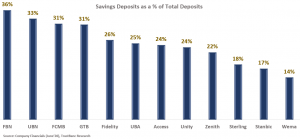
  • The cheaper a Bank’s savings deposit, the lower its interest expense/funding cost. Also, the higher a Bank’s savings deposits as a percentage of total customer deposits, the more it will benefit from a lower interest rate regime.
  • Following the reduction of MPR from 13.5% to 12.5% and now 11.5%, the minimum interest payable by banks decreased from 4.05% to 1.25% and now 1.15%. Like we noticed in the half-year financials of some banks, we expect interest expense to reduce further across the Banking sector in the coming quarters.


From the graph, the biggest winners are First Bank, Union Bank, FCMB and GTB, our estimates were based on the 2020 half-year financials of our coverage banks.

We anticipate a drop in funding costs of over N7 billion based on the latest cut in MPR alone. Our estimates based on the MPR cut in May was over N17 billion interest expense savings.

While interest income could also decline due to downward review of rates for loans linked to the MPR, we expect the impact to be insignificant given that not many loans have rates tied to MPR.

In view of the above, we expect sustained upticks in the shares of banks.

Impact on Investors: cut in MPR acts like steroids for a sustained bullish stock market performance

Monetary Policy Rate is an economic indicator closely monitored by the entire trading world including investors in the Nigerian stock market. A change in MPR has a big impact on the stock market with very varied effects.

While it usually takes at least 12 months for a change in the interest rate to have a widespread economic impact, the stock market’s response to a change is often more immediate.

Faced with declining savings interest rate, lower yields on fixed income securities and expanding negative real return, we expect Investors to find their way to the equities market in search of positive real returns.


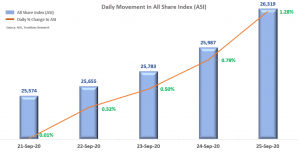
Last week, the performance of the market was flat at .01% on the first day of trade. The market jumped to 0.32% on the day the new MPR regime was announced. Since then, performance almost doubled on a daily basis to close the week with a gain of 1.28%.

Week on week, the equity market gained over 2.90% to record its best weekly performance in four months. Except for a few profit taking here and there to close the books for the month, we expect the market to continue its current bullish run.

Stock Recommendation

We are bullish on the shares of Zenith and GT Bank. Despite the declining macro environment, we believe the structure, adequate capital and liquidity buffers of these two Banks provides them with enough resilience to weather the storm.

The shares of Access, UBA and FBNH also provide near-term speculative opportunities considering their low valuations.

Away from the Banks, we like the shares of Presco and WAPCO. Generally, we advise you to stay with dividend-paying stocks with strong fundamentals and management.

Risks

The virus is still alive. The recent spike in coronavirus infections may stall recovery in the Eurozone and United States. Another round of subdued economic activities in these economies will depress oil prices. This will further compound Nigeria’s weak macroeconomic environment.

As recommended above, invest in undervalued dividend-paying stocks with strong fundamentals and management.

Conclusion

In conclusion, the cut in MPR and its impact reinforces the need to diversify your wealth. If you had some part of your wealth saved and another part invested across different investment options, regardless of the twist in government policies, you will be better off.

Imagine if you had your portfolio under one roof that provides an opportunity to save, borrow, invest and trade securities. A wealth partner that will assist you with picking government policies apart and position you to be better off regardless of policy twists. Talk to us at TrustBanc.

Have a great week in the capital market.


This week in the capital market provides a cocktail of information, education and insights on how you can take advantage of investment and funding opportunities to grow your wealth.

Leave your questions and comments below. If you need private financial advisory, send your enquiries to azeez.lawal@trustbancgroup.com or call 08028379367. Advisory is free.