DD
MM
YYYY

PAGES

DD
MM
YYYY

spot_img

PAGES

Home Blog Page 6136

This Week In The Nigerian Capital Market: MPR and Your Wealth

0

Like WizKid, smile it’s a new week. Like Israel Adesanya, you need to pick your opponent (government policies) apart so that you can win regardless of the size of the threat posed by your opponent, welcome to this week in the capital market.

  • At its 22nd September 2020 MPC meeting, the Central Bank of Nigeria’s Monetary Policy Committee (MPC) cut the monetary policy rate (MPR) by 100 bps from 12.5% to 11.5%. This is the second cut since lockdown was eased on 4th May 2020.
  • At its 28th May 2020 meeting, MPC reduced MPR by same 100 bps from 13.5% to 12.5%.
  • How does a cut in MPR affect you? We will answer this question by looking at the impact on savings account holders, Banks and Investors in the stock market.
  • Let’s attempt what MPR is before we delve into its impact. MPR is an interest rate at which CBN lends to commercial banks and other clients. Why should you be concerned?
  • MPR goes beyond just lending rate between CBN and Banks. It is the benchmark rate for tracking the movement of other market rates of interest and maintaining economic stability.

Download Slide

Impact on Savings: negative real interest rate widens

As mentioned above, MPR as a benchmark rate tracks other interest rates. E.g, It is used as a benchmark to track the minimum interest rate (“MIR”) on savings accounts, it is used to benchmark what you will earn on your savings deposits with Banks.

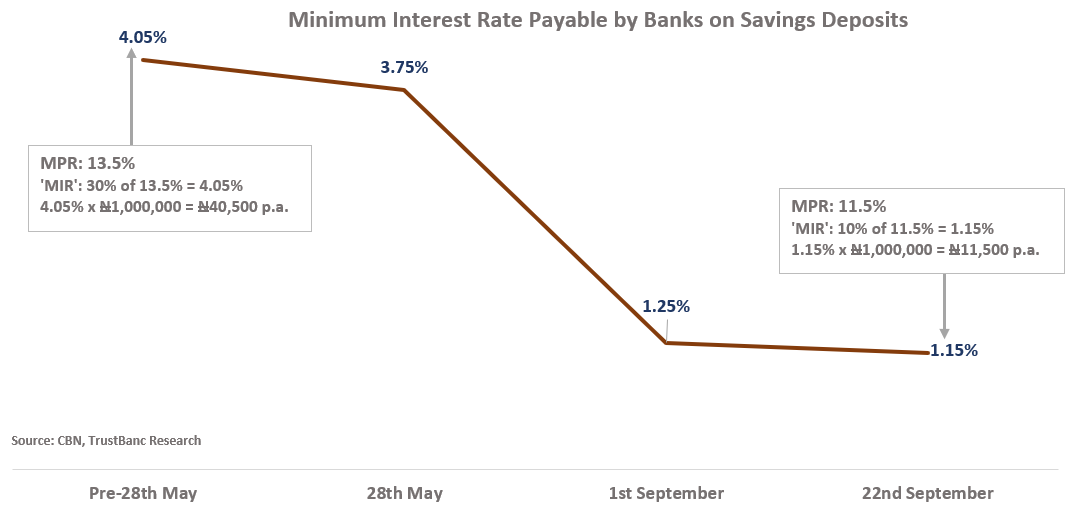
Effective 1st September 2020, you would recall that CBN reduced minimum interest rate payable by banks on savings accounts from 30% of MPR to 10% of MPR.

Please see the illustration on the graph below for a clearer understanding.


  • Earlier in the year, when MPR was 13.5%, you could earn as high as 4.05% minimum interest on your savings deposits compared to the current 1.15%.
  • From the graph, N1,000,000 savings deposit would earn a minimum interest of N40,500 per annum before the first MPR cut. That minimum interest has now reduced by over 71% to N11,500 per annum on the same amount, N29,000 loss. That’s the impact of the reduction of MPR!
  • More painfully, if you consider inflation at 13.22%, your real return on saving with a bank will come in negative at -10.66%.

In this environment of subdued interest rates and rising inflation, there is almost no incentive for saving with a bank.

Impact on Banks: cut in MPR translates to lower funding costs, higher profits

The N29,000 loss by our savings account holder above is a gain to the Banks. Lower interest rate means lower interest expense and higher profits for the banks.

  • The main source of funds for commercial banks is customer deposits – savings deposits, current account deposits, fixed and term deposits. Banks typically have strategies to target more savings deposits, because it’s cheaper compared to other forms of deposits.
  • The cheaper a Bank’s savings deposit, the lower its interest expense/funding cost. Also, the higher a Bank’s savings deposits as a percentage of total customer deposits, the more it will benefit from a lower interest rate regime.
  • Following the reduction of MPR from 13.5% to 12.5% and now 11.5%, the minimum interest payable by banks decreased from 4.05% to 1.25% and now 1.15%. Like we noticed in the half-year financials of some banks, we expect interest expense to reduce further across the Banking sector in the coming quarters.
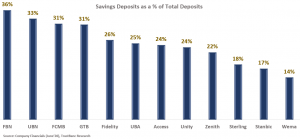

From the graph, the biggest winners are First Bank, Union Bank, FCMB and GTB, our estimates were based on the 2020 half-year financials of our coverage banks.

We anticipate a drop in funding costs of over N7 billion based on the latest cut in MPR alone. Our estimates based on the MPR cut in May was over N17 billion interest expense savings.

While interest income could also decline due to downward review of rates for loans linked to the MPR, we expect the impact to be insignificant given that not many loans have rates tied to MPR.

In view of the above, we expect sustained upticks in the shares of banks.

Impact on Investors: cut in MPR acts like steroids for a sustained bullish stock market performance

Monetary Policy Rate is an economic indicator closely monitored by the entire trading world including investors in the Nigerian stock market. A change in MPR has a big impact on the stock market with very varied effects.

While it usually takes at least 12 months for a change in the interest rate to have a widespread economic impact, the stock market’s response to a change is often more immediate.

Faced with declining savings interest rate, lower yields on fixed income securities and expanding negative real return, we expect Investors to find their way to the equities market in search of positive real returns.
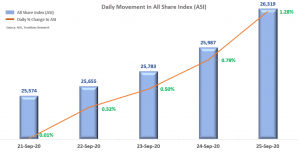


Last week, the performance of the market was flat at .01% on the first day of trade. The market jumped to 0.32% on the day the new MPR regime was announced. Since then, performance almost doubled on a daily basis to close the week with a gain of 1.28%.

Week on week, the equity market gained over 2.90% to record its best weekly performance in four months. Except for a few profit taking here and there to close the books for the month, we expect the market to continue its current bullish run.

Stock Recommendation

We are bullish on the shares of Zenith and GT Bank. Despite the declining macro environment, we believe the structure, adequate capital and liquidity buffers of these two Banks provides them with enough resilience to weather the storm.

The shares of Access, UBA and FBNH also provide near-term speculative opportunities considering their low valuations.

Away from the Banks, we like the shares of Presco and WAPCO. Generally, we advise you to stay with dividend-paying stocks with strong fundamentals and management.

Risks

The virus is still alive. The recent spike in coronavirus infections may stall recovery in the Eurozone and United States. Another round of subdued economic activities in these economies will depress oil prices. This will further compound Nigeria’s weak macroeconomic environment.

As recommended above, invest in undervalued dividend-paying stocks with strong fundamentals and management.

Conclusion

In conclusion, the cut in MPR and its impact reinforces the need to diversify your wealth. If you had some part of your wealth saved and another part invested across different investment options, regardless of the twist in government policies, you will be better off.

Imagine if you had your portfolio under one roof that provides an opportunity to save, borrow, invest and trade securities. A wealth partner that will assist you with picking government policies apart and position you to be better off regardless of policy twists. Talk to us at TrustBanc.

Have a great week in the capital market.


This week in the capital market provides a cocktail of information, education and insights on how you can take advantage of investment and funding opportunities to grow your wealth.

Leave your questions and comments below. If you need private financial advisory, send your enquiries to azeez.lawal@trustbancgroup.com or call 08028379367. Advisory is free.

Tekedia Congratulates Laycon, 2020 BBNaija Winner, and All 2020 Best Students with Tekedia Mini-MBA

4

He is the Winner and all the gifts in Nigeria are going to him. So, as a good citizen, who is NEVER a fan of the show though, I am congratulating Laycon, the winner of 2020 BBNaija lockdown edition, with free access to Tekedia Mini-MBA edition 4 which begins Feb 2021.

Laycon is the winner of 2020 BBNaija lockdown edition. Congratulations young man. He gets N30 million cash prize; a two-bd from Revolution Plus; SUV from Innoson Motors; a trip to Dublin from Guinness; home appliances from Scanfrost, and many other things including bitcoin.

The soul of a nation. Naija….you have changed indeed!

Please tell Laycon that Tekedia Institute will give him free access to Tekedia Mini-MBA edition 4 which begins Feb 2021

After I made that call, many have asked, why not open the freebies to others. Of course, we do a lot of that already. So, if you are a WINNER like Laycon, and graduated top of your college undergraduate class in 2020, Tekedia Institute offers you free access also. We are equal-talent-opportunity people here. Fair enough?

  • Winner of 2020 BBNaija Lockdown Edition – wins with Tekedia Mini-MBA
  • Winners of 2020 Class Acceleration Editions – win with Tekedia Mini-MBA

Go here and claim the awards, WINNERS. 

Tekedia offers an innovation management 12-week program, optimized for business execution and growth, with digital operational overlay. It runs 100% online. The theme is Innovation, Growth & Digital Execution – Techniques for Building Category-King Companies. All contents are self-paced, recorded and archived which means participants do not have to be at any scheduled time to consume contents.

It is a sector- and firm-agnostic management program comprising videos, flash cases, challenge assignments, labs, written materials, webinars, etc by a global faculty coordinated by Prof Ndubuisi Ekekwe.

Code Program
MINI Tekedia Mini-MBA costs US$140 (N50,000 naira) per person.
MINR Add extra (optional) $30 or N10,000 if you want us to review and provide feedback on your labs.
MINF Annual Package (includes 3 editions of MINI and optional 2 certificate courses) – $280 or N100,000.
Add extra (optional) $60 or N20,000 for each certificate specialty course. You must have attended, begun, or about attending Tekedia Mini-MBA to qualify. The following Certificate tracks are available:
CLSM Certificate in Logistics and Supply Chain Management
CBIS Certificate in Business Innovation, Growth & Sustainability
CMAB Certificate in Media, Advertising & Branding
CSBM Certificate in Startup and Small Business Management
CETS Certificate in Exponential Technologies and Singularity
CBPM Certificate in Business Transformation & Project Management
CMSM Certificate in Marketing and Sales Management
CDBG Certificate in Digital Business Growth
CPCD Certificate in Personal Career Development
CPFM Certificate in Personal Finance & Wealth Management

Payment options are here.

The bonanza concluded at 11.59 pm WAT Sept 29, 2020.

Accounting & Auditing At Tekedia Institute

0

Accounting & Auditing is the theme of this week at Tekedia Mini-MBA. Yusuf O. Sanni, Chief Internal Auditor at BUA Cement Plc begins the week with a lecture on Auditing, Forensics, Policies and Controls. Another Faculty member, Ndubuisi Umunna, Head of Finance Accounts & Admin at Royal Exchange Insurance Plc, focuses on how accounting is a necessity for Building Sustainable Enterprises. Okpaise Kenneth, a Financial Advisory Manager at AIICO Insurance Plc, concludes the theme with a class on Effective Financial Planning and Management.

Supported with flash cases, our Faculty members take our members through practical examples on how they can build sustainable businesses by adopting world-class accounting, auditing and financial planning regimes.

Session goes live on Monday at 12 noon Lagos in the Board.

Week 15 Session

0

Notes: This is the slide (PDF) from the Tekedia Live telecoms section by Engr Austyne Duru Tekedia LIVE Tuesday | 11am – 12noon | Media, Communications, and PR – Grace Akinosun, smepeaks | Zoom link Thursday | 7pm-8pm | Effective Project Management – Taiwo Abraham, Horizant | Zoom Link Saturday | 7pm-8pm | Survival Fund […]

This post is only available to members.

Etiquette Blunders Committed on Social Media

0

There is this screenshot of WhatsApp chats between a youngster and an older person that just went viral. This older person was supposedly approached by her friend’s younger sister to help the youngster. But things turned sour for this younger person when she/he started the conversation with “Hey” and then addressed the lady by her first name, Dewumi. He/she also committed more blunders by using abbreviations and failing to get clues from Dewumi that she is yet to greet her properly. Well, it is certain that the youngster has lost his/her chance of obtaining favour from Dewumi all because she/he committed etiquette blunders.

This experience by Dewumi is not peculiar to her; most of us must have experienced it at one point or another. I face it a lot with my younger cousins, students and ex-students. Sometimes I ignore them but at other times I call them out. But I realised that the majority of them do not really understand why their actions were considered ill-mannered.

There are three major etiquette blunders people commit on social media. The first one is the use of shortened form of words, that is, abbreviations. Since the coming of GSM, many teachers encounter students writing their exams with shortened forms of words. Of course we don’t waste time in marking them wrong when we see this, but they need to understand that abbreviations, and even contractions, should not be used in formal and semi-formal communications. And when communicating with an elder, except if the person is very close to the writer, abbreviations are discouraged. You don’t expect the person you’re writing to, to sit back and wonder what “fyn” or “tym” stands for. People that don’t have time to read those abbreviation-filled messages will just ignore them or call the writer to order. But in most cases, they see the writers as disrespectful and hence begin to keep them at arm’s length.

The second blunder a lot of us commit is in the way we greet recipients. You needed to open a conversation with someone that isn’t your peer and you started with “hey”, “how are you”, “hello dear”, “am dear”, “pm dear”, you name it, and you expected the person to respond in like manner or what? I don’t know what happened to our traditional “good morning”, “good afternoon” and the rest of them but we need to bring them into social media communication. Even if you don’t want to add ma/sir, at least, use our traditional greeting patterns, they are more respectful and encompassing. I don’t know about any other culture, but in Nigeria, we carried our tradition into the virtual world. If you can’t greet someone “hey” or “how far” in real life, please don’t do it on social media.

The third mistake we make, regarding social media etiquette, is starting off with pidgin, or being the first person to introduce pidgin into the conversation/writing. I know pidgin is gradually turning into our lingua franca in Nigeria, but it is still regarded as the language of the lower class. For that, it is not expected of you to be the first to introduce pidgin in a communication event, where the other participant is older or of higher status. Sometimes I tell people that even if the other person introduced pidgin, be sure that it is an invitation for you to speak pidgin too. I sometimes code-switch with pidgin with younger people but I don’t always invite them to reply with pidgin. If they do so, I revert back to English almost immediately. So, if the other participant in the communication event is good with the use of the English language, kindly stick to English until you have developed a deeper relationship that can allow the use of another language. Don’t give that person a chance to see you as ill-mannered because of your chosen language.

Kindly understand that I am not insisting that English is the only language you can use to communicate in social media. But in a situation where you are not sure of the language the other person uses, please kick off with English and wait for a sure invitation to use another language. However, if you are sure that the person only communicates with, say, Hausa (this is common amongst the tribe anyway), feel free to start the conversation with Hausa. But, never start with pidgin under any circumstances.

I don’t need to go into people hiding behind their phones to throw insults at their elders as is seen in social media platforms like Facebook and Twitter. The reason is because this essay isn’t about those ones. Here, the focus is on platforms such as WhatsApp and Telegram, where the writer communicates one on one with the receiver. There is no hiding behind our phones in this case and there is no using phoney names to mask our identity. In this case, the person you are trying to relate with knows you or knows about you; so the impact of your mistake will hit back on you immensely.