DD
MM
YYYY

PAGES

DD
MM
YYYY

spot_img

PAGES

Home Blog Page 6151

Confusion Currently Trailing The Nigerian Education Sector

0

On the 19th of March, 2020, the Federal Ministry of Education ordered for the immediate closure of all schools in the federation in order to protect the children from contracting COVID-19. Many schools were still in session when this directive came; in fact all schools were still in session at that time. However, some schools have started their examination before this circular was passed. In any case, most students and pupils have not yet completed their second term for the 2019/2020 session.

The directive from the Federal Ministry of Education was immediately adhered to. Schools were closed down with the hope that COVID-19 will soon pass by so that life will go back to normal. Well, as we all know, days turn to weeks and weeks become months. By the end of the day, our students in all levels of academic pursuit stayed at home, doing close to nothing academically, for six months now. And the number of months is still counting, hence the purpose of this essay.

During the lockdown, some private schools in Nigeria decided to keep their students “busy” and also earn some money out of it. These schools used different virtual methods to “teach” their students and give them exams. However, one thing nobody could tell was what will happen when schools finally resume. Some people said that schools will go back to finish up their second term and hurry up the third term. Others said that second term will be waived so that students will start up third term activities. They were all speculation because no one knows what the Federal Ministry of Education will say. There was this amount of trust people had in the ministry because it was strongly believed that the “experts” there would make some adjustments to time tables and curriculums so that students won’t miss much when they go back to school. No one, except maybe those up there, expected this confusion that students and their parents are facing today.

According to BBC news (Pidgin) of 4th September, 2020, the National Coordinator of the Presidential Task Force on COVID-19, Dr. Sani Aliyu, on Thursday 3rd September, 2020, announced that reopening of schools is at the discretion of state governments and school administrators. In fact, according to the BBC, Dr. Sani Aliyu instructed that school administrators and state governments should prepare to reopen schools. He didn’t actually tell them to reopen schools. If you ask me, I will say that he indirectly told schools that wish to reopen that they are “on their own”. His directive is filled with ambiguities.

From what BBC news (Pidgin) revealed, a lot of private universities are still waiting for the Presidential Taskforce on COVID-19 to give them the go-ahead to reopen. They have been ready to resume long ago but they don’t know when they should do that. Right now, these schools don’t know if they should wait for the Federal Ministry of Education, the Presidential Task Force on COVID-19, or the state government to give them the go ahead to reopen or if they should just call their students back to school since they are ready to do so.

Another confusion I am seeing is that some students in some states are going to school while those in other states stay at home. For instance, Anambra State will reopen schools fully on Monday 14th September, 2020, while Enugu State is yet to say anything. These students, though from different states, will still sit for the same external exams, such as WAEC and NECO, at the same time. My question here is why won’t the Federal Ministry of Education give schools directives to resume at the same time just the way it directed them to close simultaneously?

Another major problem facing our education system right now is the session/term these students are going into. I learnt that pupils in exit primary classes are beginning to write common entrance examinations and that some are preparing for First School Leaving Certificate Examination. I don’t know what these stand for but I hope it does not mean that students in secondary schools will be pushed up the next classes. Primary schools can do that because the pupils will still meet what they missed in their next class, even though it will be at a little higher level. But once a student misses a topic in secondary school, he has missed it. I hope our experts in the Federal Ministry of Education will bear that in mind as they look the other way while our system gets dragged in the mud.
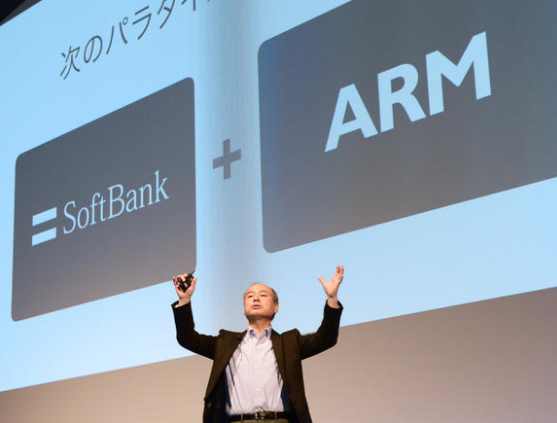
SoftBank Closes $40 Billion Deal to Sell ARM to Nvidia

0

SoftBank Group Corp is getting close to a deal which will see it sell Arm Holdings to Nvidia Corp. for over $40 billion. The Japanese conglomerate has been in talks with Nvidia for weeks now as it seeks to sell off some of its subsidiaries to offset its financial troubles.

The Wall Street Journal reported that the cash-and-stock deal is expected to close on more than $40 billion. The deal will mean a big win for SoftBank who bought ARM for $32 billion four years ago, and has been struggling with the British company.

SoftBank and Nvidia started talking in July, as Nvidia is seeking to consolidate its play in the semiconductor industry. ARM is an English tech company with a great reputation in chip making. It makes chips for modern devices including smartphones, an area where Nvidia is yet to find foothold.

But there was a challenge; Bloomberg reported that ARM’s customers, including Apple, Samsung, Qualcomm, Advanced Micro Devices and Intel could demand assurances that a new owner would continue providing equal access to ARM’s instruction set. It was the concern that led to SoftBank buying ARM the last time it went up for sale, because it is a neutral company. This concern appears to have delayed the deal for weeks, but sources familiar with the negotiation told WSJ a deal will be announced in coming days.

COVID-19 pandemic has opened more opportunities for players in the chip industry through disruption of businesses, creating needs for alternate ways of doing things as the world comes to terms with the new normal.

Market Watch noted that the semiconductor industry is seeing a surge in consolidation as chipmakers seek scale and expand their product portfolios to support the increasing number of everyday items that are connected to the internet. This means there are rooms to expand in IoT.

Analysts believe that purchasing ARM would help Nvidia to accelerate innovative ideas.

“With Nvidia’s low-cost fabless model enabling it to focus on R&D, engineering and programming, the fit with Arm would be perfect,” said Neil Campling, an analyst at Miraband Securities.

Nvidia has turned a big name in chip making, becoming the world’s largest graphics chipmaker. The California-based company has witnessed more than twenty-fold surge in stock, according to Bloomberg, giving it the opportunity to take on bigger deals. Nvidia’s market value has increased over time to more than $260 billion, making it more valuable than Intel.

Much of its success is attributed to architectural diversity into smart cars, data centers and networking gear. New Street Research LLP said the company will significantly rise if it pursues an initial public offering next year, and estimates its valuation to rise more than $68 billion by 2025.

ARM has been enjoying patronage from big tech companies as its designs become top choice for Android and iOS systems. Recently, Apple announced it is dropping Intel as it intends to switch its Mac computers over to ARM-based chipsets.

So if the deal is successful, it will become one of the biggest deals of the year. Another of the year’s biggest deals was the $22 billion purchase of Maxim Integrated Products Inc. by fellow chipmaker; Analog Devices Inc. Analysts said ARM could go public as early as next year, but the deal will likely attract scrutiny from antitrust regulators and potential pushback from ARM’s customers.

NVIDIA founder and CEO Jensen Huang sent the following letter to NVIDIA employees today:

Hi everyone,

Today, we announced that we have signed a definitive agreement to purchase Arm.

Thirty years ago, a visionary team of computer scientists in Cambridge, U.K., invented a new CPU architecture optimized for energy-efficiency and a licensing business model that enables broad adoption. Engineers designed Arm CPUs into everything from smartphones and PCs to cloud data centers and supercomputers. An astounding 180 billion computers have been built with Arm — 22 billion last year alone. Arm has become the most popular CPU in the world.  

Simon Segars, its CEO, and the people of Arm have built a great company that has shaped the computer industry and nearly every technology market in the world.

We are joining arms with Arm to create the leading computing company for the age of AI. AI is the most powerful technology force of our time. Learning from data, AI supercomputers can write software no human can. Amazingly, AI software can perceive its environment, infer the best plan, and act intelligently. This new form of software will expand computing to every corner of the globe. Someday, trillions of computers running AI will create a new internet — the internet-of-things — thousands of times bigger than today’s internet-of-people.  

Uniting NVIDIA’s AI computing with the vast reach of Arm’s CPU, we will engage the giant AI opportunity ahead and advance computing from the cloud, smartphones, PCs, self-driving cars, robotics, 5G, and IoT.

NVIDIA will bring our world-leading AI technology to Arm’s ecosystem while expanding NVIDIA’s developer reach from 2 million to more than 15 million software programmers.

Our R&D scale will turbocharge Arm’s roadmap pace and accelerates data center, edge AI, and IoT opportunities.

Arm’s business model is brilliant. We will maintain its open-licensing model and customer neutrality, serving customers in any industry, across the world, and further expand Arm’s IP licensing portfolio with NVIDIA’s world-leading GPU and AI technology.

Arm’s headquarter will remain in Cambridge and continue to be a cornerstone of the U.K. technology ecosystem.NVIDIA will retain the name and strong brand identity of Arm. Simon and his management team are excited to be joining NVIDIA.

Arm gives us the critical mass to invest in the U.K. We will build a world-class AI research center in Cambridge — the university town of Isaac Newton and Alan Turing, for whom NVIDIA’s Turing GPUs and Isaac robotics platform were named. This NVIDIA research center will be the home of a state-of-the-art AI supercomputer powered by Arm CPUs. The computing infrastructure will be a major attraction for scientists from around the world doing groundbreaking research in healthcare, life sciences, robotics, self-driving cars, and other fields. This center will serve as our European hub to collaborate with universities, industrial partners, and startups. It will also be the NVIDIA Deep Learning Institute for Europe, where we teach the methods of applying this marvelous AI technology. 

The foundation built by Arm and NVIDIA employees has provided this fantastic opportunity to create the leading computing company for the age of AI. The possibilities of our combined companies are beyond exciting.  

I can’t wait.

Jensen

YouthUp Global Partners Tekedia Institute to Launch CollegeBoost

0

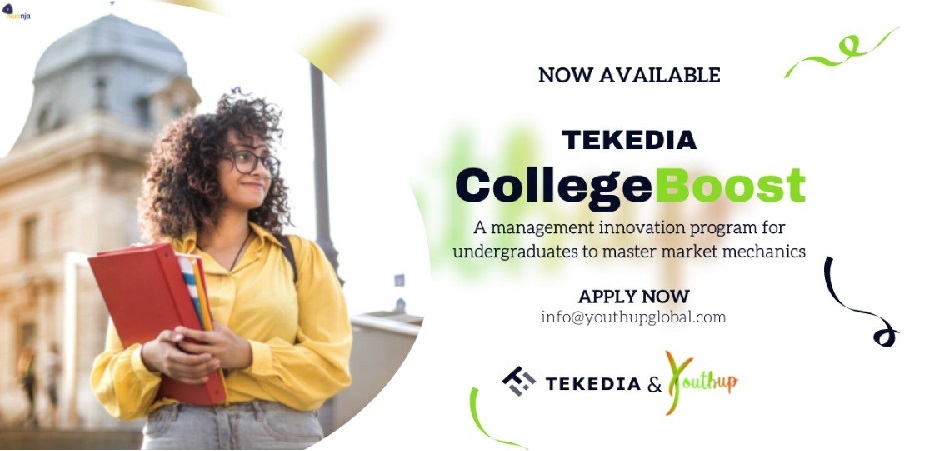
A management innovation program for undergraduates to master market mechanics

Lagos, Nigeria: Today, YouthUp, a nonprofit voice of global youths with the single goal of uplifting every young person into greatness through education, entertainment, and networking, in partnership with Tekedia Institute announced the launch of CollegeBoost on the 13th September 2020 for undergraduate students.

CollegeBoost is a management innovation program that is structured to help university students master the mechanics of markets and management systems. The Tekedia CollegeBoost mirrors Tekedia Mini-MBA, but it is more streamlined to serve undergraduate students. It is open for schools, alumni groups, student unions, etc. and each batch is scheduled to run for eight weeks which is segmented into two modules:

  • The Innovation of Firms (Part A): Four weeks
  • The Wealth in Nations (Part B): Four weeks

Of the organization’s recent reveal, YouthUp’s Cofounder, Faith Nwaobia said, “This CollegeBoost program has a perfect alignment with the first cardinal mission of establishing YouthUp Global which is to uplift young people through education, a weapon to liberate minds for an inquiry into the nature and causes of the fundamental changes in global economies and to help prepare them for a smooth academic-career transition.”

For this CollegeBoost partnership, YouthUp assumes responsibility for registration, mobilization, and all other matters concerning access to the CollegeBoost program while Tekedia Institute focuses on enrollee training. Before now, YouthUp already partnered Tekedia to coordinate the Tekedia Mini-MBA scholarship process for ten young professionals.

YouthUp’s Content team lead and Tekedia Mini-MBA scholar, Emmanuel Nwanja said that “Especially in Africa where curricular are outdated, Tekedia CollegeBoost program will provide students with the opportunity to learn innovation and real-world problem-solving capabilities.”

It is on this note that YouthUp encourages undergraduate students to embrace innovation and business management as a route to a sustainable career, organizational, and national growth. And with the program launch, all undergraduate students around the globe can now enroll to join the first batch of trainees.

About YouthUp Global

YouthUp is a youth development NGO and since its inception in March 2020, YouthUp has been instrumental in the training of more than five hundred international youths through numerous partnerships with industry leaders.

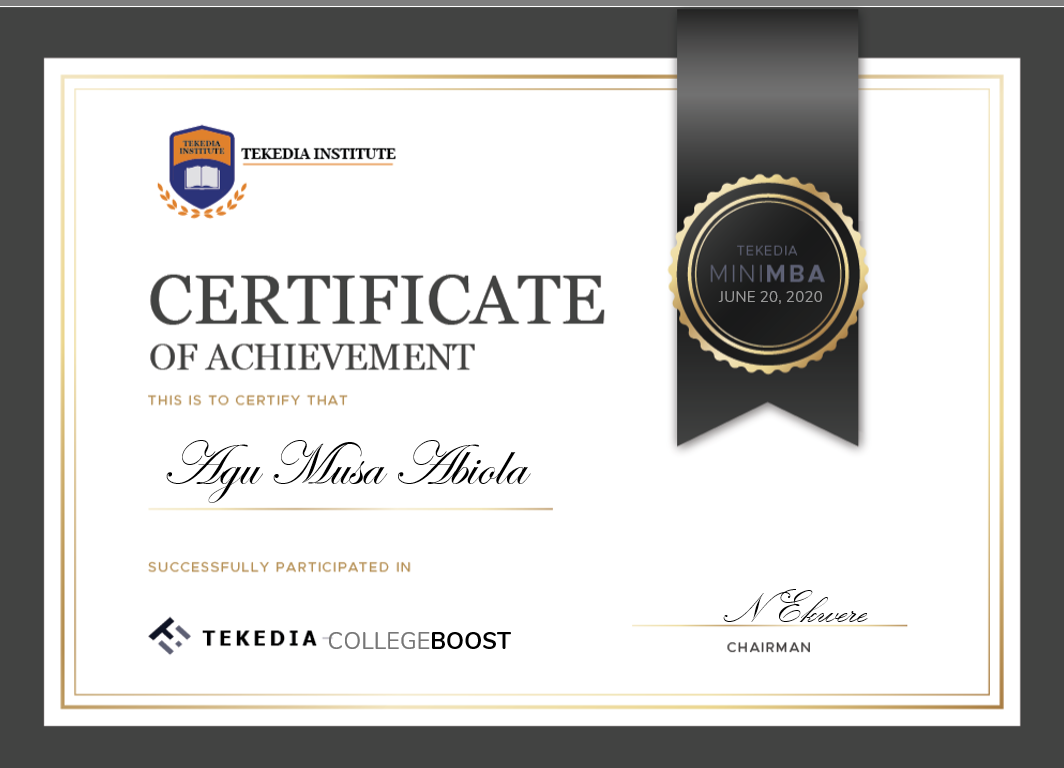
Every participant gets a certificate; sample below.

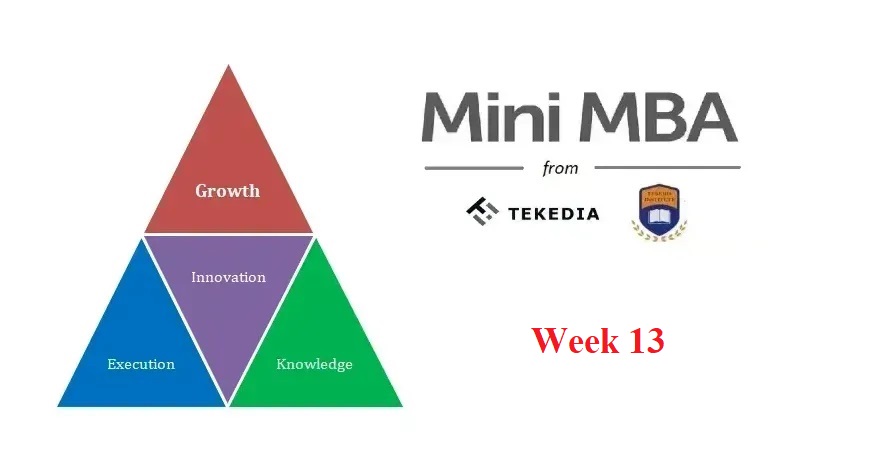
Week 13 Session

7

Notes: Slide from the Fundraising – Grant, DFIs and Government Tekedia Live of last week (PDF, password below) Tekedia LIVE Tuesday | 7pm-8pm | Product Design & Packaging – Kemisola Oloriegbe | Zoom link Thursday | 11am-12noon | Review – Ndubuisi Ekekwe | Zoom Link Saturday | 7pm-8pm | Review – Ndubuisi Ekekwe | Zoom Link Review […]

This post is only available to members.

Why Do Top Companies Across Key Sectors in Nigeria So Often Fail To Retain Key Salaried “Intrepreneurs” Beyond Five Years?

0

A couple of things started me thinking today about Nigerian Medium-Large and Large Companies (for want of a better description). I don’t want to put an EBITDA, Net-worth or employee head-count scale on it because they vary so much from sector to sector, and the challenges in the Nigerian Market are not the same as companies of the same value in many other markets globally.

The first thing was, I read a LinkedIn post by Ayodeji Balogun, CEO of AFEX Commodities Exchange. This post made references to McKinsey and Company,  and a Harvard Business Review article of 2017, which in turn references a PWC report of 2014.

A quote from  this HBR the article states:

‘The chief executive role is a tough one to fill. From 2000 to 2013, about a quarter of the CEO departures in the Fortune 500 were involuntary, according to the Conference Board. The fallout from these dismissals can be staggering: Forced turnover at the top costs shareholders an estimated $112 billion in lost market value annually, a 2014 PwC study of the world’s 2,500 largest companies showed. Those figures are discouraging for directors who have the hard task of anointing CEOs—and daunting to any leader aspiring to the C-suite. Clearly, many otherwise capable leaders and boards are getting something wrong. The question is, what?’

The next thing I began to think about is my own ‘LinkedIn’ community. This generally contains the top 3-5 individuals by salary, who are in different executive leadership roles in Nigeria based companies that cross a range of sectors in my career ‘spectrum’

Core Sectors would be various FMCG Manufacturing Sectors, Ingredients and Raw Materials, Engineering Services,  Telecommunications, Data Transport/Storage Infrastructure Providers, ISP/Tier 1 Peering, Renewable/Alternative Energy.

These people generally are not direct sources of opportunity for me, but often yield signposts which are prospects to my next ‘piece of bread and butter’.

High churn in this very important part of my network generates a lot of (unpaid) work for me. Keeping it current is critical.  When I come off the opportunity trail, contacts with these signposts often translate to business prospects or strategic partnerships with my client or employer.

So if one of them chooses to, or is caused to move on, I will notice. I will also have intimate grasp of trends as a collective phenomenon.

Some key players have perceived trends in lead talent sourcing for the Nigerian Market, both inside and outside of Africa.  Perception of talent outside of Africa tends to separate Developed Market Talent Sourcing –  US, Canada, Europe, Australia, New Zealand for example, from Emerging Market Talent Sourcing  – India, Brazil, Pakistan and the Middle-East for example.

Then there are Foreign Africans, versus Indigenous Talent.

Many postulated that cost is a factor.

Nevertheless, a recent article by Prof Ndubuisi Ekekwe, which detailed the top ten or so, salaried leaders in Nigeria, illustrates that the group has individuals reflective of ALL of these sourcing strategies!

While there may be slants to and away from one strategy or the other, there is a uniform problem with these post-holders having a shelf life exceeding five years, unless an executive investor.

Human Resources is generally one of the lowest cost centres in manufacturing and infrastructure-intensive business. It is important that Nigerian Medium-Large and Large Companies concentrate cost-saving exercises on areas where they will make most impact on Cost of Production – namely ingredients, raw materials, production consumables and spare parts subject to short replacement cycles.

As for the top 3-5 Human Assets by cost, the impact on the fortunes of the company will be on the added value they bring to the table, not on whether they saved, or paid a premium of 10 million naira per year on the contract.

These are the people that are brought in and paid a salary to lead a company, and its people on Innovation, Transformation, Repositioning, Diversification,  Acquisition, Strategic Down-sizing and other types of major change as part of a continuous process of Corporate Evolution in dynamic cycles of CONTINOUS IMPROVEMENT.

These are the ground breaking ‘Intrepreneurs’ and the Project Champions of the company’s  most defining projects.

Continuity here is a currency for stability.

Yesterday, I just bade a ‘good luck for the future’ message to one of Prof Ndubuisi Ekekwes’ mentions.

So:

WHY DO TOP COMPANIES  ACROSS KEY SECTORS IN NIGERIA SO OFTEN FAIL TO RETAIN KEY SALARIED ‘INTREPRENEURS’ BEYOND FIVE YEARS?