DD
MM
YYYY

PAGES

DD
MM
YYYY

spot_img

PAGES

Home Blog Page 6162

The New Nigeria’s Companies and Allied Matters Act (CAMA)

4
CAC

The updated Companies and Allied Matters Act (CAMA) in Nigeria is a good policy. With a minor update, it has a promise to unlock massive investments while boosting economic growth. For me, the new CAMA is very close to what you have in most modern economies except that it went deep into the affairs of religious organizations and non-profit organizations. 

With what we have seen with AMCON, the bad debt agency in Nigeria, I would not trust Aso Rock (of today and the near future) to have the accrued powers, as stated in the Act, over nonprofits, churches, (and mosques). That one is a no go area: they can take over a church school and sell it off because we have seen that playbook in the past. Today, no one has clearly stated what happened to stocks of Bank PHB even though that bank was traded on the Nigerian Stock Exchange. Until we can do simple things, governments should leave churches (and mosques) alone. 

I support the religious leaders who are asking the government to amend that section. Aso Rock over the years have not shown discipline to be trusted with sacred assets. If a pastor criticizes a government, that church would be in trouble with the assets frozen, and management changed. You can say that about imams and mosques. Giving politicians a legal tool to suspend, fire and change religious and non-profit leaders  will not be wise. Governments should focus on the capital markets and fix them before thinking of helping churches. If you check, our churches do not need help as we are the fastest growing market in that domain in the world. Abuja can stop that growth with New CAMA. Yes, it is working – leave it alone.

So, if you can ignore the above noted issue, this Act is what Nigeria needs now. Here are five key things in the Act which you will like:

  • 1.the insolvency provisions to help companies in distress
  • 2.Restriction on the number of public companies in which a person can serve as a director
  • 3. Ability of an individual to form a single-shareholder company
  • 4.Replacement of authorized capital with minimum share capital
  • 5.Electronic filing, virtual meetings and electronic share transfers.

Nigeria’s New Companies Act (CAMA) Will Attract Investments And Boost Economic Growth

Nigeria’s New Companies Act (CAMA) Will Attract Investments And Boost Economic Growth

0
CAC

The reenactment of the Companies and Allied Matters Act (CAMA) has been a subject of controversy in Nigeria’s public space, as some sections of it have been described as oppressive.

Section 839 (1) of the Act stipulates that religious and non-governmental organizations will be under the regulation of the Register-General of the Corporate Affairs Commission (CAC), and a supervising minister who will strictly regulate their affairs.

Under this rule, the CAC may wade into the organizations’ affairs, particularly when there is crisis. The Act thus empowers the Commission to suspend board of trustees of public organizations when a case of mismanagement is established, and appoint interim manager or managers.

Based on this section of the Act, many, especially religious leaders and non-profit organizations, are calling on the Federal Government to suspend it.

CAMA has been repealed and reenacted to boost ease of doing business in Nigeria, and the majority of its sections are geared toward that aim.

However, while religious leaders lead the uproar against the Act, experts said it’s in line with international best practices and should be welcomed.

Taiwo Oyedele, Fiscal Policy Partner and West Africa Tax Leader at Price water house Coopers (PwC), during the capability enhancement workshop organized for journalists by PwC, on Wednesday, said that the new CAMA will have significant impact on doing business, competiveness, attracting investments, and economic growth.

He highlighted five key changes that were introduced by the new CAMA: 1.the insolvency provisions to help companies in distress 2.Restriction on the number of public companies in which a person can serve as a director 3. Ability of an individual to form a single-shareholder company 4.Replacement of authorized capital with minimum share capital 5.Electronic filing, virtual meetings and electronic share transfers.

Compared to the old CAMA that had been in force since 1990, he said that key provisions and changes introduced by the new Act will have positive economic bearing on the country if implemented. Taiwo cited a section of the old CAMA that made provision for dissolving of public organizations instead of setting up interim management as provided in the new CAMA, to show that it isn’t as bad as it is perceived.

He however, outlined some steps that the government needs to take to ensure effective implementation of the Act.

Taiwo said the Act needs to be gazetted with a future commencement date to facilitate ease of transition. He added that for CAMA to yield the needed result, it has to be harmonized with other laws such as the Companies Income Tax Act which still requires audited accounts by all companies regardless of size.

“In addition, more flexibility is required for foreign companies who wish to operate business in Nigeria such that a branch registration should be permitted while incorporating a subsidiary will be optional. It is also necessary to ensure that the new law is kept under constant review with more frequent amendments or re-enactment say every five years,” he said.

While he applauded the new CAMA, he condemned governments’ use of taxation as means of revenue generation following the downturn of the oil sector as a result of COVID-19.

The federal government has been introducing new taxes since the outbreak of the pandemic, starting with the increment of VAT to 7.5% and the controversial Stamp Duty tax. And consequently, some state governments are following suit.

The Lagos State government introduced in August, a tax rule that requires ride-hailing drivers paying 10% tax on each trip, though it was reduced to N20 flat fee per trip after backlash. The State’s Film and Video Censors Board also introduced 5% levy on all audio and visual content produced and used however in Lagos.

There have been insignificant stimulus packages from the governments as business groan under the weight of the pandemic. With the increase in taxes, businesses, especially SME’s that are already functioning on life-support may not survive.

Experts have urged the governments to lower taxes especially as there has been little or no bailout for hardly hit business. The International Monetary Fund (IMF)  had warned Nigeria in June, that is not the time to introduce new taxes.

PwC said the governments need to spend more to provide palliatives, tax concessions and support to vulnerable persons and businesses.

Given the unusual situation, government needs to be deliberate in implementing tax measures and fiscal policies. The overall objective should be to generate revenue in a manner that does not hamper economic recovery, the firm said.

The Playbook for Growth – Tekedia Mini-MBA for Corporates

0

How can you find opportunities in this age of immense economic paralysis? How can you sharpen your antenna to anticipate opportunities before they happen? How can the evolving redesign of market architectures be captured for growth? The world of business is changing on Form and Space. To unlock that redesign, we have Tekedia Mini-MBA for Corporates. Working with us, together, we will architect a new future for your business. By the time you are done, you will have a Playbook for Growth.

Tekedia Mini-MBA for Corporates is a customized version of the general Tekedia Mini-MBA. It is designed for private and public institutions. It focuses on the same theme of innovation, growth, and digital execution. But unlike the 4-month general Mini-MBA, the Corporate vision goes for 4, 6, 8,10 or 12 weeks.  There would be scheduled webinars but no physical contacts.

When you sign-up, our team will schedule a meeting with you, discuss your business frictions, and during our program, we will work with your company to find solutions to those frictions, even as they learn. The outcome of the process has been amazing: internal innovation at scale.

We are helping companies to make their workers to become better strategists, analysts, researchers, and innovators. Yes, your staff would go through a methodological process to think of solutions for the business.

With our class notes, videos, live sessions, and cases, your team will have the right tools to produce that FUTURE for the business. You already have a great team, make them BETTER.

Let us serve you as an Innovation & Growth Partner, and using your team, you will find a new nexus to innovate, grow and advance the mission.

Tekedia Mini-MBA for Corporates is on-demand which means there is no scheduled start time; we are ready once a client is ready to start. It will be online, and fully on a secure dedicated digital board only your staff will have access for the innovation & growth training.

Tekedia Mini-MBA: a compass to business growth.  Email tekedia@fasmicro.com for a brochure.


Tekedia Institute Unveils Tekedia CollegeBoost for Schools

0

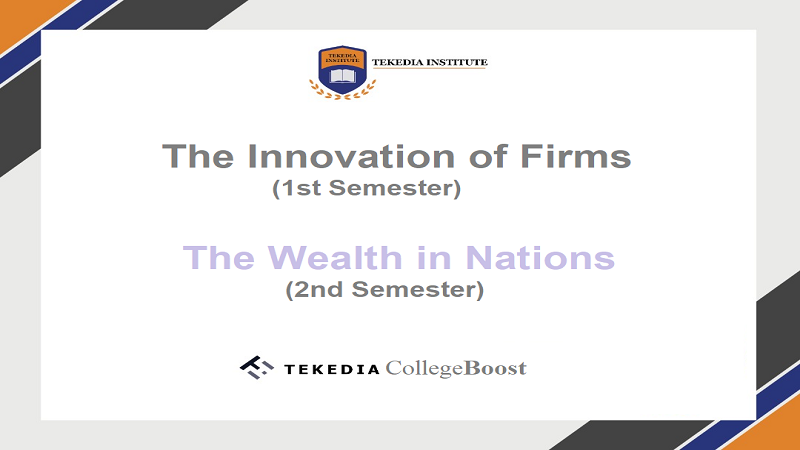
Starting tomorrow, our first university partner will onboard its students for Tekedia CollegeBoost. This management innovation program is structured to help university students master the mechanics of markets and management systems.

  • The Innovation of Firms (Part A): Four weeks
  • The Wealth in Nations (Part B): Four weeks

I have been to 103 universities in Africa; we do think we can support students as their schools prepare them. Tekedia CollegeBoost is a non-credit elective. To develop this series, Tekedia Institute worked with schools and students. 

Tekedia CollegeBoost mirrors Tekedia Mini-MBA, but it is more streamlined, and developed completely by the internal faculty of Tekedia Institute. It is open for schools, alumni groups, students unions, etc.

Tekedia Mini-MBA offers an innovation management 4-month program, optimized for business execution and growth, with digital operational overlay. It runs 100% online. The theme is Innovation, Growth & Digital Execution – Techniques for Building Category-King Companies. All contents are self-paced, recorded and archived which means participants do not have to be at any scheduled time to consume contents.

Tell your school about Tekedia CollegeBoost today. Our contact is here.

Tekedia Mini-MBA: Practicability of An Inventive Society in a Co-Learning Space

0

Some months ago, our analyst reported the emergence of Tekedia Institute’s mini-MBA as a possible disruption to the traditional ways of producing experts on business administration in Africa, and Nigeria in particular. In the analysis, it was reported that the Tekedia Institute will walk existing entrepreneurs and Nigerian professionals in sales, marketing, technology, administration, strategy, finance, etc through the innovation, growth and digital execution techniques. The entry of the Institute into the online teaching space was described as “a new sheriff is in town, time to disrupt the disruptors” by Francis Oguaju, a Business and Technology Advisor.

Infoprations Analysis, 2020

With the available data [comments of the participants], our analyst has discovered that the programme is indeed disrupting the learning space as participants continue having access to a number of professionals in varied industries as faculty members, who are co-learning with them [participants]. Analysis of 1,884 words from select comments of the participants indicate description and expression of feelings about the programme with the adoption of 687 unique word forms, which establishes their ability to communicate using distinctive words. Corpus analysis further shows that great, tekedia and invention have been used mostly by the participants and faculty members. We also found the use of group and product as dominant words [see Exhibit 3].

Examining the trends in the select comments, it emerged that participants and faculty members are sharing knowledge and ideas towards products/services creation and management. Analysis also suggests that both the participants and faculty members are working towards a number of ideas for growth and development in varied industries [see Exhibit 3 and 4].

Responding to one of the messages on invention, a participant notes that “…if these factors are giving your invention a low score, you need to change the market you are looking at. Move it somewhere else where similar inventions in that line of thought have been made and present it to the investors there. The market there will easily buy it and the investors will readily put their money down.

In summary, the market or investors do not determine whether your invention is innovative. It’s the level of information and the foundation of knowledge they had before your invention came that determines their level of connection with your work. To make people attracted to your innovation, build a foundation of knowledge, tell a story, make them know your line of thought, make them like similar works till it enters their dream. Then, they will trust you and your invention. This will make your invention more attractive and innovative to your audience. Thereby making investors put in their money because you have grown an audience that loves such kind of products.”

From the faculty members to the participants, our analyst notes that there are ability and capability to come up with ideas, designs and other strategic tools/templates for sustainable process and product/service development. Beyond the process and product/service, the learning space is also equipping participants what they need to survive personally and collectively in their respective industries or companies.

One of the unique values of the learning space is flexibility in communicating with the faculty members and sharing ideas and knowledge. With this, our analyst notes the learning space is showing that inventive society , we all crave for, is possible when less emphasis is placed on hierarchical structure for learning environment. Indeed, Inventiveness is more likely to occur if a society is less hierarchical since bureaucracy reduces creative activity.

Exhibit 1: Top Terms

Source: Tekedia Institute, 2020; Infoprations Analysis, 2020

Exhibit 2: Unique Terms

Source: Tekedia Institute, 2020; Infoprations Analysis, 2020

Exhibit 3: Discourse Trends

Source: Tekedia Institute, 2020; Infoprations Analysis, 2020

Exhibit 4: Link among the Top Terms

Source: Tekedia Institute, 2020; Infoprations Analysis, 2020