DD
MM
YYYY

PAGES

DD
MM
YYYY

spot_img

PAGES

Home Blog Page 6164

Ways to Reduce the Swindling of Job Seekers

2

A few days ago, the news of a woman that was arrested by EFCC for defrauding a job seeker went viral. According to this account, the woman, Hajiya Hadiza Umar Abubakar, in 2019, promised her victim, Nuradeen Abubakar, an instant employment in EFCC. However, for this to happen, Nuradeen was asked to pay the sum of six million naira (N6,000,000) to her. Nuradeen paid three million naira in October 2019 and promised to balance up the remaining three million naira when he receives the appointment letter. It was said that Hajiya Hadiza promised him that the appointment letter will be out in two weeks time from the day of the payment. But that was nine months ago and Nuradeen is yet to see any letter.

The story of Nuradeen and Hajiya Hadiza is not new. We hear about people defrauding job seekers of money they don’t have. We also hear of fake recruiters that give phony appointment letters to their victims. Sometimes these people that defraud job seekers are workers in the said companies. Sometimes they are fraudsters that set up offices to take advantage of the bad condition of things in the country. Other times they are relatives of top officers in the concerned companies they performed phony recruitments for. Who they are or who they are not is not the issue right now. The fact remains that a lot of people are out there to rip off the unemployed among us.

But one question that is yet to be answered is, “Why do job seekers pay heavy amounts of money as bribes to secure jobs?”

I’ve asked this question several times and the answers I always received sound like, “Wait until you’re desperate for a job.” Anytime I receive an answer like this, it dawns on me that people are still ready to pay to land jobs. Can you imagine Nuradeen paying N6m for a job in a government agency? How much did they tell him EFCC officials are paid as salary? I mean, let’s look at this logically, if someone has N6m to spare for a job that may pay him about 100k or a little more than that in a month, don’t you think that it makes no sense at all? How did he raise that money? Why won’t that money be used as capital for a business? If you have N6m to spare, will you work for someone?

The more I consider the case of Nuradeen and Hajiya, the more I realise that our problem is complex. It is possible that Nuradeen wanted the EFCC job so badly because he has heard of “deals” they do there, which can fetch him several multiples of that money he will pay Hajiya. It is possible that he heard that he will receive a fat salary in EFCC even though he will not be going to work. It is possible that he has been made to believe that government paid jobs are the best sources of income. I don’t know what he has heard that pushed him into such a foolhardy act, but it is obvious that he has been misinformed.

The fact still remains that more and more people will face the same fate encountered by Nuradeen if something is not done. The problem we have here is that many Nigerians want to sit down in cosy offices and receive fat checks by the end of the month. These same people believe that when they get old, they will continue to receive fat checks as pension. How I wish they know better.

The only way to reduce this fraudulent act of creating phony jobs is by encouraging entrepreneurship among youths. It’s not that everybody should be an entrepreneur but at least many should delve into it. And the good thing is that the more entrepreneurs we have, the more jobs we can create. At least, this will reduce the rate by which jobseekers are swindled.

Of course I know that the government needs to provide an enabling environment for new businesses to flourish. But the non-enabling environment we have here has not been able to deter many business owners. So if some people can survive the harsh and unstable government policies in Nigeria, people like Nuradeen, who have money to throw about, should be encouraged to venture into businesses, that is, if they don’t have any.

Tencent Loses $34 Billion As India Bans PUBG

0

Tencent lost about $34 billion of its market value over the last two days following the news that its wave-making game, playerUnknown’s Battlegrounds (PUBG) has been banned by the Indian government.

More than 100 mobile apps with links to China were banned in India last week after the Ministry of Electronics said it received complaints of misuse of users’ private data.

“The Ministry of Electronics and Information Technology has received many complaints from various sources including several reports about misuse of some mobile apps available on Android and iOS platforms for stealing and surreptitiously users’ data in an unauthorized to servers which have locations outside India.

“The Indian Cyber Crime Coordination Center, Ministry of Homes Affairs has also sent an exhaustive recommendation for blocking these malicious apps,” the Ministry said in a statement.

Tencent was quick to refute the claim that it’s stealing users’ data. The company said its apps have always complied with data privacy laws, and it hopes to resolve the issue with the government.

“Tencent takes the protection of user privacy and data seriously. Our apps have always remained in compliance with applicable data protection laws in India and all other markets where we operate.

“We look forward to engaging Indian authorities to clarify our long established policy and action in protecting user data, and hope to ensure the continued availability of our apps in India,” Recent said in response to the ban.

The ban came following a fresh face-off between Indian and Chinese military along the southern banks of Pangong Tso Lake. In June, the Indian government had announced the ban of 59 apps, mostly Chinese, including the popular short video app, TikTok. The September ban includes PUGB Mobile and its sister-apps like PUGB Mobile Lite and PUGB Mobile Nordic Map: Livik among others.

As the conflict between the two Asian giants escalates, more Chinese apps and tech companies are getting wound up in its lurch.

India is PUBG’s biggest market with a record 24% downloads, beating China’s 16.7% and US’ 6.4% according to data from Sensor Tower.

Consequently, Tencent and gamers have been hit hard by the ban as it means abruptly halting their source of revenue and means of livelihood.

Tencent has lost nearly $34 billion since the ban was announced, as its shares have fallen over 4% since Thursday. The tech giant will likely suffer further losses in coming weeks as the ban has been motivated by political conflict, and the Indian government is likely not going to reconsider its decision.

The loss is reportedly the biggest since the company lost $66 billion last month, following Donald Trump’s executive order banning WeChat.

Tencent went to India in 2017 with $700 million investment into Flipkart and $1.1 billion into ride-hailing service Ola; they were the most valuable internet-based companies at that time. Ever since then, the Chinese tech giant has explored other opportunities to expand its presence in India, as the country holds a huge internet market.

Part of Tencent’s strategy of reaching India’s underserved population is the PUBG Lite, introduced as a smaller version of the original game to give people with low quality phones the opportunity to play the online games. The original PUBG games require high version smartphones and it was a barrier for potential players who couldn’t afford bigger phones.

The PUBG Lite was also designed to help gamers in areas where internet connectivity were poor to receive stronger signals.

Unfortunately, the ban came at a time when a large number of India’s population is getting used to the games. It’s a shared loss between the company and Indian government. While Tencent is losing its revenue the Indian people are losing their jobs.

Ndubuisi Ekekwe To Speak at 26th Nigerian Economic Summit

2

Finally – the invitation came, and I have accepted. Hello Nigeria, the village boy from Ovim, Abia State, is going to the most prestigious platform when it comes to economic matters in Nigeria. Ndubuisi Ekekwe will lead a very important session during the 26th Nigerian Economic Summit. People, it is not going to be just talk – we will take it all the way, from design to implementation. To the Honourable Minister, NESG CEO, and someone here who recommended me, thank you for the invitation.

The 26th Nigerian Economic Summit (NES #26) will convene national and global policy makers, business leaders, development partners and scholars to lead and participate in sessions that will focus on building strategic partnerships and cooperation between governments, businesses and the civil society for resilience.

Digital Transformation is key to Africa’s future

0

Many young people in Africa feel they have been  lied to; education no longer equals post-graduate employment and employment no longer guarantees economic mobility. Entrepreneurship, meanwhile, is an ever-risky escape. Without digital and problem-solving skills, African youth struggle to find secure employment and create sustainable enterprises. Our increasingly technology-driven world is leaving them so far behind that even when jobs and untapped sizeable markets exist in Africa, they miss out. 

Youth (18-35 years) account for 60% of Africa’s jobless (Source: World Bank). Rejected by formal employment and education opportunities, millions embrace entrepreneurship. Over 70% of youth in Nigeria, Ghana, Senegal, Mali, DRC, Congo, Rwanda, Uganda, Ethiopia, and Mali are self-employed or in family work (Source: Brookings Institution). Unsurprisingly, then, small and medium-sized enterprises (SMEs) are the primary driver of economic activity across the continent. In  Africa’s largest economy, SMEs contributed 48% of GDP in the last five years, accounting for 84% of employment, and comprising 96% of all businesses (Source: Nigeria Bureau of Statistics). And yet, these businesses fail at alarming rates. 

In Africa’s second largest economy, 50% of SMEs disappear within 24 months (Source: Standard Bank South Africa). For instance, one entrepreneur who had started a recycling company in Nigeria to empower youth to monetize recycling services had grown her monthly revenue to $3000 within one year, but was now struggling as customers and employees alike grew wary of all high-contact businesses. The failure of SME’s has so many devastating effects- When SMEs fail, livelihoods fall under threat, Food cannot be purchased, Medicine cannot be procured, and Tuition cannot be paid.  

The proliferation of technology has transformed the workplace as people increasingly interact digitally with ever-smarter machines. “The need for some skills, such as technological as well as social (problem-solving), analytical and critical thinking skills, will continue to rise, even as the demand for others, including physical and manual skills, falls. These changes require youths, entrepreneurs and workers everywhere to deepen their existing skill sets or acquire new ones.  Companies, too, will need to rethink how work is organised within their organizations.” (McKinsey & Company, 2018). Without digital literacy and problem-solving skills, African youth will struggle to create technology-enabled enterprises that survive the increasingly frequent disruption (e.g. COVID-19, automation) in today’s world. Our world is in the midst of digital transformation, and so far, as a result of COVID-19, many have been left behind.

Employment change since the first steam powered textile looms displaced craft workers in 18th-century Britain. Consider the effects of the first Industrial Revolution: at one point, more than 95% of jobs involved growing food; today fewer than 2% of people in the developed world work in agriculture.  
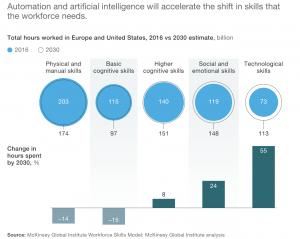
Reports, such as the World Economic Forum’s 2016 The Future of Jobs, suggest that we are entering a very different jobs era. In this fourth industrial revolution, automation and disintermediation are destroying jobs and disturbing the way businesses operate at such an unprecedented pace that new jobs are no longer sufficient to replace those redundant roles. 

Upskilling and Reskilling in the age of COVID-19, is the Way to Go

Startups that continue to innovate consistently outpaces that of established businesses. (EY Job Creation Survey). Technologies require people who understand how they work and can innovate, develop, and adapt them. Hence, there is a significant need for everyone to develop at least, basic digital skills for the new age of automation and post-COVID era. In EY Global Job creation survey 2016, It was  found that among 25 skills analyzed, basic digital skills are the second-fastest-growing category, increasing by 69 percent in the United States and by 65 percent in Europe. (EY Job Creation Survey).

Digital skills must also function alongside together with other abilities such as strong literacy and numeracy skills, critical and innovative thinking, complex problem solving, and an ability to collaborate, and socio-emotional skills. However, Nigeria and Africa’s education system is not well prepared to deliver this need because the education system and curriculum do not give flexibility or allow room for innovation and technological advancement. We are stuck in the old methods of the school system focused on hard skills with very little or no real-world practical application. Therefore, we need more Edtech platforms in Nigeria and Africa to fill this gap.

To better understand these needs, I conducted stakeholder interviews with university students, recent graduates, and employers in Nigeria. Our conversations revealed that many young people, some despite receiving university education, have poor computer skills, including little knowledge of Microsoft Suite or G-Suite. Many also expressed extreme difficulty finding employment even months after graduation. These challenges are worse for youth with no higher education, and young entrepreneurs are also struggling because they lack the basic skills to succeed in their businesses. With Nigeria’s growing population, our government will be in tumult if nothing is done to revamp the education system to become more problem-solving focused. 

Digital skill shortages have negative implications for the economy and the labor market. They can result in increased labor costs, lost production due to unfilled vacancies, slower adoption of new technologies, and the implicit and explicit costs of higher unemployment rates. Conversely, appropriate soft skills in individuals can boost economic growth.  The skills required to stay competitive are both soft skills such as problem-solving, innovation, creativity, critical thinking, and communication. And basic digital skills such as using cloud computing tools like Microsoft teams and Google Suite Applications for collaboration. There are more advanced skills like programming and analytics but not everyone can adapt. What is required is that at least everyone, regardless of your occupation should gain basic digital skills to stay competitive in the 21st Century Workforce.

Edtech Startups are Rising to the Challenge

Edtech platforms are rising to fill the skill shortage gap. Like Nigerian-based nonprofit, Inspire Africa for Global Impacts Initiative launched the Ignite Innovation Lab (IGL) Virtual Digital Transformation, centered on elevating young people in Africa to be able to take hold of these opportunities – opportunities to drive towards their goals, opportunities to thrive and opportunities to survive. IGL Digital Transformation lab directly addresses these challenges, teaching digital business skills through design thinking,  virtual collaboration and fostering entrepreneurship to help young people create new technologies, businesses, and jobs.

Launched in July 2020, IGL is exposing African youth to digital business skills in the age of COVID-19, by bringing together young talents virtually to innovate and collaborate on solutions to some of Africa’s most pressing challenges. The individuals use cloud computing to collaborate with their team members online and are supported by their mentors who provide direct feedback on the platform. They are equipped with the toolkit needed to develop digital enterprises that are progressing the Sustainable Development Goals and the skills to thrive in the 21st Century Workforce.  

The Ignite Lab approach of digital transformation is a unique way of upskilling the youth and tackling high SME failure rates. It galvanizes young people to learn digital skills and business know-how and apply them towards solving issues that affect Africa and the world. The virtual Lab is using simple, yet powerful, tools like human-centered design-thinking and business technology, but builds a pan-african digital learning experience around them. Participants aren’t simply ingesting one-way information, or executing without guidance.  With the support of expert facilitators, mentors and a network of social entrepreneurs, they are ideating, debating, collaborating, communicating, problem-solving, and more. As a result, more than the typical MOOC, the IGL Digital Transformation becomes an incubator, a hackathon, a mixer, a virtual watering hole for Africa’s future young leaders. 

The longer term outcomes of the Digital Transformation activities are even more numerous and notable. Youth unemployment is directly targeted and one who chooses to seek formal employment will have more opportunities available to them due to their new digital skills, and their employers will be more productive for it. Those that choose to start a business will be more likely to succeed because of their learning and, therefore, break cycles of unemployment–not only for themselves, but for others as research shows that startup hiring consistently outpaces that of established businesses (EY Job Creation Survey). Increasing employment will decrease socioeconomic inequality and contribute to economic productivity at national and regional levels. Beneficiaries of this methodology will be better positioned to contribute and benefit from greater African economic integration, having collaborated across borders during the program. 

Tony Elumelu describes Africa as a continent of opportunities with huge returns on investments, therefore, we must prioritise training and mentorship, just as we prioritise capital. We must also ensure that relevant platforms to learn digital business skills are created just as Inspire Africa for Global Impacts Initiative  and many others have done. 


Article written by Cynthia Mene and contributed by Mene Blessing

The New Nigeria’s Companies and Allied Matters Act (CAMA)

4
CAC

The updated Companies and Allied Matters Act (CAMA) in Nigeria is a good policy. With a minor update, it has a promise to unlock massive investments while boosting economic growth. For me, the new CAMA is very close to what you have in most modern economies except that it went deep into the affairs of religious organizations and non-profit organizations. 

With what we have seen with AMCON, the bad debt agency in Nigeria, I would not trust Aso Rock (of today and the near future) to have the accrued powers, as stated in the Act, over nonprofits, churches, (and mosques). That one is a no go area: they can take over a church school and sell it off because we have seen that playbook in the past. Today, no one has clearly stated what happened to stocks of Bank PHB even though that bank was traded on the Nigerian Stock Exchange. Until we can do simple things, governments should leave churches (and mosques) alone. 

I support the religious leaders who are asking the government to amend that section. Aso Rock over the years have not shown discipline to be trusted with sacred assets. If a pastor criticizes a government, that church would be in trouble with the assets frozen, and management changed. You can say that about imams and mosques. Giving politicians a legal tool to suspend, fire and change religious and non-profit leaders  will not be wise. Governments should focus on the capital markets and fix them before thinking of helping churches. If you check, our churches do not need help as we are the fastest growing market in that domain in the world. Abuja can stop that growth with New CAMA. Yes, it is working – leave it alone.

So, if you can ignore the above noted issue, this Act is what Nigeria needs now. Here are five key things in the Act which you will like:

  • 1.the insolvency provisions to help companies in distress
  • 2.Restriction on the number of public companies in which a person can serve as a director
  • 3. Ability of an individual to form a single-shareholder company
  • 4.Replacement of authorized capital with minimum share capital
  • 5.Electronic filing, virtual meetings and electronic share transfers.

Nigeria’s New Companies Act (CAMA) Will Attract Investments And Boost Economic Growth