DD
MM
YYYY

PAGES

DD
MM
YYYY

spot_img

PAGES

Home Blog Page 6168

What Innovation Really is, and why Patents alone don’t just cut it.

3

What is Innovation?, or better still what does Innovation mean to you?

Because frankly Innovation means different things to different people; to some, Innovation means flying cars, A 90 Hz refresh screen (Smartphone Junkies), The iPhone, or some dystopian scene from some sci-fi movie where humans live side by side with Aliens, Fly around in Space Ships, have Guns that shoot lasers and sorry, this isn’t Star Wars.

Either way, Innovation has different definitions, depending on where you grew up, and the kind of Sci FI movies you watched.

Remember the 1985 movie Back to the Future, where they predicted we’d all have Flying Hoverboards in 2015? This is 2020, and apparently that has not happened. We do have Uber, Bird, and TikTok, but I digress.

What Innovation Really is.

The First true definition of Innovation is from the Business point of view. Let’s put it this way; if you can’t apply it profitably or Sustainably in Business or to support a Business case, it isn’t Innovation, it’s an invention.

Now here’s a short Story;

You wake up tomorrow morning, and somebody has played around and built a Time Machine (I’m Thinking Elon, that guy is practically trying everything he sees in the movies). You get to try it out, you wake up in Berlin in say 1775, July 4th to be Precise, America gained independence last year, and you want to wish your Great, Great, Great (you know where I’m headed with this) Grandpa who doesn’t know you’re from the Future a happy independence.

You make the mistake of Sending the letter on the 4th of July, because you’re still used to WhatsApp, and all that Instant Messaging stuff. You send the letter on the 4th of July, your Grandpa gets it sometime in September or early October.

Your Grandpa probably now thinks you’re Crazy.

Another example; You decide to travel cross-country to get a lay of the land. If you’re Broke, chances are you’re going to walk cross-country. If you’re Middle class, you’ll be riding a horse, and if you’re Billionaire level, you’ll be in a carriage with a couple of escorts. They haven’t invented the Air Conditioner yet, so if the Sun Decides to show off, you’ll be burning up, regardless of all the Gold you have Stored up.

No Netflix, Entertainment is strictly watching your neighbors fight or better still going to the town square to see what is on display.

No Google, if you want to read, you go to the Library. You literally have to search for information and stuff yourself.

No Camera, your Memories are your Photographs. If you’re gifted, or wealthy enough, you paint the picture yourself, or hire an Artist to do it for you.

When you eventually Come back to 2020, you’ll make one meaningful conclusion; In 1775, Life was hard.

This is what Innovation is about. Innovation is simply Making Life Easier.

Innovation is about making life easier. The Assembly line invented by Henry Ford made life easier (at least for those in Production), The Wright Brothers, and the Airplane?, it takes 7 hours to Fly From London to the United States, by ship it would take around 3 days. Today communication is largely instant, i send it now, you get it now. You don’t have to wait for days to get a letter or anything of that sort.

The Truth is, Innovation is about creating the perfect balance between Technology (The Enabler), Design (The Users Advocate), and Business (The Guys who fund it). The End result of this balance is a product that makes life easier for your users, and at the same time improves the bottom line of your Business.

Innovation isn’t patents, What patents really do is display the Technology quadrant of your innovation matrix, if that technology doesn’t make life easier for your users, or translates into profitable business outcomes, your business isn’t innovative, it’s just a business that has lots of patents.

Obsess about Ease.

Too many companies fuss about how they can make their Product better, but what really is better? Does better mean a lot more functionality?, your Product being able to do more, or ease?, your Product making life easier for your users?.

The Easier your Product makes the lives of your users, the better it is. A better Product is an easier Product, not a more Functional one.

Your team needs to become Product Agnostic, and Obsess about ease. How can we make life easier for our users?, what Technological development can aid that purpose?, and can we do this in a way that has a meaningful impact on our Businesses bottom line?.

Answering these questions is the root of true Innovation, Not just a list of the Patents you own. Besides Kodak Filed for Bankruptcy, even though they owned more than 1000 Digital imaging Patents.

So much for Patent Innovation.

Beyond Buzzwords

Putting AI at the back of your name has nothing to do with being innovative. The real question is How does AI make life easier for your users?.

YouTube’s Algorithm studies my viewing history, and fills my feed with Videos they believe will interest me. They’re usually correct, and their Algorithm saves me from the stress of having to search for everything myself (which would practically ruin the user experience). Sometimes Innovation is about making life easier for people by helping them think less.

Forget the Buzzwords, the question should be simple; how does this Technology, how does this Product make life easier for our users, and how can we keep on making life easier for them?.

Conclusion

Innovation is more than just Sci-fi futuristic stuff, it’s about creating the perfect blend between Technology, Design, and Business. It’s about creating products that are profitable to the Business side, it is more than Just adding Functionality to a Product, it is about making life easier for your users.

Register for Tekedia Mini-MBA Edition 3

0

This is the last opportunity in 2020 to attend Tekedia Mini-MBA. A four month management program, 100% online, self-paced and sector agnostic. Our class notes are becoming books because they are that really good. Then, the videos.  You study at your pace with support from our community.

Register and get your login now https://www.tekedia.com/programs

Tekedia Academic Programs


The Tesla’s 1,000% Returns

1

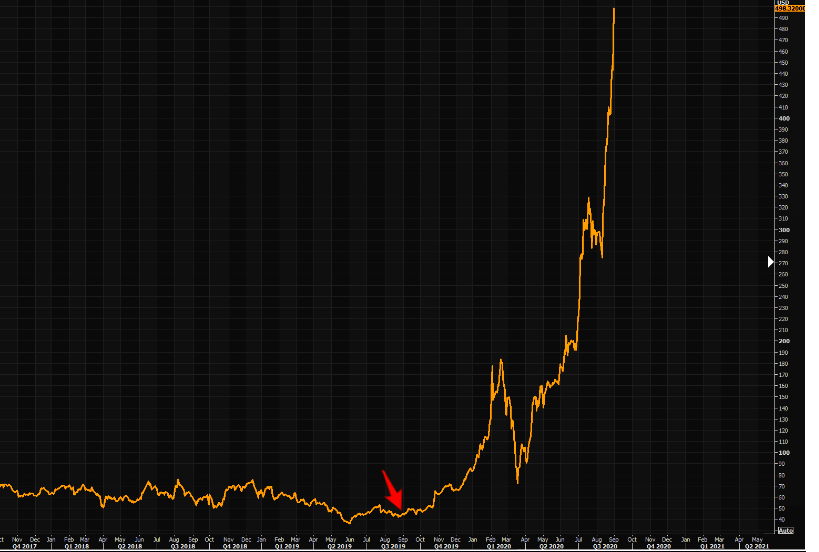
Tesla’s 1000% – one year ago it closed at $45.12…currently near $500. And with that, Elon Musk moves into top 3 (or 4) on Bloomberg Billionaires Index. Electrons against hydrocarbons and Wall Street is voting for electrons.

Elon Musk has overtaken Mark Zuckerberg to become the third-richest person in the world, according to the Bloomberg Billionaires Index. The Tesla founder is now worth $115.4 billion to Zuckerberg’s $110.8 billion, as shares in the electric vehicle behemoth continued their rally on Monday after undergoing a forward stock split. Musk’s net worth has grown by $87.8 billion this year as shares of Tesla, now with a $464 billion market value, soared almost 500%. Amazon’s Jeff Bezos is still the world’s richest person, worth more than $200 billion. (LinkedIn)

As Musk triumphs with electrons, Zoom CEO is rising with bytes.

  • Zoom CEO Eric Yuan made $5.2 billion Monday after his videoconferencing company reported record quarterly earnings, Bloomberg reports.

  • Zoom said its revenue during the second quarter was 355% higher than it was during the same period last year, shattering analysts’ estimates.

  • Yuan, along with Jeff Bezos and Elon Musk, is among the highest-earning billionaires throughout the coronavirus pandemic.

  • Zoom saw a major boost in market value as schools, companies, and social functions transitioned online to promote social distancing, with increasing reliance on videoconferencing technologies for day-to-day life.

  • Bloomberg now estimates Yuan is worth $16.4 billion, a more than 360% increase from his net worth at the start of the year.

The Need to Regulate the Production and Sale of Skin Bleaching Cream

0

A friend told me about her house help that uses a popular brand of cheap bleaching cream and what it did to her skin. According to her, the help’s skin was so discoloured and wrinkled that she couldn’t allow her to handle the house cooking or feed her baby. She said that when it became too unbearable for her to see the help in that form, she decided to change her cream for her. So, my friend seized her help’s cream and gave her another one that had no bleaching effect. Well, the help left a few weeks after my friend’s decision and, you know the most amazing part of the story, she returned the new cream my friend gave her, intact. She did not even break the seal on the cream. She preferred staying dry to using a non-bleaching cream.

I have always wondered why women, and even men, bleach their skins. I have always asked if they did not see people, whose skins were damaged by bleaching creams. I have asked if they thought that bleaching creams will give them flawless light-complexioned beautiful skins. I mean, why do they even believe that what is inside a bottle can change their original skin colour and still make them look good? Worst of it all is that most of them go for very cheap ones.

I know that most people that change their complexions seek for social acceptance but, unfortunately, they earn themselves social rejection. As a child, I was taught how to find people that bleached their skins (check back of the ankles and elbows) and when we see them, we start singing “Iru Fanta okpa Coke” (Fanta face and Coke leg). We make mockery of them even though we do that from a distance. But society never accepts people that changed their skin colour.

Whenever I see people that bleached their skin, I wonder if they know how pathetic they look. I doubt if they know that they have developed red-toned skins that look as if they were stretched. Their veins and arteries are visible and greenish-blue in colour. In fact, the criss-cross intersection of their veins reminds one of the pictures of road networks of a city at night. Their palms and feet remind an onlooker of a well-roasted boli (roasted unripe plantain). Their skins are multicoloured; many look like they were painted by customers for a TV show. Worse of all, they smell. Yes, a little increase in temperature and the people that bleach sweat profusely and smell like the meat you left inside a poly bag overnight.

A lot of health practitioners have been campaigning against bleaching the skin. The side effects of this are more than giving the person a rainbow-coloured zebra-crossing complexion, where no part of the body is evenly toned. The effects are also more than ageing the skin. From what I have heard from health practitioners, bleaching the skin affects and damages internal organs too. From their explanations, the skin can absorb this cream and the active ingredients will find their way into the bloodstream. Apart from causing skin cancer, these active ingredients can affect the kidney, bladder and liver. So why would someone want to alter his melanin just because he or she wants to look…good? I don’t think so.

It may be hard to discourage people from bleaching their skins, but it can be controlled. When Nigerians started committing suicide with Sniper, the government banned it from the open market. Right now, you can’t see Sniper displayed on counters or moved around in push trucks and wheel barrows. It may still be in circulation but it is out of reach of a lot of people. Why then has the government not done to bleaching cream what it did to Sniper?

People may say that those that want to bleach their skins should be allowed to do so. Of course, this is a logical argument considering that cigarettes are still sold in every nook and cranny of the country despite its health hazard. But, how many times have you heard the government insisting that the companies that make bleaching cream include its health hazard on the label? How come these manufacturers are allowed to lie to people with pictures of the “before” and “after” of beautiful women, who they claimed used their products? What is the job of the Standard Organisation of Nigeria (SON) if not making sure that products are up to the standard they claimed? People may take decisions to kill themselves, but they should be given an opportunity to reconsider those decisions.

Of course, the job of the government should be to make it hard for those that buy bleaching cream to do so. It can decide to regulate its production and sale. It may decide that only pharmaceutical companies should produce and sell it. It may insist that people should buy it only with a doctor’s prescription. The government can do a lot of things to take these products off the open market and discourage its production. Right now, every Tom, Dick and Harry can buy chemicals and mix up a bleaching cream, pour the liver-killer into a bottle, paste a beautiful label on the bottle and then throw the product into the open market. Our overzealous young men and women will rush that product and, tomorrow, they will come out with damaged external and internal organs.

Opera Launches Nanobank As it Divests Nigerian Subsidiary

0

Opera, a leading global internet brand has announced the launch of a new addition to its number of businesses. The Norway-based company announced through its Q2 financial report, the creation of Nanobank, to reach more markets around the world.

“Opera today announces the formation of Nanobank, creating the largest emerging markets dedicated fintech companies in the world. Nanobank is being created by consolidating the relevant businesses and technology platforms from Opera with those of Mobimagic, reaching a combined registered user base of approximately 50 million people,” the company said in a statement.

Opera is focusing on fintech in the wake of COVID-19 disruptions. Combined earnings of Mobimagic and Opera generated $209 million in revenue and a pre-tax profit of $68 million in 2019, and $120 million in revenue on $10 million loans disbursed with a total value of $686 million, the company said.

The impressive result has inspired Opera to seek expansion into new markets. The chairman and CEO of Opera, Yahui Zhou said fintech offers the company enormous space to make profit, and they intend to expand into new markets through the consolidation of their successful companies.

“Our ambition and potential in the fintech space enormous. We are now taking the next steps to further boost this business – making it even larger, consolidating profitability between two highly successful companies, and realizing benefits of scale to support attractive cash generation,” Zhou said.

He explained that Nanobank will operate as a separate company, to enable flexibility for both Nanobank and Opera, including the chance to take strategic investors or float shares.

The company said it is looking to do financial businesses beyond microlending, though it has yielded significant growth despite the downturns of COVID-19. Nanobank expects to fuel growth through scaling in existing markets, continued geographic expansion, and from the launch of financial services beyond microlending.

Opera will own 42% of the equity interest in Nanobank, while Mobimagic’s shareholders will own a combined 58%. The company said it expects to report a one-time gain in the third quarter as a result of the Nanobank transaction, currently estimated to exceed $100 million as Nanobank becomes an equity accounted investee for Opera.

Opera’s CFO, Fred Jacobsen said that the company’s users’ metrics have stayed strong and year-over-year revenue trends have improved monthly since it plummeted in April, due to the impact of coronavirus.

However, the company reported a slow recovery of its microlending revenue, and said 42% of it would be replaced by the newly introduced Nanobank results.

“Microlending revenue and OPEX will be replaced by our 42% of Nanobank’s results as of August 20th” as it is expected to show “strong sequential revenue growth in the third quarter and expand margins as the business scales back up.”

Among the newly introduced initiatives are OList and European fintech, which is expected to start generating limited revenue in the 2H of the year, although 2021 is the targeted year. Opera’s co-CEO, Song Lin said the initiatives have been encouraged by the inflow of 379 million active users as of July, and the European fintech is being tested in Spain as the company aims to capture European markets.

“We continue to push forward on our new initiatives such as OList and European Fintech, and we are pleased with the progress we’ve made over the last several months. We are now testing our initial and innovative buy-now-pay-later product, in our first major market, Spain.

“We’ve acquired a small number of users already with plans for a formal launch later in the year, all of which is aimed at having European Fintech become a significant contributor to revenue next year,” he said.

Lin acknowledged that the push to expand into European and North American markets has been spurred by the growth in Africa and Asia where it has many thriving products especially, financial services.

Although Opera recorded 10% revenue decrease to $55.4 million, the overall performance of its businesses resulted in the reported gains.

However, Opera said it has made a $6.1 million divestment from a Nigerian subsidiary without mentioning a name. Therefore, it has left many wondering which of its Nigerian subsidiaries it could be.

Analysis run by Techcabal pointed at Okash. Opera’s Q2 report highlighted the progress of its services in Nigeria, excluding Okash. The software company acquired OKash from OPay in December 2018 for $9.5 million, but the lending service has proved to be lagging behind its counterparts in India and Kenya.

The Q2 report noted that Kenya with OPesa and India with Cashbean have been Opera’s biggest market in lending, with average loans of $40 and $50 respectively, while Nigeria’s Okash was notably omitted. Opera mentioned countries it’s planning to take its Nanobank operations to, and Nigeria isn’t one of them.

This development suggests that the divested company must have been OKash, and that OPay must have snapped it up.