DD
MM
YYYY

PAGES

DD
MM
YYYY

spot_img

PAGES

Home Blog Page 617

For the Horse To Fly in Union Bank, Feed It With Better Tech and Service

0

Wishing the horse good luck as it prepares to fly: “Union Bank of Nigeria, one of the country’s oldest financial institutions, has officially completed its merger with Titan Trust Bank Limited, following final approval from the Central Bank of Nigeria (CBN).”

Union Bank has a new opportunity because we have seen how the “elephant” [First Bank] is dancing in Nigeria. So, if an elephant can dance, a horse can fly. I truly wish the horse the best of luck because it is a good horse.

In the old Union Bank branch in Adeola Hopewell, Victoria Island, Lagos, I ran a savings account. And when I left the banking sector, with the employee bank account closed, Union Bank graciously waived some restrictions, making it possible for Diamond Bank to send me money via money market. Most banks would not have been flexible, but they accommodated me, as according to them, they knew I had left Nigeria based on a treasury bill instruction I had given weeks before.

When a horse can be that kind, that horse deserves to live stronger. The custodians must feed the horse better tech and service so that it can fly more customers. Fly better paths, horse union!

Union Bank Completes Merger with Titan Trust Bank, Marks New Chapter in Nigeria’s Banking Evolution

0

Union Bank of Nigeria, one of the country’s oldest financial institutions, has officially completed its merger with Titan Trust Bank Limited, following final approval from the Central Bank of Nigeria (CBN).

The milestone, announced on Thursday, signals not just the end of a transaction that began with a Share Sale Agreement in 2021 but also the beginning of a new era for Nigeria’s banking industry.

According to Mrs. Olufunmilola Aluko, Union Bank’s Head of Brand and Marketing, the merger consolidates Titan Trust’s agility and innovative strength with Union Bank’s 108-year legacy of stability and trust. Under the arrangement, Union Bank fully absorbs Titan Trust’s operations and assets, with the Union Bank brand continuing as the sole identity. Titan Trust Bank ceases to exist as a separate entity.

With an expanded footprint that now includes more than 293 service centers and 937 ATMs across Nigeria, as well as strengthened digital platforms, the combined bank is positioning itself to deliver greater value across retail, SME, and corporate markets.

Union Bank’s Managing Director and Chief Executive Officer, Mrs. Yetunde Oni, described the transaction as “a pivotal moment in our 108-year journey, and a launchpad for delivering greater value to our customers. By blending stability with innovation, we are better positioned to meet the evolving needs of Nigerians and to be their most trusted financial partner.”

Echoing this, the Chairman of the Board of Directors, Mr. Bayo Adeleke, framed the consolidation as “a new era of growth, collaboration, and shared prosperity. By bringing together the strengths of both institutions, we are committed to creating lasting value for our customers, shareholders, and communities while advancing Nigeria’s financial inclusion agenda.”

The bank emphasized that customers will not experience disruptions, assuring that account details remain unchanged and services will continue seamlessly. An accelerated focus on enhanced digital solutions is also underway, reflecting the wider shift in Nigeria’s banking landscape toward technology-driven service delivery.

A Backstory of Transformation in Nigeria’s Banking Sector

The Union Bank–Titan Trust merger is part of a broader restructuring trend that has shaped Nigeria’s financial industry for decades. Union Bank itself has undergone waves of transformation. Founded in 1917 as Colonial Bank, it became Barclays Bank of Nigeria in the 1920s before assuming its present name in 1979, following indigenization. For much of the 20th century, Union Bank was regarded as one of Nigeria’s “big four” banks, symbolizing stability and reach.

However, in the wake of Nigeria’s banking consolidation under the Central Bank’s reforms in the mid-2000s and rising competition from newer, tech-savvy institutions, Union Bank began to lose ground. By 2012, a recapitalization plan saw a consortium of investors led by African Capital Alliance inject funds to rescue the bank. Since then, Union Bank has fought to reposition itself in a highly competitive market dominated by GTBank, Zenith Bank, Access Bank, and others.

The entry of Titan Trust Bank in 2019—one of the youngest commercial banks in Nigeria—marked a new disruption. Despite its short history, Titan Trust quickly became a challenger, leveraging innovation, speed, and strategic capital backing to make inroads where older banks were struggling.

In December 2021, Titan Trust Bank signed a Share Sale and Purchase Agreement (SPA) with Union Global Partners Limited, Atlas Mara Limited, Standard Chartered Bank, and other core shareholders, who collectively held 93.41 percent of Union Bank’s issued share capital. The agreement paved the way for TTB to acquire 89.39 percent of Union Bank’s shares in the first tranche, with subsequent regulatory clearances confirming its majority ownership.

Its 2021 acquisition of a majority stake in Union Bank was widely seen as a bold statement of intent, signaling how younger, well-capitalized players could reshape the industry.

Implications of the Consolidation

Analysts note that the merger underscores a global trend in banking where older, legacy institutions consolidate with newer, more agile entrants to remain relevant in a fast-changing environment. For Union Bank, absorbing Titan Trust’s operational model and digital culture could accelerate its push into tech-driven banking solutions, a necessity given Nigeria’s booming fintech ecosystem and the growing demand for mobile-first services.

As the dust settles, the completion of this merger may well determine whether Union Bank can regain its stature as a leading force in Nigerian banking—this time not just by heritage but by innovation and resilience in an increasingly digital age.

Cardano Price Prediction: ADA Aims for $100 Billion Market Cap and Top 5 Ranking as Little Pepe (LILPEPE) Holders Brace for Huge Gains

0

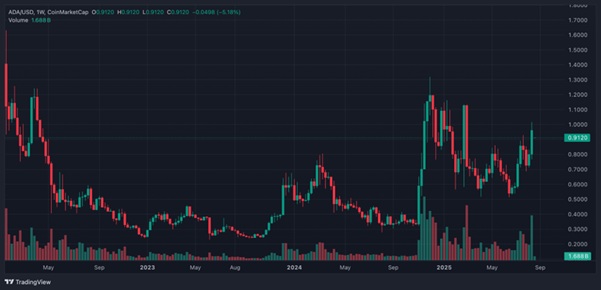
Cardano (ADA) is at $0.9298, reflecting an 8.83% increase over the past 24 hours and a trading volume of approximately $2.54 billion. Despite a slight weekly decline of 4.10%, ADA has shown impressive yearly growth, surging by 144.74%.  The latest Cardano price prediction suggests ADA is aiming to reach a $100 billion market cap and climb into the top 5 cryptocurrencies. At the same time, Little Pepe (LILPEPE) holders are closely monitoring ADA’s trajectory, anticipating huge gains as market sentiment turns increasingly bullish.

Cardano Price Prediction: ADA Targets $100 Billion

Cardano (ADA), currently valued at $0.9298, has demonstrated strong bullish momentum in recent days. With more than 65% of ADA’s supply staked, the reduced circulation is contributing to upward price pressure.

ADA Price Chart via TradingView

This structural advantage supports the latest Cardano price prediction that ADA could triple its market cap and hit the $100 billion milestone, achieving a top 5 ranking. The Cardano price prediction highlights this as more than speculation, market structure, staking activity, and technological progress provide tangible support for ADA’s push toward the top 5 rankings.

Little Pepe (LILPEPE): The Meme Coin Built Differently

While Cardano charts its path to a $100 billion market cap, Little Pepe (LILPEPE) has captured the attention of meme coin enthusiasts. Built on a dedicated Layer 2 blockchain, Little Pepe offers ultra-low fees, lightning-fast transactions, and support for decentralized applications. Unlike traditional meme tokens, LILPEPE focuses on utility and community strength, making it stand out in an overcrowded meme token landscape. From its earliest presale stages, demand for LILPEPE has been overwhelming. Starting at $0.0010, each round has sold out at record speed, with Stage 11 closing faster than expected. Stage 12 is currently priced at $0.0021, and with a projected launch price of $0.0030, early investors are already securing impressive returns.  The presale allocation of 26.5% of the 100 billion total supply has drawn in millions of unique wallets, demonstrating widespread community excitement.

Little Pepe Holders Expect Huge Gains

Little Pepe (LILPEPE) has become one of the most talked-about meme coins in 2025, with price growth potential that could soar over 67,900% from presale to peak projections. The project’s identity as “the world’s only chain where sniper bots won’t work” has added credibility among traders tired of unfair practices in other meme projects. Its roadmap showcases clear plans for expansion, with multiple utilities in the works, including NFT integrations and community-driven dApps. The project has also passed a full audit by CertiK, achieving a security score of 95.49%. This audit reinforces the trust investors place in Little Pepe, establishing it as one of the most secure meme tokens on the market.

LILPEPE’s Growing Reputation and Community Strength

Crypto experts—many of whom played roles in earlier top-performing meme tokens—are quietly supporting the project, giving Little Pepe an edge in market strategy and execution. With its listing on CoinMarketCap and increasing social media traction, the coin is quickly rising in popularity. The community-driven culture around LILPEPE is also unique. Rather than focusing purely on speculation, the project embraces humor, creativity, and strong decentralization values. From the “swamps of Solidity” to the “jungles of JavaScript,” the story of Little Pepe adds to its charm while strengthening its brand identity.

Cardano Price Prediction Meets Meme Coin Momentum

The Cardano price prediction of reaching a $100 billion market cap provides a broader bullish backdrop for the crypto space. Investors watching ADA’s progress are also allocating capital into meme coins like LILPEPE, seeking explosive growth opportunities.  As ADA advances toward the top 5 rankings, the positive sentiment could spill over into community-driven tokens that capture investor imagination. Little Pepe (LILPEPE), with its successful presale, community backing, and strong security credentials, is well-positioned for a massive breakout. Holders are bracing for gains that could define the next wave of meme coin success stories.


For more information about Little Pepe (LILPEPE) visit the links below:

Website: https://littlepepe.com

Whitepaper: https://littlepepe.com/whitepaper.pdf

Telegram: https://t.me/littlepepetoken

Twitter/X: https://x.com/littlepepetoken

Managing Work Stress: The Role of THC in Business Anxiety

0

The pressures of modern work life can trigger significant anxiety for many professionals. Balancing a demanding workload, maintaining deadlines, and maintaining relationships with colleagues all contribute to rising stress levels. This article explores how THC, a compound found in cannabis, has emerged as a potential tool for managing work-related stress and anxiety.

The Science Behind THC and Stress Relief

Recent studies indicate that THC, short for tetrahydrocannabinol, interacts with the endocannabinoid system in the human body, which plays a key role in regulating stress and anxiety levels. When THC binds to cannabinoid receptors, it can lead to feelings of relaxation and euphoria. This effect can help individuals cope with the pressures of work environments, which often exacerbate anxiety. Research from the National Institute on Drug Abuse highlights that THC may reduce feelings of anxiety at lower doses, helping to balance mood.

As professionals face various workplace challenges, exploring the benefits of THC can be a helpful option in addressing their mental well-being. Individual experiences with THC can vary based on specific strains used. Some strains may promote relaxation, while others might energize or enhance creativity. Whether you explore Presidential OG or a different strain, selecting the right type might significantly influence how one manages stress in various work settings. Experimentation under safe and legal conditions is often recommended to find the most suitable option.

Dosage control is equally important, since too much THC may heighten anxiety rather than reduce it. Pairing THC use with mindfulness practices such as meditation or deep breathing can amplify the calming effects. Some individuals report improved sleep quality, which directly supports stress management. THC’s potential as a tool for relaxation depends greatly on responsible and informed use.

Impact of Stress on Workplace Productivity

High levels of stress can diminish productivity and impair an employee’s ability to focus on tasks. According to studies conducted by the American Psychological Association, stress contributes to lost productivity, costing employers billions annually in lost work hours.

Employees overwhelmed by anxiety often face increased absenteeism, disengagement from their roles, and challenges in communication with colleagues, leading to a toxic work environment. In contrast, an environment where stress is managed effectively can lead to greater job satisfaction and enhanced performance. Research shows that companies that prioritize mental health can experience lower turnover rates and higher employee morale, fostering a more productive workplace.

Integrating THC into Workplace Wellness Programs

Given the increasing acceptance of cannabis in various regions, organizations are starting to reconsider their approaches to managing employee mental health. Integrating THC into workplace wellness programs could involve providing education on responsible use, techniques for stress management, and alternative therapies. These programs can benefit employees by creating an open dialogue about mental health and reducing stigma around discussing cannabis use for stress relief.

Companies might take into account incorporating resources like workshops or collaborations with experts in cannabis wellness to educate staff effectively. Organizations must address the legalities surrounding cannabis use when developing these wellness programs. Establishing clear guidelines and ensuring compliance with local and federal laws can create a safe environment for employees exploring THC as a coping resource.

Potential Risks and Considerations

While THC could provide relief for some individuals, it’s important to think about the possible risks associated with its use. Individuals new to cannabis may find that their response to THC can vary greatly, leading to unexpected side effects such as increased anxiety or paranoia, particularly in high doses.

Workplace policies may dictate specific drug use regulations, and violating such policies could result in disciplinary actions. Employees should be mindful of their company’s stance on cannabis, ensuring responsible and informed choices regarding its use, even for stress relief. Understanding personal limits and seeking guidance from professionals can help navigate the complexities surrounding THC use.

Alternative Stress Management Techniques

Besides THC, a multitude of alternative methods can help manage work-related stress effectively. Practices such as mindfulness meditation, physical exercise, and therapy have shown promise in reducing anxiety levels. Implementing mindfulness techniques into daily routines may provide a sense of calm and clarity amidst chaos.

Physical activity offers another powerful outlet for stress relief. Exercise stimulates the release of endorphins, chemicals in the brain that act as natural painkillers and mood elevators. Incorporating regular fitness activities into daily work schedules, even short breaks for brisk walks, can enhance focus and alleviate stress.

Therapists specializing in workplace-related anxiety may offer tailored strategies for individuals struggling with their emotional health. Professional support can equip employees with coping mechanisms, enriching their toolkit for handling stress. Incorporating these alternative practices alongside considering THC can lead to a holistic approach to managing work anxiety. By diversifying their methods, employees can enhance their emotional resilience against workplace pressures.

As workplaces evolve, understanding and addressing stress has become a critical component of employee wellbeing. THC presents an interesting avenue for alleviating anxiety, but it’s important to approach it with caution. By fostering open conversations about mental health, integrating various stress management techniques, and ensuring responsible cannabis use where appropriate, employees and employers can work together toward a healthier, more productive work environment.

Egypt-based Fintech Munify Secures $3M Seed Funding to Transform Cross-Border Finance for Egyptians

0

Egyptian fintech startup Munify has raised $3 million in seed funding, led by Y Combinator, with participation from BYLD, Digital Currency Group (DCG), and other strategic investors.

The fresh capital will fuel the company’s expansion into new markets, bolster regulatory and banking partnerships, and scale its engineering and compliance teams.

Commenting on the round, Munify founder and CEO Khalid Ashmawy said,

Remittance flows are one of the most critical financial lifelines for Egypt, yet millions still face costly, slow, and fragmented services. We’re building the infrastructure to make global banking and payments radically more accessible for Egyptians, wherever they live.

Founded in 2024 by Khalid Ashmawy, Munify is redefining how Egyptians abroad and businesses manage money across borders. The fintech is the cross-border Neobank for the Middle East and its diaspora.

With services already available in the U.S., U.K., Europe, and the GCC, the platform targets freelancers, SMEs, and Egyptians overseas, many of whom struggle with high remittance costs, delayed settlements, and rigid payout options.

As more Egyptians turn to freelancing and remote work through platforms like Upwork and Fiverr, reliable cross-border payment solutions are becoming essential.

Traditional ways of receiving USD into Egypt are full of obstacles. Bank transfers can take days (or weeks) and often come with hidden fees. Many platforms force freelancers into rigid payout methods that consume much of their earnings. And in some cases, accounts can even be frozen for unclear “safety” reasons.

Munify ensures that workers and entrepreneurs keep more of their earnings while avoiding the friction of traditional banking systems. The fintech makes this process seamless.

With a USD account and virtual cards in one app, Egyptians can:

  • Receive USD directly from clients and platforms.
  • Use virtual cards to shop online or pay for services instantly.
  • Send funds home or withdraw when needed, without losing money to unnecessary fees.

For remote workers, it means less stress about how payments will arrive.

Notably, in today’s interconnected world, businesses are increasingly global-serving customers, hiring talent, and managing suppliers across multiple countries. However, this global reach brings significant complexity, especially when dealing with multiple currencies.

Traditional banks often require businesses to open separate accounts in each country, leading to high fees, poor exchange rates, and administrative headaches. Currency conversion delays and the lack of transparency in international transfers can erode profits and slow down business operations.

Munify’s multi-currency accounts are designed to solve these challenges by offering a single dashboard to manage balances in USD, EUR, GBP, and more. This streamlined infrastructure gives businesses greater control, flexibility, and clarity over their global finances, reducing the need for multiple bank relationships and simplifying cross-border operations.

By integrating multi-currency accounts with tools like invoicing and payouts, Munify eliminates the need for businesses to open separate bank accounts in each country. This reduces costs, streamlines operations, and provides flexibility for companies managing global suppliers, employees, and customers.

Looking Ahead

With its mission to simplify money movement and empower financial independence, Munify is positioning itself as the leading embedded finance platform in the MENA region.

By merging secure, innovative, and scalable financial solutions, the startup aims to unlock new growth opportunities for both individuals and enterprises in an increasingly interconnected economy.