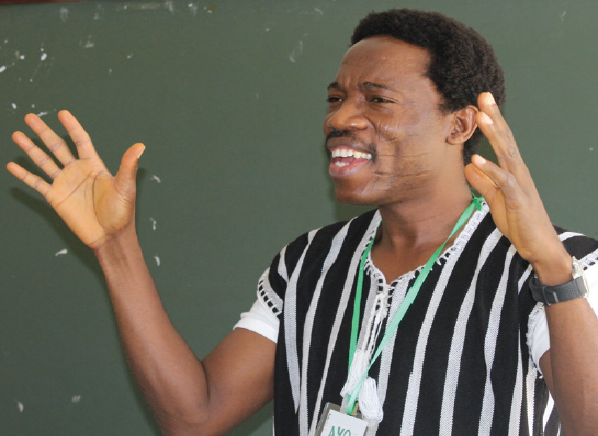
Professor Ayobami Ojebode is the immediate past Head of Department of Communication and Language Arts at the University of Ibadan. During his 9 years of being the Head of the Department 41 PhD graduates and 13 first class degrees were produced. Professor Ojebode has been deploying his skills, knowledge and experience in development communication and studies towards sustainable development in Nigeria and Africa since 2002. In this piece, he speaks with Tekedia on how to produce quality PhD graduates and the need for embracing professional PhD certification in Nigeria.
Excerpts
Tekedia: Recently, you completed nine years of heading the Department of Communication and Language Arts. Can you take us through how it started?
Ojebode: Well, it was a short story that became long. Living is like conducting research. You know where you start, you never know where it will end. I was appointed Acting Head of Department in 2011 for two years. In 2013, I completed the term and I was to either leave or get a renewal. There was a prolonged strike and no meetings could be held. All Heads of Departments at that time whose terms were up stayed on because of the strike. By the end of the strike, the Department met (led by the Dean) and I was asked to step aside. The meeting came to a unanimous decision to recommend to the Vice Chancellor that my term be renewed for another two years. The VC sent a letter to inform me that my term had been for a period of one year, and thereafter for two years. It was a shock. That was how I got to spend 5 years on that seat. At the end of the 5 years, I had been promoted professor, and was the only fulltime full professor in the Department. The Vice Chancellor, following tradition, appointed me full Head of Department for 4 years. That was how we came to the 9 years you talked about. I did not want or wish for it; and I did not like it but then things went that way.
Tekedia: Over the years, stakeholders in the education sector have been saying that the sector is underfunded. As a former head of an academic unit in the University of Ibadan, what was your experience on getting timely funds from the University to run the department? What was your experience sourcing for funds using external sources, especially your past students?
Ojebode: The university system in Nigeria is certainly underfunded and mis-funded. These are two different things. The Federal Government and the States, and I must say, goaded by the Academic Staff Unions of Universities assume the responsibility of paying every student’s tuition. In other words, they wanted a tuition-free university system. Till this very hour, ASUU still supports, I almost said, demands that tuition-free regime in support of poor students. However, government has not been able to rise up to the demands of this tuition-free boast of theirs. Universities are forced to find ways of augmenting what the government gives – and one must quickly add that this is not peculiar to Nigeria. In the US, public universities do not depend totally on any government. They charge heavy fees and still have to scout around for grants and foundation supports and so on from all sorts of sources. In my own case, I had to look for fund for a number of projects that we executed down to what can go for even capital project such as provision of inverter and solar panels for staff; purchasing a departmental car; inviting professionals to spend time with students etc. We hardly ever had anything in the official wallets of the department that could cater for all these needs. I said that universities are also mis-funded. You might be wondering what that means. Our university system has been set up pretty much like civil services with its bureaucratic clogs and hindrances. These all create stupendous wastages.
Take for instance, and I am sure this will offend people, a situation where number of non-teaching staff far exceeds that of teaching staff. And this is what you have in all government universities. You must pay salaries. Some of these staff rise to levels and occupy positions where they must ride cars and have drivers and secretaries and messengers. The university must pay for all of these. It is only just and fair that you pay people since you employed them. And don’t ask me if we need these people. Once people are employed, they must somehow find work to do. So, you have employed seven people to do the work of two. Good. Instead of that file to move from Table 1 to Table 2 and get completed, it must move from Table 1 to 2 to 3 to 4 up until 7 people have to justify their pay. You see? So, so much money is spent in the university that has absolutely nothing to do with the vision and mission and calling of the university. And I am not blaming the non-teaching staff or denigrating them. I am simply saying we have set up a system that thrives on avoidable delay and wastage, a behemoth like the NNPC, that drains much more than it produces. Do you know that if a classroom is leaking, the Vice Chancellor does not have the power to take money meant for replacing official cars to mend the leaking roofs? In the Faculty of Arts, in 2018-19, academic staff had to contribute money to fix dilapidated classrooms. I headed the committee that was in charge of that, and I was very proud of my colleagues.
Tekedia: This year your department will be celebrating its 45 years of existence. What have been the contributions of the Department to global academic community and Nigerian society?
Ojebode: It is difficult to talk about ourselves. Let me show you something. Talking about our contributions to the global academic community, our products have headed or are heading nearly two-thirds of Departments of Mass Communication or Communication Arts or Language Arts in this country. Two of our products have been vice chancellors. Others have been directors of institutes and so on. Outside of Nigeria, our products are doing extremely well in the academia. In the industry, both home and abroad, our products are leaders with distinction. In marketing communication, in public relations, and in both print and broadcast journalism, they are distinguishing themselves.
The first person to obtain a First Class degree in the Department rose to a top-level position in the extractive industry as a public relations person and then went on to serve as Director General of the largest television network in Africa. Even before they graduate, our students start clinching awards in tough national and international competitions. For instance, Nneamaka Okafor, came first in the 2012 selection test for the Cannes Lion’s International Festival of Creativity. The second and the third positions were also won by our students.
In 2018, we emerged the Best School of the Year at the year’s Creativity Week, at the annual advertising event organised by Chini Productions in collaboration with the Roger Hatchuel Academy of France. One of the four students who represented us, Miss Ayomikun Akinlosose, won the Silver Medal at the event and that entitled her to a fully funded trip to the Dubai Lynx Festival in 2019. Miss Ayoyemi Oladipo won the Advan Award for Marketing Excellence in 2018 while Nifemi Williams was the second runner-up at that competition. This year, Ayoyemi Oladipo won the first prize in the Miami Ad Scholarship Competition. I can go on and on. I can tell you of Gbenga Adeoba, one of the most quiet students I have ever taught but a young man deep in thought and gifted in words. He was the winner of the 2019 Sillerman First Book Prize for African Poets. Or Kunle Shittu, or Chris Ogunlowo or Damilola Banjo or Tunde Bada.
Tekedia: It’s a common knowledge that getting a first class in social sciences, arts and humanities courses is difficult. But recently a report says under your headship you produced 13 first class graduates in 9 years. Can you walk us through the strategies and tactics you and the staff employed to attain the feat?
Ojebode: I agree with you that obtaining the first class is a difficult task, especially in the Humanities in the University of Ibadan. In our case, it once appeared that it was meant for the gods because for some 36 years, we managed to produce only two. But in 9 years, we added 13 to that number. Well, I honestly cannot explain how it happened. We did not hold a meeting in the Department or anywhere to say, ‘now we must produce first class’. Even if we decided as a department that we must now produce first class, you know these students take many, many courses outside. For graduates in the first class, you must score very high in all these internal and external courses. What I can say however is that all those who have obtained the first class in the Department have gone on to prove their mettle as postgraduate students and as people in the industry. They have been amazing ambassadors.
Tekedia: Now, let us discuss doing PhD programmes in Nigerian universities and doing PhD programmes in foreign universities. Any similarities and differences?
Ojebode: Here and everywhere, a good PhD is a huge amount of work. It takes a heavy toll on the student and also on the supervisor. Those who complete the PhD without tales of difficulties are rather few. Such stories hover around lack of materials, difficult learning environment, and difficult supervisors. I was of the opinion that doing a PhD in Nigeria is more difficult than doing it in any other place in the world because of the factors I just enumerated until I began to listen to colleagues from other parts of the world. Last week, in our doctoral academy, we were mourning the death of a PhD student in Pakistan who committed suicide after staying on the PhD for fifteen years. One is not sure if that extreme action was connected to the PhD, was due to something else or was a product of a combination of many factors. This just suggests that the PhD is a demanding degree everywhere. I think private universities in Nigeria have the fastest PhD lane right now.
Tekedia: What do you think students and stakeholders in Nigeria need to do to improve PhD training in the country?
Ojebode: I can tell students to work hard, and to define for themselves a vision for their PhD. Have clear goals, and good time management right from the start. Do not come to the supervisor without a convincing idea of what you want to study. You have a Master’s degree, remember. Your confidence and mastery of the content and methods go a long way in determining how people, including your supervisor regard you. Universities also have to work out a framework that monitors supervisors and ensure that imperious supervisors are checked. It should be possible for a student being unduly delayed by a supervisor to have a complaint loop that is taken up at the postgraduate school. A department in the University of Ibadan once read a riot act to students over delay of their studies but it was an indirect riot act to the supervisors.
And it worked somewhat. The fastest PhDs we have produced have also turned out to be the best. In other words, staying long on a PhD does not necessarily improve the quality. Importantly, that administrative “suspension” between the time the final draft is made and the time the defence is organised must be shortened. In UI, it is called registration of title of thesis. It sometimes takes as short as three months; it other times take as long as 18 months. What’s that! Shortening this delay will take the efforts of everyone involved: the student, the supervisor and the department who should ensure that the abstract is top level, and the faculty and the graduate school who should ensure rapid turnaround, and limit comments to those made by experts and near-experts in the field. In a university I know, not UI, a PhD student in literary studies was asked to take their abstract to someone in Physics. I mean, iambic penta-metre sounds pretty much like science but …
Tekedia: In developed countries, we have seen that a number of Universities are doing professional PhD, accepting publications for PhD certification. What is your view on this? Can Nigeria emulate these universities?
Ojebode: Yes, professional PhDs are growing in popularity. And there is nothing wrong in Nigeria considering them. They come in a variety of ways: while some are project-based, others are publications based. Heavy theorisation with detailed methodological specifications is often absent. Concerns have also been expressed about quality assurance in these PhDs, same as for academic PhDs. It is a major concern; universities who are opening up these programmes just to generate funds are not likely to assure quality.
Like this:
Like Loading...