DD
MM
YYYY

PAGES

DD
MM
YYYY

spot_img

PAGES

Home Blog Page 6189

Why a Fool at Forty is NOT a Fool Forever

2

The adage, “A fool at forty is a fool forever” is not indigenous to Nigeria but we have adopted it and even use it more than many of our native wise sayings. In most cases, this proverb is used to address and refer to people, who did not meet up to societal expectations. These expectations usually border around financial independence, marriage and family life, and general conducts. By this saying, a person, who fails to measure up to what is expected of him as an adult, is indirectly referred to as a failure or, worse, a fool.

Ordinarily, in our society, a young man is expected to achieve financial independence and wealth before the age of thirty. He is expected to set up a thriving business, build a house in the village and in the city, buy an exotic car, and then, marry a young damsel, who will help him to manage his wealth. All these should be in place before he clocks thirty. If he is still struggling or has no job or source of income at the age of thirty, know it that his village people will believe that he is an “efulefu” (a fool or a useless person). That is an ideology in an Igbo society. And believe me when I say that it is still present and that it positively and negatively influences our young men. Of course some of them meet up to these expectations, some genuinely, some fraudulently, while others don’t. Those that couldn’t meet up feel out of place.

Like I stated earlier, this ideology still exists in Igbo society as of date. But if we trace its origin, we will find out that it started when an Igbo man doesn’t have to wait for someone to employ him before he starts earning a living. It started in the days when young men grew up and picked up professions, such as farming, hunting, fishing, healing, and the rest of them. In those days, life was simple. So tell me why a young man shouldn’t have his own “obi” before he is twenty?

Some decades ago, young Igbo men still “hit” it early. But then, most of them go into apprenticeship at ages as early as nine or ten. They will stay with their “masters” for about seven years, so that by the time they are like eighteen years old, they are already managing their masters’ businesses as well as planning towards setting up their own. In those days, most Igbo boys own their own businesses before the age of twenty. I know this because while we were in the university, our age mates that “dropped” out of school after primary education were already “Big Men”. Then, they used to drive their exotic cars to UNIZIK to look for wives while their mates struggled to write assignments and jump buses. But, is the society still the way it was then? Your guess is as good as mine.

Now, formal education is the in thing. Everybody wants his children to become graduates and work in banks or telecom companies. People want their children to become doctors, lawyers and accountants. They no longer think that trading, mechanics, welding, and the rest are commendable professions. Things have changed and it has affected everything. This is why I said that a fool at forty is not a fool forever.

Some people do not realise that it does not take time before one attains the age of forty. A person that graduates from a higher institution at the age of twenty to twenty-two years may have to sit down and wait for his result to be processed before he heads for his NYSC. By the time he is done with NYSC, he would have been around twenty-five years old or more. By then, he still sees what his mates have seen. He will start jumping from one interview to another. If he by chance finds a job, he will face the fact that salary cannot even pay bills. Now, this is the young man that should build a house, buy a car and marry before he is forty. That is unfair.

The essence of this article is not to encourage laziness among those that are looking for excuses not to hustle. It is not to say that it is impossible these days to make wealth genuinely before the age of thirty. And it is certainly not to scare the youths into believing that they can’t make it before the age of forty. This post is targeted at those who felt that they have failed because they couldn’t meet up to laid down expectations before their fortieth birthday.

Most of us have crossed that line before we even found ourselves. Most successful people in the world did not break through before or during their thirties. People like Col. Sanders found themselves at the age that Nigeria retires people. But he was in society, where he was encouraged and, at the age of 62, he founded KFC, which is in different countries of the world today. People say that age is nothing but a number; that philosophy should also be applied here. That a person wasn’t fortunate to break through before he got into his forties doesn’t make him a failure or a fool. He still has all the time in the world to find himself, if he truly wants to.


Why a Good Product Doesn’t Sell Itself

0

This one thing will happen when you get these insights. It is the fact that your mindset will be improved and your thoughts changed.

Now, imagine the early days when Google was programmed. I believe you could still remember vividly. Yes, it was Sergie Brian and Larry Page that did the foundational development, they became the founders.

Fact, one of the most important websites in the world today is Google search. This is because it is valuable(providing what people need daily).

Onward…

Their vision to make information useful and accessible universally is being realized. Imagine, nobody used that service in the beginning of the company?

I want you to answer this. What would have become the future of Google had it been that they had no users in the early days? I know your answer will be that they would have existed for just a year and folded.

But, that did not happen because they took their product(search) to the market. Marketing or commercialization completes their innovation, that was why  the product became part of our daily utilities today.

That is why we want to know through this analysis why a good product will not sell itself .We shall get started right away. Are you following?  Yes you are.

 Reasons why Good product Doesn’t Sell Itself.

Well, I saw a survey on Linkedin and Watsapp a couple of days ago. Guess, what the survey was about? It was obviously the subject  we are currently discussing.

The poll questionnaire was “a good product sells itself, Yes or no.” According to the poll, the yes had 60% while the no had 35% votes.  But, what I will tell you from experience and learning that it is one of the misleading polls out there.

Here are the reasons why a good product doesn’t sell itself.  

  • Who determines if it is a good product?

The first misleading information is the concept of a good product that sells itself. Who really determines whether a product is good or not?

Is it the entrepreneur that produced it or the user that uses it? As the Tekedia platform and community explains that a product is what the user says it is, the quality of a product is determined by the consumers.

A good example is Took Pick. In Nigeria, it is used as a fork to eat another food (Suya). Yes, the user sees it as both a toothpick and a fork (a type of spoon).

It is the consumer that ultimately determines if your product is good or not.

Until, that is determined, your product remains neither bad nor good. The users determine this through your sales efforts- when they get to use this product.

As they use it, they provide you with feedback about the product. The feedback is part of the process of making a product good.

  • The Market Factor:

A product has two parts which are the production part and the marketing part. A product that is produced without marketing remains incomplete.

As Peter Drucker puts it “Innovation and marketing makes money, others are cost”. That is one of the ways to make money from your product is to market it in order to sell it to the target market. Without this then, your product remains as a part and not as a whole.

  • The Demand Side Needs to be Created.

There are two components of a business that entrepreneurs create. They need to create the supply of a product and the demand for the product. These components don’t just happen, they are the result of cause and effects.

Even the famous first law of motion says every body remains in a fixed state of rest unless an external body acts on it.

While the supply side of your product is the making and production of the product, the demand side is the marketing that sells the product.

These two variables have to be created.

  • The Third law of Value.

One of the profound laws of business and value is the third laws of value stated in 3S Rules. It stated that the value of a product is only determined by the marketing test. The market test is when the product gets to the users and in exchange the users pay the business. The only way to do this is to find the potential users of the product and take the product to them where they are. Without this, the value of your product is still $0.

Armed with these insights, you should pay special attention to your sales and marketing. What matters most to every business is that the product should get to them so as to solve their problems. As such, it has to be taken to them. Therefore, a good product does not sell itself until it is sold


Fly Vetifly – More Helicopter Routes Coming Across Nigeria

1

Vetifly will commence operations in Lagos on Aug 27. I invite our community to join us by downloading the app, on click . Fly over traffic and insecurity. We will be ramping up operations across the nation. I know one is there for Lagos to Ovim (Abia state), to serve Abariba, Ohafia, Isuikwuato, Bende, Aro Chukwu, etc. What routes do you want us to serve? We want to know. Thanks

Good People, we are excited to announce that Vetifly will be going live in a few days. We are set to commence operations. With Vetifly, you’ll now be able to book a helicopter ride with the tap of a button. Flights will commence from the 27th of August. Go here, download Vetifly app (Android and iOS) and book your first flight – https://vetifly.com/download

Prices are lower if booking is done on charter and Lift routes well in advance. Given the demand, prices may increase closer to the day of the flight. So, take action.

How Committees Worded and Framed University of Lagos’ Sacked VC, Professor Ogundipe, in Their Reports to Governing Council

0
Source: University of Lagos’ Committees Extracts, 2020; Infoprations Analysis, 2020

Our analyst has earlier reported how the crisis between Professor Oluwatoyin Ogundipe and Dr Wale Babalakin, the Chairman of the Governing Council of the University conferred complicated status on the Vice Chancellor. In the previous analysis, it also emerged that the sacked Vice Chancellor disregarded procedures, laws and misappropriated N800 million in 3 years.

In the current analysis, our analyst examines the extracts of the Committees set up by the Council to establish its position on the removal of the Vice Chancellor. The extracts, in the form of a report, had 14,382 words and 2,794 unique words. Analysis further reveals that the report has 19.4% vocabulary density, which means the report is complex with lots of unique words. This signifies that the report contains unique words that were not reused frequently.

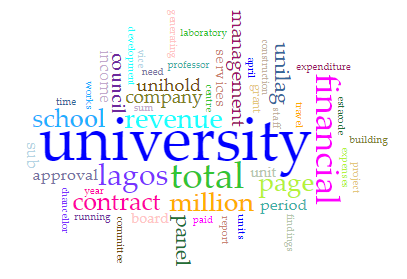
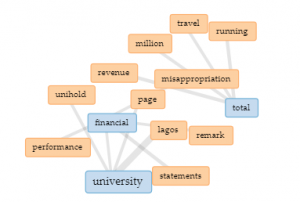
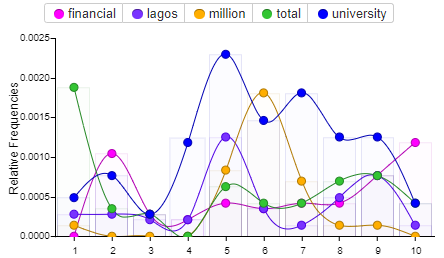
Analysis also reveals that University (161 times) is the most frequently used words followed by total (84 times), financial (73 times), Lagos (59 times) and million (54 times). The number of times of using these words point towards the fact that the Committees worded and framed the sack Vice Chancellor within the contexts of his financial deployment towards the University’s needs and accountability after the deployment [see Exhibit 1 and 3].

Exhibit 1: Link among the keywords in the Committees’ Extracts

Source: University of Lagos’ Committees Extracts, 2020; Infoprations Analysis, 2020

Exhibit 2: Words Dominance

Source: University of Lagos’ Committees Extracts, 2020; Infoprations Analysis, 2020

Exhibit 3: Trends of the Dominant Words

Source: University of Lagos’ Committees Extracts, 2020; Infoprations Analysis, 2020

Court Ruling Buys Uber and Lyft More Time in California, but the Battle is Far from Over

0

Uber and Lyft got a lifeline that saved them from shutting down in California on Thursday. The two companies have been in a legal battle with the state of California over their business model, and threatened to shut down operation in the state if last week’s ruling comes into effect.

The state of California had in May filed a lawsuit challenging the classification of Uber and Lyft drivers as non-employees. The lawsuit argued that it goes against the state’s new labor law (AB5), enacted in January. The law weighed in on a three-part standard to determine the status of an independent contractor. 1 They are free from company’s control; 2 they are doing work that isn’t central to the company’s business; and 3, they have an independent business in that industry.

The three-part standard stands in contrast with the gig economy and e-hailing companies are at the helm of it.

A San Francisco court last Monday ordered Uber and Lyft to reclassify their drivers as employees in 10 days, or by this Friday.

But in a ruling on Thursday, the court gave the companies a lifeline though their travails continue. Uber and Lyft have been pushing for a referendum in November that will exempt them from the AB-5 law. In October last year, the companies, including DoorDash, launched a $100 million campaign to fight the legislation.

With the court’s order delaying the enforcement of the previous ruling, the companies have more time to operate in California under the gig economy.

“we are glad that the Court of Appeals recognized the important questions raised in this case, and that access to these critical services won’t be cut off while we continue to advocate for drivers’ ability to work with the freedom they want,” Uber’s spokesman Noah Edwardsen said in a statement.

The companies said earlier before their request for delay was granted, that they would shut down operation on Thursday night.

“As of 11:59 pm today, the travel operation through our rideshare platform in California will be suspended,” Lyft said in a statement before the ruling. But the company made an update following the ruling. “Rideshare is ON. The California court has granted our request for a further stay, so our rideshare operations can continue uninterrupted, for now.”

In the new deadline issued to the companies by the court, the CEOs of the ridesharing companies are required to submit by September 4, sworn statements with “implementation plans” for complying with the law within 30 days if the court upholds the earlier injunction order and if the referendum fails.

Oral arguments are to begin October 13, and Lyft’s spokesperson Julie Wood said they will keep fighting.

“While we won’t have to suspend operations tonight, we do need to continue fighting for independence plus benefits for drivers,” Wood said in a statement.

Uber and Lyft are counting on their drivers and the public to win the referendum. The companies have been known for inciting public’s empathy just to have their way with the government. They have made it clear that they can’t afford a business model that will require them to pay the minimum wage and other workers benefits, as it will mean less drivers and expensive rides.

But unlike other times when Uber had used public empathy to get away from regulators, coronavirus appears to have worked in favor of the government. Industry watchers said that suspending their services will have little impact on the government’s stand as lockdowns in many US states including California have restricted people’s movement for months, warning riders zeal to fight for cheaper transport.

Uber has been caught up in a very difficult situation in its parent state California, as it is its largest market in the US. The ridesharing company has been weighing its options ever since the AB-5 came into force in May, which includes using a franchise-like model to license its name to fleet operators in the state and avoid employing drivers directly.

The company has argued that drivers are not the core of its business; therefore, the AB-5 law doesn’t apply to them. But the court had dismissed the claim and had ruled against its gig economy that the state said it’s oppressive to drivers and goes against the law.