We are updating this page as readers, critics and reviewers comment on this book. To read this book, you must be a participant in Tekedia Mini-MBA. Join here.
This book is a worthy read to all aspiring, low-fly and high-flying entrepreneurs, including those envious of the privileges that Dangote Empire has enjoyed. Noteworthy to say, I doubt Mr Aliko Dangote himself understands these privileges as a Conglomerate Tax (reward for helping Government out on high-pains by moving upstream) and not benefits of tribalism, feudalism, and/or Northern Nigeria cabalism. (source)
This book is a very amazing piece. It presents concise, well thought-out and very clear insights on how to build companies with focus on solving problems not many people can solve and consequently, have government’s attention and support. Thank so much for this Prof. (source)
Though relatively new in the core business world, this is the best business book I have read after reading some international ones. Thanks, Prof Ndubuisi Ekekwe for this book and all your faculty for this platform. I have taken numerous courses on Coursera and the like, but this platform is down to our business climate. Kudos. (source)
Nice job, thanks! A great read to start a prosperous year journey. (source)
The focus of this book will certainly culminate into creating great African innovators. It is a great book (source)
“This is my best read so far in 2021. I’m reading “The Creative Edge” by Matthew Ashimolowo now, let’s see if it will topple this one”. (source)
“Ndubuisi – a really great effort on this book. Very nice you ask your Tekedia Mini-MBA members to read it as a practical case study. I see things differently now. I never knew that Dangote Group had failed in other ventures. I will check Dangote Noodles, Liberty Merchant Bank, Dangote Capital, etc to learn more. While he gets government support, I can see his success is not only through government since government could not help him in other areas he did not have intrinsic advantages. All my managers are reading and I have asked them to give me one area we can become a king. Elumelu/Ovia for banking, Dangote/ASR for cement, … brilliant perspective and thought leadership”(email)
The insights in this book are educating and inspiring. I have learned what it takes for a business to be a conglomerate( moving from downstream to upstream) with Nigeria as a case study. Thank you very much indeed for this. (source)
Well researched and presented book. I’ve learnt a lot and a good eye opener. (source)
“This book is a very amazing piece. It presents concise, well thought-out and very clear insights on how to build companies with focus on solving problems not many people can solve and consequently, have government’s attention and support. Thank so much for this Prof.” A critic/reviewer, on “The Dangote System”.
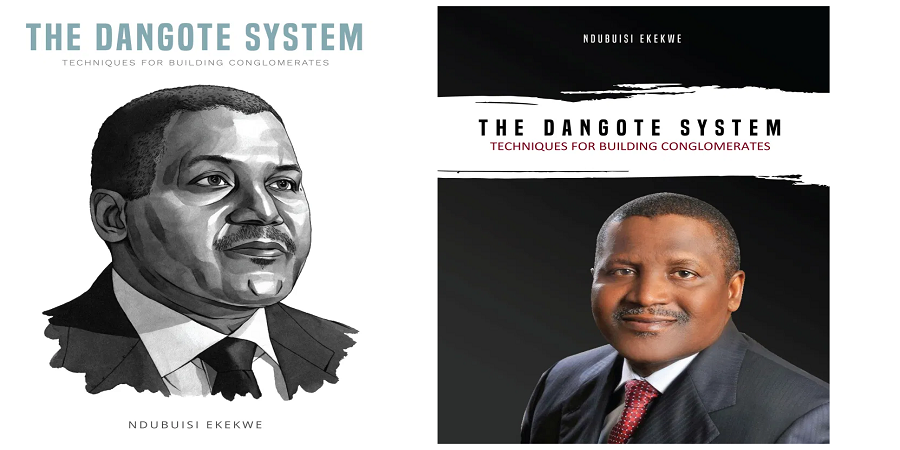
Read “The Dangote System: Techniques for Building Conglomerates”, and master what it takes to build great companies. It is exclusive to Tekedia Mini-MBA participants, register here for full access.
Since the announcement of the removal of Professor Oluwatoyin Ogundipe as Vice Chancellor of the University of Lagos by the Governing Council led by Dr Wale Babalakin few days ago, different reactions have continued to trail the announcement. Our checks reveal that the removal communicated by the Registrar and Secretary to the Council, Mr Azeez Oladejo has led to the emergence of academic and non-academic unions’ insistence on the recognition of Professor Ogundipe as the substantive Vice Chancellor of the institution.
From meetings to the media, Unions in the institution believe that the removal was illegal and that the Governing Council should be dissolved by the Federal Government. As the debates on whether the Council has legal instrument to remove the Vice Chancellor or not rage on, historical retrospect analysis conducted by our analyst indicates that this is not the first time that Vice Chancellor and Governing Council face-off happened in the institution.
Tim Livsey, a lecturer at the Department of African History, University of Oxford. In his book titled “Nigeria’s University Age: Reframing Decolonisation and Development”, the University Don documented how the appointment of Professor Eni Njoku by Aja Nwachukwu [Federal Minister of Education], an Igbo, was not accepted by the leading Yoruba politicians. When Richard Akinjide, a Yoruba, emerged as the new Minister of Education, information has it that the Governing Council refused to renew Professor Njoku’s appointment and Professor Saburi Biobaku (1918-2001), a renowned historian and an Egba man from Igbore, Abeokuta, present day, Ogun State was appointed as Vice Chancellor.
This development nearly led to the death of Professor Saburi Biobaku, when “a radical student activist, identified as Kayode Adams, surged forward from the crowd [during a public engagement with the University Community by Professor Biobaku] and stabbed the Vice Chancellor at the back, ostensibly in protest against Njoku’s removal.” Now, it appears that the history is repeating itself.
As the groups and individuals continue expressing their views on the matter, this piece takes a look at what the law says and what people and entities has said about the issue on digital sphere. Our analyst specifically examines ongoing conversation on the face-off within the Nigerian Twitter Community in relation to the public interest in understanding actors through information seeking using the Internet.
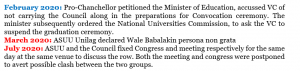
Examining the genesis of the crisis, our analyst discovered that the face-off became public knowledge in February, 2020 within the frame of what could be described as ‘early warning’ to other stakeholders [see Exhibit 1]. Further checks reveal that there were no proactive steps by the concerned stakeholders to resolve the crisis during the month. The inability to resolve the matter in February, 2020, according to our analyst led to the announcement of the University’s Pro-Chancellor, Dr Wale Babalakin as persona non-grata by Staff Unions in the University.
This Act [which has been subsequently amended by the Universities (Miscellaneous Provisions)(Amendment) Act 2003 and Universities (Miscellaneous Provisions)(Amendment) Act, 2012) was designed to reconstitute the Councils of all Federal Universities and among other things, to set out a uniform procedure for the appointment of Vice-chancellors, and other Principal Officers.
Powers of the Council
The powers of the Council shall be exercised, as in the Law and Statutes of each University and to that extent establishment circulars that are inconsistent with the Laws and Statutes of the University shall not apply to the Universities.
Independence of the Council in exercise of its functions
(1) The Governing Council of a university shall be free in the discharge of its functions and exercise of its responsibilities for the good management, growth and development of the university.
(2) The Council of a university in the discharge of its functions shall ensure that disbursement of funds of the University complies with the approved budgetary, ratio for-
(a) Personnel cost:
(b) Overhead cost;
(c) Research and development;
(d) Library developments; and
(e) the balance in expenditure between academic vis-a-vis non-academic activities 11.
Vice-Chancellor of a University.
(1) There shall be a Vice-Chancellor of a University (in this Act referred to as “the Vice-Chancellor”) who shall be appointed by the Governing Council” in accordance with the provisions of this section.
(2) Where a vacancy occurs in the post of a Vice-chancellor, the Council shall-
(a) Advertise the vacancy in a reputable journal or a widely read newspaper in Nigeria, specifying-
(i) The qualities of the persons who may apply for the post, and
(ii) The terms and conditions of service applicable to the post, and thereafter draw up a short list of suitable candidates for the post for consideration;
(b) Constitute a Search Team consisting of-
(i) A member of the Council, who is not a member of the Senate, as chairman;
(ii) Two members of the Senate who are not members of the Council, one of whom shall be a professor;
(iii) Two members of Congregation who are not members of the Council, one of whom shall be a professor, to identify and nominate for consideration, suitable persons who are not likely to apply for the post on their own volition because they feel that it is not proper to do so.
(3) A Joint Council and Senate selection Board consisting of –
(a) The pro-Chancellor, as chairman;
(b) Two members of the Council, not being members of the Senate;
(c) Two members of the Senate who are professors, but who were not members of the Search Team, shall consider the candidates and persons on the short list drawn up under subsection (2) of this section through an examination of their curriculum vitae and interaction with them, and recommend to the Council suitable candidates for further consideration.
(4) The Council shall select and appoint as the Vice-Chancellor one candidate from among the three candidates recommended to it under subsection (3) of this section and thereafter inform the Visitor,”
(5) The President may appoint as Vice-chancellor, any one of the candidates recommended to him in accordance with the provisions of subsection (4) of this section.
(6) The Vice-Chancellor shall hold office for a single term of five years only on such terms and conditions as may be specified in his letter of appointment.
(7) For the avoidance of doubt the provisions of subsection (6) of this section shall –
(a) Only be applicable to those appointed to the office of Vice-chancellor after the commencement of this Act;
(b) Not confer on a person serving a first term of office as Vice-chancellor before the commencement of this Act, any right to renewal of the appointment for a further term of four years
(8) The Vice-Chancellor may be removed from office by the Governing Council on grounds of gross misconduct or inability to discharge the functions of his office as a result of infirmity of the body or mind, at the initiative of the Council, Senate or the Congregation after due process”.
(9) When the proposal for the removal of the Vice-Chancellor is made, the Council shall constitute a joint committee of Council and Senate consisting of-
(i) Three members of the Council one of whom shall be the Chairman of the committee,
(ii) Two members of the Senate, provided that where the ground for removal is infirmity of the body or mind, the Council shall seek appropriate medical opinion.
(10) The Committee shall conduct investigation into the allegations made against the Vice-Chancellor and shall report its findings to the Council.
(11) The Council may where the allegations are proved remove the Vice Chancellor or apply any other disciplinary action it may deem fit and notify the Visitor accordingly provided that a Vice- Chancellor who is removed shall have right of appeal to the Visitor.
(12) There shall be no sole administration in any Nigerian University.
(13) In any case of a vacancy in the office of the Vice- Chancellor, the Council shall appoint an acting Vice-Chancellor on recommendation of the Senate.
(14) An acting Vice-Chancellor in all circumstances shall not be in office for more than 6 months”.
From the above sections and provisions, it is clear that the Governing Council has the right to appoint a Vice Chancellor, subjected to the Visitor approval. It is also obvious that the Council has the legal right of removing Vice Chancellor when he or she was found guilty of wrongdoings. We can well see that Vice Chancellor can appeal to the Visitor.
The Data: Complication in Actors and Actors in Complicated Discourse
From the staff of the University, their declaration of Dr Wale Babalakin as non-persona grata remains a struggle against “arbitrariness, tyranny and unbridled dictatorship” and that there is a need to reinstate Professor Ogundipe as Vice Chancellor of the University.
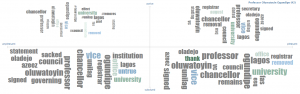
As the staff continue supporting Professor Ogundipe, Nigerians in the Twitter Community are also expressing their feelings about the removal and the possible implications for the University. Between 6pm on August 12, 2020 and 2pm on August 13, 2020, our analyst discovered that Nigerians discussed the matter with the specific reference to the Governing Council and the University’s Registrar. Purported and illegality were the two words predominantly employed by the members of the Community [Twitter].
Starting from the first user, who tweeted at 6:51 on August 12, 2020 and the last user, who tweeted at 2:34 on August 13, 2020, insistence and remove frames permeated the Community along with purported and illegality topics of the discourse. With this, our analyst describes the simultaneous emergence of the topics as complicated discourse. This is premised on the fact that the users were found to use the topics to explicate who should be blamed and who should be praised among the two primary actors [Professor Ogundipe and Dr Babalakin].
The complicated discourse becomes more useful in understanding the actors, when analysis reveals that the discourse connected with the public interest in the actors by same percent [the discourse led to same 64.3% connection]. Surprisingly, analysis shows that the discourse had 66.7% linkage with public interest in knowing more about the Governing Council.
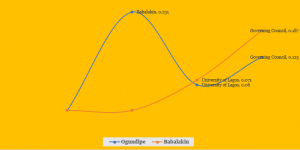
Analysis further shows that one percent of public interest in Professor Ogundipe increased information seeking about Dr Babalakin by 23.1%, while a percent interest in Dr Babalakin increased the need to seek information about the Governing Council by 18.7%. This is quite different from what we found for Professor Ogundipe. One percent interest in Professor Ogundipe only increased public’s need of seeking information about the Governing Council by 12.5% [see Exhibit 2].
Exhibit 2: Nexus among the Actors
Source: Google Trends, 2020; Infoprations Analysis, 2020
The Extracts
University of Lagos’ dated August 12, 2020 and signed by Oladejo Azeez, Esq, Registrar and Secretary to Council, stating that the Vice Chancellor, Professor Oluwatoyin T. Ogundipe, FAS has been removed from office with immediate effect. The purported removal is an illegality. [Insistence]
Professor Oluwatoyin Temitope Ogundipe remains the Vice-Chancellor of University of Lagos. Thank you. Signed Professor Oluwatoyin T. Ogundipe, FAS Vice Chancellor, University of Lagos. [Insistence]
EdugistNG: This decision was based on the Council’s investigation of serious acts of wrongdoing, gross misconduct, financial recklessness and abuse of office against Professor Oluwatoyin T. Ogundipe, FAS. https://t.co/IgjSMSJ7hO [Remove]
President Trump wants to ban WeChat, one of the most important digital platforms in the world. It is part of the pieces for the control of the new data age. I have called it the Data World War in which China and the United States are just entering the early phases. The data of nations would define the prosperity of nations because at the end of everything, data connects us back to that old century postulation by Pythagoras: the world is made up of numbers. The more you understand data, the better you can fix frictions in markets and nations. Indeed, data is the gunpowder of the knowledge economy. Anyone who controls and dominates on it will win the castles of wealth.
President Trump has signed an executive order to ban U.S. transactions with ByteDance, the parent company of TikTok, as well as WeChat owner Tencent. The move was issued under the International Emergency Economic Powers Act and comes into effect in 45 days, following growing tensions with China over security concerns. Microsoft (LinkedIn’s parent company) is currently in talks to acquire the U.S. operations of video-sharing app TikTok, which has up to 80 million active monthly users in America (LinkedIn)
Interestingly, like I noted, if China wants to retaliate and ban Microsoft Windows, it would score an own-goal: “Ban Microsoft Windows or Apple iPhone? Not really because those would be own-goals to China. For every Windows sold, China makes money because the machines which power Windows are largely assembled in China for Dell, HP, Lenovo and others”.
In association football, an own goal occurs when a player causes the ball to go into their own team’s goal, resulting in a goal being scored for the opposition
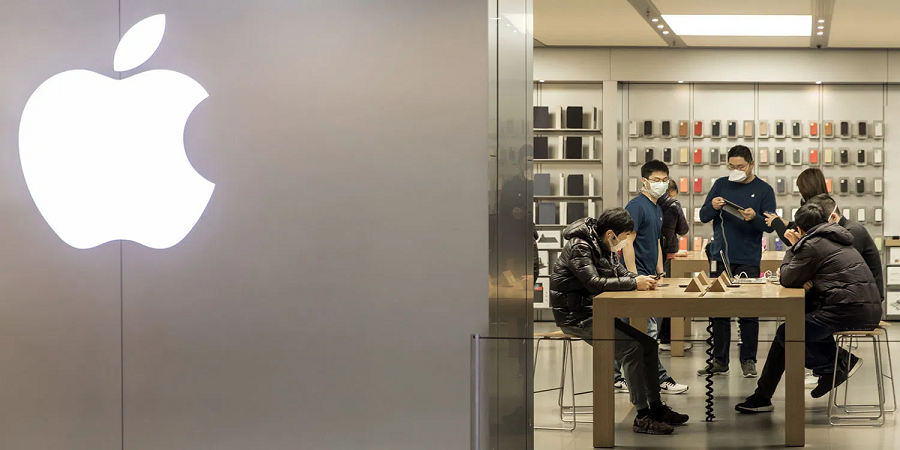
But it is not only China that could score an own-goal; America could also score own-goals. Indeed, if the U.S. bans WeChat, many Chinese iPhone users will have no other option than to drop iPhones and pick another phone brand where they could easily use WeChat. Without WeChat, no one could function normally in China, unlike the iPhone which has clear substitutes. According to Bloomberg, “A survey on the twitter-like Weibo service asking consumers to choose between WeChat and their iPhones has drawn more than 1.2 million responses so far, with roughly 95% of participants saying they would rather give up their devices.”
iPhone loyalists across China are now reconsidering their attachment to the device after Donald Trump issued an executive order last week barring US companies from doing business with WeChat […]
A survey on the twitter-like Weibo service asking consumers to choose between WeChat and their iPhones has drawn more than 1.2 million responses so far, with roughly 95% of participants saying they would rather give up their devices. ‘The ban will force a lot of Chinese users to switch from Apple to other brands because WeChat is really important for us,’ said Sky Ding, who works in fintech in Hong Kong and originally hails from Xi’an […]
The ban threatens to turn iPhones into expensive ‘electronic trash,’ said Hong Kong resident Kenny Ou, who sees WeChat as one of the most essential software on his handset
Banning WeChat will have marginal impacts in China because the nation has no alternative and will stick with WeChat, but it could cause massive dislocation for Apple and American hardware makers. The implication is simple: devices made by American companies which cannot possibly install WeChat would simply disappear in China as they would have no material value without WeChat. If President Trump goes ahead and bans WeChat, call it an own-goal as we say in football (yes, soccer). Apple needs better pastors to pray against WeChat ban!
Where China has to pay attention is its companies traded in the U.S. If Trump wins re-election, the risk of some of these companies being delisted will rise. I noted that in a piece where I wrote, “I think China will just chill – it has met an unpredictable American leader that cannot be modeled by any communist party algorithm. That would be wisdom because any nonsense move, Trump can delist all Chinese companies in Wall Street!”. That seems to be on the fly.
U.S. Treasury Secretary Steven Mnuchin on Monday said companies from China and other countries that do not comply with accounting standards will be delisted from U.S. stock exchanges as of the end of 2021.
Mnuchin and other officials recommended the move to the U.S. Securities and Exchange Commission last week to ensure that Chinese firms are held to the same standards as U.S. companies, prompting China to call for frank dialogue.
The UK economy slumped by 20% in the second quarter 2020 to record its worst performance since 1955, plunging the country into its deepest recession since 2009.
The coronavirus pandemic unleashed unprecedented havoc on the country’s economy, forcing shutdown of industries and causing job losses that resulted in a 2.2% contraction in the first quarter.
UK finance minister Rishi Sunak said the worst is yet to come but the country will get through it.
“Today’s figures confirm that hard times are here. Hundreds of thousands of people have already lost their jobs, and sadly in the coming months many more will. But while there are difficult choices to be made ahead, we will get through this, and I can assure people that nobody will be left without hope or opportunity,” Sunak said.
UK household spending shrank following coronavirus lockdown that shut businesses and forced spenders to get closefisted.
London as a top tourist destination keeps the UK hospitality business booming. But the global travel restrictions and flight bans held the hospitality industry to a standstill forcing companies to furlough workers and eventually laid them off. The UK economy has lost over 730,000 since the outbreak of COVID-19 pandemic.
The economy succumbed to the pressure and Kallum Pickering, a senior economist at Berenberg said things may get worse.
“Typically, recession data are subject to heavy reasons. Nevertheless, taken at face value, the bigger-than-expected contraction suggests some down risk to our call of a 9.5% contraction suggests some downside in full year 2020,” he said.
Britain’s economic woes have been linked to its handling of coronavirus lockdowns that shuttered retail stores and put self-employment and other public services to a halt.
“The larger contraction primarily reflects how lockdown measures have been in place for a larger part of this period in the UK,” the Office for National Statistics said.
The UK recorded the worst outcome compared with other European countries that were severely hit by the pandemic. There was 22.1% decline in economic output in the first half of 2020, which compared to Germany, France and Italy is a milestone of economic trouble.
The Office for National Statistics (ONS) said the record doubles the 10.6% fall the United States recorded. But among G7 members, Britain is expected to have more GDP growth.
While other economies in Europe were showing signs of recovery, Britain was embarking on lockdown and was way behind in reopening. It was until July 4 that it allowed restaurants and some shops to open, while Italy, although hardly hit, allowed opening in Mid-May. Germany started to reopen bookstores, bike shops and car dealerships on April 20.
The months of lockdown exerted a crippling economic impact on the UK’s GDP, as business activities including sports events were suspended. But in June when the economy gradually opened, the GDP recorded an increase of 8.7%, according to ONS. But it could do a little to salvage the already ravaged economy. Deputy national statistician for economic statistics, Jonathan Athow, said: “despite this, the gross domestic product in June still remains a sixth below its level in February, before the virus struck.”
While the lockdown took the larger part of the blame, it is believed that the economy was already heading in the direction of recession. Shadow chancellor Anneliese Dodds blamed Prime Minister Boris Johnson for the escalation of the economic downturn. He said: “a downturn was inevitable after lockdown – but Johnson’s job crisis wasn’t.”
Many workers have been sustained by the government’s furlough scheme of job subsidies, but it is due to end after October. Sunak said workers know that the scheme is “not sustainable indefinitely,” and the government shouldn’t pretend that “absolutely everybody can and will be able to go back to the job they had.”
While Sunak assured that the economy would bounce back, the time frame isn’t certain and there are signs it could get worse. Alpesh Paleja, an economist at the Confederation of British Industry, said companies are still finding it hard to pay their bills, and “a sustained recovery is by no means assured.” He added that “the dual threats of a second wave and slow progress over Brexit negotiations are also particularly concerning.”