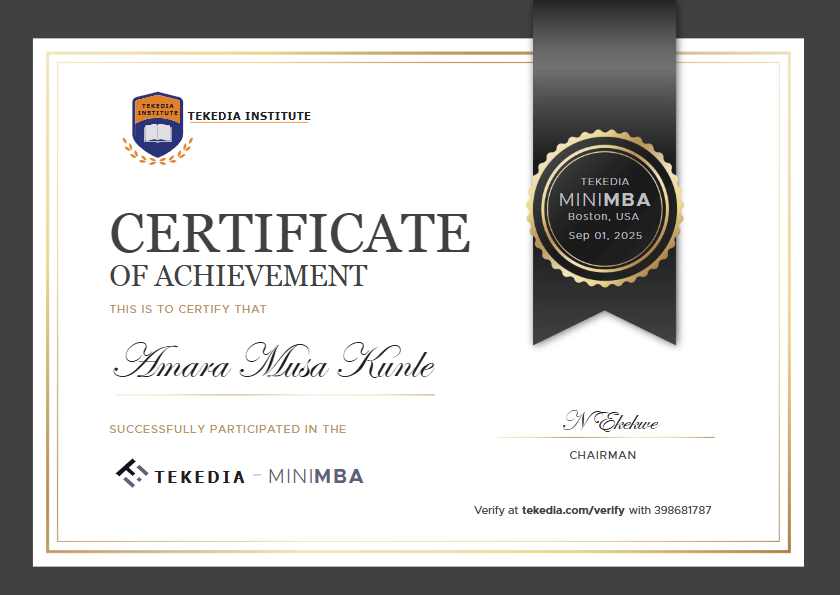
What is Tekedia Mini-MBA? Tekedia Mini-MBA is a leading 12-week online innovation management program designed to equip professionals and business leaders with the skills needed to thrive in a rapidly changing world. The program is 100% online and features a global faculty of industry experts who deliver content through a mix of videos, flash cases, challenge assignments, and live webinars.
With a focus on practical application and real-world scenarios, the Tekedia Institute Mini-MBA provides a comprehensive and flexible learning experience that is relevant across all business sectors. It offers an immersive curriculum that not only deepens your understanding of business fundamentals but also empowers you to drive innovation and lead with confidence.
The next edition begins on Sep 15, 2025. Register here today and save.
I resumed at the bank’s headquarters by 7:30am, only to be told to return at 4:30pm for a night shift. That first night, my first ever night duty, I fell asleep. The lead engineer that night reported me to our Unit Head the next day. The next night, I “dozed off again.” By the third night, the message was clear: “You either figure out how to stay awake, or you can go home and sleep as much as you want.”
That was my wake-up call. This was no ordinary role — starting scripts on Oracle, maintaining HP9000 servers on UNIX/Linux, and running End of Day (EOD) operations across 13 dot-matrix printers. If we failed, the bank wouldn’t open for business the next day because System has not completed the EOD routines. Customers would hear “system is down,” not because of network issues, but because two graduates couldn’t complete the task. The pressure was immense; I just completed NYSC days ago for this type of responsibility!
I also learnt something early: your colleague is not necessarily your friend, and the workplace is not a family. I once told a new graduate as I became “lead” in the same routine months later: “If you can’t manage your sleep, I’ll request you be replaced.” He was shocked because his “Pally” was speaking bluntly. Yes, I reminded him—if both of us should fail, the bank could see our failure as sabotage, with legal and criminal consequences. He got the message fast.
Yet, despite the tenacity, it was super-rewarding. Fresh graduates were trusted with enormous responsibilities and paid exceptionally well—so much that many of us volunteered to work on all holidays. But the reward came with a warning: if you stopped delivering value, the exit was swift and cold. Then I came to America and saw that the two-week notice in Nigeria is uncommon; here, it is “at will” which means you can be hired today and fired today. Globally, this is the message:
Work is work. It’s not family. Don’t be deceived by the illusion. Deliver value, or step aside.
And the Lesson: Change your attitude at work. You’re not anybody’s kid there. You are valued as long as you deliver. Have a great week ahead.
The cryptocurrency market in 2025 is shifting fast. Cardano (ADA), formerly a top player, is having trouble keeping up, while new and established alternatives like Little Pepe (LILPEPE) and Ripple (XRP) are getting all the attention. Investors look at fresh chances as meme currencies and utility-driven tokens change the game.
Cardano (ADA) Struggles to Retain Investor Interest
With its proof-of-stake consensus methodology and the introduction of smart contracts, Cardano has been one of the most cutting-edge initiatives in crypto. However, even with its technology, investors have become less interested in the past few months. ADA is worth $33.3 billion and is presently trading at $0.9341. Market activity reveals that trading volumes are decreasing, which means that retail and institutional participants are less interested. According to analysts, the relative strength index (RSI) showed that the market was overbought before the drop. This meant that a correction was likely. The larger bearish wave in the crypto markets has also worsened Cardano’s problems. Many people wonder if Cardano can regain its prominence because its growth is slower than that of competitors like Ethereum and Solana. Long-term investors regard ADA as a solid blockchain for the future, but the short-term momentum doesn’t seem strong.
Ripple (XRP) Rises Amid Growing Adoption
Ripple (XRP), on the other hand, has become one of the biggest winners of 2025. XRP has one of its best cycles ever, with a market valuation of more than $183 billion and a trading price of $3.08. The success of Ripple is directly linked to how useful it is in the real world. It is getting easier and cheaper for banks, payment processors, and sites that help people send money between countries to use XRP to make payments. Investors have more faith now that regulators have made their minds up, which was one of the most significant problems Ripple had to deal with as it tried to grow its presence worldwide. XRP is one of the best investments in 2025 because of this mix of popularity and legal stability. Analysts say it might keep growing as Ripple’s technology is widely used in global payment networks.
Little Pepe (LILPEPE): The Meme Coin Reinvented
While XRP represents institutional utility, Little Pepe (LILPEPE) shows that meme coins can evolve into something far greater. The project is currently in presale Stage 12 for $0.0021. So far, it has raised over $22.6 million and sold over 14.4 billion tokens, a sign of investor conviction. What sets LILPEPE apart is that it is not just a hype-driven meme token. The team has developed a Layer-2 blockchain, audited and certified, explicitly designed for meme projects. This blockchain offers:
Zero transaction tax
Sniper-bot resistance
Staking rewards
A Meme Launchpad for developers
These features show that LILPEPE is merging the viral nature of meme culture with actual blockchain utility. In doing so, it offers investors both short-term hype potential and long-term sustainability. Reports from market commentators highlight LILPEPE as one of this cycle’s most promising meme coins. With its scalability, speed, and ecosystem tools, it positions itself as a contender on the meme coins industry with the likes of Dogecoin and Shiba Inu.
Why Investors Are Paying Attention
The contrast between ADA’s struggles, XRP’s rise, and LILPEPE’s explosive presale has not gone unnoticed. Cardano may eventually recover, but investors are looking at tokens with stronger near-term momentum at this point. XRP benefits from institutional adoption, making it a safer bet for those seeking stability. Meanwhile, LILPEPE is creating FOMO in the market, not only because of its meme-driven appeal but also because of its blockchain innovation. With presale stages selling out quickly, prices could multiply rapidly once LILPEPE lists on major exchanges.
Conclusion
Real-world payments help Ripple (XRP), but Cardano (ADA) struggles to attract investors. To prove meme coins are real, Little Pepe (LILPEPE) is creating a blockchain ecosystem. This adjustment stresses investor market adaptation. As ADA suffers, XRP and LILPEPE are gaining attention for their use cases and development potential. LILPEPE is risky but profitable, while XRP is stable with adoption. Investors can check the presale website, ecosystem updates, or Telegram. Little Pepe might be 2025’s breakout star as XRP stabilizes and Cardano struggles.
For more information about Little Pepe (LILPEPE) visit the links below:
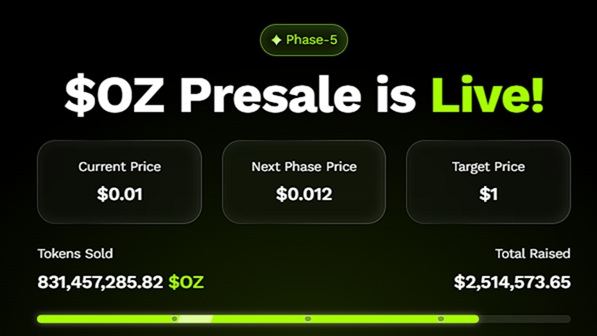
Ozak AI has quickly emerged as one of the most talked-about presales of 2025, and much of this buzz comes from its remarkably low entry price. At just $0.01 per token in its presale, Ozak AI is offering investors one of the cheapest entry points into a project that analysts believe has the potential to deliver 100x returns in the coming years.
While many established tokens such as Bitcoin, Ethereum, and Solana have already achieved significant market capitalization and face slower growth curves, Ozak AI stands at the beginning of its journey, where the upside potential is at its greatest. With over $2.5 million raised and more than 830 million tokens sold out already, the early momentum is a strong indication that investors are rushing to grab this rare opportunity before the presale stages run out.
Why the $0.01 Presale Price Matters
The crypto market often rewards those who enter projects early, and Ozak AI’s $0.01 presale price is a prime example of this. Unlike tokens that launch at inflated valuations, Ozak AI’s strategy is to offer an affordable entry point that enables small, medium, and large investors to accumulate significant positions.
If Ozak AI successfully launches at its projected $1 target, early participants at the $0.01 stage could be sitting on 100x gains by 2026. For context, this means that a $1,000 investment during the presale could potentially grow to $100,000 if Ozak AI hits its long-term goal.
Many investors often lament missing out on opportunities like Solana, which was available for under a dollar in its early days, or Polygon, which delivered hundreds of times returns after its presale. Ozak AI now appears to be offering a similar window, only this time with a foundation built around AI-powered trading and analytics, a sector that continues to capture global attention and market demand.
$OZ Strong Presale Momentum
Momentum is one of the clearest signs of market confidence, and Ozak AI’s presale numbers speak volumes. In just a short period, the project has raised over $2.5 million and sold 830 million tokens, highlighting how quickly investors are rushing to secure their share.
Unlike slow-moving OZ presales where traction takes months, Ozak AI’s rapid sell-outs across stages demonstrate that the community sees strong value at this early stage. The speed of fundraising also adds a layer of urgency, pushing latecomers to act before prices rise further across subsequent stages.
Ozak AI’s Verified Listings and Audits Build Trust
One of the major concerns for investors in presales is legitimacy, but Ozak AI has already taken steps to address this. The project is listed on CoinMarketCap and CoinGecko, giving it visibility and credibility within the wider crypto community.
Moreover, Ozak AI has undergone a Certik audit alongside an internal audit, ensuring transparency, security, and reliability for investors who are regularly cautious about scams in early-stage projects. These measures now not only best enhance investor confidence but also function as Ozak AI as a critical participant in the swiftly growing AI-crypto space.
Why Analysts Believe Ozak AI Can 100x
Analysts point out that Ozak AI combines three powerful trends—AI, blockchain, and automated trading. With more traders, institutions, and retail investors demanding tools that can optimize decision-making, Ozak AI’s customizable dashboards, AI-driven risk management systems, and portfolio optimization tools provide a compelling use case.
Ozak AI’s presale at $0.01 presents one of the most compelling opportunities in 2025 for investors seeking explosive growth potential. With over $2.5 million raised, 830 million tokens sold, verified listings, and security audits completed, the project has already crossed key milestones that demonstrate both credibility and demand.
Combined with its real-world AI utility and strategic partnerships, Ozak AI is uniquely positioned to deliver the type of returns that early investors in Solana and Polygon once enjoyed. For those who believe in the future of AI-driven finance, Ozak AI’s presale could very well be the cheapest 100x opportunity of this cycle.
About Ozak AI
Ozak AI is a blockchain-based crypto project that provides an innovative platform that focuses on predictive AI and advanced data analytics for financial markets. Through machine learning algorithms and decentralized community technologies, Ozak AI enables real-time, accurate, and actionable insights to help crypto lovers and corporations make the perfect choices.
Meta’s aggressive push into artificial intelligence, anchored by its $14.3 billion investment in data-labeling startup Scale AI, is showing signs of strain only months after the deal.
What was billed as the cornerstone of CEO Mark Zuckerberg’s campaign to position Meta at the forefront of AI superintelligence now risks becoming another costly experiment, with some analysts warning it could mirror the company’s ill-fated metaverse adventure.
According to TechCrunch, Ruben Mayer, a former Scale AI executive tapped to help establish Meta Superintelligence Labs (MSL), left the company after just two months. His departure adds to a string of talent shakeups inside MSL, where Meta has struggled to integrate high-profile recruits from OpenAI, DeepMind, and Scale AI itself.
Even more troubling, multiple people familiar with the company’s operations told TechCrunch that Meta’s own researchers are increasingly bypassing Scale AI’s data, despite the multibillion-dollar tie-up. Instead, they are turning to competitors Mercor and Surge, whose higher-cost, higher-quality annotation systems are seen as better suited to training advanced AI models.
One insider told TechCrunch that several researchers view Scale’s data as low quality, and there’s been a clear preference for other vendors.
A Fraying Partnership
Meta initially touted its investment as a way to expand its commercial relationship with Scale AI while also luring CEO Alexandr Wang and his top executives into leadership roles at MSL. The hope was that Wang’s track record and network would help Meta attract AI talent at the pace needed to catch up with OpenAI and Google.
But the relationship has shifted rapidly. After Meta’s deal, Google and OpenAI cut ties with Scale AI, and the startup soon laid off 200 workers in its labeling division. Scale’s new chief executive, Jason Droege, has tried to pivot the business toward government contracts, securing a $99 million deal with the U.S. Army.
For Meta, the pivot raises doubts about whether the enormous outlay will deliver the quality data pipeline it desperately needs. Some suggest that Meta has put billions behind a vendor that many of its own researchers don’t want to use.
Internal Chaos
The upheaval comes at a sensitive time. Zuckerberg has grown frustrated with the company’s AI output after the underwhelming release of Llama 4 in April. That disappointment set off a scramble: Meta expanded partnerships with AI voice and image startups, announced a $50 billion Hyperion data center in Louisiana, and stepped up hiring raids on OpenAI and Anthropic.
Yet the influx of new talent has bred tensions. Several recent hires from OpenAI have already quit, citing Meta’s heavy bureaucracy. Longtime staff from its generative AI unit have also departed, feeling sidelined by the new structure. Among the latest to leave was Rishabh Agarwal, a researcher who posted on X that while the vision for superintelligence was compelling, “the biggest risk you can take is not taking any risk.”
“The pitch from Mark and @alexandr_wang to build in the Superintelligence team was incredibly compelling,” said Agarwal. “But I ultimately choose to follow Mark’s own advice: ‘In a world that’s changing so fast, the biggest risk you can take is not taking any risk’.”
Director of product management for generative AI, Chaya Nayak, and engineer Rohan Varma also announced departures in recent weeks.
Déjà Vu: The Metaverse Trap
Investors and analysts are increasingly skeptical. Zuckerberg poured more than $40 billion into the metaverse, rebranding the entire company around the vision, only to see its Reality Labs unit lose more than $10 billion a year without meaningful user adoption. Now, some fear the AI gamble could follow the same trajectory.
Unlike rivals OpenAI and Google, which have already rolled out revenue-generating AI tools, Meta’s AI products remain largely in research or experimental stages. Its AI chatbot integrations across WhatsApp, Instagram, and Messenger have drawn interest but not significant revenue.
However, Zuckerberg and Wang insist MSL’s first major model will launch by year’s end. Success would allow Meta to stake a claim in the AI arms race, where Microsoft-backed OpenAI and Google’s DeepMind still lead. But if Meta continues to struggle with talent churn, vendor disputes, and questions about data quality, its $14.3 billion Scale AI bet could go down as one of Silicon Valley’s most expensive miscalculations.
For now, Wall Street remains unconvinced. Meta shares dipped last week amid reports of further AI unit departures, a reminder that investors may not grant Zuckerberg as much patience this time as they did with the metaverse.