Today, we provided funding to a startup undergoing training in Tekedia Mini-MBA. Over the last 6 weeks, the team has grown revenue in a niche area on payment and remittance. Our experience with receiving payment across Africa on Tekedia Mini-MBA has pushed me to declare that nothing has truly happened on African intra-payment. From Ghana to Cameroon to Tanzania, and beyond, Africa remains far away when it comes to payment.
We lost members from Tanzania as they were unable to pay. In Cameroon, we were saved as we have a country manager. The same happened in Ghana, etc. In Congo DR, a friend had to help: his fellow citizens pay him; he pays us via PayPal USA. The story is the same: inter-border payment within Africa remains primitive.
With that experience, I started looking into the payment and remittance nexus. We will announce this firm when the team gets ready this week. Tekedia Mini-MBA besides being a management training school is also an accelerator. We have data now to begin to support innovators.
I call young people to continue to build; the future has abundance.
From Professor Olufemi Adebisi Bamiro to Professor Isaac Adewole, the University of Ibadan community was promised better infrastructure, welfare and continuous development for 10 years. By November 30, 2020, it will be 15 years that the community has received messages and pledges of good fortunes from candidates for the position of Vice Chancellor of the University. On this date, Professor Abel Idowu Olayinka will complete his 5 years single term of being the Chief Executive Officer of the oldest University in Nigeria.
In the last few days, our analyst has been writing insights and established metrics that could be used by the stakeholders in charge of selecting and appointing a new Vice Chancellor of the University. This piece is another one that aimed at revealing some of the gains of Professor Abel Idowu Olayinka’s leadership and what the incoming Vice Chancellor could learn from his deficiencies. This is imperative because the University cannot afford not to have a strong strategic leader who would continue from where he will be stopping and correct the lapses.
This piece emerges because of the need to have a robust discourse around Professor Olayinka’s leadership. Like the analyst noted in one of the previous articles, Professor Olayinka has done his parts. After all, he is not an angel. He is destined to make mistakes and retrace his steps for future growth. Therefore, the article should be seen as a way of gauging his performance in relation to his strategic plan titled “Accelerated Development through Consolidation and Innovation.”
Our Measures and Data
To the best of our knowledge, this is the first time an article is x-raying an outgoing Vice Chancellor in any University in Nigeria. He is being judged considering his contribution on academic, research and quality assurance, administration, financial management and branding of the institution in the last few years. Specifically, the piece interrogates the key resources in terms of relational, strategic, structural and human capital, he employed to deliver value he promised the University Community, especially staff and students.
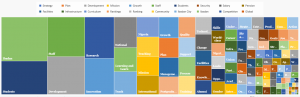
As stated earlier, our first data source was his strategic plan. Since the plan is his strategic template for managing human and material resources towards the realisation of the mission and vision of the University, we leveraged it and extract keywords [dominant words he used to explain his ability and capability to lead the University for 5 years]. We called the select keywords strategic keywords because we found that the words were used as constructs and concepts to depict his vision and mission for the University in relation to the University’s own [see Exhibit 3]. As constructs and concepts, we found most of the words as promising and deciding how the resources will be allocated across the University and outside it.
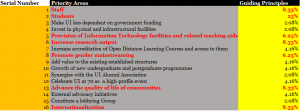
Guiding principles and goals inherent in the strategic plan were our second data category. Guiding principles are the fundamental assumptions tied to each of the priority areas [see Exhibit 1] he intended to focus on as the University’s Vice Chancellor. The principles establish specific steps that he would take in order to realise each of the priority areas. Our analysis, however, suggests that the principles are prescriptive in nature. This means that there is possibility of altering them while implementing the plan due to unexpected situations. The third data source was his recently released My Stewardship Report. In the report, he documented all his activities from 2015 to the current year. We also analysed his speeches, delivered within the University environment.
His Strategic Plan: What is in It?
In our analysis of his plan, we found 16 priority areas with 48 guiding principles. In terms of guiding principles allocation to the priority areas, analysis indicates that Professor Olayinka believes in amassing his resources towards the realisation of the priority areas differently [see Exhibit 1]. Analysis further reveals a connection of 79.7% of guiding principles and goals [short, medium and long terms].
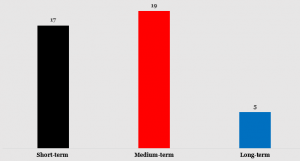
To realise his vision and mission for the University, he developed 17, 19 and 5 short, medium- and long-term goals respectively. In spite of the high percent of connection of guiding principles and goals, analysis reveals 63.6% of the principles leading to the formulation of goals he had. This means that other factors that were not part of the principles accounted for the remaining percent.
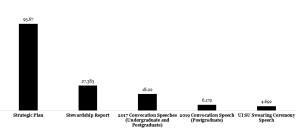
Beyond the principles and goals, we selected 118 strategic keywords [see Exhibit 3]. These words were searched in the strategic plan, stewardship report and speeches he delivered within the University environment. From the analysis, we found a total of 6,709 of the keywords in the strategic plan after counting frequency of each word. A total of 2,080 of the keywords was found in the stewardship report. This indicates a difference of 4,629 keywords.
In his 2017 convocation speeches [comprising undergraduate and postgraduate], we found a total of 1074 keywords. This is quite different from what we discovered in his 2019 convocation speech delivered during the award of postgraduate degrees. Analysis establishes a total of 348 keywords. His speech during the swearing ceremony of members of the Students Union Executive had a total of 210 keywords.
Looking at the data further, we discovered that Ibadan [590 times] appeared the most in his strategic plan, while it was students [154 times] in his stewardship report. Students [102 times] also appeared the most in his 2017 convocation speech and research occurred the most in his 2019 convocation speech. Again, occurrence of students as keyword 46 times made it most used word in his speech during the swearing ceremony of Executive Members of the Students Union.
What are the implications of these results? This was further explored by our analyst with the specific reference to how the keywords contributed to his actions [activities during the years]. In all, analysis establishes strong percent of the link between the keywords in his strategic plan and those used [replication of the words was considered] in the stewardship report and speeches he delivered.
Our analysis reveals that the keywords in the plan and stewardship report were related by 83.7%. This percent dipped when we analysed the connection of the keywords in the plan along with those in the 2017 convocation speech. We discovered 76.8% linkage. This also dropped when the connection between the keywords in the plan and those in the 2019 convocation speech [we discovered 70.1% connection] and 2019 UI SU swearing ceremony [we found 52.0%] was analysed. These results imply that Professor Olayinka has only managed to appropriate his keywords in planning and reporting achievements than applying the same vigorously while engaging with the stakeholders [see Exhibit 4].
This is another factor we considered imperative to understand how he has employed and deployed financial capital. We examined projects/contracts he has executed, excluding the projects/contracts that commenced in the years before his tenure started in 2015 [2014 downward] The year 2015 was counted because there is a need for him to continue with projects/contracts already approved during his predecessor (Professor Adewole).
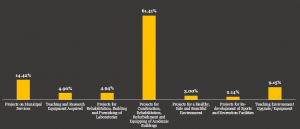
Our analysis shows that he spent N5,239,163,687.05 between 2015 and 2018 [this includes projects/contracts awarded before he became Vice Chancellor in December, 2020]. During the period, N748,451,955.29 was the average spending on projects/contracts [see Exhibit 5]. Examination of his stewardship report indicates that a brand new 200kva Perkins Engine Power generating set for the Vice Chancellor’s lodge & other location was procured in 2018 at N15,235,500.00. Electrical materials worth N160,195,911.03 was supplied. In 2018, one new Prado VX, V6 leather petrol 2017/2018 model was purchased for Pro-Chancellor at N55,938,750.00.
We also found that a Mathematics Laboratory is being constructed at the rate of N75,247,128.80, while construction of Laboratories and Offices for Faculty of Pharmacy, practically completed, was awarded at the rate of N170,000,000.00. The Lecture Theatre, Offices, Seminar and Conference Rooms for the University of Ibadan School of Business Lot 1, 2 and 3 were completed using N211,447,14 7.60 allotted to them. Despite stating 12 projects as those carried out at Halls of Residence, the total amount expended on each project was not stated in his stewardship report [the part is highlighted using red colour without any explanation].
Beyond these results, we explored the implications of Professor Olayinka’s guiding principles, goals and strategic keywords on the projects/contracts. Our analysis indicates that one percent of the principles increased his spending on the projects/contracts by 34.5%. It was 37.8% when we considered the goals [short, medium and long terms]. Surprisingly, analysis shows that one percent of the strategic keywords reduced his spending on the projects/contracts by 35.3%. With these results, there are positive and negative implications for advancing the University as stated in his strategic plan. One of the implications is that the principles and goals seem better in terms of helping him realising his vision and mission for the University than the keywords.
Exhibit 5: Spending on Key Projects/Activities between 2015 and 2018 (in Naira)
This question will be answered in the second part of the article, which x-rays the implications of the guiding principles, goals and the keywords on human and material resources he has been managing since 2015.
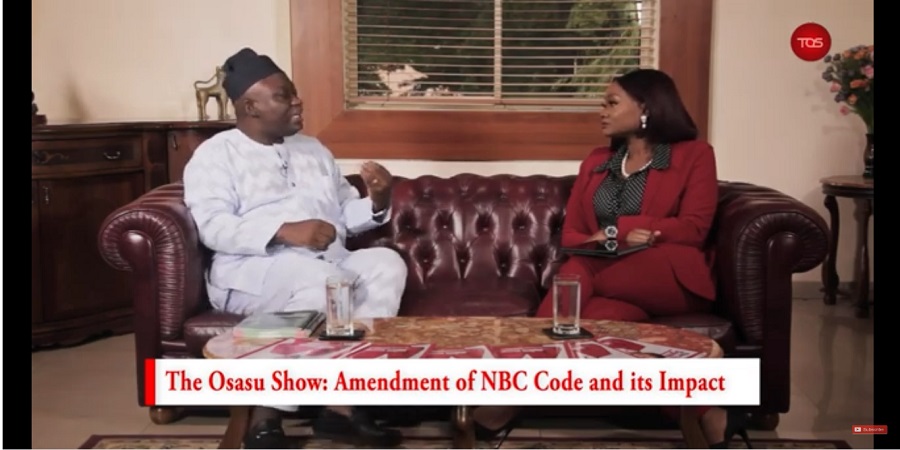
I wrote on how the new Nigeria Broadcasting Code could destroy innovation in the PayTv sector. For the other side of that story, I have been waiting for when we would hear from the National Broadcasting Commission (NBC), the custodian of the code. Mr. Armstrong Idachaba, the Director-General of NBC, has now responded via an interview at The Osasu Show. Of course, he defended the amendments to the broadcasting code which bans exclusive content on Pay TV among other components.
PayTV players like DSTV and GOtv are now banned from having exclusive sporting content in Nigeria. Upon paying pounds, euro and dollars, the companies are required to share content with local players like NTA. More so, if they pay for La Liga Spanish football league, they are required to spend at least 30% of the amount on the Nigerian league.
Yes, if everyone has access to the same contents, we can remove all the logos as all players have been unified. Why invest $1,000 to create content your competitor can get for $300 when you are done? The world lived as an inventive society for centuries, with no innovation, until property rights began to emerge in some areas. The difference between Elon Musk and Tesla is property rights.
Most men who pioneered the fundamental elements of chemistry and physics died poor as no one gave them money to commercialize their ideas. And the reason that happened was that the merchants who had the money did not see how they could recoup their investments if anyone could have access to steal the innovations after they had funded them.
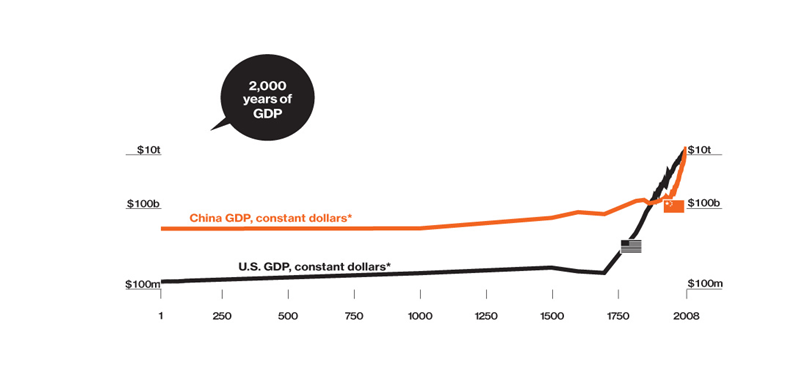
Then, towards the end of the 18th century, property rights began to emerge, giving makers and their backers legal protections to maximally profit from their ideas. That singular move changed the world, turning it from an inventive society into an innovation one. If you look at the gross world product (the combined GDPs of nations) over the last 2,000 years, the curve moved from being flat to an exponential one, around 1800. What happened was evident: men and women became greedy for the love of money and went out and fixed market frictions via products and services, knowing that doing so would make them rich.
Who will waste time creating/acquiring content in Nigeria when everyone can get it for nothing? I get you…
2,000 Years of GDP (Source: Bloomberg, World Bank. Brookings)
In a landmark judgment, a California judge has ruled that Uber and Lyft drivers cannot be classified as independent contractors and issued a preliminary injunction to that effect.
The state of California had in May filed a lawsuit challenging the classification of Uber and Lyft drivers as non-employees. The lawsuit argued that it goes against the state’s new labor law (AB5), enacted in January. The law weighed in on a three-part standard to determine the status of an independent contractor.
They are free from company’s control;
They are doing work that isn’t central to the company’s business;
They have an independent business in that industry.
The three-part standard stands in contrast with the gig economy and e-hailing companies are at the helm of it.
California is the parent state of both Uber and Lyft, and it is the biggest market for e-hailing services. The rule will ensure that hence, drivers and on Uber and Lyft platforms get employment benefits. But judge Ethan Schulman of the San Francisco superior court where the verdict was reached, gave a 10-days window for the enforcement, to give companies a chance to appeal.
Uber said it plans to appeal the ruling which it described as insensitive to the plights of drivers in the middle of a pandemic, when the government should be working on providing jobs for the people.
“The court’s ruling is stayed for a minimum of 10 days, and we plan to file an immediate emergency appeal on behalf of California drivers. The vast majority of drivers want to work independently, and we’ve already made significant changes to our app to ensure that remains the case under California law. When over 3 million Californians are without a job, our elected leaders should be focused on creating work, not trying to shut down an entire industry during an economic depression,” Uber’s spokesperson said in a statement.
In response to the California state’s new law, Uber announced new features on its app to help the drivers stay flexible. The updates which took effect mid-January include seeing trip information upfront to help drivers make informed decisions. The information will include trip time, distance, destination and fares. The update also empowers drivers to accept or reject rides without being punished. Uber promised to introduce more features that will make the job more flexible for drivers.
Lyft said the ruling undermines the wishes of the drivers who don’t want be employees, and enjoy working as independent contractors.
“Drivers do not want to be employees, full stop. We’ll immediately appeal this ruling and continue to fight for their independence. Ultimately, we believe this issue will be decided by California voters and that they will side with drivers,” Lyft spokesperson said.
The Guardian reported that Uber, Lyft and DoorDash have spent more than $100 million on a 2020 ballot that aims to incite voters against the AB5. But they were chided as the move was cited in the suit as “an aggressive public relations campaign in the hopes of enshrining their ability to mistreat their workers,” even in the middle of “a once-in-a century pandemic.”
However, the drivers are divided on what they really want. While many of them want such flexible work without entitlements that will hinder their independence, others want their efforts rewarded with employment benefits.
The judgment is the first of its kind for the gig economy in the United States, but not in the UK.
In 2016, Uber drivers in London, led by Yaseen Aslam and James Farrar, took to the streets to demand employment rights. The protests birthed a lawsuit that challenged the gig economy. The employment tribunal ruled in favor of the drivers, but Uber appealed the judgment and likewise lost in the appeal court. In its final attempt to save its business model and probably the gig economy, the ride-hailing company heads to the Supreme Court.
As the UK drivers wait on the verdict of the Supreme Court, the development in California is signaling the beginning of the gig economy’s disruption.
Uber has defended its business model saying that the majority of the drivers want to be treated as self-employed. But on the other side of the case, the claimants said the ruling will determine if workers will continue to be abused under the gig economy.
“This is our final showdown with Uber but the stakes could not be higher for everyone. If Uber wins, there will be an unseemly rush by greedy employers to collapse employment as we know it and Uber-ize the entire economy. Uber drivers and other gig economy workers would be robbed of the right to unionize,” said Aslam.
The gig economy has denied many full-time workers employment benefits, including the protections that the law provides in times of crisis.
Mathieson, an associate of Bates Wells’ employment team said “this landmark case will have enormous implications for how well, or badly, workers in the fastest growing sector of the economy are treated.”
We have started approving capstone topics for the Certificate programs. We have constituted a small committee which looks at the three proposed topics and then picks one. Once that is done, the member is asked to develop the topic. Here are options:
Submit a one-page study structure: tell us how you plan to approach this research or project.
Submit a work-in-progress table of contents: tell us potential topics of sections in this work.
While you can do both, we need just one. Once that is done, you will receive comments. Then, you begin your study. Please learn more on the Capstone here.
Tekedia Certificate courses are completely capstone-based. Tekedia capstone is a research paper or a case study exploring a topic, market, sector or a company. You must have attended, begun or about attending Tekedia Mini-MBA to qualify to register. At the moment, we cover the following areas:
CLSM – Certificate in Logistics and Supply Chain Management
CSBM – Certificate in Startup and Small Business Management
CETS – Certificate in Exponential Technologies and Singularity
CPCD – Certificate in Personal Career Development
CPFM – Certificate in Personal Finance & Wealth Management
CBIS – Certificate in Business Innovation, Growth & Sustainability